konjaku: entering a Google search for Beigao village, the first page of hits consists of map and location entries, generated, perhaps automatically, for an entity which no longer exists. This is true of most of the other villages I search for, most of the 50 villages. There may be, as is the case with Beigao, an encyclopedia entry giving village statistics.
Next, questions on inquiry boards, how do you get from Beigao to…?
Does anyone know if Beigao village in Chaoyang is going to be demolished? If so, when?
Like Changdian, there was an artist colony in Beigao.
At Black Bridge International Arts Garden, a sprawling studio, artist commune and kung fu school, several dozen supporters have gathered outside to demonstrate against the pending demolition. In black robes and hard hats, carrying Styrofoam spears, axes and swords, they pose for photos behind a barbed wire fence.
Last month, Black Bridge’s water and electricity were cut, and then authorities spray-painted the character chai – which means “demolish” – on the walls surrounding the compound. The compound’s residents, a floating population of people ranging from their early 20s to middle age, have refused to budge.
Feng Zhong Yun, 43, an artist and kung fu master who founded the compound in 2007, has been through this before: He was forced to relocate when Beijing’s original artist village, Yuan Ming Yuan, was torn down, and again when rent at 798 became too high.
This time, though, he said he was not going anywhere: “I have to protect my rights.”
http://www.atimes.com/atimes/China/LE20Ad02.html
Even so, Beigao was demolished. This blog, in Chinese, documents the demolition of the artist complex, in 2010-05.
http://blog.artintern.net/article/104190
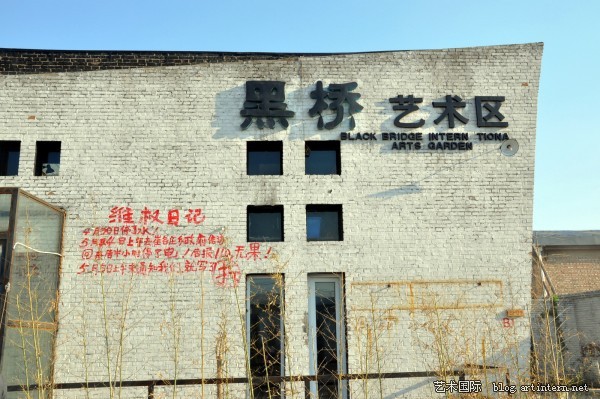
Black Bridge artist village
Demolition begins on the artists’ property
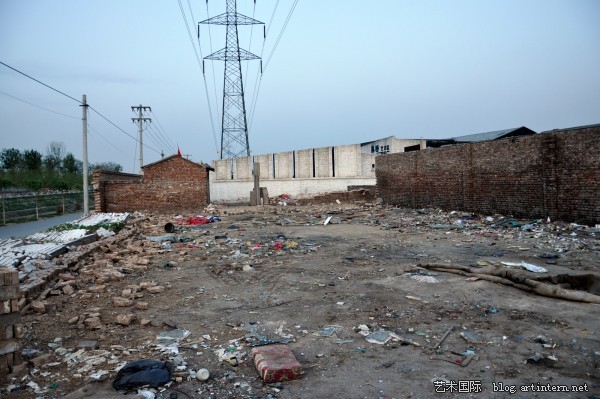
Western artists Wolfs + Jung also established a studio there in 2008. They have a site which records the demolition of the village, and their art project recording this fact.
http://wolfsandjung.com/WJ/LAND_CHINA/index.html
One of their photos. See more on their web page.
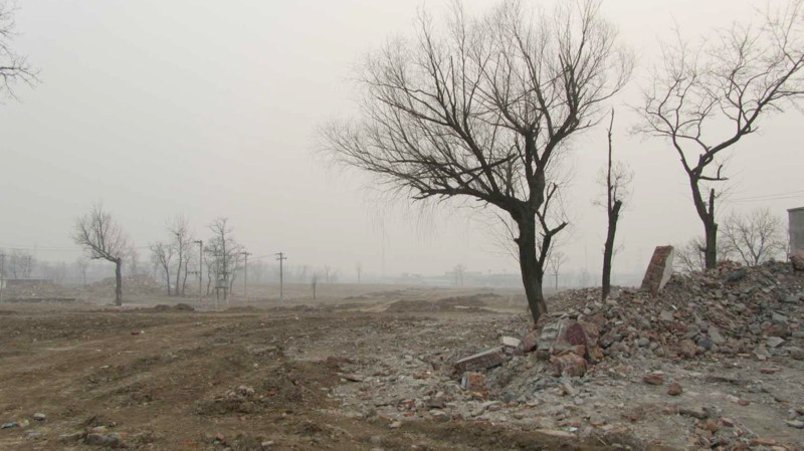
Beigao village site
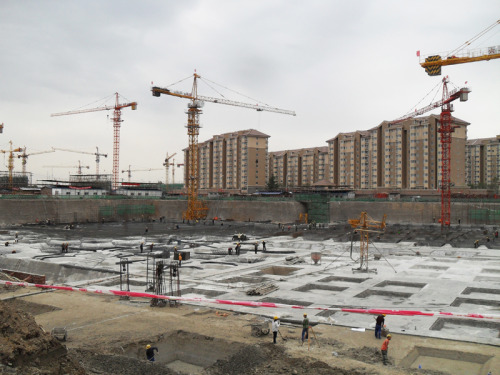
Another visitor, jordanhi, in 2011 visited the site of the demolished Baigao. He writes,
“When I went to Beigao last week, I found that a handful of new residential buildings had been finished, on the eastern third of the site (one of my research teammates remarked, “it looks like a field of Courtyard Marriotts”). Construction continued feverishly, with an army of workers pouring concrete and operating cranes. The scale of the scene was unbelievable – I have never seen a site like it, outside of architectural periodicals about, well, the urbanization of China. I was fortunate enough to bike through a shift change as well, and see hundreds of workers come and go, the color of their hard hats seemingly identifying their position or unit.
The other two thirds of the site was a barren wasteland. There were a few mounds of rubble, and a few buildings standing near the periphery, but these were the exception. Most of the brick and stone had been harvested. In both scale and desperation, this landscape far surpasses anything that I am familiar with from my time in St. Louis and Detroit – and there are dozens of scenes like this, all over Beijing right now, which will be converted to various new land uses (some municipally beneficial, some ethically suspect) in a few short years.”
Beigao previously appeared in one of my posts, as follows
Within two years, in Cuigezhuangxiang, the five villages Beigao, Dongying, Suojia, Cuigezhuang, and Shangezhuang, comprising 6800 village households, will all one after another move into Jingwang Jiayuan, and part completely from the village life of the past.
https://konjaku.wordpress.com/2012/09/07/dawangjing-follow-up-3-live-in-a-tall-building/
konjaku: The Dawangjing village demolition (second paragraph below) established a precedent for rural urban unification in Beijing, but because the expectation of future profits from land development, and the resulting compensation amounts paid out, cannot be reduplicated for every village, this example casts a formidable shadow on the demolition of the fifty villages a year later. Beigao village is one of those villages that seems to have benefitted from the Dawangjing precedent. The following article gives a general summary of the situation “after Dawangjing.”
Beijing compensation amounts for demolished villages expected to climb upwards, 70% will follow the Dawangjing example
http://news.dichan.sina.com.cn/bj/2010/05/19/162242.html
Among the 227 administrative villages Beijing will transform, 141 will become “reserve land” [land the government holds in reserve as a way to raise capital, either by selling to developers for a high price, or by taking out bank loans with the land as collateral].
In 2009-05 Dawangjing village in Chaoyang was selected as a model for the project of urban rural unification. The village was demolished, and the village land was held by the government as reserve land. The government took out a loan, with the land as collateral, and used the loan amount to finance the replacement housing for the villagers. After the village was demolished, the land was offered for sale, and with the proceeds the loan was repaid.
In a short time, 4.3 billion yuan was acquired for Dawangjing village, and the villagers, with this high compensation, moved out in 40 days, without any forcible demolitions or protests to higher authorities. This is what municipal party secretary Liu Qi called “the Dawangjing miracle.”
One year later, the Dawangjing model has expanded over the entire city, “blossoming out everywhere.” But in the space of one year, the real estate market and the regulatory mechanisms have completely changed.
In Beijing, the zone in which urban and rural intersect comprises 753 square kilometers, with 227 administrative villages. Of these, 141 are slated in the plan to reserve land, that is, the village land will become part of a large-scale development project. This is what is happening with Dawangjing.
Beigao village, is, like Dawangjng, also in Cuigezhuang township. 2010-05-13, the proportion of villagers who had moved out in advance of demolition was 98%. Under 40% had signed contracts for replacement housing, which the city was starting to build.
Beigao and Dongying are villages 2 kilometers from Dawangjing. One year after Dawangjing was transformed, these two villages have embarked on the same road. In Beijing northeast and east sections, there are more than 30 square kilometers of village land waiting to be urbanized, following the same method.
Those who are managing the demolition and relocation of Beigao, are for the most part township and village level cadres. The Ciugezhuang assistant township head Hu Zhenjian said, in general when a village is being demolished, the assistant party branch secretary comes with three to five assistants. They help with the work, but their main objective is to study, to learn the methods of demolition and relocation, in order to emulate them.
Interview with Hu Zhenjian, assistant Cuigezhuang township head
Reporter: now that a year has passed, how is the Dawangjing model faring?
Hu Zhenjian: at present, urban rural unification is still a hazy concept. Everyone knows the objective, but how to see it through to the end is still something no one knows. Beiwu and Dawangjing are different, and Tangjialing is more so.
Reporter: is this model the best possible one for the villagers in this locality?
Hu Zhenjian: Speaking generally, our policy benefits the people. In planning how much land is set aside as “reserve land” and how much allotted to be part of the green zone, we have considered the population of the area in our calculations, and left a relatively suitable amount for the villagers.
Holding land in reserve seems to be a key part of model. Why did you choose this method?
As a matter of fact, this is a function of the market. Laat year, when the Dawangjing project was initiated, land prices were at their lowest ebb, the loan granted by the bank was quite ample. One can see that historically this was the most favorable moment, and we snatched it.
Now that real estate prices have climbed upwards, do you not face a significant risk?
There is a risk, if the opportunity passes, but not necessarily. Last year the bank was willing to grant loans, but this year, maybe not. If there are going to be losses, buying and selling land grinds to a halt.
——–
Money raised from putting land in reserve becomes a fund for demolishing and relocating villages
To demolish villages and relocate the inhabitants takes money. Administrations of average villages, townships, or even counties, do not have the budget for it. In the case of Dawangjing, the Chaoyang branch of the Beijing city Reserve Land Center (a state-run institution), proceeded with the first phase of development [requisitioning land, demolishing existing structures, providing basic infrastructure such as roads]. The necessary capital was raised by the Reserve Land Center. The problem of where to acquire the funds needed to transition the villagers into urban residents with the attendant financial safeguards, was solved by taking the price difference between the first phase of development [described above] and the second phase, namely, the commercial development projects. These expenses include providing old-age insurance, medical insurance, etc., as well as help in finding employment.
[konjaku: “price difference,” that is, the money the government received from developers for rights to use the land, a very large amount because of the potential commercial value of the projects to be built, minus the amount the government spent in the first phase of development.]
The price difference in the two phases of reserve land development was the motive power behind the Dawangjing model. It provided stable profits for both the local government and the bank. But in the next round, with a readjustment of the real estate market, there is uncertainty as to whether profits will be forthcoming. The Dawangjing model, which is supposed to bloom everywhere, now has an element of risk.
As house purchase prices go upward, the villagers’ expectations for higher compensation amounts also rise up. When Dawangjing relocated in 2009, prices in the area were 10,000 to 15,000 yuan [per square meter] In a year, this rose to 30,000. Villagers outside the Cuigezhuang township office complained that unless compensation amounts rose to keep pace with the market, the amounts they were slated to receive were only enough to buy half a residence.
[konjaku: taking 150 square meters as the area of a standard residence in a multi-story building, at 10,000 yuan per square meter, the price in dollars is about $236,000. For 30,000 yuan, in dollars it is about $703,000.]
After Dawangjing, villagers in the surrounding area took the Dawangjing amounts as the standard, which became an endless headache for the township during subsequent village demolitions.
Another risk is that the reserve land process is financed by bank loans. According to an Academy of Social Sciences 2009 report, among the various types of government loans, borrowing against reserve land as collateral occupied 70% to 90% of all loans, in some areas it reached 100%. What this means is that if the government starts to suffer losses with its reserve land projects, its financial lifeline will be imperiled.
According to Yan Jinming of the College of Management at Beijing People’s University, loans to the government are different from loans to individuals or other entities, and carry less risk. As long as the economy does not undergo radical change, the risk is manageable. However the government should be aware that in the restructuring of the real estate environment, the banks are going to tighten up their lending practices.
[konjaku: this refers to a restructuring effort by the government to rein in the housing bubble in 2009]
Looking into the future, the key factor is whether all these massive development projects will turn out to be commercially viable.
Beigao 北皋
Dongying 东营
Dawangjing 大望京
Cuigezhuang 崔各庄
konjaku: I found very little material on the demolition of Beigao village. This is one of the few articles.
Stray dogs cause concern in Beigao village, which is about to be demolished
http://news.dichan.sina.com.cn/2010/04/01/141487.html
This morning at 8 o’clock, in Beigao village near the Airport Expressway outside the 5th ring, there are stray dogs foraging in the garbage dump. One can see more than 10 stray dogs inside the village perimeter.
Chaoyang district Cuigezhuang township Beigao village was listed this year as one of the 50 focal point urban villages. Demolition of the entire village is about to begin.
“The tenants have all moved away, and these dogs were left behind,” said one villager. Another reason is that many other villages and small towns in the area are being demolished, and stray dogs from those places has gradually assembled in Beigao. The villagers are worried that these dogs may carry disease, or they might injure someone. Villager Wu Xuemei, standing in front of the Primary School entrance gate, worried that children might be bitten.
A township official said, the stray animal problem is being placed under control of the demolition management. Sometime this week the township dog office, the agricultural enforcement brigade, and the local police sub-station will together gather up all the strays.
A member of an Animal Aid Organization said there were probably 100 stray animals altogether in Beigao. Their organization will bring these animals to a clinic, and after sterilizing them, they will try to find suitable homes for them.
konjaku: this article tells us how compensation was determined for Beigao village, and at what price the villagers were be allowed to purchase replacement housing ( 4500 yuan per square meter, considerably under the 2010 market price of about 30,000 yuan.).
Beigao village is on the northern bank of the Beixiao river, near the Airport Expressway. It has a population of 1850 residents, and 20,000 migrants. Village economy consists entirely renting rooms (the so-called “tile economy”).
This morning at 10 AM, inside Beigao village, cranes mounted on tracks appeared, demolition workers assembled, and the demolition began. From the loudspeakers set at the entrances to alleyways a speech, “this is to implement urban rural unification” was being broadcast. Inside the Relocation Office, the villagers were lined up, receiving the reports on the estimated values of their houses [which determines their compensation amounts.]
Those determined to be long-standing village residents will be granted, for each individual, a reduced price of 4500 yuan per square meter for 50 square meters of their replacement residence.[a family of three would get 150 square meters at this reduced price]. If they purchase a residence that exceeds this standard, they will pay 7000 yuan per square meter for the additional space. In addition, those villagers who move out within the designated time period will receive other awards and subsidies. To start with, they will receive 5000 yuan per household.
Residents of Beigao village and nearby Dongying village will both move into the same replacement housing as Dawangjing village residents: Jingwang Jiayuan. At present it is under construction, projected to be completely by the end of this year.
Jingwang Jiayuan will consist of buildings from nine to eighteen stories, with a community services center, a sports and recreation center, welfare facilities, a concentration of green spaces, kindergarden, primary., and middle schools,and a community hospital. The residences are designed as 50 square meters for one person, 75,100 square meters for two persons, and 150 for three persons.
Once Beigao village is demolished, its land will taken as Chaoyang district reserve land.
The compensation villagers will receive for their homesteads is calculated as an equation:
the “standard” land price, 1600 yuan per sq meter x K(see note below) + house purchase price, 600 yuan per sq meter + reward for moving out in advance of the deadline, 500 yuan per sq meter x the homestead surface area + the building replacement cost (in the case of Dawangjing, this was set at 400 yuan per square meter)
K is apparently a coefficient, expressing the difference between the average land price and the current actual land price. However, I am not confident in my knowledge of how K works in practice.
konjaku: In an actual calculation made for Dawangjing village
(http://news.qq.com/a/20090507/000258.htm)
K was “1” so multiplying by 1 did not affect the valuation.
Using the same method as the Dawangjing one (see next paragraph), and taking the homestead area to be compensated at 300 meters, this is the total for a Beigao village family
(1600×1+600+500)x300+ (400×300) =810000+120000=930,000 yuan ($146,261).
This family is 70,000 yuan short of being “millionaires.”
If a family of three then bought a 150 square meter residence for 45000 yuan per square meter, they would spend 675,000 yuan, leaving them with 255000 yuan ($40,099)
In contrast, the Dawangjing formula included a bonus, “ cooperating with the urban rural unification pilot project bonus,” and the standard land price was 2500, giving this formula, for a homestead area of 280:
(2500×1+800+1600+500)×280+(400×280)=1,624,000
This shows how the Dawangjing families become “millionaires.” If they spent the same amount on a replacement residence (675,000), the remainder would be 949,000. Since we have been told many villagers were millionaires even after purchasing their new residence, probably at least some Dawangjing families received higher compensation packages. However, what the Dawangjing family has left over after purchasing a residence is still more than the total compensation received at Beigao.
This equation for determining compensation for demolition in Beijing was set out in 2002
http://house.sina.com.cn/r/2002-01-21/6782.html
konjaku: this article gives the impression that Beigao villagers were well compensated.
http://dy.chengxiangba.cn/s/d/c.html
Beigao village is demolished — the banks march into the village to take on customers
Guangdong Development Bank looks to opening a branch in Beijing
The other day, the work to demolish and relocate Beigao village began.
Besides the team pulling down houses, the team removing and gathering bricks, and the team involved in waste recovery, this reporter found that banks were very much a presence in the village. Working to attract customers, they had managed to take in 100 million yuan in deposits.
“Guangdong Development Bank can handle all your needs, please come inside and talk it over.” At the southwest entrance to the village, inside the compound of the demolisher’s offices, six or seven people in work clothes were calling out to the passing villagers. The bank had set up an office in the two story government building where the demolition activities were being coordinated. Inside the village, posters advertising the Guangdong Development Bank were everywhere.
As the villagers, who had come to the government building to receive estimates of the compensation they would receive, were passing in and out, the staff members of the bank were calling out to them from either side, and handing out flyers. They also handed out gifts, such as umbrellas or handbags. The flyers had the heading “Service program for customers undergoing demolishment and relocation.”
“In less than one day, we have given away close to 1000 flyers.” A bank employee said they had rented this office especially to get customers whose homes were being demolished. They had made her a service plan just for these circumstances.
This reporter through interviews discovered that in Beigao village a number of banks were competing with each other. They had special counters offering money management, they offered gifts, even VIP bank cards. The banks were going to great lengths, and drawing in lots of customers, with the enticement of VIP cards.
Guangdong Development Bank hired a Beigao villager to be director of operations there. He said the bank gave him the assignment of getting 100 million yuan in deposits. If he achieved that, they would make him a regular employee. “Just by putting together all the compensation funds of my family and relatives, we nearly made that amount,” said the 20 year old, with an air of confidence.
Four years ago, Beigao villager Wang Hairong (pseudonym) built three stories on top of his house, making it in total more than 400 square meters. He calculated that, with four family members, at the time of demolition they would receive over 2 million yuan in compensation. “If we buy a new residence, we’ll still have more than 500,000 yuan, which will more than qualify us to receive a bank VIP card.”
Because he had not yet received his estimate, Wang Hairong did not yet know how much compensation his family was entitled to. But this reporter found that many villagers were buying new residences and putting the remainder into bank accounts.
If every family had some 500,000 yuan to deposit, and assuming there to be 500 homes in Beigao that were being demolished, the total would be 2.5 billion yuan.
note: VIP cards entitle the bearer to comprehensive wealth management services, the ability to use the card overseas, and various discounts on goods and services.
konjaku: Beiyuan village seems to have gone through a happier process than Changdian. The villagers were generously compensated, no accounts of corruption have surfaced, and the township government is proud of the replacement housing it constructed for the villagers. However, the only source for the end of Beiyuan village is one blog, translated and summarized here. This blog ends with several uncaptioned photos, which hint at some other narrative.
朝阳区来广营乡Chaoyang District Laiguangying township 北苑村 Beiyuan village
the history of the name, Beiyuan:
http://baike.baidu.com/view/1774147.htm
Beiyuan, as a name indicating a place in north Beijing, first appeared in Ming. The “bei” (north) means ”north of the city, “yuan” refers to a walled “garden,” used by the imperial family for hunting, and other amusements. During Yuan, Ming and Qing this was a lush area of grasses and forest, with a circumference of 10 li (5 kilometers). The imperial family raised deer and other animals, and built pavilions and terraces to admire the scenery. In spring and fall the imperial retinue came to hunt and enjoy themselves. During the Qing (1644-1911) the garden gradually went into a decline. When the Republic of China was founded (1912), it was made into an encampment for troops. Sometime later during the Republic, the uncultivated land turned into a village. During the 1990s large scale residential communities were built in the area, such as Beiyuan Jiayuan, which has become one of the capital’s largest such communities.
A somewhat different, less formal account from the blog:
http://blog.sina.com.cn/s/blog_4aba1d6f0101auav.html
The area that is now Beiyuan village was to the northeast of the capital. In the old days it was all grass and trees, the Yuan Emperor made it his hunting garden. The ancestors of the residents of present day Beiyuan village were those who did services for the hunt, and gradually assembled and made a village nearby. When the Ming Emperor Zhu Di overthrew Yuan, he built a number of military barracks in the area, and many of the Beiyuan villagers served at the barracks, while others did agriculture.
In 1958 there were less than 200 people in Beiyuan village, so it was incorporated into the larger People’s Commune of the area. In 1982 [with the end of People’s Communes] the Beiyuan village committee was reestablished. At that time. Beiyuan villagers made a living growing grains and raising pigs.
In 1990, in conjunction with sponsoring the 11th Asian Games, Beijing city began to develop its northern region. The number 13 subway line, running from Tiantongyuan to the Asian Games village, created a new urban-rural link that included the Beiyuan area. The Beiyuan farmland was gradually requisitioned for development projects. With construction of the Beiyuan Jiayuan, Taihe Zhuangyuan, Beijing Qingniancheng[large scale residential communities], many people from other places began pouring into the area.
Beiyuan Jiayuan
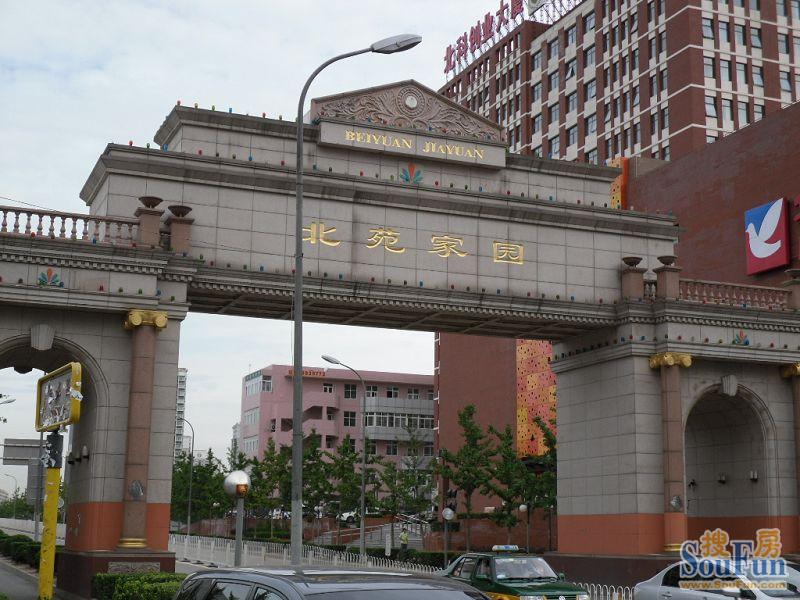
Beijing Qingniancheng

In 2009 there were less than 2000 Beiyuan village residents, but there were more than 8000 workers from elsewhere who had come there, too many for the already weak village infrastructure to support. The roads were bumpy and filled with trash, water and sewage were uneven, the lives of the villagers were severely affected. Sanitation and public security were compromised. In 2009 Beiyuan was entered as one of the listed up villages.
Laiguangying township took energetic steps to mobilize all relevant departments in a coordinated effort to address the public security issues in Beiyuan. Ten patrolmen were specially delegated to set up work stations, from which they patrolled continuously 24 hours a day. The township also sought to fix the village problems involving streets, water and sewage, with a concerted effort to stop illegal building [villagers adding on to their property to create more rooms to rent].
However, all these efforts were mere stopgap measures. In 2010 Beiyuan village was designated as Chaoyang district “reserve land.” The first step was to build replacement housing for the several thousand villagers, the second step was to demolish the village, and the third was to go on to new development projects.
The final demolition “grand banquet” [generous compensation] at Beiyuan village
http://blog.sina.com.cn/s/blog_4aba1d6f0101aubr.html
konjaku: I have only translated parts of this blog directly relevant to Beiyuan village
2010. Three villages in Laiguangying township –Beiyuan, Baifen, and Liugezhuang were included in the demolition zone, involving 689 compounds, 1872 households, 3338 permanent residents, and 15,331 migrants.
From the perspective of society, demolition and transfer of residents is a locus of contradictions. From the perspective of one family, it is about the redistribution of profits. In terms of traditional thought, it is a great trial a person undergoes in the vicissitudes of the world.
Beginning in 2011, demolition of these three villages began. The villagers got a large sum as compensation, the majority became millionaires, with a few getting ten million.
Mr Zhang was a resident of Laiguangying township Hongjunling village. In 2003 the village was demolished and the villagers “moved up” to replacement housing. At that time every household got a settlement of several hundred thousand yuan. After buying a new residence there was hardly anything left over. But in the case of the residents of these three villages, after buying both a new residence and a car, the villages have enough left over to still be millionaires (1 million yuan is about $157,000).
According to Mr Zhang, compensation in these three villages was set according to the market price of real estate in that area. Rising real estate prices meant all the villagers benefitted. Taking a one story house of 250 square meters as an example, the total compensation amount was 1.8 million yuan. In addition, the family could purchase a replacement residence for 4500 yuan per square meter [as opposed to the market price of 21000 yuan].
In the three demolished villages in 2011, involving over 1000 residents, the majority received 2 million to 3 million yuan, with a few obtaining a figure over 10 million. The household of a Mrs Liu in Beiyuan village had 5 members. They purchased three replacement residences [in a multi-story building], and still had 5 million yuan left over.
In 2003, the average price estate price was 6000 yuan per square meter. By 2010, this had risen to 21,000 yuan. Villagers around Beijing suddenly felt like “land kings” feeling the value of their land going up. Becoming wealthy through receiving a high compensation became the prevailing myth, even though there had been such myths before.
Villagers whose villages were demolished between 2002 and 2008 in Laiguangying township said the difference in compensation rates were unfair. At that time, the standard was 2700 yuan per square meter, in addition to a 4000 yuan inducement fee.[a 250 square meter house would yield approximately a 675,000 yuan compensation].
But in the case of Beiyuan village (2011), villagers said the rate per square meter was 2500 yuan for land, 800 yuan for buildings,1600 for cooperation fee, 500 for encouragement fee [total 5400, for a 250 square meter house a sum of 1.35 million, although the total amount seems to have been more]. This itemized compensation policy was something that villagers before 2010 did not enjoy.
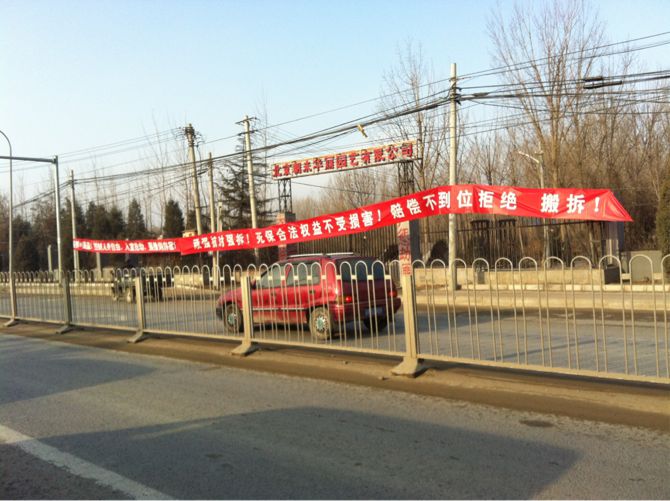
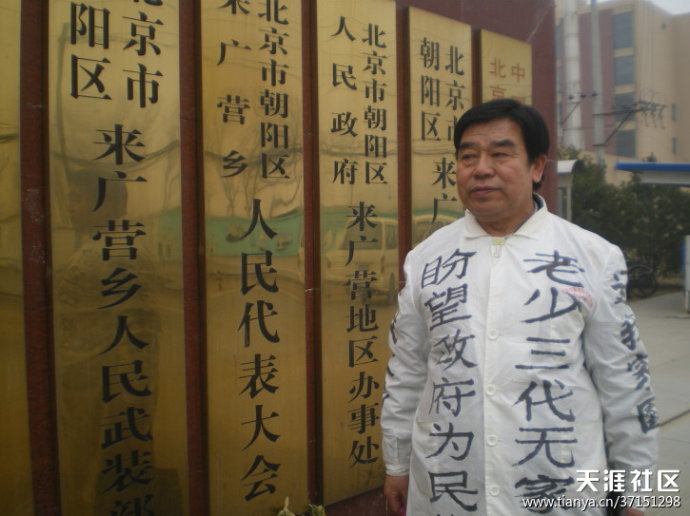
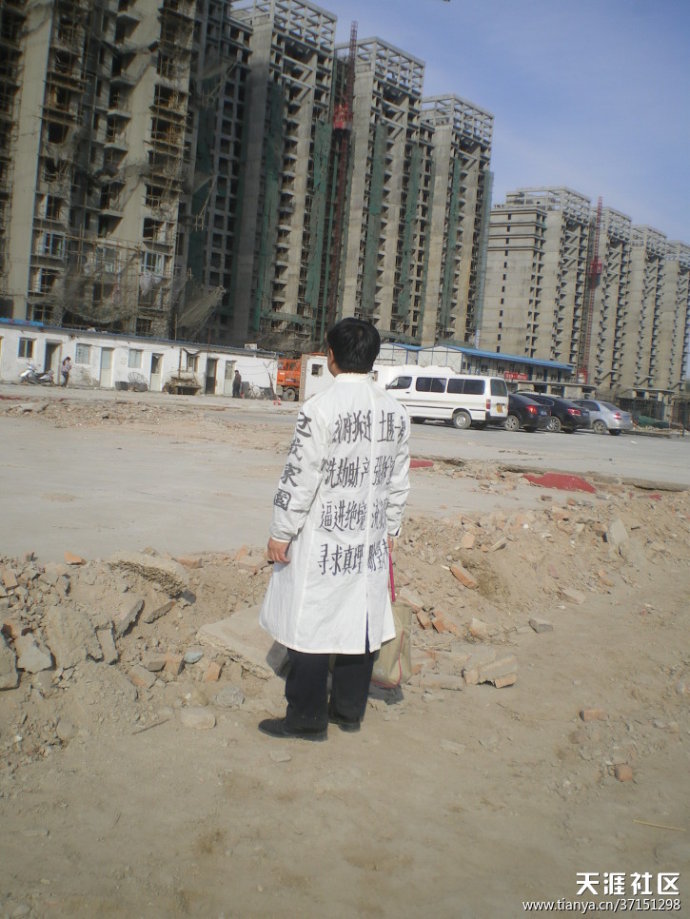
konjaku: this blog concludes, “below are four photos found on the internet. This writer cannot vouch for their truthfulness.”
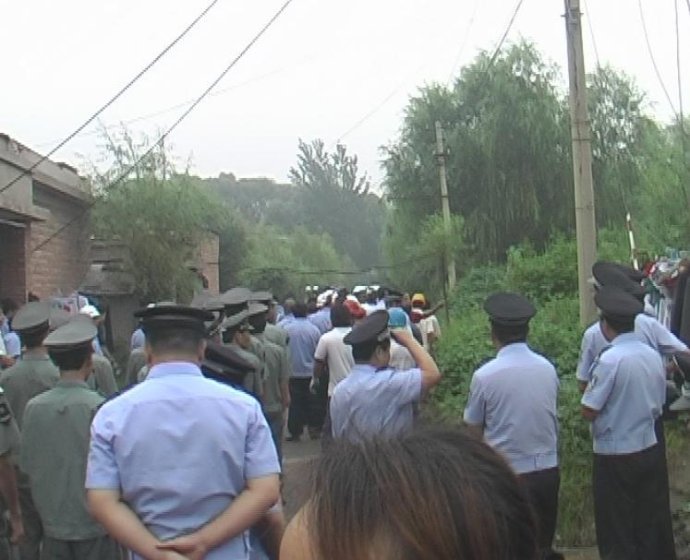
The first photo is of a red banner. I can’t read all of it, but I think it was put up by the government to convince villagers not to resist demolition of the village. Then two photos of a man wearing a white coat with slogans. On the front: “Young and old, three generations without a home,” and “ hope that the government will for the sake of the people…” [missing end of phrase]. In the first photo, the man is standing in front of government offices, Chaoyang district, Laiguangying township. In the second, he is standing in front of the Laibei Jiayuan buildings, under construction. There is no explanation of what is happening in the last photo.
————————————————-
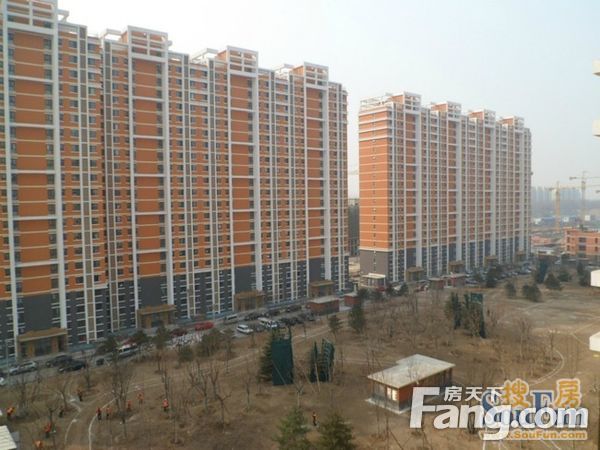
Replacement housing: Laibei Jiayuan
konjaku: the township government seems to have spared no expense in building replacement housing for Beiyuan and other demolished villages under its management. The following is from a Chaoyang district government website.
http://www.bjchy.gov.cn/affair/cxjs/
After being under construction for two years and three months, the replacement housing Laibei Jiayuan is completed. This is the largest construction project undertaken by Laiguangying district. It wil house more than 3500 relocated villagers.
Recently, this reporter went to Laibei Jiayuan to take a look, and found it to be a graceful living environment, planned on a human scale, with a complete set of facilities. One can feel the warmth and care that went into building this project.
Walking into Laibei Jiayuan, on sees eight tall and straight, tangerine-yellow buildings, quite eye-catching. If one didn’t know beforehand, it would be easy to mistake this for a high-end real estate product. Wide and spacious roads are flanked on both sides by a huge green area, in which many timber-bearing trees have been planted. Even though it is winter now, it is not hard to imagine how this area will look at the beginning of spring. Construction and building maintenance staff are shuttling about, cleaning and making final preparations for the opening.
Summary: with 30% of the area devoted to greenery, Laibei Jiayuan provides a beautiful natural environment. The lay-out is spacious and open, but also provides opportunities for residents to mingle and meet. It will be convenient for traffic when the external roads leading in and out of the project are completed, and in the future there will be public transportation. For residents, there will be a large underground parking garage for 1200 cars.
There will be kindergartens, community service centers, building maintenance service centers, post-office, shopping, etc, a complete set of facilities for daily life, arranged all around the site. The building external surfaces have been built with new energy-saving composite materials that preserve heat, cutting down on heating costs. Doors and windows also preserve heat, and are soundproof. Hallway lights are voice-activated. There is a system to collect and reused rainwater.
Laibei Jiayuan has been designed to give residents abundant opportunity to enjoy the surrounding landscape. The buildings are oriented north to south, for maximum light, with 100 meters of space in between, and residences have balconies from which to view the scenery. As for security, there is a manned checkpoint for every residential unit.

Great care was taken in the construction, with strict quality control and inspections at every stage. The buildings are designed to withstand an 8 point earthquake. Laibei Jiayuan has received commendations on its design from borh Chaoyang and Beijing city.
Laiguangying township 来广营乡
Beiyuan北苑村
Baifen白坟村
Liugezhuang刘各庄
Hongjunling红军营村
Beiyuan Jiayuan 北苑家园、
Taihe Zhuangyuan 太和庄园、
Beijing Qingniancheng 北京青年城
Laibei Jiayuan 来北家园
konjaku: because a huge fund of money was allotted to the plan for new development in Chaoyang, when the nearby village Dawangjing was demolished to build the Chaoyang New City, the villagers received generous settlements, and the “Dawangjing model” was put forward as a standard for other villages. Dawangjing villagers were offered 8100 yuan per square meter for their homesteads, Changdian villages 6000 yuan. But without having all the details, it is hard to make an exact comparison. In the Dawangjing model, the villagers also get a share in the commercial profits from the development built on their land, but there is no mention of this sort of settlement with Changdian village.
In any case, it seems that while some Changdian villagers refused to leave their homes and started a protracted effort of resistance, others accepted the proposal offered them, and moved into a multi-story residential project, Dongba Jiayuan. 东坝家园.
In this regard, Changdian previously appeared in an article in this blog dated 2010-08-22, six months after the announcement of demolition of the village. In this article, Changdian villagers have moved to the residential development in Dongba nearby, but they are having trouble adjusting to life in multi-storied residential towers. The local government is having them attend classes in a “citizen’s school”, to learn proper behavior in urban settings.
https://konjaku.wordpress.com/2012/08/31/peasants-must-learn-how-to-live-in-residential-towers/
“Jinzhan town Changdian village is one of the 50 marked up villages. Everywhere in the village are the ruins of demolished houses. It had as many as 1200 residences. One villager said in his compound he grew onions, garlic and cucumbers, among other things. In the summer he didn’t have to buy vegetables.”Now I can no longer grow anything.” He said he was unable to adjust to living in a multi-storied building.
Besides Changdian, in Jinzhan town there are three other villages that will be demolished: Mafang, Louzizhuang, and Caogezhuang. An official involved in these operations said, in communities where displaced villagers were congregated they transplanted rice seedlings in the designated green areas, and piled up corridors with heaps of goods. To prevent these problems, they hope to transform the peasants’ ideas. For this reason, investigation and research into how villagers can adjust to urban life is a major topic in Chaoyang. The director of the citizen’s school says the next session will cover “civilized behavior in public,” divided into four topics: the public environment, public order, human relations and the public good.”
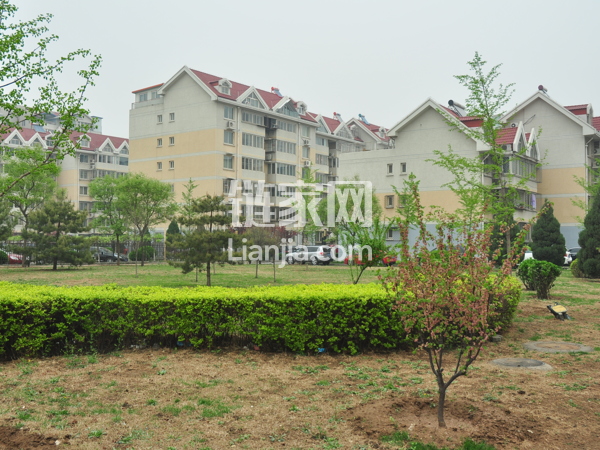
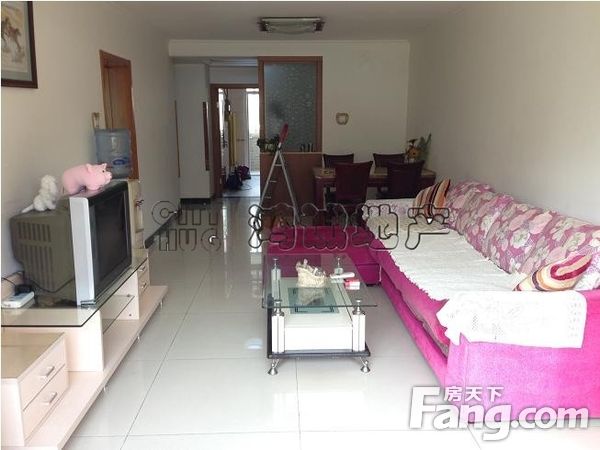
Dongba jiayuan photos:
konjaku: villagers who relocated to replacement housing also made this discovery:
After the entire village was demolished and the inhabitants relocated, villagers said that seven months later some returned to find their ancestral graveyard razed to the ground.
http://www.china.com.cn/news/law/2010-10/31/content_21238740.htm
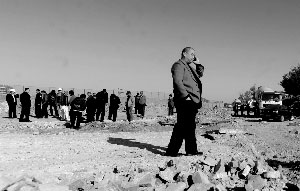
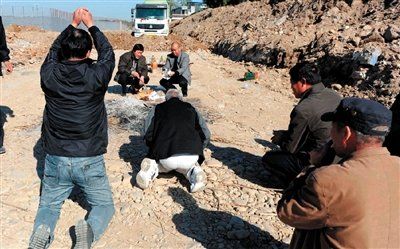
Villager Pan Shuyao said, starting in the 3rd month of this year, demolition procedures began in Changdian village, but the day before yesterday villagers discovered that the graveyard west of the village had been flattened. Construction workers were in the process of dumping construction waste material on the site, as they were repairing a road nearby. As soon as they discovered this, that night the villagers brought six or seven of their own cars, including a BMW, a Nissan Teana, and a Volkswagon Passat to block the construction site.
This graveyard is situated at the intersection of Jinzhan town and Cuigezhuang town, on a piece of land about two thirds of an acre. According to a local person this land began to be used as a graveyard in the 1980s and 90s. There were about 80 gravesites.
A villager said that now the graveyard is covered with rubble. This site is along the road to the construction site for the residential replacement housing development Jingwang Jiayuan.The project manager, Mr Zhong said, at the time they set up their construction site, the villagers had all been relocated, and there was no sign of a grave mound, nor any gravestones.
Pan Shuyao and the other villagers said that at the time of the village demolition they were not informed that the graveyard was also going to be demolished. Now they want be able to dig up and transfer the graves to another location as soon as possible. They also plan to ask for compensation for their mental suffering.
At the time the village demolition was announced, the Changdian village production brigade secretary Wang Zhenshan refused to say whether or not the graveyard was also going to be demolished. A staff member went to the site and took photographs, and told the villagers the matter would first be discussed with Cuigezhuang town, and other leaders, before making a decision.
At 6 yesterday evening the villagers were still guarding the site and waiting for a decision.
Meng Xiansheng, a lawyer in the Beijing City Renhe office said that since rural village land is owned by the village collective, naturally the graveyard also is under village collective ownership. However, as for the structures built upon the land, if these were demolished there should be compensation, an amount adequate to move the graves elsewhere.
Zhang Yuan.
Notes: Jingwang Jiayuan is a replacement housing project for Dawangjing village.
Wang Zhenshan was later arrested for fraudulently taking demolition money and replacement housing for himself.
konjaku: Changdian village was also mentioned in the article detailing the career of Liu Xiquan. A portion of village collective land was taken over for one of Liu’s main projects, the “Crab Island Resort.” The “Around Town –Time Out –Beijing” website describes it as follows, “Crab Island is a curious out-of-town resort known for its fake beach (and for hosting this year’s INTRO music festival). But there’s an amusement park, too, with 17 rides. From a swinging pirate ship and a splash-tastic water flume for kids, to a sprinkling of more aggressive options for grown-ups – such as an 880m-long coaster, and a spinning disc of death, a la Happy Valley’s ‘Apollo Wheel’ – it’s got all your basics covered.”
http://www.timeoutbeijing.com/venue/Around_Town-Parks__Gardens/9822/Crab-Island.html
“In 1994, Liu Xiquan was reassigned as CP committee secretary for Jinzhan town. Jinzhan town was at the time one of the three poorest areas of Chaoyang. Resident’s yearly income was on average a few hundred yuan. Liu Xiquan spend several months in thoroughgoing research, then set about developing three projects: “Urban Agriculture developments,” “Crab Island Resort Island” and “Tulip Garden.” Two of these projects became very successful, giving Liu in the days to come significant credit, to boost his future career.
A collegue who knew Liu Xiquan at that time said he was completely dedicated to developing Crab Island…But as several Changdian villagers said, a section of village collective land was taken over for these two projects. The village party branch secretary rented the land out to developers, but did not give the villagers any compensation money. The dissatisfied villagers complained to a higher level of government, and went to measure the land taken for Crab Island themselves, finding it to be 22 acres, for which they had received nothing. The relevant government bureau found the villagers to be correct. The then village party branch secretary took responsibility and was transferred to another post, and has not since returned.”
konjaku: now that Changdian village has become “land held in reserve” for the future Changdian New City, certain clean-ups are underway (in 2015):
Towers of Trash Pile Up at Beijing’s Unregulated Landfills
http://weekly.caixin.com/2015-06-05/100816389.html
2015-06-08
In Chaoyang district Jinzhan town Changdian village, the Beixiao river turns southeast. On 06-03, at a spot less than 20 meters from the river, there is an old garbage landfill area of approximately 45000 cubic meters, being excavated. This is an illegal garbage dump that is in the process of being cleaned up.
On the edge of this large pit, materials brought up so far are used plastic bags mixed in with brick and stone fragments. From four to five meters down in the pit, everything is immersed in ground water. The garbage that has been dredged out of the pit is spread out to dry in the sun, waiting to be sifted through.
In this garbage, there are obviously many polluted materials which have already seeped contaminants into the ground water and the soil. Since 2006, Beijing city has undertaken to clean up these illegal landfills, of which there are close to 1000. There are still 70 at which clean-up has not yet started.
konjaku: this may or may not be different from the Refuse Acceptance Site run by a director of a demolition company on Changdian village land. If different, then there were two garbage disposal sites within a relatively small area. This seems to be indicate that when a village becomes the target of future development, in the short term it can also become vulnerable to money-making schemes (Crab island, the golf course, etc) on the one hand, and the dumping of trash, legal or ilegal, on the other.
konjaku: the faces of Dong Jinting. Dong Jinting was one of several officials arrested in connection with Liu Xiquan, and whose bio and photo shortly thereafter disappeared from the Chaoyang district government website. Later, photos of her while she was still in power have been posted, and numerous photos of her during her trial.
Photos of Chaoyang district Assistant District Head Liu Xiquan’s mistress
Author Wang Meng
Liu Xiquan is serving his sentence in jail, and these days his younger brother Liu Xiwu is shut up in his estate in Dongba, undergoing investigation. It has been leaked to the outside world that the estate, including thoroughbred horses and dogs, actually belongs to Liu Xiquan, who used it for corrupt purposes. Another person who has been taken away for investigation (2011-05) is the Chaoyang district Agriculture deputy director Dong Jinting, who is suspected of being Liu Xiquan’s mistress.
These are supposed to be photos of Dong Jinting before her fall, in a dark suit and sunglasses.


http://baike.baidu.com/view/8685906.htm
On 2012-08, Dong Jinting was convicted of misappropriating 177,500 yuan of public money, and accepting 15,000 yuan in bribes. The Beijing city court sentenced her to nine years in prison. She used the misappropriated funds mostly for beauty aids, as she enjoyed spending money on cosmetics.
Photos of Dong Jinting at her trial. It is hard to see the same person, compared to those photos, above. The intent seems to be to show someone stripped of any attributes of power and position.

konjaku: by contrast, there are no photographs of Liu Xiquan during his trial. This is clear from a Google image search of both Liu Xiquan and Dong Jinting. The dominant image of Liu Xiquan that appears is still the one of him sitting at his desk, presumably before he was arrested. Obviously, this is not the case with Dong Jinting.

Liu Xiquan image search result (Click on image for an expanded view). There is the picture of him at his desk(second from top left), and meeting with people, but none after he was charged with crimes. The fifth image from top left is of Dong Jinting.

Dong Jinting image search result. Her various attitudes at her trial are well represented.
konjaku: the demolition of Changdian village involved corruption, resistance, and the use of force. Accounts are incomplete, sometimes undated. A 2010 article describes the posting of the announcement to demolish Changdian, and the villagers’ initial reactions. There is no further treatment in news sites after that. Bits of the story can be found indirectly in other places. There were several artists colonies in Changdian which were demolished along with the village, and there is coverage of the protests waged by the artists. There are fragments of text, appeals for help, from villagers who refused to leave their homes, from which we can assume there was a period of resistance to the demolition. Also, Changdian appears in coverage of the corruption of local officials, who seized village property or absconded with funds which were supposed to be used as compensation for villagers losing their homes.
北京朝阳金盏乡长店村 Beijing city Chaoyang district Jinzhan township Changdian village
A photo of Changdian village from Google satelite (copied 08-2015) shows most of the structures cleared away. On the bottom right corner is a section of the golf course (referred to below).

Beijing city Jinzhan town Changdian village undergoes demolition and removal of residents –one’s native land is hard to part from
http://news.dichan.sina.com.cn/2010/03/25/138515.html

Photo caption: several days after the announcement concerning the demolition and transfer of the village residents was posted in Changdian village, it is already full of ads stuck onto it by moving companies
Starting today, demolition begins in Changdian, one of the 50 listed up villages. The announcement states that those who move out of their homes within the stipulated time period, between 03-25 and 04-13 will receive an award of 160,000 yuan ($25,767). Those who choose to move into the prescribed replacement housing, will be exempted from paying the building maintenance fee for two years.
In regard to those who do not reach an agreement with the government as to compensation within the time limit, once the deadline for demolition has passed, the district government approves the use of force to demolish their homes and move them elsewhere.
Although it has been five days since the announcement to vacate has been posted, among the villages there has been little movement to comply. The announcement pasted at the village entrance is in tatters, while clustered on walls everywhere are ads from moving companies.
This morning, the villagers have all received estimates regarding their property. They are being offered 6000 yuan per square meter of their current homes, which is quite tempting. But, “They can’t expect us to move!” Many have lived on this land for generations, and a number of old people are reluctant to leave, “if I can speak my mind, however much money they give us, we are not willing to go.”
Those whose houses are being demolished, can choose to receive either a monetary settlement or replacement housing. Those who choose the monetary compensation, cannot participate in the replacement housing. If they choose to buy replacement housing, the standard is that the price of 50 square meters per person will be 4500 yuan per square meter. If the area of the new residence comes out to more than 50 square meters per person, they will have to pay 7000 yuan for each additional square meter.
Reporter Zhao Chao
konjaku: the artists zones and Changdian:
“Current State of Chinese Art” Wang Chunchen
“ Then [at the start of an art boom in 2000], at the rural-urban continuum of the northeast outskirts of Beijing, artists’ work areas such as Suojiafen, Feijiafen, wine factory, No.1 field, Caochangdi, Huantie, Jiangfu, Xiedao, Changdian, Nangao, Beigao, and Black Bridge appeared one after another. Most of these new art zones are owned by peasants or investors and rented to the painters or artists. However, in 2009 many of these art zones such as Zhengyang, 008, Dongying, Beigao, soon were demolished so that the land could be used for real estate development.” p 288
in Subversive Strategies in Contemporary Chinese Art, ed Mary Wiseman, Liu Yuedi, Brill, 2011
In one sweep Chaoyang New City demolishes 20 artists zones
http://jzx.jinrongxuewang.cn/i/g/g.html
In the middle of January, at the 008 artist colony in Changdian village, an art performance entitled “Warm Winter” was in progress, expressing that the site was under threat of demolition. As captured in video, a gang of young toughs rushed in to the exhibit to ruin the performance. They tore down the posters, chased and beat the artists, causing injuries. Although the artists resisted with force and spirit, the out-of-control situation went on for along time
Zhang Xiaotao’s 15 year old student Wang Yuanhai, had studied emei style kung fu, and he used his skills to rescue the artists, who were surrounded by attackers.
[for a photo record of “Warm Winter” see
http://blog.artintern.net/blogs/articleinfo/jinzidejia/78843%5D
The underlying reason the artists were attacked, lies in Beijing’s strategy of eastern expansion. In Chaoyang’s 34 square kilometers, there is a three year plan to set aside land in reserve to develop the Chaoyang New City in the future, mostly in the townships in east Chaoyang, involving a population of 100,000 people. In the Chaoyang New City there will be built the fourth diplomatic quarter, a business zone associated with the airport, a large scale residential district, and a financial support systems zone. This New City is rapidly rising out of the ground.
The more than 20 artists colonies sprang up in a spontaneous and disorderly manner on the urban fringe zone of Chaoyang, were by no means included in the plan for the Chaoyang New City. They have already had to experience having their water, electricity, heat, etc cut off, in the attempt to force them to vacate. The artists and supporters have mounted a resistance, leading to a stalemate.
Jiangfu zhuangyuan is in Chaoyang, in Jiangtai township, 10 minutes from the 798 artist colony by car. Artist Zhang Xiaotao was at 798 for four years, but finding the space too cramped, three years ago he and his friends Yu Fan and Wang Wei, also from the Sichuan Fine Arts Academy, decided to move to Jiangfu. Jiangfu was quieter, more undeveloped, with more open space, and the rent was one third of what he was paying at 798. They were able to take over a half-built warehouse, and spent three months finishing it, floor, walls, and roof-beams.
Zhang Xiaotao’s happiness lasted for four months. Not long after the renovations were complete, he received a notice, “Chaoyang district cites this as an illegal building.” The owner of the property, Zhang Xiaotao’s landlord, had outstanding loans and unpaid mortgages. Because the Olympics were approaching, the government refrained from using force to move him out and demolish the building. In the meantime, one after another, some 50 artists moved to Jiangfu. Things seemed calm and settled, therefore Zhang Xiaotao put aside his worries and concentrated on his work. A year and a half passed. Then, 2009-06, policeman holding police dogs came to his door, with a comprehensive order to demolish the building.
In short, the township had property rights to the land, which they sold to a big developer named Jiangfu International. The developer was planning to build a complex of residences for senior citizens (Jiangfu Manor International Senior Citizens Villas) on a large tract of land which included Zhang Xiaotao’s studio. The artists had spent time and money renovating their buildings, but for the time being they were not being offered any compensation. As soon as the artists were forced out, Jiangfu International sealed off the main entrance and built living quarters for laborers inside the compound.
Summary: “we artists were at first shocked, we started to reconsider our connection to society.” They held meetings to plan a counter-strategy. “Up to now we had dealt with intellectual matters, not action. We had the freedom to go abroad, to leave China and come back again, but when it came to a political fight, we saw we were not significant.” In the end, they decided not to try and wage a legal fight. Because the buildings were illegal to begin with, the judgement would not be in their favor. Instead, they held exhibits to rally public support. They garnered enough interest and media attention, that the threat of forcible demolition was lifted. The artists cracked open the sealed door to their compound and moved back in, and the big developer even helped them, by repaving the small road that led to their building.
Currently the Jiangfu Manor International Senior Citizens Villas are under construction. The artists are living peacefully, they have a contract allowing them to stay till 2013. [end summary]
While the Jiangfu artists were successful in preserving their colony, three kilometers away, the Zhengyang 008 colony is caught up in an intense conflict. At Jinzhan town Changdian village, a right turn off the Airport Expressway, in a line there is a Shanxi hand-cut noodle restaurant, a cell phone store, a grocery, and a beauty parlor. Within three years, the Beijing Finance Support Systems Center wil be constructed there, an industrial park that will manufacture credit cards and other banking products.
Most of the buildings of Changdian village have already been demolished, and the villages are supposed to “move up” into new high rises. The village homesteads are empty land, held in reserve to build the Financial Support Center and the 4th Diplomatic Quarter. The village party branch secretary Wang Zhenshan i nervously telephoned the artists, “If I am unable to hold onto my job [because I can’t get you to leave], I’ll be eating dinner at your house.”
But after a two hour telephone conversation, the artists were not convinced. As a result, the 008 colony became the subject of repeated surprise attacks. 11-26 they received notice to move out in one week. This despite the fact that they had paid a half years rent in advance to the landlord. On 12-04 at 6 in the morning their landlord dismantled the electric transformer at their building. Soon they were plunged into a primitive existence, without power, heat, running water, or lights (adjacent streetlights were also turned off). Zhang Wei recollected that the oldest of their group was over sixty, and the youngest was a three year old child. Without heat, the temperature was 13 degrees below zero.
The artists rented a generator, but were subject to night attacks. Unknown persons broke in late at night and with iron clubs smashed car windows, building windows, completely destroyed a glass atrium, and stole artworks.
konjaku: this source does not give the conclusion to the conflict.
More details in English (scroll down) on the conflict:
http://blog.sina.com.cn/s/blog_46cde4250100ft6j.html
konjaku: an appeal from the village( undated):
http://weibo.com/guoyang1007
I write to appeal: my home is in Changdian village, which is undergoing demolition. About half of the residents still have not vacated. They have already cut off the water supply, making it difficult for us to live normally. The state has forbidden demolition by force, so the town government is using this kind of pressure, which is just force in a disguised form. We the villagers have written countless appeals to the higher authorities, therefore they are aware of the situation, but the water is still cut off. Friends, please reprint this appeal, we hope to generate support and get the attention of the relevant government department, to quickly resolve this matter.
konjaku: reports of corruption:
http://jzx.jinrongxuewang.cn/g/r/b.html
In 2009 Changdian village received the notice of demolition and transfer of residents. The problem of corruption in the village was very severe. The common people reported to our Party and to the nation the extent of the corruption in Changdian. The cadres fraudulently took money meant for compensation of vilagers, among them was a policeman of the local police sub-station. Yang Guogang, head of demolition, a native of Changdian, illegally appropriated funds. Jinzhan township head Changyu Gang, secretly divided up replacement housing, to the profit of the cadres. The township and village sold land, constructed a hot spring resort and a golf course, which caused problems with the village ground water supply. But what of these? They are just a drop in the bucket of corruption in Jinzhan. We wish that correspondents of the people, people from all walks of life, would come and see with their own eyes the real situation here.
Jinzhan township head Changyu Gang, Village Committee Chairman Liu Jinku, Changdian village Secretary Wang Zhenshan, and Changdian villages cadres broke both precedent and the law. For a low price they contracted out village collective land, constructed an artist’s village, then forced the artists to terminate their lease, misappropriated the village land.
Liu Jinku, the Changdian village committee head, Before 1996 he sold his own homestead and buildings to someone else (Liu Shulan). He built buildings on 1000 square meters of village collective land, land that was not for commercial use, then rented out the buildings. When it came time to demolish, all of a sudden there were seven permanent residences attached to the land. In this way Liu Jinku fraudulently collected compensation on this land, along with several other persons, one of whom was a policeman of the Jinzhan township sub-station. Liu Jinku and his wife divorced, in order to create another “household” eligible for compensation. Village collective land is the property of the nation. By appropriating this land for his own purposes, he violated national property. When 1000 square meters of land was used to get compensation for homesteads that never existed, where did this money go?
Liu Jingang (Liu Jinku’s younger brother) rented six acres of village land, saying it was in order to grow crops, but he built on part of the property, and kept expanding the buildings. When it was time to demolish he submitted the figure of 220,000 square meters of constructed space (for which he would receive compensation). Just like his brother, he enriched himself with public land. Using his brother’s authority as village committee head, he rented village collective land at a low price, built an artists’ village, which was done without approval or the villagers’ knowledge. When demolition of the village began in 2009, the artists raised a protest. Liu Jingang assembled 50 employees, who threatened and intimidated the artists. He forced the artists to terminate their lease, and took over the land in order to collect compensation for the buildings.
Li Jingmin, director of a demolition company, made a contract with the Changdian vilage committee for 60 acres of land, consisting of vegetable fields. He changed the land into a Refuse Acceptance Disposal Site, which collected the refuse acceptance fee for every truck that dumped a load there. On top of the refuse mound they built day and night a huge shack, for the purpose of collecting compensation money illegally.
Yang Guogang, the Jinzhan township demolition head. For his homestead of 225 square meters he received 40 million yuan, while villagers with homesteads of an equivalent size, received 26-28 million yuan.
The village committee, in order to demolish the village, used gangsters and criminals, who taunted, deceived, insulted, threatened and smashed property. They cut off water, electricity, internet, and blocked roads. They turned off streetlights, and ceased security monitoring. They killed dogs, filled in keyholes, smashed windows, set fires, and torched cars.
Wang Zhenshan, village party brnach secretary, followed the same pattern as Liu Jinku. He took over village collective land meant for farming, and built buildings on them which he rented out for personal profit. When the village was to be demolished he claimed the buildings to be legally homesteads, and collected compensation, also divorcing his wife in order that they could collect amounts for two homesteads.
http://www.21ccom.net/plus/wapview.php?aid=37863
Source: Caijing
This reporter has learned from interviews that many villagers and cadres from demolished villages in Jinzhan town, reported to authorities that Liu Xiwu built up substantial “businesses” on properties in those villages of theirs that were slated to be demolished, during a period of almost four years. So far, this reporter has been able to see two of these properties in on the spot investigations.
In Changdian village, there is a piece of land surrounded by a concrete block wall. Inside there are three steel structures meant to be farmers markets. Each one is 80 meters long and 20 meters wide. There are security cameras, public security personnel, and guard dogs at the site. A village cadre confirmed the owner of the property was Liu Xiqu, and said, “This market was constructed after all the village land had been measured in preparation for demolition. Who is going to use it?”
Five minutes away by car, in Dongba township, on the west side of the Beixiao river, there is a breeding farm that is under the name of Liu Xiwu. It is even larger then a nearby similar one in Juzhifang village. The front gate is always tightly shut, but villagers who have gone inside say there are camels, peacocks, Sichuan ponies, dogs, a fishpond, and a sumptuous house with beautiful specimens of gingko trees.
At present, Liu Xiwu is under investigation. A Chaoyang official divulged that in recent years, there have been many complants sent to the authorities referring to his brother, Liu Xiquan. A Caijing reporter was given one such document from “a person close to Liu Xiquan,” detailing accusations of misuse of funds in constructing the green zone, replacement housing for villagers, Crab Island, Tulip Garden, etc.
notes:
For the artists Zhang Xiaotao and Yu Fan see
http://www.saatchigallery.com/artists/zhang_xiaotao.htm
http://www.artnet.com/artists/yu-fan/
The Jiangfu Manor International Senior Citizens Villas 将府庄园国际老年公寓别墅 is intended to be a state of the art senior citizens’ community.
http://bj.house.sina.com.cn/scan/2010-04-28/1140343468.html


At present, the last few remaining residences at Jiangfu Manor (General’s Garden) are still available to buy, at a price of 15,000 -16,000 yuan per square meter, with a right to possess for 50 years. A buyer can move in 2010-10.
Jiangfu Manor is northeast of the 5th ring, within the green zone, next to the Airport Expressway, close to the Yansha shopping mall. Directly to the south of the project is a pier jutting out into the water from which residents can fish. To the west and southwest is verdant green forest, altogether there is over 2 million square meters of green zone surrounding the project, creating a superior environment.

The Jiangfu Manor Senior Citizens Villas development has already been approved by the Ministry of Civil Affairs, as a non-profit social services enterprise, a model project for the nation.
konjaku: The second village on the list is Xidian village, administered by Gaobeidian township.
西店村 Xidian village
朝阳区高碑店乡 Chaoyang District Gaobeidian township
Each village on this list has its own history and specific set of conditions that determine the manner in which it will disappear. The reason why the new Xidian, after the old village is demolished, will transform into a set of villas in a Ming and Qing style, lies in its proximity to Gaobeidian village (a smaller unit within the township). Gaobeidian village, Gaobeidian Furniture Street, Gaobeidian International Folk Tourism Culture Village, are all newly constructed evocations of a traditional past, or an idea of the past.

Gaobiendian Furniture Street
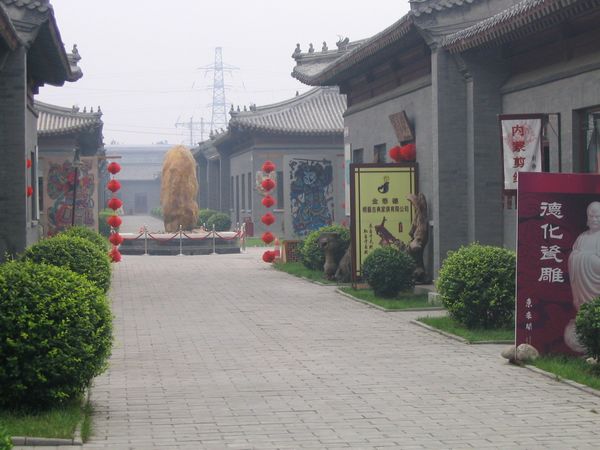
Gaobeidian village

Gaobeidian Furniture Street
The details of the settlement with the villagers are not completely described, but if the villagers (not the government) are ultimately really made responsible for construction costs of their new “villa,”there will be difficulties.
Beijing, along the Tonghui River southern bank, will build 500 villas which copy a historical style
http://news.xinhuanet.com/house/2011-06/29/c_121598768.htm
Source: New Beijing Report (Xin Jingbao)
2011-06-29
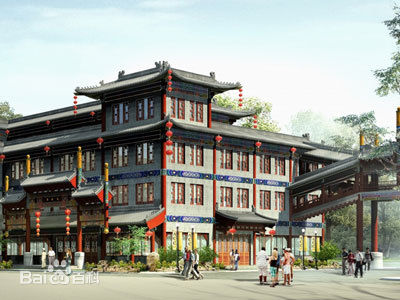
Photo: a graphic rendering of the proposed 500 historical style villas and two multi-story towers at Gaobeidian town, Xidian village
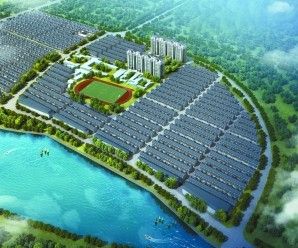
Yesterday the project began to transform Xidian village, in Gaobeidian township along the east extension of Chang’an Road. The majority of the villagers will live in the historical style villas, which will be based on Ming and Qing design elements. These villas have already become the choice of more than a few entrepreneurs, and the yearly rent will be over 300,000 yuan ($48,000).
This transformation requires demolishing 458 household compounds, involving 1012 residents. The early stage of tearing down houses and moving the occupants has begun, it is estimated the project will be finished within two years. The villagers are being offered 20,000 yuan as an inducement to vacate their homes promptly.
Xidian village is under jurisdiction of Banbidian administrative village. The Banbidian Party Branch Secretary Li Yunfeng said the Xidian villagers have three options. The first is to exchange their homestead for a villa. The villa comprises 85% of the surface area of constructed space of an average homestead. The villagers will need to pay construction costs of 1125 yuan per square meter, amounting to between 200,000 and 300,000 yuan, for which they can receive a loan.
The second option for a villager is to exchange their homestead for a residence in one of the two 16 story buildings to be constructed on village land. If the area of constructed space on the homestead is 100 square meters, the villager can obtain a residence in one of the buildings that is 200 square meters. The first 100 square meters is free of charge, for the remaining 100 meters the villager will need to pay 2800 yuan per square meter. The third option is a combination of the two, for example, if the village has a credit of surface area left over after receiving a villa, that can be applied to a tower residence.
As for the building style, it will coordinate well with the east side of Gaobeidian village. Further, the two villages will integrate with the style of the Shengshi Longyuan Culture and Creativity Industrial Park. All these will compose an atmosphere of folk culture along the bank of the Tonghui waterfront area. Those parts of the project which replace the villagers’ homesteads, can only be transferred to another villager, never sold outright.
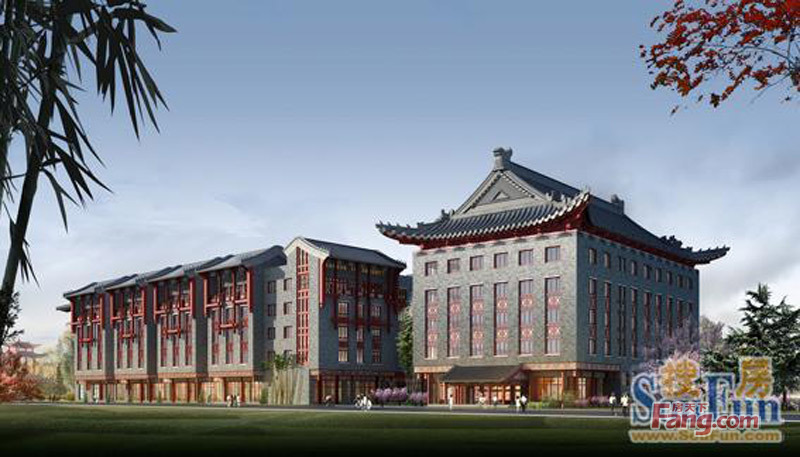
Shengshi Longyuan rendering

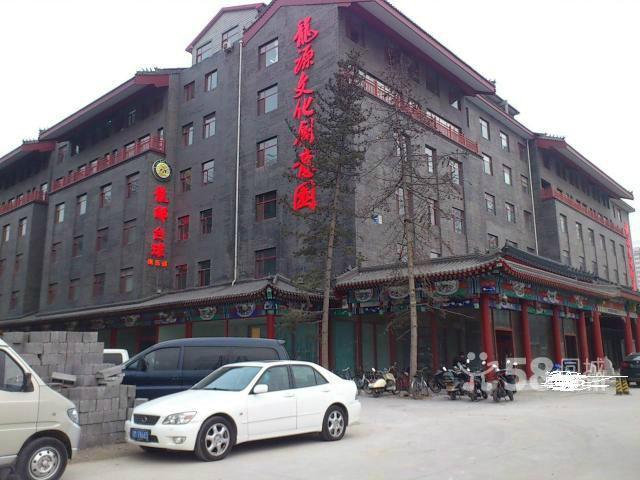
Shengshi Longyuan–its actual appearance
Why does the constructed space of a villa amount to only 85% of the homestead it replaces? Li Yunfeng said, it is because they do not want to repeat a mistake made when they built the Gaobeidian historical style architectural complex. They did not leave enough room for the cars. In the new Xidian village project, roads will be at least 6 meters wide. This will enable cars to go in and out easily, promoting business development. However, the constructed space of buildings will be smaller.
Villager Zhang said, “If I buy a building I will have 85% less space, but if I can recoup the loss through rental income, it might be worth it.”
Is the “pieces of tile economy”[villagers building additions in their compounds to rent to migrants] going to collapse in a heap?
Villager Zhang said, renting rooms was our chief source of income. If we change to living in villas, will we still be able to rent and receive income?”
This reporter found that in nearby Gaobeidian, one third of the villas are rented out. There is a health club, grocery stores, etc. One villager said, all the villas located on the Tonghui waterfront are rented, and the rent is 300,000 yuan a year, or more.
Xidian villager Zhang said, he is preparing to rent out the first and second floors of his villa, and live on the third floor. “I am not against them [the local government]managing things, as long as they don’t harass people, or violate the law [using force to demolish village homesteads].
Li Yunfeng said, a number of small scale but creative companies had already expressed a interest in renting villas. In the future with the opening of the Qinshui Culture and Creativity Industrial Park, this will draw in new innovative businesses, which will greatly expand employment opportunities for the residents.
Reporter: Rao Pei
————-
http://www.beinet.net.cn/jjyw/chengshijianshe/201106/t820889.htm
Source: Qianlong net
2011-06-28
Xidian village is a small village, 5,2300 square meters, with 458 household compounds and 1012 residents. As one of the 50 listed -up villages, it is being demolished and within two years will be replaced by an architectural complex in a Ming and Qing historical style. As a combination of residences, and the Qinshui Culture and Creativity Industrial Park, this project will supply the villagers with both new places to live, and a source of employment.
“In this location where the urban and rural meet, public security and the environment are comparatively poor, therefore Beijing city has listed up this village to deal with the problem,” said Li Yunfeng. “According to the plan worked out by the government, the villagers have the option to live or manage businesses in the historical style villas or in the multi-story buildings. Because these are being constructed on the site of the village, the villagers will not have to separate from their native place.”
———————————————
konjaku: to understand the transformation of Xidian, it helps to see a diescription of Gaobeidian village:
Gaobeidian:
http://www.szmag.net/NewsInfo.aspx?id=38051
Mention “urban village” amd most of us think of a place where environmental conditions are bad. People pouring in, hastily thrown up buildings put up by villagers to rent to these outsiders, old buildings falling over, public security in confusion. Who could imagine that in the capital of Beijing, just 8 kilometers from Tian’anmen square, there is a 2.7 square kilometer urban village, that is definitely unlike the usual urban village.”
This village is called Gaobeidian. It already existed in the Liao era (907-1125), therefore it is over 1000 years old. According to historical records, in the Liao and Jin (1115-1234), it was an imperial grain and food transport center on the Grand canal. Today it is located between the fourth and fifth ring. Although in the midst of a busy area full of traffic, it has a quiet and secluded atmosphere. It is truly worthy of praise that this tiny plot of land still exists next to the Beijing new Central Business District (CBD).
When this reporter came out of the southwest exit of the Gaobeidian subway stop, going along Gaobeidian Road toward the village entrance, the first thing that met the eye was the rippling water on the surface of the Tonghui River. Next was the Tonghui irrigation canal, which runs through the village. This is the terminus for tours of the capital water system, one can ride a boat north to the Summer Palace, or east to Tongzhou district.
Crossing a bridge I came to the village entrance. There were rows of scarlet eaves and grey tiles, three story buildings in a Ming and Qing style, redolent of Beijing flavor. Strolling unhurriedly, down broad and orderly streets and alleyways, the style of the buildings was integrated, each with a business occupying the bottom floor. Everywhere the buildings paid respect to tradition while being new and up to date, it was pleasing to both the eye and the mind.
Going along the main village road adjoining the river, on which there were at this time few cars, I came to a traditional gate with “Gaobeidian Village” in large red letters. Workers were putting lights up in the trees, to welcome the upcoming Lantern festival.In the public square in front of the village committee building, groups of villagers in twos and threes were serenely basking in the sun. They told me the village continued to have many festival activities redolent of traditional Beijing: stilt-walking, home-made paper lanterns, Chinese yo-yo [diabolo] spinning, yangge dances, waist-drum dances, etc. The play with actors on stilts performed in the village can be traced back to the year 1887 of the Qing era.
[Summary, photos added, not in original] The reporter describes coming to a stone statue of the Yuan era (1279-1368) scientist Guo Shoujing, who personally supervised at Gaobeidian the construction of a key sluice gate (called “Ping-jin Sluice”) for the Grand Canal. Some stone remains of the original Yuan sluice gate can be seen. Nearby were two temples. In the 60s they were destroyed by the Red Guards, but were rebuilt in 2007.

Guo Shoujing

the sluice gate
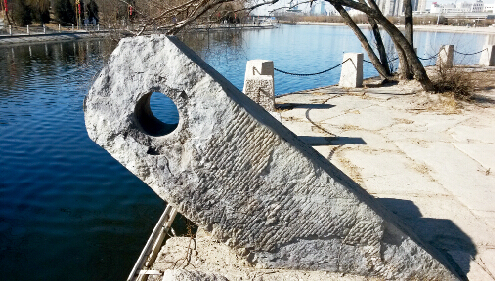
the sluice gate
In the past, the villagers could make a living catching the fish and shrimp left in the lock when the Ping-jin sluice gate was shut. Even today this reporter saw villagers fishing, though they say now it is just for fun. [End summary]
Oh yes! Today, each and every household in Gaobeidian lives in a three story villa. For a long time, the villagers have not had to fish for a living. Some ten to twenty years ago, one saw here a different picture: squeezed together one story houses, narrow, cramped, sunken streets, tangles of electric wires, garbage strewn everywhere…it was “a village without agriculture, villagers without farmland, who had become urban residents, but without employment.”
In 2002, Zhi Fen took the post of Gaobeidian party branch secretary. “Demolition was what we had to do, but if we had had to adopt 2005 standards for demolition, it would have cost several billion yuan. But if we didn’t demolish, how could we redevelop, with high voltage wires above and sewage pipes below?” The woman Secretary encountered many difficult problems. In the course of multiple on the spot investigations and discussions with village representatives, in the end Gaobeidian village decided the village collective would be in charge of building a completely new village. The model they followed was the already existing Gaobeidian Furniture Street. After ten years of great effort, on both sides of the Tonghui River, there is a new community dedicated to Chinese culture, folk customs, tourism, recreation, and antique furniture stores.
In 2006, the total yearly income of Gaobeidian was 1.439 billion yuan, and the average income of a villager was 25,600 yuan ($4,123). In 2014, in this village, in which permanent residents number under 10,000, the total income was 3.547 billion yuan, with individual income at 38,000 yuan ($6,121). It has become known far and wide as a well-off village.
Gaobeidian has received numerous awards and designations, as “ Democratic rule by law model village,” “Green and good living standard village,” “Most beautiful Beijing village,” etc.
konjaku: although I found no articles or posts, on or by Juzifang villagers, giving their reactions to the demolition of their village and transfer to replacement housing, there is a considerable account of information on one native son of the village, Liu Xiquan. The career of Liu Xiquan illustrates one aspect of the urban rural transformation. The pace and pressure may be particularly intense in Chaoyang district. Because of the expansion of the Central Business District (CBD) into three additional zones of high rise office buildings “anchored by signature parks and green boulevards,” there is a huge amount of development capital at play.
http://www.som.com/projects/beijing_cbd_east_expansion
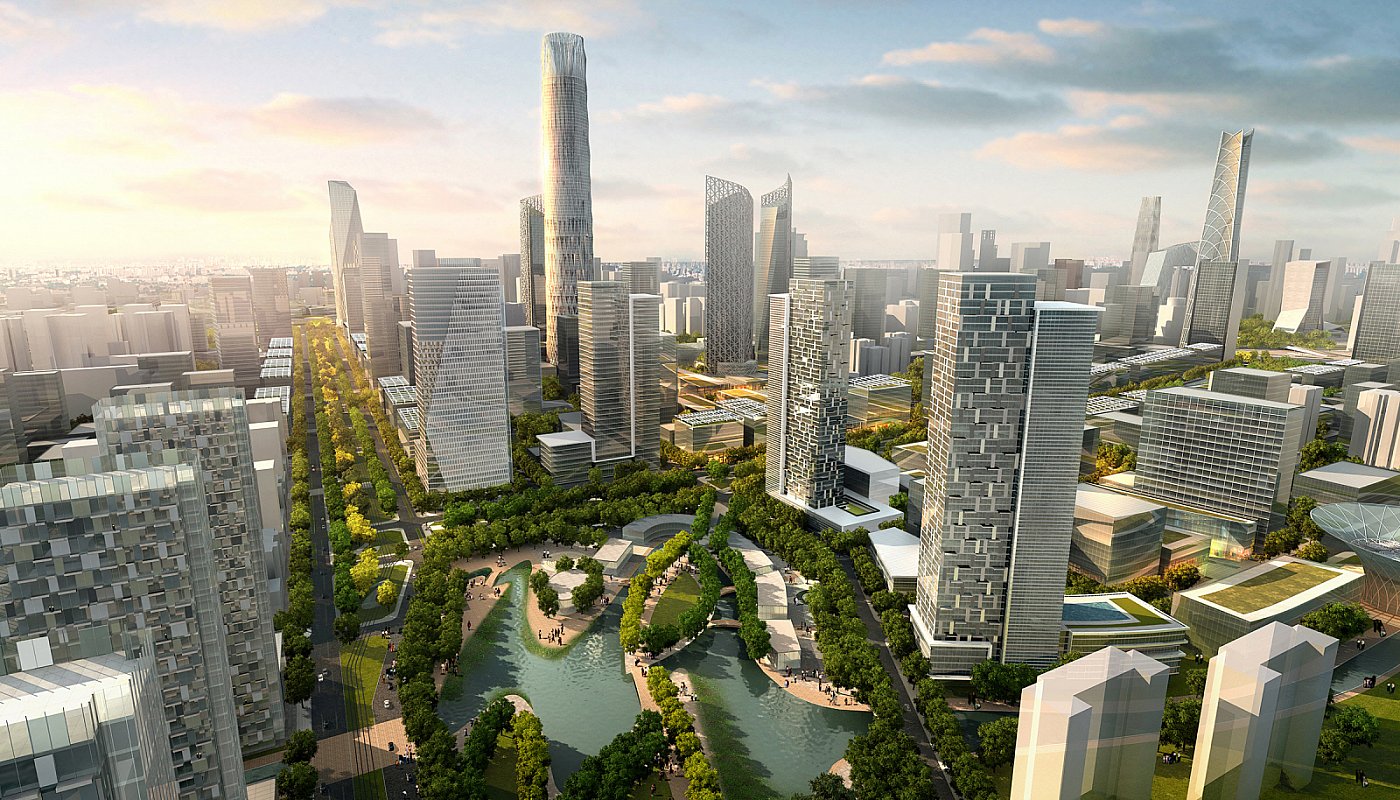
CBD eastern expansion
Beijing Chaoyang District Deputy District Head Liu Xiquan arrested for bribery –was in charge of village demolition work
2011-06-21
http://politics.people.com.cn/GB/1026/14953447.html

When he was 19, he began as deputy director of the village production brigade. At 55, Liu Xiquan, while pursuing a political career, has never completed separated from agriculture, and he has never completely separated from Chaoyang. For 36 years, in Chaoyang. which is both city and suburb, he experienced the complex ups-and-downs of urban transformation. Many village residents had to part from their land, many parcels of agricultural land were shifted to industry. In the midst of an era of massive changes, Liu Xiquan was responsible for the work of demolition. It was a powerful position. In charge of huge sums of money, he faced difficult tests of character.
Yesterday this newspaper reported that Liu Xiquan was under investigation for suspicion of taking a bribe. As of today, as a result of the investigation, the District Deputy Chief of Agriculture reported that Liu Xiquan had been formally arrested on criminal charges.
A person close to the investigation leaked that the matter in question is 200 million yuan diverted to set up a slush fund for the Agricultural Commission. A certain amount of this fund was supposed to be used for compensation to those relocated in the demolition of Jinzhan town.
Apparently, at the opening ceremony of the Jinzhan town new construction project, a certain teacher “created a disturbance.” The dormitory the teacher lived in was demolished, but the teacher had neither received compensation money nor replacement housing. This alarmed the city leadership present at the ceremony. Not long after that an investigation was begun into the demolition situation at Jinzhan town. From looking at the account books of the finance official in the Agriculture Commission, and another in the office of the Green Zone Construction Headquarters, a conspiracy came to light. In short order, in 2011-05 mid-month, the Agriculture Commission deputy-director Dong Jinting, the Agriculture working committee secretary Wang Baojun, Chaoyang Deputy Director Liu Xiquan, and the Agriculture Commission Director Chen Xiaodong, were all taken away for questioning.
A reporter from this newspaper was unable to find the whereabouts of these Agricultural officials. A few days later, their names disappeared from the Agricultural Commission website.
In addition to being suspected of diverting demolition compensation funds, Liu Xiquan’s younger brother Liu Xiwu was suspected of having “foreknowledge” about the demolition plans. That is, knowing which areas would be demolished, he snatched up the land at a low price and constructed buildings on the sites, to illegally receive compensation.
However, Liu Xiquan’s face is still up on the District government website.
Liu Xiquan’s career
In 1956-04, Liu Xiquan was born in Chaoyang district, Dongba town, Juzifang village. At present this village has been demolished, only a few scattered village houses remain. A villager pointed to the ruins of a demolished house on a plot of land at the top west position of the village, and said, “ This is the old Liu family house. It occupied more than 100 square meters. It was the largest, tallest, and best house in the village.”
As an insider revealed, Liu Xiquan’s father Liu Yaoyuan was a cadre in the People’s Commune of Dongpa town. When Liu Xiquan was 18 he became an agrotechnician, at 19 he was made Deputy Director of the production brigade, at 22 he was sent to the Beijing Municipal Party Committee Government and Administration School to study for three years. After he graduated and returned home, Liu Xiquan was appointed jointly as Juzifang village party branch secretary, and as deputy director of the agriculture, industry and commerce corporation. He held these positions for six years. During that period the media reported that the accumulated capital of the Juzifang village collective increased by 30 times every year.
A number of villagers said, when Liu Xiquan was village party branch secretary, he approached matters calmly and with complete self-possession, and did things according to his own methods. However, he gave the impression that he was not concerned with human feeling. As an example, villagers point to the dispute between Liu Xiquan and his childhood friend, Chen Jun (a pseudonym).
Chen Jun was a Juzifang villager, he was a primary and junior middle school classmate of Liu Xiquan’s. Chen Jun made his living raising sheep. After getting married, he had three children outside the state planned birth requirement. At that time, Liu Xiquan had just become party branch secretary. To make an example of Chen Jun before the whole village, he directed the production brigade to kill and eat all of Chen Jun’s sheep, and to demolish his house.
In 1994, Liu Xiquan was reassigned as CP committee secretary for Jinzhan town. Jinzhan town was at the time one of the three poorest areas of Chaoyang. Resident’s yearly income was on average a few hundred yuan. Liu Xiquan spend several months in thoroughgoing research, then set about developing three projects: “Urban Agriculture developments,” “Crab Island Resort Island” and “Tulip Garden.” Two of these projects became very successful, giving Liu in the days to come significant credit, to boost his future career.
A collegue who knew Liu Xiquan at that time said he was completely dedicated to developing Crab Island. He took a team of people with him to perfprm on the site inspections of Xiaotangshan in Changping district. “Because he was from an agricultural background, the questions he raised during the inspection were very specific regarding agricultural issues, causing those on the scene to admire him quite a bit.”
But as several Changdian villagers said, a section of village collective land was taken over for these two projects. The village party branch secretary rented the land out to developers, but did not give the villagers any compensation money. The dissatisfied villagers complained to a higher level of government, and went to measure the land taken for Crab Island themselves, finding it to be 22 acres, for which they had received nothing. The relevant government bureau found the villagers to be correct. The then village party branch secretary took responsibility and was transferred to another post, and has not since returned.
From 1999, Liu Xiquan steadily rose, from the Chaoyang Agricultural Commission Director to finally become Deputy-Director of Chaoyang District. In this post his responsibility was in urban rural unification, in urbanization of the villages,and creating the green zone. He was responsible for large-scale projects,and was the top authority of the famous Dawangjing village demolition pilot project.
According to colleagues, Liu Xiquan stayed out of the limelight and focussed intensely on the job to be done. The Agricultural Commission cadres all evaluated him highly. “There were so many demolitions going on, but so few incidents of village groups launching complaints to the higher levels of government, which illustrates that the Agriculture Commission was fully prepared for any eventuality.”
In Chaoyang official circles, Liu Xiquan was particularly close to the Agriculture working committee secretary Wang Baojun. Wang Baojun’s career followed pretty much the same course as Liu Xiquan’s, the two first worked together as CP committee members of Jinzhan town.
In Chaoyang, in which new construction projects in the villages and towns were numerous and sweeping in scope, The Agricultural Commission was the real power. Liu Xiquan came up through the Agricultural Commission, and had the heavy responsibility to allocate huge sums of money.
Land in Chaoyang which the district government intended to take over, formed a part of the land to be requisitioned under the overall Beijing city plan. 2009-07-18, Chaoyang district held a meeting to prepare the land to be requisitioned for urban rural unification. Those in the meeting proposed the sum of 26.2 square kilometers of land to be set aside for this purpose, in the northeast and east sections of the district, in the area of Jinzhan, Dongba,and Pingfang towns. Altogether it would mean demolishing and relocating eight towns, more than 20 villages, and relocating 104,000 residents. The Chaoyang Finance Bureau leaked that for 2009-2010 there was a fund of 117.1 billion yuan (18.8 billion dollars) set aside for this project, with 86 billion yuan set aside for demolition, compensation, and relocation. That Liu Xiquan had responsibility over this amount of money is quite astonishing.
To manage this huge sum, Chaoyang district issued guidelines, which specified a watchdog group whose duty was to track the spending. This group operated under the direction of the leader in charge, namely, Liu Xiquan. Because the authority ultimately rested with Liu Xiquan, he could divert money free from any oversight.
Liu Xiquan’s younger brother was also implicated in the case. Liu Xiquan is the second oldest of five siblings, he has an older sister, two younger brothers, and one younger sister. His wife Wei Jingling was originally an accountant in Dongba town, with Liu she had one son and one daughter. Their son Liu Wei is already grown up and married, he opened a restaurant in Pingfang town. Every time the Agricultural Commission has a banquet or other function, they use his restaurant. His daughter is studying abroad in Australia.
The fourth oldest of the five siblings, Liu Xiquan’s younger brother Liu Xiwu, was in the past sent to prison for eight years for armed robbery. Afterwards his sentence was commuted to two and a half years. After he got out of jail, in two years he started three companies under his own name. In 2003, he founded a Beijing Audi dealership, with registered capital of 5 million yuan. In 2004, a restaurant, with registered capital of 400,000 yuan. Again in 2004, he started a home furnishings and decoration company, with a registered capital of 100,000 yuan. These companies, one after another, all had their licenses cancelled or revoked.
A villager of Changdian village Jinzhan town, said that Liu Xiwu knew which villages were going to be demolished in advance, and built buildings on the land. He was a well known local character in a number of villages around Changdian, in which he had several properties on which he raised dogs. This reporter found there was an aquatic breeding farm under his name, with an address in Juzifang village, but its business license had been revoked.
Reporters Wang Yi, Mu Yi, Wen Jing, trainee Zhou Fanfan, Finance and Economics Magazine
konjaku: a month or so later, further details:
http://news.sina.com.cn/c/sd/2011-08-03/170022928162.shtml
According to one local, Liu Xiwu to most gave the impression of being a specialty dog breeder. “Liu Xiwu had a manor house and estate, inside he raised fine horses and dogs, and he had a big fishpond. On holidays Liu Xiquan always came with his friends, other officials, for amusement.” An insider in the Chaoyang district government said, the dogs had a certain bearing on Liu Xiquan’s promotions. When he gave a present to one of his superiors, he always sent a dog, a highly sought after breed, a dog that cost 100,000 yuan or more.
In Juzifang village, which was Liu Xiquan’s hometown and where his official career began, Liu Xiwu had an aquatic breeding farm [“Golden Auspicious Aquatic Farm”] and a dog kennel [“Mountain Deities Dog Pen”]. The former was to the west of the village. It has been demolished, and in its location a high level building has been built, replacement housing for the villagers. The later was in the north of the village, next to the Liu family old homestead. Not long ago it was also demolished, reduced to ruins.
An old person who lived near the aquatic farm, said that previously the land comprising 13 acres, had been a vegetable plot for the village, in 2008 it had been taken over by the Liu family. Other local residents said, they often saw handsome purebred horses on the property, grooms exercising the horses, trim and well-maintained horse-drawn carriages pulled by pairs of horses, and guests arriving in BMWs.
A man who ran a business nearby said at the aquatic breeding farm hired six or seven 20 year old grooms to train the horses. These grooms came to his store everyday to buy things, and he heard from them that the horses were very expensive, of excellent pedigree, worth from 100,000 yuan to as much as 1 million yuan. They said that on the aquatic breeding farm there were 40 purebred horses of all types. Now, for close to these to a month, these locals had not seen the horses brought out to exercise at all. They guessed it was because of the “Liu Xiquan incident” that was running in all the newspapers.
http://www.moj.gov.cn/Discipline_Inspection/content/2012-10/10/content_3890506.htm?node=39178
2012-10-10
Chaoyang Deputy District Head Liu was sentenced in court today for accepting 1,860,000 yuan in bribes, and for expropriating individual’s property worth 100,000 yuan. It is reported that Liu admitted his guilt and that his attitude is very good, but the court has not accepted the assertion put forward by his defense, that Liu took the initiative to come forward and turn himself in.
Liu Xiquan is 56 years old. A number of his subordinates have already undergone trials and been sentence on corruption charges. The Chaoyang Agriculture Committeee Deputy Director Dong Jinting received 9 years, Agriculture Working Committee Secretary Wang Baojun received 10 years.
The case against Liu Xiquan came into the open because of a protest from Jinzhan town residents whose homes were demolished but did not receive any compensation. The Chaoyang District Agriculture Commission began an investigation, and discovered a slush fund, maintained by the three defendants mentioned above.
The accusation against Liu Xiquan mentions 6 incidents of taking bribes, three involving the slush fund. 1) He spent 52,900 yuan on camera equipment (8,500 dollars) using money diverted from the Commission, 2) before going abroad on a fact-finding trip, he acquired a a Bank of Beijing International credit card and spent 300,000 yuan (48,000 dollars) of Commission money, 3) before National Day in 2010, he took 500,000 yuan (80,5000 dollars) from the fund.
Father and son
Liu Xiquan’s son Liu Wei was also accused of fraud and taking bribes. In 2009 Liu Xiquan used his official position to have a car dealer in Jinzhan town pay off the remainder of the price of a BMW X5. He told the dealer, “my son wants the car, but he only has 500,000 yuan. If you give it to him now, he’ll pay off the rest later.Just do as you see fit.” The dealer understood the final phrase to mean that he, the dealer, should absorb the rest of the amount, and so, accordingly, he put up the remaining 410,000 yuan, and took the loss. When Liu Xiquan realized he was the subject of an ongoing investigation, Liu Wei went to see the dealer and said, “if anyone asks, say that you covered 200,000 yuan of the price of the car, with the understanding that I would pay you back later.”
Liu Xiquan admits to all the charges brought by the investigation, but he also states that he came forward and turned himself in. His defense counsel argued that Liu and his family have already given up all of their ill-gotten gains. The defense further argued that Liu did not abuse his authority by getting other people to obtain illegal funds for him. Therefore his crime is not that severe, and the defense asked the court to be lenient.
However the court believes that during the period when Liu Xiquan was arrested and then in detention, he did not take the initiative to explain his illegal acts, therefore the court is unable to confirm Liu’s claim that he “turned himself in.” After review, the court determined that Liu could not be said to have turned himself in.
After deliberation, the court determined that Liu Xiquan had used his position as a government member to extort money from others. He accepted bribes, amounting to an exorbitant amount of money, and according to the law deserved severe punishment. But because he had made a deposition detailing all his offenses, had admitted his guilt, has a good attitude, and because his family members have given back all the illicit money, it is fit to be lenient.
Therefore, in the end the court sentenced him to 13 years, and confiscated his property, to the extent of 100,000 yuan. At present, the court has not yet pronounced its judgement on Liu Wei. (reporter Yang Changping).
http://epaper.jinghua.cn/html/2015-05/15/content_198314.htm
2015-05-15
After the court gave its verdict, Liu Xiquan did not accept it. He appealed. The Beijing City High Court on 2012- 11-16 rejected his appeal, and affirmed the original judgement. Liu Xiquan is currently in the Ministry of Justice Yancheng prison serving his sentence.
2015-04-20, prison authorities sent to the court a proposal for a reduction of Liu Xiquan’s sentence. According to prison authorities, the criminal Liu has, while serving his sentence, received citations of praise six times. They state he has shown true repentence. According to the subsequent investigation by the court, Liu has been able to admit guilt and show remorse, he has taken seriously and strictly observed the prison rules. He has undergone re-education, and participated energetically in thought, culture, and technology studies. He completes his assigned work on schedule.
Taking into consideration his praise citations as well, the court considers him eligible for a reduction of sentence, and accordingly has reduced his sentence by one year.
konjaku: the list of fifty focal point villages begins with nine villages in Chaoyang.
Number one is Juzifang village. 驹子房村
There are few sources, the most I can put together is a timeline of the demolition.
Also, there are evocative photos taken by a photographer with the sobriquet Dama Huajun大麻花君, dated 2011-04-30
2009-12-09
“Juzifang vilage, Changdian village [both in Chaoyang district] begin process of demolition and vacating of residents.”
http://news.163.com/09/1209/15/5Q3OB7M1000120GR.html
“It is estimated that the process of demolition will be completed by next year. Construction on replacement housing will begin this year, and at another site next year.”
2011-09-01
http://money.163.com/11/0901/09/7CRVKB7100253B0H.html
“Chaoyang focal point villages, the process of demolition begins for three villages” states that Juzifang is “99% demolished.”
2014-01-13.
“The empty land of demolished Juzifang village” is designated by the town district as one of the places where fireworks may be legally set off during the New Year’s festivities.
http://www.dongba.com/news/213
This indicates that the Juzifang village site is still empty land.
Dama Huajun’s blog, with more photos:
http://blog.sina.com.cn/s/blog_537c48f80100qo7q.html


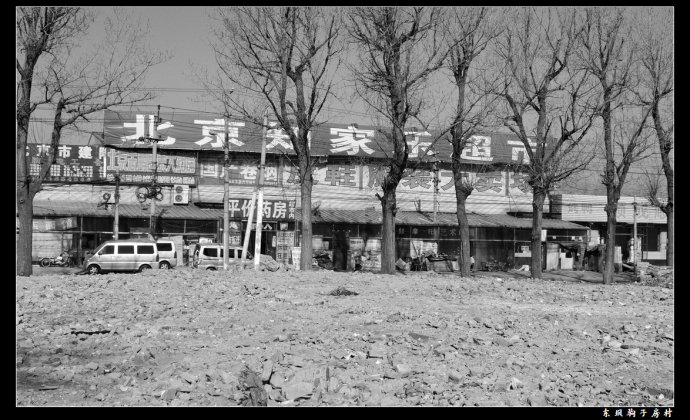


The urban rural unification project. From 2010 to 2020, 450 villages located along the Beijing city periphery have either been demolished or are awaiting demolition, and the inhabitants relocated. This project affects 620,000 registered permanent residents, and 2,800,000 members of the floating population. As Beijing has spread outward in expanding rings, these villages, which had once grown imperial rice, or served as gateways to the capital, lost the dignity of their respective histories and became urban villages, and finally, urban slums, filled with migrant workers seeking cheap rentals. If all goes well, the villagers receive financial compensation for loss of their homesteads, and are resettled in new residential towers, with the promise that they will eventually be reclassified as urban residents. This is a significant change in status, as they will be eligible for social security, and other types of social insurance previously beyond their grasp. The Beijing city project is a microcosm of the national effort to urbanize all rural residents, and to transform China into a predominantly urban nation.
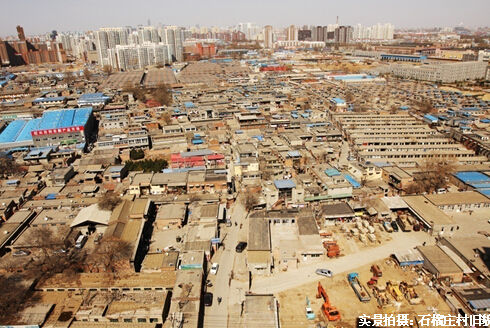
However, in the process the villagers on the periphery of Beijing are displaced, and may undergo a sense of displacement. They are expected to become urban residents, for them a new social role in a new environment, competing for good schools and jobs with those who are already urban residents, who have more know-how and privileges. They have had to give up their homesteads and land, and many feel their future is uncertain.
I covered this project in this blog in entries between May 2012 and December 2013. Out of necessity, I focussed on those villages which had received the most coverage in the media: Beiwu and Dawangjing, as models for the project as a whole, and Tangjialing and Liulangzhuang, which got more attention because the migrant workers crowded into these to villages were college graduates seeking jobs in Beijing’s silicon valley.
Now I will try and document more thoroughly the fate of fifty “listed-up” or “focal point” villages, those classified in the project as needing immediate intervention (that is, demolition and relocation).
挂账重点村 listed up, focal point villages
For a comprehensive introduction to the urban rural unification project, see my translation of this article in Caixin by Gong Jing and Zhang Yanling.
For a look at the national project to urbanize all rural residents:
https://konjaku.wordpress.com/2014/03/12/transforming-a-population-overcoming-half-urbanization-2/
konjaku: a footnote to the previous post, as to why “home furniture manufacturing” is being singled out as one of the “polluting industries” to be expelled from Beijing city.
Beijing to put into effect the strictest standards regulating polluting discharges from home furniture manufacturers 2015-06-10

By 2017, oil and solvent-based paint will be completely expelled the wood furniture processing International
http://news.ifeng.com/a/20150610/43947664_0.shtml
On-line News (reporter Lin Wei): Beijing in the near future will issue new environmental standards, involving industries that use boilers, petroleum, and also home furniture manufacturing. Among these, the new, stricter standards regulating polluting discharges from home furniture manufacturers have drawn the most public attention. The new standard considerably reduces the amount of benzene allowed in wood furniture, and the permitted level of particular matter (PM 2.5) discharges will be fixed. This will not only improve the quality of the atmosphere, but will benefit the consumer as well.
The permitted level will be announced soon. An official in Beijing’s Department of Environmental Protection said it will be the strictest yet. During the wood furniture production process pollutants are discharged into the air : benzene, non-methane hydrocarbons, and particulate matter. The density of these emissions must stay below a certain limit. Also, in the finishing of the wood, spray paint and polishing agents are discharged into air. These uncontrolled emissions must be subject to investigation to determine the consistency of droplets, and a limit established. Beijing Department of Environmental Protection Deputy Chief Zheng Zaihong divulged that the goal behind formulating these new standards is to eventually remove the oil-based paints and solvents from the marketplace entirely. According to the China Industrial Paint Association, application of paint releases 4.3 million tons of volatile organic compounds into the atmosphere every year. Oil-based paints comprise 98% of this total, water-based paint 2%. The superiority of water-based paint in terms of environmental effects is obvious. The goal is to completely replace oil-based paint products in the market with water-based paints. By the first day of 2017, oil-baed coatings and spray paints are to be completely banned.
In the European Union, water-based paints which do not contain formaldehyde, benzene, methylbenzene, and other harmful substances, currently make up more than 90% of the products sold on the market. However, since the technology necessary to make these products is more exacting, the net costs are higher, therefore in the home furnishings industry in China, use of these products is not yet widespread. Deputy Chief Zheng Zaihong divulged that at present furniture manufacturers that use only water-based paints make up only 15% of the market.
konjaku: a number of articles mention the health hazards to consumers from wood furniture that has high levels of formaldehyde, as in this cartoon, in which the salesman says, “zero formaldehyde”: 
konjaku: more on the effort to remove from Beijing those industries and businesses deemed inappropriate for the capital city.
2015-02-07
http://bjwb.bjd.com.cn/html/2015-02/07/content_256148.htm
Yesterday afternoon, this newspaper (reporter Gu Zhongshan) learned that the Beijing industry working conference has decided that starting this year, twelve types of polluting industries, especially casting, forging, and home furniture manufacturing, will face readjustment and removal from our city. Starting this year, annually 300 or more businesses categorized as polluting, focussing on town and village industrial compounds, will be subject to on-the- spot shut downs and withdrawal.
Although figures are not complete, last year the city cancelled or revoked the permits of over 800 businesses considered not appropriate to the capital city, and shut down on the spot 392 manufacturing or polluting industries.
Beijing is making a great effort to find suitable locations for businesses within the Beijing -Tianjin- Hebei sphere. This year our city will construct a biomedical industrial park in Ji county in Tianjin. It is pushing forward quickly with the construction of the 4th Hyundai plant [ in Cangzhou in Hebei] and a Mercedes Benz components and parts factory, A number of high-end, technologically innovative, “star” companies, are this year completing their alignment with the Beijing -Tianjin- Hebei cooperative development nexus. They are transferring their research and development, production and manufacturing arms to Hebei or Tianjin, while keeping their general headquarters concentrated in Beijing. In addition, a large number of businesses and industrial zones are staying in the city, but they are “upgrading.” In 2015, Beijing will transform the structures in 19 open economic industrial zones into environmentally responsible green buildings. and the same for five open economic marketing zones. By 2017 all the open economic zones will be transformed in this way.
town and village industrial compounds 镇村工业大院
konjaku: the article above mentions “focussing on town and village industrial compounds.” To understand better what these are, I translated the following. It appears industrial compounds belong to an earlier form of makeshift industrial development, now to be replaced by new industrial parks.
Shoubaozhuang village has previously appeared in this blog, as one of the villages in Chaoyang district subject to community transformation management:
Photos of Xihongmen town small factories:


Xihongmen moves out industrial compounds in order to restore village land
http://www.bjnews.com.cn/news/2015/02/04/352623.html
2015-02-04
Recently in Xihongmen town, a new industrial park began to take form. In order to push ahead with urban rural transformation, as well as industrial upgrading, Xihongmen town, starting in 2012, began a plan to take five years removing 27 industrial compounds, and dispersing a population of 100,000 members of the floating population.
New Capital News (Xinjingbao) reporter Pu Feng
Geography:Xihongmen town is in southern Beijing between the 4th and 5th ring. Near Tuanhe road, in the past there gradually came into existence a village-level concentration of industrial compounds. The village land there was for the most part given over to industries run by the village collective. Starting in 2012, Xihongmen town began to demolish and remove these industrial compounds, and at the same time began industrial upgrading. The government has made a promise to the villagers, that after upgrading and transformation village collective ownership of the land will not change. The village collective will put up capital, and set up an affiliated company. Villagers will become shareholders, with an amount of shares based on how much they invest. This plan will be promulgated over the villages making up the entire town. The village residents will have a stable and long-term source of profits.
Xihongmen, in the northern most part of Daxing district, is close to central Beijing, therefore, it is a typical example of the “urban rural fringe zone”. During the 80s it developed a village collective economy, and 27 industrial compounds grew up in 27 village hamlets. As times changed, these compounds gradually became antiquated and on the low-end side of the industrial scale. They were places where members of the floating population collected. Accidents caused by safety violations became frequent occurrences.
In the effort to push forward industrial upgrading of the urban rural fringe zone, starting in 2012, Xihongmen made a plan to demolish industrial compounds over the next five years, vacating 9.6 million square acres.Getting rid of the congestion of industrial factories also means reducing the congestion of people. By 2017, the new Daxing Industrial Park will completely supersede the 27 industrial compounds, and make obsolete also the100,000 members of the floating population who worked in them.
At the northeast corner of Nanqiao in Xihongmen town, adjacent to the green zone, is a narrow road, on which two cars can barely pass each other. Large and small trucks criss-cross, kicking up clouds of dust. On the north side of the road there is a small three story building, surrounded and obscured by steam and vapor. Behind it are rows of other small buildings, forming an enclosing wall around the compound. There are 10 or so transport trucks parked in front. Although the local residents have already heard this compound will be demolished,for the time being business continues.
According to a local, the industrial compound is a complete small society. Inside there is a factory, dormitory, a market, even a kindergarden. Most of those inside do not have the relevant qualifications or specialized licenses.
Starting in 2011 or earlier, this Shoubaozhuang industrial compound, occupying 117 acres, had at its peak more than 280 businesses inside, more than half of which were clothing manufacturers. Xihongmen Assistant Town Head Wang Biao said, this sort of village-grade industrial compound gradually over time filled up with migrant workers, doing low-end industrial work, with many unfixed safety hazards. When these industrial compounds were first introduced into the area, land rents were cheap, “the villagers were happy with 3000 to 5000 yuan per 1 mu (1/6th of an acre) ,” renting out to multiple layers of intermediaries for contracted projects. Many non-conforming buildings went up, most of the profits went to the hands of the intermediaries. The villagers’ own profits were small, they nourished plenty of middlemen and land agents [slang: “land-worms”].
What this means is, the model of improving the village economy by renting out the village collective land, was desperately in need of fresh ideas. Shoubaozhuang bore the brunt of this scrutiny, and became the first pilot project. Starting in 2011, the old and shabby industrial compounds of non-conforming buildings, made of brick, tile, and colored tin roofing, were demolished. These have long since disappeared.
Now, in the diagram of the plan to transform plots of land in the urban fringe of Xhongmen town, there is an area designated “Number 3,” referring to a patch of empty land from which the old industrial compounds have been demolished and completely removed. There a Culture and Creative Industry Park is rising quickly from the ground, built by Shanghai Financial Valley.
Wang Biao said, to upgrade, the first step is to demolish the old. He leaked the information to us, that besides 500,000 square meters in parcel 2, there were 2 million square meters in parcel 1 that would become available.
How will the village use the cleared, soon to be vacant land for industry? As Xihongmen town pushes forward with the demolition, they have come up with a new management model to insure profits for the village collectives. Wang Biao said, after demolition of the industrial compounds, the ownership of the land will revert to the village collective. The right of use of the land will be registered with a property management company. The company, Shengshi Hongxian, under the direction of the government, will manage the interests of village shareholders. The government will provide a plan, recommend industries, and give support with infrastructure. After the development has gotten off the ground, the government will turn over management entirely to Shengshi Hongxian.
The property investors will pay rent on the land during the construction process, and once the construction is done, Shengshi Hongxian, following the concept of “switching land for capital,” will retain a fixed amount of property rights and ownership.
Shengshi Hongxian will also be responsible for distributing profits to the villagers, based on the value of the land in each village, and the proportion of shareholders. After the construction is complete, the villagers will have the opportunity to be employed in the new industrial park.
To summarize, the village collective retains ownership of the land, while the management company acquires the usage right of the land. The investors have property rights and title to the buildings that have been built on the land. The rights, interests, and obligations of these parties are clearly stipulated in the contract. This brings about an equitable sharing of the profits, and ensures both that the villagers do not lose land ownership, and that the investors will see profitable returns on their investment.
According to the Xihongmen plan, by 2017 the 27 village industrial compounds will all be demolished. The 9.6 million square meters of land will be divided according to the “20% 80% principle,” with 20% as land for development, and 80% designated for the green zone.
Wang Biao said, before setting this 20-80 percentage, they did some very exact calculations, and determined that, based on previous records, that out of the total of 9.6 million, if 2 million square meters (approximately 500 acres) was set aside for business use, that would generate enough profits to sustain the villagers. On this 20% of land, they will invite different types of industrial parks to be built. Already on the Number 3 plot, two new industrial parks are beginning to take form.
One of these is “Hongkun Jinronggu”(Hongkun Value Town), which will function as a general headquarters for small and medium size businesses, in internet finance, e-commerce, etc. The other is the Starlight Movies and Television Industrial Park which will develop image and sound technology, as well as animation. In addition, negotiations are ongoing with some sixty other businesses.
Hongkun Value Town renderings:
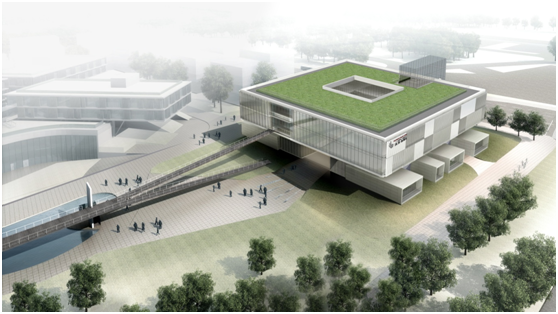


These new industrial parks will completely replace the 27 old industrial compounds, which had within them more than 5000 individual businesses of all types, and 100,000 employees, members of the floating population. Wang said confidentially that this year that construction would start on 200,000 square meters, and it would be finished and ready for use by the 10th month of next year.
As for the 80% of land designated for the green zone, already 12,000 new trees have been planted, and are taking root under a blue sky.
 Translations about social issues: China