The central factor of Beijing Tianjin Hebei cooperative development: an orderly removal of the functions not essential to the capital in Beijing
http://finance.people.com.cn/n/2015/0501/c1004-26935071.html
2015-05-01

Yesterday, General Secretary Xi Jinping presided over a conference of the Central Committee Political Bureau, to begin deliberations on an outline of the Beijing Tianjin Hebei cooperative development, of which transferring the functions and businesses not appropriate to the capital out to the periphery is an extremely important part.
To implement an orderly removal of the functions not essential to the capital in Beijing, it is first necessary to say what the capital functions are. In the 2nd month of last year Xi Jinping, while performing on the spot investigations in Beijing, said it was necessary to reaffirm the capital as the center of national politics, the center of culture, the center of international associations, and the center of science and technology innovation. This would bring to reality a humanities Beijing, a science and technology Beijing, a green eco- Beijing, a first-class international city, and a harmonious place to live.
These four centers are without doubt the essential functions of Beijing. But besides these, Beijing takes on and carries out other functions. If these are not removed, it will be in an impossible situation. As municipal party secretary Guo Jinlong has said, removing the non-essential functions is the only way out. Beijing must take up the task without hesitation, and distribute some of these to Hebei and Tianjin.
But in order to relieve congestion by transferring certain industries out of Beijing, it is first necessary to smash through barriers inherent in the system, in the restrictions which come about because the city administrative districts hold on to their prerogatives. Moving out the non-essential industries and adjusting the scale of industries staying in the capital must be done first, then after that, controlling and restricting the scale of the population. If the government attempts to control the population by simply trying to restrict and expel the floating population through administrative measures, this will damage the healthy development of the city organism.
This reporter has learned that in the draft due to be released by the conference, there is a list of the non-essential industries that are prioritized to be moved out of Beijing: industries in general, especially those with a high energy consumption; service industries, especially goods distribution centers and regional specialized markets; social services, including some educational and medical facilities, and also government administrative offices.
Beijing: to remove non-capital functions requires Beijing Tianjin Hebei cooperative development
http://www.jfdaily.com/caijing/new/201502/t20150211_1237998.html
PRC General Secretary Xi Jinping convened the ninth conference of the finance and economics leadership small group yesterday. The group indicated that relieving congestion by removing the non-capital functions, while pushing forward with Beijing Tianjin Hebei cooperative development, is a huge project of systems engineering.
What are the non-capital functions? Why do they need to be moved out of Beijing? How should one go about doing it? Like a single stone stirring up multitudes of ripples, this has become a hot topic on the internet.
What are the non-capital functions? In order to know, we must clearly differentiate the core capital functions from the non-core functions, and determine their relationship.
Concerning the core functions, Xi Jinping has put forward a clear cut strategy for the city: to be the center of national political affairs, the center of culture, the center of international concourse, and the center of science and technology innovation.
What are the non-capital functions? Head of the China Regional Science Committee Yang Kaizhong divides these into two major types. These are formed by considering along economic lines: the first is the relatively low-end, that of low benefit, low added value, of low influence in the economy. The second type is areas of the public sector which are not in the market.
“In government documents, the concept of Beijing is formulated in many ways: as a world cultural center, as a financial center, as a goods distribution center, etc., there are more than 20 such formulations.” Beijing has all the high level financial policy organizations: the Central Bank, the China Banking Regulatory Commission, the China Securities Regulatory Commission, the China Insurance Regulatory Commission, and the Center for Settling Accounts of Funds. Of all major colleges and universities in the country, 70% have a research center in Beijing. One third of the national focal point laboratories and engineering research centers are in Beijing. More than half of the members of the Chinese Academy of Sciences are in Beijing. Inside Beijing’s second ring there are several hundred administrative organs and state-run institutions. The functions of a number of these administrative and social service systems are not directly related to the capital. Last year, 230 million people came from elsewhere to the capital seeking medical treatment.
Why relocate the non-capital functions?
Beijing is the largest city in China by area. At the end of 2014, the population reached 21.5 million. The city is crowded. Basic resources are in short supply, environmental capacity has reached a ceiling. The “especially large city urban disease” is increasingly prominent. That there are too many functions is at the root of the problem.
Over a number of years, why have people done their utmost to push their way into the already crowded Beijing? The answer is that there are the best educational resources, the highest standard of medical care, and a huge concentration of power and authority. Netizens say that even if they build1000 more first class hospitals, quadruple subway routes and roads, spread out the city to the tenth or twentieth ring, it will be unable to solve the problem. There will still be haze in the atmosphere, traffic will be steadily worse, and the population will keep climbing, before long at 50 or 100 million.
How should one go about relocating the non-capital functions?
In 2014, the largest clothing wholesale collecting and distributing center in northern China, the Beijing zoo area clothing wholesale markets, are in the process of relocation. The 10,000 merchants who have gathered here over 30 years, and paid tens of millions in taxes, are formally taking their leave of the capital. Behind this move, is a vision for the transformation of Beijing.
Last year, Beijing took the initiative in issuing a list of 147 industries that are either forbidden or limited. It has shut down or evacuated 392 individual polluting industries, and is pushing forward with 53 more. It has torn down 36 large markets in the center city. At the same time it has made an effort to shift to a so-called “high-grade, precision-based, and advanced” economic structure, deepening the reforms first tested out at Zhongguancun (Beijing’s silicon valley).
Moving out industries to relieve congestion is not a simple matter. If one examines carefully, one can end up with a list of one thousand separate businesses that need to be moved out of the city. To form a complete set, each district must sufficiently cooperate. Beijing city, to prepare properly, has to check each district’s assessments and methods, and for each itemize how many people and businesses are to be moved. When the industries and businesses are moved, the full component of people must move with them. But to only transfer out industries is not at all adequate, that is alleviating the symptoms, not a cure. Government offices, state-run institutions, scientific research facilities, colleges and universities, even the offices of the armed forces must also relocate to the periphery. Only then will Beijing’s urban disease undergo a thorough cure.
The detailed list of functions and industries to be relocated is in the process of being drawn up. These include “one batch of manufacturing industries” “one batch of wholesale markets in the city center,” “one batch of educational facilities” etc. It states no more large hospitals will be built in the center city.
At the close of this year’s People’s Congress at the end of January, the Consultative Conference determined that Beijing would close 300 businesses in 2015 considered to be polluting (such as home furniture manufacturers), and to accelerate construction of the Tongzhou supplementary city center. The plan is to invest 1.03 billion yuan to relocating industries and dispersing the population. There is a fund of 45.24 billion to speed up innovation and development in key technologies: new energy resources, new materials, biomedicine, also to stimulate new ideas in information technology and traffic systems.
Giving up or renouncing certain things and acquiring others, is the guiding spirit of the joint Congress on these matters. Orienting the new southern airport toward Hebei, for instance. The Beijing mayor: “if there is a polluting business that does not relocate, we’ll pull the plug on it.” And, “Businesses that relocate will generate tax revenues. Beijing does not intend to keep all those revenues for itself.”
Five methods to redistribute industry
“Prohibit” “Shut down” “Control” “Transfer” “Adjust.”
Prohibit: to prohibit building new factories, or expanding existing factories, of industries on the forbidden list, especially those that fall in the category of manufacturing industry.
Shut down: to immediately shut down any factory that generates a high level of pollution, or that has a high energy consumption, or a high water consumption. Overall to take administrative action over the industry compounds in towns and villages, to accelerate cleaning up small-scale, messy factories.
Control: this is directed toward the disposal of waste materials, including refined oils and food processing wastes, to safeguard the city environment and peoples’ daily lives.
Transfer: those industries which do not correspond to the capital city –manufacturing industries which rely on natural resources and are labor intensive — are to be transferred out of the city
Adjust: among high end industries, those which do not have a comparatively advanced and superior manufacturing arm, will implement adjustments.This will take place in terms of the Beijing-Tianjin-Hebei ongoing coordination of the rearrangement of the distribution of industries across the entire area.
Beijing city has made a plan, to invest 10 billion yuan in 2014-2018, an investment fund for Beijing-Tianjin-Hebei cooperative development.
非首都功能 non-capital functions
高精尖 high-grade, precision-based, and advanced
konjaku:
In attempting to constrain or reduce the population of Beijing, there have been measures aimed at getting portions of the floating population to return to their native places. By closing off school admissions to families without a Beijing household registry, at least the mothers and children have to leave. In practical terms, it is mothers and children who use more of the city social services than the father. The father, remaining in the city, contributes his productivity (although of course mothers are usually employed too), while the rest of the family, considered a drain on city services, depart.
However, “hard” policies like these cause social tension. The problem is rethought: instead of targeting the floating population, move whole industries, those at the “low-end” of the economy, and all the people associated with them, out to the periphery. In addition, move some social services out as well. The organic fabric of the city will not be rent apart, but will be lifted whole and intact, to a new location.
In the vision of Beijing after all this relocation, it will still be “the center of scientific and technological innovation.” Of course, those on the periphery also want to build high-tech industrial parks and research centers. Yongqing officials, while welcoming the construction of an International Clothing City to absorb the wholesalers displaced from Beijing, would actually rather have a high-tech center of their own. How many high tech research centers can there be, gleaming in the sun by day and sparkling with lights at night? As many as it is possible to imagine, it seems.
Beijing “Dongpi”–Goodbye!
http://news.cqnews.net/html/2015-05/15/content_34232929.htm
2015-05-15
[Dongpi 动批, nickname for the Beijing zoo area clothing wholesale markets]
Xinhua net 2015- 05-15 reporter Zhang Shuqi
“There’s nothing we can do –we just have to shed one layer of skin.” Thinking back on the events of the last four months, Li Ming still had lingering anxieties.
Around the New Year period for about one month, Li Ming, who was a tenant with a stall in the Tianhaocheng clothing wholesale market, rushed around to around 20 retail and wholesale markets in Tianjin, Hebei, Shandong, etc., both large and small.He had an inventory of stock valued at about 30,000 yuan, which he sold off at cheap prices. But his business was not finished. He still had to negotiate with the Tianhaocheng market the return of ten years of rent which he had advanced, and to talk to his landlord about when he could terminate the rental agreement where he lived.
In the Tianhaocheng clothing market, there are 1300 tenants in the same fix as Li Ming.
The clothing wholesale markets took form in the mid- 80s. There were 13,000 stalls, over 30,000 employees, and 100,000 customers daily. If Beijing city was going to relieve congestion, it was obvious that these markets in the city center would have to go. Last year Beijing demolished or shut down, upgraded or transformed, 217 markets. The emptied out area totalled 2,188,000 square meters.
If the move was irreversible, what would happen to all those people employed in the markets? For those who had already moved out, and for those who were hunkered down and staying where they were for the time being, what did the future hold?
Li Ming came from Shandong, He was one of the more successful players in Tianhaocheng market, with ten or more stalls. Business was good, every month he paid his employees more than 10,000 yuan. Now, because Tianhaocheng market would not renew his contract, he had to find a way out.
Not long ago, a group associated with a market in Xiqing district Tianjin city chartered a large bus, and invited the Beijing zoo area tenants to come investigate their market. When Li Ming got on the bus, he was surprised to find almost all the seats taken, and the majority were familiar faces.
They went to Tianjin. Since the market was not fully constructed, they stood around a scale model of it listening to the management introduce its features. A staff member spoke of Tianjin’s residential possibilities, tax policy, the aid available for school admittance for their children. But since the market was not yet built, the tenants decided to wait and see.

After returning from Tianjin, Li Ming and several of his fellow wholesalers went together to Langfang, Baogou, and other localities in Hebei, but were not very satisfied with any of them. “These markets in Tianjin and Hebei, I figure it will take them three years before they really get going,” said Li Ming.
After going over the possibilities many times, Li Ming decided to stake his fortune on Yongqing. “The new market going up there has favorable policies which are appealing. It is not well known yet, but I want to get in on it from the beginning.”
Nowadays Li Ming has already opened his store in the new market. Customers on the city periphery are scattered, but gradually accumulating. “It is a bit like Dongpi when it first started out.”
As the Tianbaocheng market closes, the phrase that lingers in one’s ears is, “I had to sell for a loss.”
41 year old Mr. Deng is an outstanding tenant at Tianbaocheng. Last year his business did so well, his name was posted on the honor roll in the Tianbaocheng main hall. However, since the news spread of the marker moving out, Mr Deng has continuously posted deficits. “Shoes worth over 100 yuan, sold at 40. Several hundred pairs of shoes, for a loss of over 20,000 yuan.” Even though things are like this, he continues to energetically call out to passersby. Selling these shoes for some amount is better than storing them away, which won’t earn him even a penny.
Originally Mr Deng’s wife also worked at their stall, but since business was off, his wife and child had to get temporary jobs elsewhere to supplement the family income. When he came to Beijing several decades ago, his family of three squeezed into a small one story house outside the fourth ring, with a rent of 500 yuan a month. He was living in an urban village not too far from the zoo area. Many of his neighbors were tenants at the same Tianbaocheng market.
Now, since Mr Deng was not able to sell off all his stock, even at reduced prices, he and his wife decided to temporarily continue rent a stall in a part of Dongpi in which the relocation plan has not yet been put into effect. However the location of the new stall is not good, and business is sluggish.
Although the Tianbaocheng signs have come down, there are other markets in the Beijing zoo area in which the managers have heard they are supposed to relocate, but they have not yet gotten any precise information.
In the Dongding wholesale clothing market, there are a number of larger stalls in which the yearly rent is as high as 300,000 to 1,000,000 yuan. Even so, in the seven floors of the building, there is not one vacant stall. The news of relocation is not effecting business in the slightest. Many of the tenants believe that relocation, in the short term, will be difficult to implement.

Dongding market
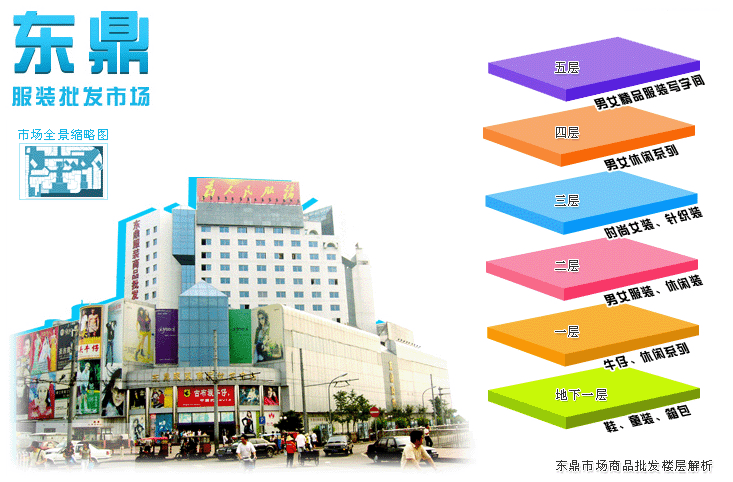
The 7 floors of Dongding market
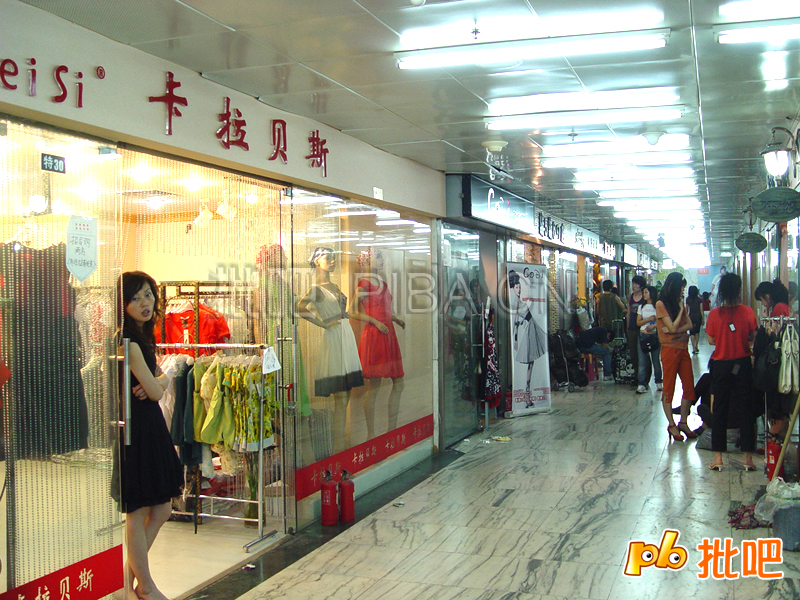
Dongding interior
“Move? Two years after they said move, and nothing has happened, do you believe it or not?” Mr Zhang, who had managed a stall for more than ten years, was doubtful. “In Dongpi there are 10,000 tenants or more, and many of them have contracts that are for a good many more years, how is it possible that they will simply have to leave? And if tenants move, they definitely need to receive compensation and help in resettling, this will require a large fund of money and time, at least three to five years.”
Mr Zhang pointed out something else. Because of all the media stories about the markets having to relocate, the flow of people to the area has recently increased. Many are young people who buy a few things and take souvenir photos, “because they have heard the markets are disappearing, ha-ha!” Mr Zhang figures that, for the near future, he will be able to get a little extra income from these ‘Memories of Dongpi tours.’
However overall, traffic to the area is steadily declining. A Mrs Cui, who sells sticks of candied fruit (tanghulu) at the number 4 line subway thoroughfare, says she used to sell 150 sticks a day or more, but is now down to about 50.
Opposite the markets, there is a line of small restaurants selling breakfast crepes (jianbing), Sichuan style noodles, and braised skewered snacks (malatang). Although these places are small, there is a steady stream of customers, and at mealtimes there are long lines. These restaurants feed and support the workers and merchants going in and out of Dongpi. If the markets move, what will they do? On the other hand, it may be appropriate for some of this prosperity to be shifted out to the periphery.
But when asked, the managers of these small restaurants are not worried about the relocation of the markets. “Even if the wholesalers all vacate and these become office buildings instead, there will still be people inside who need to eat a meal.”
Mrs Cui has a small market, less than 3 square meters. She stocks water, crackers, instant noodles, and feminine products. “One months rent is 6000 yuan, and I have already paid till the end of the year. Peoples’ anxiety is going up. If the market really does relocate, my business will suffer.”
According to an informal count, there are 20 or more goods transporting business around the market area. Every day they transport or ship a million yuan worth of clothes to areas all over the country. 56 year old Mr Huang comes from Zhangjiakou (city in Hebei), and has been at Dongpi for 30 years. Every day he goes busily back and forth in the market, collecting goods from various stalls, and taking them to a shipping and delivery center. Mr Huang says there are 400 stalls he works for. For hauling a load of goods, he makes 10 yuan, each day he earns 300 yuan or more. When he has nothing to haul, he sits with some fellow workers, chatting, smoking, and reading the newspaper.
Aside from delivering goods, there are those who transport people as well. Parked outside the Dongpi markets are a number of black [unregistered, illegal] taxis. Every day the drivers call our for customers, to ferry people back and forth between Dongpi and Dahongmen [the other large clothing wholesale market].
It is reported that last year stalls in Dongpi dccreased by 1300, 10% of the total. This year it is predicted they will again decrease by 1300.
Altogether about 100,000 people work in Dongpi. It is like a huge, immense tree with many branches and leaves. In the near future, when this tree has to move out, will all those branches and leaves be able to grow and develop elsewhere?
Beijing zoo area wholesale markets vacate 200,000 square meters within the year –accelerate the move to the periphery
2015-05-06
http://finance.sina.com.cn/china/dfjj/20150506/133522117912.shtml

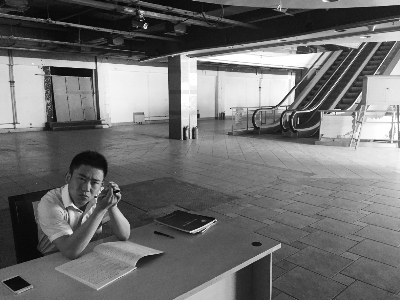
According to the Legal Evening News (reporter Zhao Chao) the wholesale markets continue to vacate and move out to the periphery, paving the way for future improvements in the district. Municipal party secretary Guo Jinlong said, within the last several months, 350 tenants had all vacated.This Evening News reporter went to investigate the Tianhaocheng wholesale market, and found the billboards on the outside of the building have all been taken down, and on every floor, there is no trace of the former tenants. Even the public transportation signs that were on posts have been torn off.
The billboards, of all different shapes and sizes, had given a disorderly and unsystematic impression. Now it looked like a regular office building. If a person happened to come there, he would not know what was inside the building. A former tenant said, “the billboards are down, and the throngs of people are no longer here.”
A Xicheng district city management official on the enforcement team in charge of signs and displays said that in the result of an investigation while the wholesale market was still operating, they found there were 160 advertising signs. Many were put up without going through the permission process, and were installed illegally. Not only did they have a negative effect on the appearance of the city, but they represented a hidden danger [poor installation, heavy signs might fall]. In the space of one month, all the signs and boards affixed to the building wall were taken down. This has caused all the surrounding environment to be much improved.
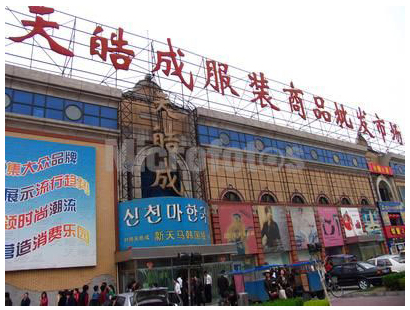
Tianhaocheng,before the signs were removed
As a relieving of congestion and restructuring of industrial function, not only the outside of the building, but the inside is also being improved and upgraded.
Behind the several large markets in the Beijing zoo area, there is one small road. Because it is next to the markets, it is a “service area” for them. There are small stores and many small restaurants, which the people from the markets patronize, and a goods distribution center. In the past there were always many small vans parked, facing outward into the street, making it crowded and squeezed. In the same neighborhood there is a school, and the effect of this commotion does not have a good effect on the school or nearby residents.
This reporter has found out that in the Wenxing neighborhood, they are carrying out a clearing out and ordering of the environment. The lease agreements of the small stores are coming due, and these one after another will move away. Before long it will go back to being a quiet, residential neighborhood.
konjaku: Langfang is the prefectural-level city with jurisdiction over Yongqing. A resident of Langfang apparently does not expect to see an improvement in their own quality of life from large construction projects like the Taiwan Industrial New City. The resident is hoping rather for “medical facilities, sanitation, education and cultural resources.”
I have been translating 睡城 (shuicheng) as “bed-town” which is actually a Japanese word referring to towns outside Tokyo. such as Hachoji. Every day many commuters from Hachioji take trains into central Tokyo to their jobs. However, residents of Hachioji do not lack facilities and infrastructure. In China, shuicheng, literally “sleep-city,” does refer to a town in which people can sleep, but not live. In the following article, the Langfang resident Zhao Rong’s son has to go to high school in Tianjin.
This article supports the contention of Zheng Xinye (https://konjaku.wordpress.com/2015/02/25/beijing-drive-out-the-low-end-population/) that central Beijing is full of people, that is to say, congested, because people who live in outlying areas end up going into Beijing for basic services, such as seeing a doctor.
http://finance.sina.com.cn/china/dfjj/20140408/075218730981.shtml
Photo: Hebei province Langfang City, Yongqing county at a small garden at an intersection next to the “Taiwan Industrial New City,”and the “International Clothing City,” project, an old man sits and rests.

“ As far as I am concerned, Langfang is nothing but a bed-town,” Zhao Rong, a financial manager, has lived in Langfang for some ten years. Almost every day he drives in to Beijing for work, and returns here to sleep.
During those ten years, the “Beijing-Tianjin-Hebei unification” idea has come and gone several times, under different names. Having gone through this before, the residents of Langfang, a town midway between Beijing and Tianjin, are only cautiously optimistic about the latest “unification.” Previous efforts have only made the cities more prosperous, and done nothing for the surrounding countryside.
As for benefits Zhao Rong would like to see from the current unification plan, the first is improvements in the traffic system. He takes the Jinghu (Beijing-Shanghai) freeway to go to work. If that is crowded, he has no alternate route. More traffic facilities will also encourage people to live outside Beijing.
But Zhao Rong wants much more than that. His job is in Beijing, but his registered permanent residence is in Langfang. His child goes to high school in Tianjin, his wife has a job in Langfang. At present they are like a family living apart. Therefore Zhao Rong places his hopes in the future. “After ‘unification,’ will we be able to enjoy all the benefits Beijing residents receive? Will my child be able to move on to the next level of education without any obstacles thrown in the way?” To put that in plainer language: does unification mean the college entrance exam system will also be unified?
Zhao Rong worries that if public services do not improve in Langfang, unification will simply result in more people crowded into Beijing city. He can’t remember the last time he went to a clinic to see a doctor in Langfang. For one thing, options for medical treatment in Langfang are limited, but besides that, it has become customary for everyone to think, “going in to Beijing is somehow better.”
Zhao Rong hopes that medical facilities, sanitation, education and cultural resources will become more equally distributed. “If some of these things are divided among Langfang and other cities on the Beijing periphery, then people will naturally follow after and settle where they can make use of them.”
During the previous “unification” attempts over the previous ten years, such as creating the ”Bohai sea economic zone” or the “Capital ring economic zone,” Zhao Rong has observed the same phenomenon: in a ring around the periphery of Beijing, house prices suddenly rose. Just as on previous similar circumstances, even though the government has not yet definitely set down what it is going to do, Langfang house prices are starting to rise sharply
On 03-31, at Langfang Kongque [Peacock] City, everywhere cars with license plates from Beijing and Tianjin are parked. Sitting on a spacious sofa in the sales building, Wang Yu’s face looked very tired. Since 03-09, when several buildings in the development were opened for sale, she has not had a day off. Every day she is at work until 8 or nine in the evening dealing with customers, all from Beijing. “The price of these buildings is 8 to 10,000 yuan per square meter. Last week a customer came from Beijing and bought 52 two-story small size units.”
“Thy have a lot of 38 squares, and those will be good to rent once we buy them” said a middle-aged woman with a Beijing accent over the phone, standing in the display area. Shortly afterward she went to inquire with the salesperson, and before an hour had passed she had bought three 38 square meter units. She said she was buying them as an investment.
Wang Yu said, the next time a new building is offered, she estimates it will be 300 to 500 yuan more expensive (per square meter). Searching for house prices on the net, at the beginning of 2013 in Langfang prices averaged at 6699 yuan per square meter, but now were at 7277 yuan, a rise of 578 yuan.
All over Gu’an County, which is under the jurisdiction of Langfang (a prefectural-level city), there are signs announcing the “Beijing New Airport, “ real estate company ads saying ”Grab the low-lying land before the airplanes start flying.” For new residential developments in Gu’an county, prices are rising faster than in those in Langfang city, as much as 1000 to 2000 yuan per square meter.
A Langfang city official said all this is just movement of the markets, nothing about it to criticize. But Zhao Rong, with his experience in the financial sector, thinks all this real estate speculation is not a good thing. Langfang is already a bedtown, but if during the unification process it is somehow set off to greater advantage in regards to Beijing and Tianjin, many of those employed in those cities may desire to come and buy homes in Langfang, then what will happen? One Langfang official said, “We don’t want to turn into another Yanjiao, a mere prop for Beijing.”
———–
The Beijing Number 2 Airport, called the “Beijing New Airport,” is at the southern edge of Beijing, at the intersection of Daxing district and Langfang in Hebei. It will be an international large scale airport. Construction started in 2014, and it is estimated it will be ready for use in 2018. The new airport has had a large effect on house prices in the vicinity. In Gu’an County various real estate companies have decided their best slogans are “Grab up the low-lying land of the New Airport city,” and ”Get in on the value of airport district land!” Since the project began, real estate prices in Gu’an have steadily risen.
http://mall.fang.com/mall/201404/sddejc.html
konjaku: continuing to follow what is going to happen to the displaced Beijing wholesalers. They must find a place among large-scale plans for economic development zones on the city periphery. In the planning stage, the nod seems to go to those conceived on the most massive scale…Yongqing is again a strong contender, but the story is not over yet. All these Trade Cities, High Tech Industrial Parks, etc, have yet to be constructed.
Yongqing manufacturing and commerce at the same time show strength–a plan to merge with the Yizhuang Economic Zone puts the project back on the front burner
2015-01-14
http://finance.chinanews.com/house/2015/01-14/6966789.shtml
International Clothing New City rises suddenly from the ground
In the last year or so, in the wake of the Beijing Tianjin unification strategy, Yongqing, once a sleepy county town, has risen to national prominence, because of the development of Taiwan Industrial New City and the International Clothing New City.
Compared to half a year ago, the International Clothing New City, now again under construction, is buzzing with excitement. The interior of a high building on the east side is being fixed up, a steady stream of vehicles is bringing in materials. On the west side, a factory and office building are taking form. At each construction site there is a sign designating which company is in charge of construction, the total area of the project, a schematic diagram of the construction plan, etc. –all clearly marked.
Actually, it was four years ago that ground was broken for the construction of the International Clothing New City, and ten years ago that Yongqing got Taiwanese merchants to start development of the Taiwan Industrial New City. But at that time the national policy was not clearly formulated, and it was difficult for the Taiwanese industry to attract investment. Construction was broken off. The Taiwanese merchants withdrew, and the Zhejiang merchants stepped in. The site name changed to Zhejiang Merchants Clothing New City, but from force of habit people still called it the Taiwan Industrial New City.
Once the Beijing Tianjin unification plan was solidified, increasingly the clothing industry focussed on moving the clothing factories and markets clustered in the second and third ring [in the center of Beijing]to somewhere outside the city. Although Yongqing seemed the superior choice, both for its location and because construction had already started, Baigou [in Hebei, also in between Beijing and Tianjin] and Xiqing[near Tianjin] were also candidates, making the choice still up in the air.
Just when these satellite towns seemed all the same, in their capacity to absorb the excess production of Beijing, Yongqing laid out its trump card. It would join up with the Beijing Economic and Technology Development Zone [also called the Yizhuang Development Zone], and would form the “Beijing Yizhuang Technology Park,” or “New Yizuang.” The New Yizhuang would be a fusion of industry and commerce, drawing from both for its effect, as a model of Beijing Tianjin unification. The Clothing City to the north, the Yizhuang zone to the south, will side by side develop a new industrial park, including high tech industries and medical research.
Available land for all this development was limited. In the end, the Clothing City will have to split into sections. One insider said, the manufacturing and wholesale segments will stay at their original locations, but the more high end trade and selling outlets will be at another site to the north.
However, it is premature to say that this “two city” [Yizhuang and Yongqing] development will actually be realized. Can the International Clothing City be built on such a massive scale? Can the New Yizhuang really be as immense as current projections make it? If this development is going to be the model project for Beijing Tianjin unification, first there has to be a top-level plan, that will make us nod in assent.
For this project to actually come about, the major obstacle to overcome is the lack of land available to meet the target. At present there is some 700 mu (117 acres) designated for the International Clothing City, but this is to be used for garment factories. The plan to move the clothing wholesale markets out of Beijing has just been completed, but which land parcel will be used is still up in the air. Therefore Yongqing has requested from the province and nation 2215 mu of agricultural land, to make up the balance. Since next year they will need more invested capital, manpower, and material resources for the construction, this application for land will be the start of a policy tilt in favor of their development.
“Right now we are just waiting for the national plan to come out, hoping this will solve our land problem,” a Yongqing developer said.
Beijing business news reporters: Li Duo, Chen Tingting
konjaku: The following article moves us up the present (2015-04). No mention of Yongqing.
Beijing zoo area wholesale market businesses urgently need a new place to move to — looking in Shijiazhuang [capital of Hebei]
2015-04-23
http://finance.people.com.cn/n/2015/0423/c1004-26889762.html
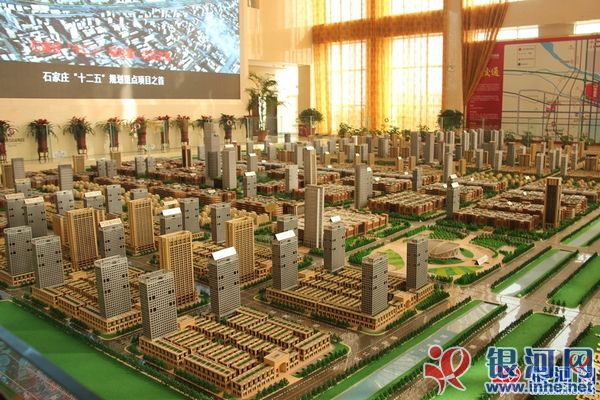
As the work of moving the Beijing zoo area, and Dahongmen wholesale markets begins in earnest, the number of people coming to take a look at the Shijiazhuang THE CITY International Trade City continues to climb [file photo, above]
“This year the Beijing City government has announced it intends to get rid of the congestion stemming from the wholesale markets. This is a promise of the city government to the citizens. It is about to be accomplished, there isn’t any choice in the matter.” This was the response of the municipal party secretary and mayor Wang Anshun to any points of controversy, pushing forward against any opposition.
Since the announcement was made at the beginning of the year, the wholesale business have been in a ferment, searching for the ideal spot to move to on the Beijing periphery. Shijiazhuang, Langfang, and Baigou have advertised themselves as having the capacity to handle this large shift of businesses. Where will the shrewd operators end up?
The display and sales center for the Shijiazhuang THE CITY International Trade Center has been full of people every day during April. A woman said, she and her friend managed a business in the Tianyi market for many years. Before coming here, they had been to Baigou, Yongqing, etc. After analyzing the business possibilities, the convenience for daily life, and the traffic conditions, they had decided on Shijiazhuang. “We have already purchased four adjoined units in the market, and made a reservation at an extended stay hotel nearby. In the future the Beijing zoo area and Dahongmen wholesale markets will move here, and this will mean more people will also come here to live. Therefore buying a residence here would also be a good investment.”
“Beijing is in the process of shedding industries not essential to the functioning of the capital, to decrease congestion. Shijiazhuang is in the process of restructuring its economy and upgrading its industries. Integrating this effort with the Beijing Tianjin Hebei unification,will be a very promising project,” said market development committee general secretary Xu Pengfei.
A Beijing Xicheng District official said, “Shijiazhuang is Hebei’s provincial capital, ideally located between Beijing and Tianjin, it has a substantial population, healthy patterns of consumption, circulation of goods, traffic, schools, medical facilities: in many aspects an abundance of resources. In the future the Shijiazhuang economy wil grow, it will be advantageous for our merchants to move there now.”
Shijiazhuang THE CITY International Trade Center is being built by a Zhejiang merchant bloc, which has invested 80 billion yuan. It will include research and development, business and trade, warehouses and goods distribution, e-commerce, and manufacturing, all integrated together. The first thing to be built in the Trade Center will be a 3 million square meter business complex in the form of a shopping mall. Each building will have rooftop parking and a pedestrian plaza.

“Whoever comes here will be treated as a special guest, we will welcome you with favorable policies and optimal facilities, both hard and soft[ware]. We sincerely invite the Beijing zoo area clothing wholesalers, and the Dahongmen wholesalers, and every other business under heaven, to let our THE CITY create a comfortable spot for you,” said an International Trade Center representative.
New Beijing Daily reporter: Fang Wangyang

the site in its current state

konjaku: this is one model for social and economic development: a familiar but strained, deteriorating institution (in this case, the clothing wholesale markets in central Beijing) is ordered shut down, and those associated with this institution are supposed to move to a new, spacious, modern site outside the city. Given that the wholesale markets are viewed as magnets attracting the “low-end population” to live and work in those districts in which the markets have grown up, moving these markets to new facilities on the periphery is perhaps also supposed to transform the target population out of their “low-endedness,” although this is unsaid. In the spacious, shining, modern, rational model of an “International Clothing City,” in which all the processes of manufacturing and selling are brought together, those who were previously thought “inappropriate” for the capital, will find their true place and function. For the time being, the small wholesalers are being rapidly removed from locations in the center of Beijing, but where they are going seems to be still up in the air. The first article here suggests it will be Yongqing. The second article gives another perspective.
Note: there are two major clothing wholesale complexes in Beijing, Dahongmen, which is to the south of the city center, and the Beijing zoo area clothing wholesale market.
Dahongmen:
http://english.visitbeijing.com.cn/shopping/markets/n214860924.shtml
Beijing zoo:
http://www.meiguoxing.com/Shopping/Beijing_Zoo_Clothing_Market.html
Hebei Yonging grabs the Beijing-Tianjin-Hebei clothing market group –will construct a composite satellite town
2014-05-19 http://finance.sina.com.cn/china/dfjj/20140519/010919145268.shtml
The relocation of the Beijing wholesale markets has become a hot issue this year. As many markets and associated businesses have taken a wait and see attitude,the two Dahongmen markets, and six other major markets last Friday signed a contract with the Yongqing International Clothing City. In the future Yongqing International Clothing City is planning to attract clothing businesses both from the Bejing-Tianjin-Hebei region, as well as from the Yangtze River triangle and the Pearl River triangle, to forge a clothing industry center. These eight markets altogether posses more than 9000 businesses, with 35,000 employees. The terms of the deal are still being negotiated.
“Every single one of our businesses are moving to Yongqing, Dahongmen textile market board chair Wang Jilei said. These businesses are very willing to move to Yongqing, because a collection of Daxing clothing manufacturers have already moved to Yongjing, therefore the wholesalers will be closer to their supply chain. As for the Dahongmen original location, Wang Jilei said they had been renting there. After they move to Yongqing they will get property rights, and they will also be able to buy and own other stores within the market. “We will not only have our original business, but we will also have a new investment channels.”
A reporter at this newspaper has learned that many other Dahongmen wholesale markets are planning to move to Yongqing, and a number of them have already signed contracts. The Beijing wholesale markets in Xicheng and Fengtai, previously looked at Langfang and Baoding in Hebei, and Wuqing near Tianjin. Why did these eight large markets decide to move to Yongqing? The first factor is that it is relatively close to Beijing. Its location is an important nodule in Beijing Tianjin unification, being 48 kilometers from Beijing, 60 kilometers from Tianjin, 80 kilometers from the Beijing capital airport, 110 kilometers from the Tianjin new harbor, 17 kilometers from the Second Capital Airport. Especially once this new airport opens, Yonqing International Clothing City will take a big step forward in internationalizing its business.
The Yongqing International Clothing City is located in the Hebei Yongqing Taiwan New Industrial City, occupying 5000 acres. The clothing industry is its first focus, but there is also e-commerce, freight delivery and shipping, banking and tourism, and other service industries under development. When the building project is completed it will be a next-generation new satellite town for Beijing, the largest business assemblage in China. Building of the Hebei Yongqing Taiwan New Industrial City began in 2006, but since then the Taiwanese merchants has disinvested, at present the Zhejiang merchant consortium has taken over. In the future the name will be changed to either Yongqing International Clothing City or Yongqing New Economic Zone.
The following photo sequence documents the wholesalers in the process of moving out of their old quarters, along with photos of construction in the Yongqing Taiwan New Industrial City, dated 2014-04-03.
http://www.llzg.cn/forum/topic-72930.html 


location of Yongqing

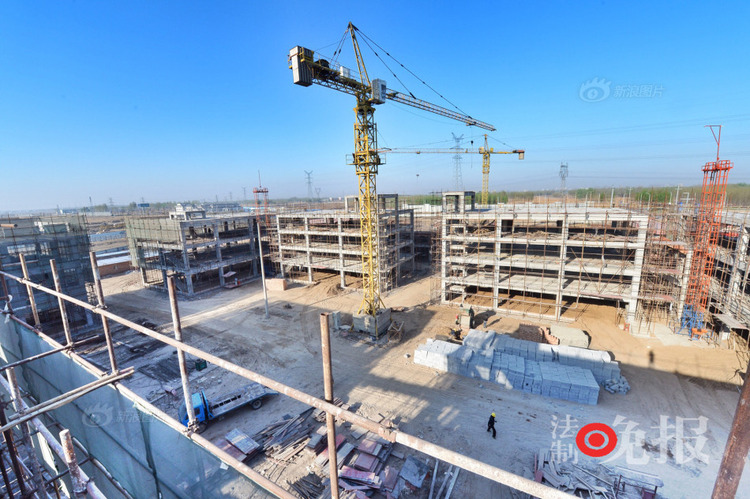


rendering of the completed International Clothing City
Beijing Zoo Area Wholesale Markets will settle down where? In Yongqing, the Quota of Land Needed is still in Suspense, Undecided
2014-07-01 http://www.nbd.com.cn/articles/2014-07-01/845226.html
Source Daily Economic News (Meiri Jingji Xinwen) Reporter: Zhang Wen, dispatch from Langfang
Originally within the industry many firmly believed that the wholesale markets around the Beijing zoo would settle down south of Beijing in Yongqing. However, the suspense of where markets will actually end up has once again arisen. As reported, the Dahongmen markets are planning to move to Yongqing, but now the land required for the new construction has not yet been acquired. On 06-25, a staff member at the Yongqing Taiwan Industrial New City who was reluctant to give his name, leaked to the Daily Economic News that they had only acquired some 700 mu of land which was designated to be a garment factory in the Yongqing International Clothing City. The land for the Dahongmen and other wholesale clothing markets is still in the planning phase, not yet resolved. From 2010-09 up to now, they have acquired 400 mu, and in the first half of this year Hebei and Langfang together designated another 350 mu. They still need an additional 2000 mu. (A mu is one sixth of an acre). The same staff member said, “Right now we are waiting for the national plan to appear, hoping that will solve the problem.”At the same time, this reporter has learned that Beijing city intends to tighten its management controls, not only on the large clothing wholesale markets like Dahongmen, but also on the small scale clothing, shoes, hat, and sundries “morning markets” that set up on the street.
Yongqing’s dilemma
Yongqing (“forever clear”) got its name in the Tang dynasty, during the Chaotian reign period (742-756). It meant, “the desert that is always clear.” It is directly south of Beijing, on an axis 60 kilometers from Beijing, and the same distance from Tianjing. It is under the administration of Langfang, a prefectural-level city in Hebei. If one takes the 828 road bus from the Yongdingmen long distance bus stop, after 29 stops one can get off in front of the Yongqing government building, but as for going back to Beijing, the last bus leaves at 5 in the afternoon. In its long history, the speciality in Yongqing has been agriculture. It is a latecomer to other forms of economic development. In terms of the total sum of economic activity, Yongqing ranks at the bottom in the Langfang administrative district. In 2013, total income was only 920 million yuan; among the 380,000 permanent residents, 340,000 are farmers. Being close to Beijing and Tianjin has not helped to quicken the pace of Yongqing’s economic development over the last couple of decades. On the contrary, it has accelerated the erosion, as young people and businesses moved away.On Cailiu Road. Yongqing’s main shopping street, the owner of a home appliance store said, “the goods we sell come from Guangzhou. But they first go through Bazhou or Langfang, only then do they reach Yongqing. This reporter did an internet search for ”Yongqing distribution company,” and only one company came up, besides three based in Langfang.
However, starting in 2009, the Yongqing government has been very effective in attracting investment and new businesses. [details omitted]. Zhejiang business associations, which have played a leading role in the Beijing wholesale clothing markets, have been behind the effort to bring these markets to the Yongqing International Clothing City (previously called Zhejiang Commerce New City), located inside the Yongqing County Taiwan Industrial New City. According to a government website, more than 670 clothing manufacturers have signed contracts to move to Yongqing. An Industrial New City staff member said the plan is to have businesses representing all stages of the clothing business, including manufacturing and processing, to move to Yongqing. This supply chain, including the clothing wholesale markets, will be a major artery for the Chinese clothing industry to become international in scope. There are also plans to build a high-tech industrial park in Yongqing [details omitted].
A staff insider told this reporter, “We hope to find a profitable equilibrium developing both the clothing industry and the high-tech project. In the end we must see which has the best prospects. To deal with the problem of finding the target quota of land, we either have to focus on one over the other, or somehow increase and decrease proportions to balance them out. Actually, in Yongqing, even though it is a big agricultural county, at the same time there is a problem with finding enough available land. As a staff insider said, of the 65.7 square kilometers designated for the Industrial New City, only 8 square kilometers conforms to the use standards of the plan. There are high hopes for the Yongqing International Clothing City, but construction is lagging. A taxi driver told this reporter, “for years there has been no movement, now suddenly on the net there’s lots of talk.” This reporter went to the site of the Yongqing Taiwan Industrial New City to investigate. There is one area near the road where the buildings are already constructed and finished, but another large area of land blocked off from view, wrapped around by a fence made up of signs advertising the project. 

“the largest clothing industrial base in the north”
“At present we have already built eight factory buildings, each is 6500 square meters. They have not yet been put to use. There are 30 garment factories under construction, these are almost finished. However, as far as businesses go, the plan has just come out, and we do not have many takers yet,” leaked an insider staff member. As a net news site states, “the Yongqing International Clothing City began construction in 2010-09. Total land area is 30,000 mu (5000 acres), budget is 80 million yuan. The Beijing branch of the Zhejiang merchant association took the lead, and numerous Zhejiang entrepreneurs invested. Over 670 clothing manufacturors have already signed contracts, and eight of the Dahongmen clothing wholesale markets on 05-16 announced their move here.” Concerning these eight markets, an insider said, “More or less all of them are already investors who have stock in the Yongqing project.” An insider revealed:” The Dahongmen wholesale clothing market Zhejiang merchants started managing the Yongqing project in 2009. At that time, a mu of land cost between 30,000 to 100,000. They purchased land and began to develop a first class development. However, in the last five years, the pace of advancement slowed. The original plan –to build garment factories in the first phase, and to attract clothing businesses in the second –has been put on hold, because they have only acquired 700 mu of land. There are 600 clothing manufacturers who have already paid all or part of the money but they have not yet gotten the land to build the factories for them. At present, the price for a mu of land has risen to above 300,000 yuan.”
The dilemma that the Dahongmen merchants face, is that they have not yet succeeded in building the part of the project that is for the clothing merchants, while Beijing city is increasingly tightening its control over the wholesale markets for clothing and other sundries. A wholesale dealer said, “ We have heard Beijing city will soon issue a new policy, making it more difficult for the wholesale markets to operate as they have in the past. When this comes out, those involved in the wholesale business will have to quickly come up with a scheme to adjust and find new opportunities.” An industry insider said, “If the wholesale markets are going to move outside the capital, this will effect both the merchant tenants, and those who own and develop commercial properties. The former are searching for space in a new market, the latter are looking for new investment opportunities. The two are not necessarily bound together. The developers may decide to invest in an area in which there is not already a flourishing market, which may make it uncertain for tenants. On the other hand, if the developers choose a place where there is already a well-established market, it may be hard to accommodate so many newcomers.
konjaku: The phrase“Beijing Tianjin Hebei unification” seems to have become an important concept defining the future of the Beijing periphery, at least to the east. The reasoning is that Beijing’s expanding population is outpacing the growth of urban services and even basic urban functions. The only way to release this pressure is expand outward, into areas of Hebei surrounding the city that have up to now suffered from a lack of development. This expansion must also be coordinated with the nearby large city of Tianjin (population of 10 million). This derives from the same underlying assumptions for driving out the “low-end masses” from the city center.
The area tries to reverse an unbalance through forced cooperation– the Beijing Tianjin Hebei unification reaches a critical juncture
http://news.xinhuanet.com/house/bj/2014-04-03/c_1110076438.htm
The Beijing Tianjin Hebei unification has become a hot topic all over, both in terms of regional planning and in the exclusive value put on high rise building projects. The world outside the capital, that always looks to economic trends in Beijing to decipher which way the country is going, sees this as a sign that in the new process of economic reform the Beijing Tianjin Hebei unification is “number one.”
However, the “urban disease” [over-development], and impoverished [under-developed] areas co-exist. Entrenched barriers to economic benefits, and [untapped] latent economic capacities also co-exist. Environmental destruction and the call for more development lead to difficult dilemmas. The contradictions of development under the Beijing Tianjin Hebei unification plan reflect the problems of urbanization across the whole country. These problems have forced a reevaluation of the plan, and Beijing Tianjin Hebei unification now faces a new critical juncture.
2013 early spring, dense thick haze repeatedly covered the Beijing Tianjin Hebei area, causing deep concern among the public. At the same time the topic of the Beijing Tianjin Hebei unification again became widely talked about. With the haze in the skies it was impossible to not to confront the problems of development, “we all breathe the same air, and share a common fate.”
While Hebei has been enthusiastic about the plan, Beijing and Tianjin have been less so. Yet nowadays, there is an urgent need for these cities to cooperate more fully, to relieve the congestion of their central urban areas. According to Chinese Academy of Social Sciences Research Fellow Dan Jingjing, Beijing, with its expanding population, can no longer carry its burden. It has reached the limit of its resources, and must respond to environmental ultimatums.
Ten years ago the Beijing Master Plan 2004-2020 was released, based on a projected population of 18,000,000, but this figure was soon rendered obsolete. By 2012, Beijing had 20,693,000 residents. Along with this increase, land became scarce, traffic became more backed up, pollution increased, housing prices rose, in short, all the symptoms of the “urban disease” appeared.
Beijing especially has reached the ceiling in terms of development, the only way out is Beijing Tianjin Hebei cooperation. Urban economy and management professor Zhu Erjuan said the only way Beijing can get out of its deadlock, a point at which basic systems no longer function, is to expand outward, and seek areas of development in the larger area. “As Beijing and Tianjin look for a solution in integrating and assimilating into the areas on their peripheries, this will also form a new opportunity for those areas.”
If by analogy Beijing and Tianjing need to “lose weight” there are areas in Hebei which “do not have enough to eat,” and whose need for development coordinated with the two urban centers is quite acute.
Although it adjoins the two largest cities of Northern China, encircles the capital[Beijing] and to the east has a coastline, the benefits Hebei receives radiating out from Beijing and Tianjin are next to nothing. Beijing and Tianjin suck in all the resources and capital from the surrounding area, even to the point of creating a “poverty zone.” “Under a large tree grass does not grow tall” is the expression public opinion uses to describe the embarrassing situation of poverty zones near Beijing and Tianjing.
In 2005, the Asia Development Bank announced the result of a survey: in the areas surrounding Beijing and Tianjin there were 3798 impoverished villages, 32 impoverished counties. 2,726,000 people whose average annual income is under 625 yuan.
Nine years later, in 2014, at a time when Beijing describes itself a “fully modernized international city,” the Hebei provincial government issued a report stating that poverty assistance was still urgently needed.
“The three areas, Beijing, Tianjin, and Hebei, have to some degree become linked together, but each is fixated on its own immediate self-interests. They are not looking at the distribution of business interests and real estate in the area as a whole. This is because everyone is waiting for the national plan to be issued.” said Zhu Erjuan.
konjaku: on the way to a national plan.
Beijing Tianjin Hebei unification –Three large plans appear, soon to be announced by the State Council
http://www.chinanews.com/gn/2014/07-23/6414432.shtml
Beijing Tianjin Hebei unification can be traced back to 1982. That year, the “Beijing construction master plan” came out. In it for the first time the expression “greater metropolitan area” was used, to refer to the capital and its surrounding area as one concept. Since then, for the next 30 some years,we had first “Beijing Tianjin Hebei economic unification,” next, “Beijing Tianjin Hebei metropolitan area” and now, finally, “Beijing Tianjin Hebei unification.” This latter term represents the escalation of the concept to a national strategy, a project on which there is now a high level of attention, as of 2014-07.
This reporter has learned that the master plan, still in the draft stage, is divided into three sections that are meant to be synchronized together: besides the overall development plan, there are also sections devoted to transportation and environmental protection. The plan is in the final stage of revisions, and is about to be announced by the Council of State.
Council of State Research Fellow Chang Jiwen told this reporter that solving traffic problems was a major focus. “How can Beijing, Tianjin, and Hebei be unified? The first step must be to unify the overall transportation system. Developing high speed trains or light rail will bring the area together under one convenient transport grid.” This will spur urbanization and economic development.
As for the environment, Chang Jiwen said they had to have measures in place to implement detailed rules and regulations that follow the just released “Ten stipulations on the atmosphere” and “Ten stipulations on water.” Besides that, they needed to control pollution by automobiles and other vehicles by unifying gasoline quality, unifying restrictions on CO2 emissions, and unifying regulations to limit vehicle traffic [for instance, banning cars with even numbered license plates on certain days].
Beijing Tianjin Hebei unification is not only a matter of local development of that area, but it also ushers in a new level of expanded growth on a national level. The appearance of this new large scale plan will require the attention of the central authorities and the cooperation of different departments. Chang Jiwen said, “They will need to listen to the opinions of every side –this is a big plan, and it will not do for each to act by their own selfish calculations.”
Analysis
Why 30 years has not produced unification
“In localities which needed development, the main financing came from local taxation. However, in places in which there were no major companies or businesses [Hebei non-urban areas], there was very little tax revenue,” Hebei Polytechnic University research specialist Zhang Guigao said.There may be only a few businesses generating a significant amount of profits, and if even one leaves a locality, it makes a big difference in tax revenues. He added that in the current tax system, tax officials are entirely responsive to the concerns of the local government in their area. They are only concerned with collecting taxes in the area under their jurisdiction. If one takes a locality as the unit of taxation, it is very difficult for different localities to participate in any kind of revenue sharing. This has restricted unification.
Local government officials are only concerned with the development of their own regions. Beijing, Tianjin and Hebei administrations each do things their own way. Officials are haunted by the need to boost the GDP in their own area, which will be an impressive mark on their own careers.
To give an example, the Tianjin alkali factory must import salt. It is faced with the transport cost, and a lack of railroad capacity to fulfill its demand. Xiao Jincheng has suggested that the Tianjin factory relocate to someplace in Shandong, or, from the Tanggu district next to Tianjin to the Dagang district nearby, but neither Tianjin city or the Tanggu district were willing to allow the move.
Chen Changzhi(Vice Chairman of the Standing Committee of the National People’s Congress of the People’s Republic of China): Beijing Tianjin Hebei unification faces many problems
http://news.sohu.com/20141126/n406406442.shtml
He believes the major difficulties and problems are these: 1) the orientation of the three areas are not well defined, the division of employment possibilities is not rationally set out. There are too many social and administrative functions concentrated in Beijing, the population increases rapidly, leading to extreme traffic congestion and a shortage of water resources 2), the economical discrepancy between the three regions is great, and only loosely integrated 3) the two large cities (Beijing and Tianjin) siphon off the resources of the area around them, and do not radiate out any beneficial energy in return. Hebei forms a ring around Beijing and Tianjin, but it has many impoverished counties. The Beijing average output value generated by individuals is three times that of cities in Hebei such as Baoding and Zhangjiakou, and there is also as great difference in the level of public services, such as education and medical care.
In pushing forward Beijing Tianjin Hebei unification, we must ask: how will the markets of the three areas be unified? how can there be a balanced development of public services? how will eco-compensation mechanisms be set up? To put in place an appropriate strategy, we must fully solve Beijing’s “urban disease” problem, Tianjin’s latent development potential problem, and Hebei’s industrial development problem.
1) We must strengthen the upper levels of the plan. To make the plan hard and firm, we must smash the “one third of a mu” way of thinking[see note], in which each acts according to their own sphere of influence. Instead of everyone doing things their own way, the plan should clearly identify the inherent strengths of each region as a basis for cooperation.
2) Strengthen industrial unification. Beijing needs to “thin down,” transfer out some of its superior aspects: its functions, its science and technology, its people with technical knowledge, its international economic connections. This will improve the economic structure based on high tech research and development. Hebei has lots of open space, good natural and human resources. If new industries enter Hebei, integrate with those already there, and through vigorous winnowing the surplus is eliminated, this will lead to a more optimal, advanced industrial structure. Tianjin’s strong point is its harbor, trade, better circulation of materials, including international trade. Through cooperation a mutual industrial base can be hammered out.
3) Strengthen environmental protection. According to an analysis, 30% of the PM 2.5 in the Beijing Tianjin Hebei area derives from burning coal, the rest is from motor vehicles, industry, burning sorghum stalks, and raised dust. Air, water, and soil pollution problems cannot be solved by doing better in only one area, all must cooperate.
4) Build a convenient traffic network.
konjaku note: one third of a mu, a phrase often used by old-time Beijingers, means “one’s own sphere of influence.” One third of a mu refers to the size of the sacred imperial field which the emperor ceremoniously tilled in springtime in the Ming and Qing eras.
Cai Yihong: Beijing Tianjing Hebei unification: put people first, as the basis for unification
http://bj.house.sina.com.cn/news/2014-11-25/13105942876781890810879.shtml
2014-11-25
Xi Jinping General Secretary put forward the question: what is the core value of Beijing Tianjin Hebei unification? Recently government, industry, media, and scholars have all tried to answer this question, but this writer feels what is most implied in the plan for unification is –take people as the basis!
Looking back on the history, Beijing Tianjing Hebei unification first appeared with the concept “larger metropolitan area” in 1982. Since then, for 30 years, only the words “Beijing Tianjing Hebei unification ” have existed, but there has been no real results. Compared with the continuous success and prosperity of the Pearl River triangle and the Yangtze River Delta, Beijing seems like a fixed star, remote from the masses, shining in the vast night sky, its brightness acting to set in relief the 39 impoverished counties of Hebei –an example of the saying, “darkness under the lamp” [light radiates up and outward, thus directly under a lamp it is dark]. Tianjin resembles another heavenly being stuck in the same old ways, the flourishing bull in the sky, while its surroundings do not share the same space.
Just as netizens have come to doubt, for some decades the nation has made a lot of noise about Beijing Tianjing Hebei unification, but Beijing has continued to expand, “spreading out the flatbread,” and Tianjin has been the beneficiary of many policies, but Hebei has been ignored. Unification has been just empty talk.
In my humble opinion, what General Secretary Xi Jinping should personally stress as of first importance is the problem of Hebei economic development. This will be what readily solves Beijing’s “urban disease.” The policy must be one of sustainable development within a new type of urbanization –any policy that considers only economic factors, or only the environment, or only population, or only society, or only regional cooperation, will not be enough.
Therefore, the first step is to eliminate Beijing’s special prerogative, and accelerate a series of initiatives to develop the infrastructure of Hebei. Step by step, the public resources of Beijing, Tianjin and Hebei must be redistributed fairly and impartially, such that the high quality elements in Beijing are diverted to flow outward. As one specialist says, this can be done gradually, first the easiest steps, than the hard. For example, an easy step is to have Beijing, Tianjin, and Hebei share the same prefix 010, for long distance calls, the same health insurance system, the same social security system, won’t these put into practice the policy of unification? In education the three areas could be unified with the same college entrance exam system. And traffic systems of course…
The unification cannot do without economic development, but certainly it must also rely on the market. For instance, if Beijing’s low-end service industry transfers to Hebei, this sort of industrial shift must also follow market principles. There are many cases in which industries are shifted mainly through government policy and not through market forces, and this merits rethinking.
At this point, when the central government has not yet released the specific details of the unification project, the various local governments are keeping their mouths shut, but racing to seize the best positions at the starting line. How about using the golden opportunity presented by Beijing Tianjing Hebei unification to explore how to elevate the region as a whole? This would make everyone a winner.
Cai Yihong is Secretary-General of the Research Committee of China International Urbanization, and Director of Urbanization Magazine
It is not acceptable to “drive out the low-end group” by keeping their children out of schools
http://view.news.qq.com/original/intouchtoday/n2833.html
“In Touch Today,” from Tencent
2014-06-23

the high-end masses

the low-end masses
Beijing this year implemented “the strictest policy in history” for non-permanent residents to admit their children to schools. As a person connected to the operation leaked, the real purpose of this is population control, as a way to drive out the low-end group. But this type of policy not only violates the spirit of compulsory education, but it is questionable as to whether it will actually achieve its aim or not.
Driving out the lower end group to control the population mistakes the incidentals for the fundamentals
From the beginning of this year, population control has become a major event in Beijing. The government has been blowing out wind, declaring its position unceasingly. Since this strict policy has appeared, it has obviously been regarded as a thorough population control measure. A Tongzhou Education Commission official has said to some Tongzhou household heads, “this is a major trend happening in Beijing, they want to drive the low-end group and the [wholesale] markets out of Beijing.”
The following fable comes to mind: because on earth there were unceasing problems between rich and poor, it was decided to move all the poor people to a different planet, then the two would be separated. Even so, after the migration was completed, it was discovered that many rich people had snuck onto the poor peoples’ planet, and many poor people had managed to stay on the rich peoples’ planet. When these people were asked why they did not go to their own planet, the rich said they wanted the poor peoples’ services and benefits, and the poor people said they were used to following after the rich people to make a living.
This fable illustrates this social truth: poor people and rich people are unable to completely separate from each other. If you take all the “low-end people” and drive them out of Beijing, then who will perform services for the high end. Is it possible that Zhao Wei [famous actress/celebrity] will go and serve Fan Bingbing [another famous actress/celebrity] as a housemaid? Will Zhang Chaoyang [businessman, founder of the Sohu search engine] go and give Li Yanhong [businessman, founder of Baidu search engine] foot massages? On the other hand, many low-end people do not mind giving up their homes to go and work in Beijing, going straight to the places where there are many high-end people, because those are the places where resources and opportunities are many.
As an example of the way in which a concentration of resources brings life and opportunity to the low-end masses, consider how the two Dahongmen clothing wholesale markets in the Beijing zoo area started. We know that these two markets, because they belong to the category of“low-end,” are in the process of being moved out of Beijing. But how did they originally come about? Beijing, for the sake of the high-end people, set up a highly developed transportation network. Small clothing retailers coming in to Beijing from elsewhere to replenish their stock, discovered that with this more convenient transportation network they could return home the very same day. As more retailers began coming in more frequently, this increased demand gradually drove the expansion of the wholesale markets into their current size.
Therefore, if the government wants population control, they should first move the “high-end masses,” because the low-end people will follow after them.
When it comes to moving the high-end masses, there has been much talk but little action, but “driving out the low-end population” has happened vigorously and quickly.
There have been continuous rumors that Beijing will disperse batches of the high-end masses, that from this year schools, hospitals, state-run enterprises, ministries and commissions, and other subordinate government offices will be relocated, but it is obvious that nothing is going to come of it. Whenever the media reports on a relocation project, the high-end people who would be affected all say, “We cannot move.” When the high-end masses say they cannot move, then they don’t have to move, but the low-end masses can shout and protest all they like, and they are still forced to move.
Beijing has actually for quite some time had a policy of relocating the low-end masses. In the past they moved those low-end masses that had Beijing permanent residency– those that lived in hutongs (traditional alley neighborhoods) in one story houses, the lower strata of society. From 2005 to 2011, in the “capital functioning center,” that is Dongcheng and Xicheng, in all they reduced the population by 72,000 people. In Changping district and other surrounding areas they built many large residential towers with a complete set of facilities, and sent the low end masses who had been living in the city center to those places. After they had moved the permanent resident low-end people out, even more non-permanent resident low-end people moved in and rapidly filled the vacant space. The population of the center city increased by 170,000, migrants from elsewhere.
Why did one batch of low-end masses leave, only to replaced by a new batch? Because the people with power and authority stay in the city center without relinquishing it and that attractive power continues to draw the low-end masses.
What driving out the low-end population does to families
Although the government’s population control policy creates a lot of trouble and inconvenience for the low-end group, those who have come to the city to pursue a better life manage to find some way to stay in the city. However, keeping the whole family together becomes very difficult. Refusing to admit the children of non-permanent residents to Beijing schools, is an extremely effective method to break up a family and keep them from living together. However, this aggravates the social problem of children and the elderly left alone to ”mind the house.” The media in recent years has reported on horrific, inhuman cases of repeated sexual assault occurring to young girls and elderly women. With families being forced to live apart, more of this population is vulnerable.
Although the policy of not admitting non-permanent resident children to Beijing schools does drive many children back to their hometowns, there are many others who end up staying with their parents. These children who are unable to go to school receive no guidance, making it easy for them to develop into problem youths. The video from Naixi village that went viral on the internet is a good example of this. As one youth in Naixi village said, almost all of the young people in Naixi village are from somewhere else. They have no money, they do not go to school, they hang around the internet café every day, or play ping pong. Without money, about all they can do is find some younger kids to extort money from.
konjaku: Naixi village incident: In May 2014, in a village in Chaoyang, Cuigezhuang, where many migrant families live, a video was made of three older boys assaulting a younger boy, including throwing a brick at his head. The three were arrested, and fortunately the younger boy survived the attack. The attackers became symbols of the lack of social services available for children of migrant worker families. In articles about the incident the three attackers are called “school drop-outs,” but if there is a policy of not admitting non-permanent resident children to schools, the population of children with nothing to do all day can only increase.
http://www.bjreview.com.cn/print/txt/2014-07/21/content_630362.htm
konjaku: the policy to “use industry types to control population,” that is, to relocate low-end industries and businesses outside of Beijing, especially to areas in Hebei, as a way of driving out those who depend on these businesses, has undergone its own process of formulation. For instance, China Daily (English) posted on 2014-04-10, that 207 companies in the chemical, construction material and casting industries were slated to be moved out of Beijing, because these “consume huge amounts of energy, cause serious pollution, and yield limited revenue.” There may be areas of severe unemployment in Hebei that would welcome any type of industry, but this proposal seems to have run into problems. The same day China Daily posted another article stating that there never was any such list of 207 enterprises.
http://www.chinadaily.com.cn/opinion/2014-04/10/content_17421240.htm
http://www.chinadaily.com.cn/business/2014-04/10/content_17424442.htm
Compared to a plan on this scale, moving the wholesale markets either seems to be settling for less, or to be just one part of a larger ambition. In any case, the change, in terms of peoples’ lives and livelihoods, has been documented in a number of evocative photographs.
The markets before relocation began:
http://finance.people.com.cn/n/2014/0903/c1004-25597569.html
Photos of the markets emptying and people moving their merchandise
http://pic.fashion.sohu.com/detail-549919-0.shtml#0
http://photo.gmw.cn/2014-04/02/content_10879928.htm
http://slide.news.sina.com.cn/c/slide_1_2841_49086.html?img=388790#p=1
Here is a selection (click on photos to enlarge):
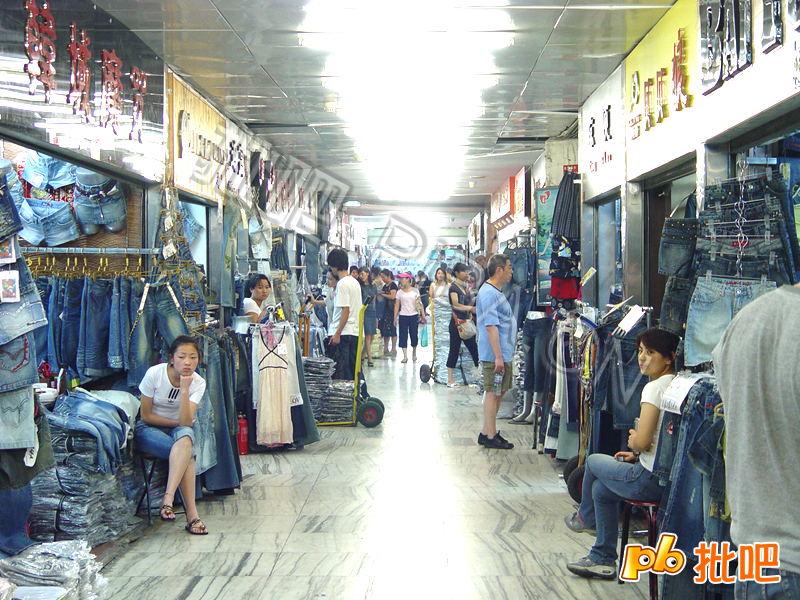
Before
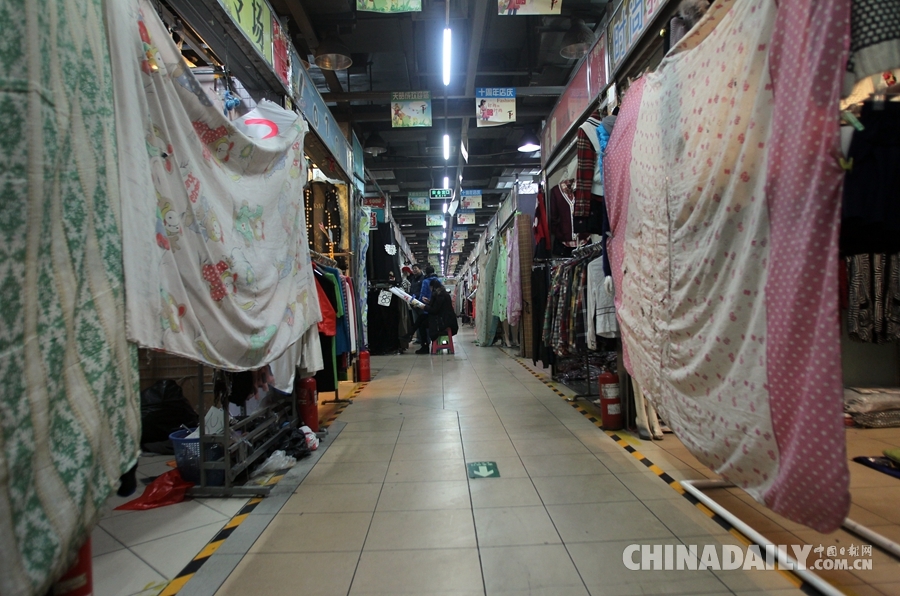
and after

businesses starting to leave

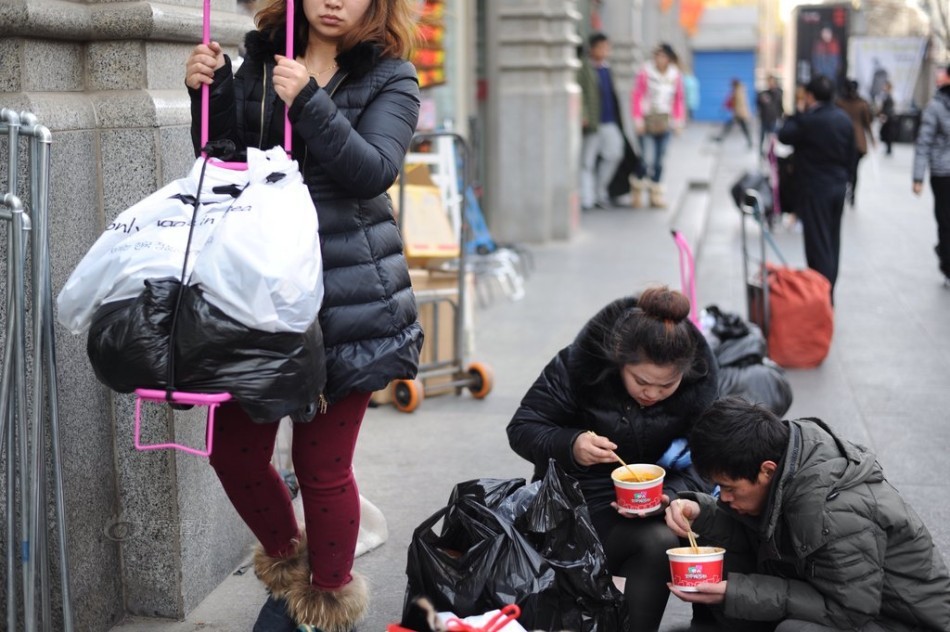

konjaku: here is a concrete result of Beijing’s policy to drive out the low-end masses by relocating low-end businesses out of the city center, such as clothing wholesale markets that cluster around the Beijing Zoo area in Xicheng. The relocation started some time ago, but in 2015-01, the Tianbaocheng clothing wholesale market began to be dismantled.
http://news.xinhuanet.com/photo/2015-01/12/c_127380551.htm
1-12, a man walks alone through the desert basement floor of the Tianhaocheng.
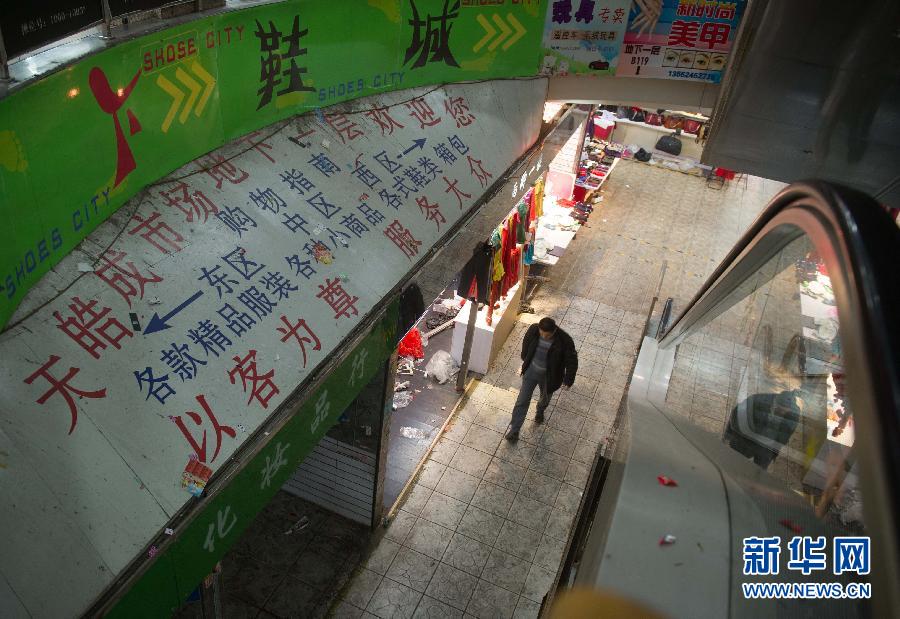 That day, with the Tianhaocheng sign already dismantled, business formally closed. and the market relocated. This was the first clothing wholesale market to withdraw from the Beijing zoo area. The majority of merchants have already left, but there are some still waiting for the cash pledged to them for leaving. In the Beijing zoo area, for over 30 years clothing and sundries markets have flocked together to this area, called by the nickname “Dongpi”(from “zoo” and “wholesale.”). There are many places on the Beijing periphery which are competing to become the place where all these markets move. (Xinghua reporter Luo Xiaoguang)
Relocation of Beijing zoo area wholesale clothing markets accelerates
http://news.xinhuanet.com/local/2015-01/13/c_1113982607.htm
2015-01-13
Xinhua net on 01-13 reported that that at the Tenhaocheng, a clothing market at the center of the Beijing zoo area wholesale clothing markets, operations have begun to take down the sign from the top of the building. One of the 12 markets in the Beijing zoo wholesale clothing markets area, once its sign comes off and it is dispersed, it will do much to relieving congestion in the area.


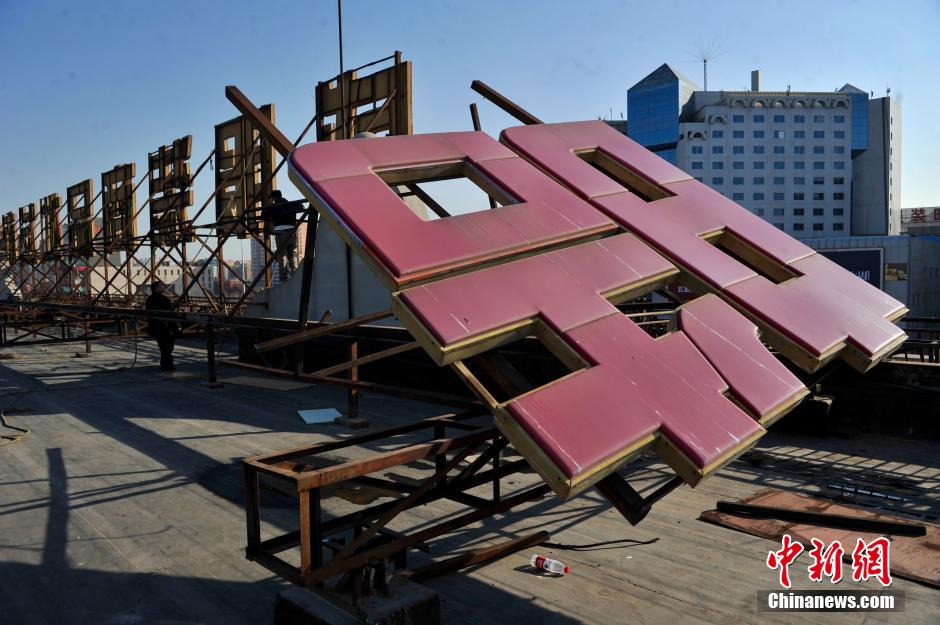
On the 13th, during the Xicheng district People’s Congress, vice district head Sun Shuo said, relocating the whole complex had already begun. In 2014, the number of market stalls had been reduced by 1300, or 10%.
This is regarded as the largest clothing wholesale collecting and distributing center in Northern China, It began to take form in the ‘80s, and for 30 years it has been the center for fashionable and low-priced clothing. During its period of great prosperity it was called “number one for all of Asia.” Every day of the year it supported the livelihood of more than 10,000 businesses, and 10,000 buyers stopped in to browse.
But, as the scale of Beijing city, its population and industries expanded, the market became increasingly worn out. Its environment became messy, order became confused. This is something many people who passed through it experienced.
As pressures from increased population and the environment reached the limit. the markets no longer continue into the future. At present in the whole city there are 21,148,000 long standing residents, among those 8,027,000 are from elsewhere. Compared to the year 2000 it is an increase of 5,459,000. Power-driven vehicles have topped 5,000,000. The Beijing population uses 1/20th of the water of the whole country.
With these numbers, Beijing must do something to relieve congestion. The districts must cooperate on a plan for sustainable development. From 2014-02, with the start of the Beijing Tianjin Hebei coordinated development plan, and the strategy to move urban functions from the city center, the the Beijing zoo area wholesale clothing markets became viewed as a prime example of congestion in the city center, and an impedance to urban functions.
The Xicheng district Party Committee Secretary Wang Ning said, there are more than 20,000 businesses in the wholesale markets that each year contribute 60 million yuan in tax revenue to Xicheng district, but the district government has to spend 100 million yuan annually to manage traffic and deal with environmental problems in the wholesale markets and vicinity.
But whether the tens of thousands of businesses stay or leave has drawn much attention, and caused a difficult problem
“ 5 items for 10 yuan!” “Clearing our inventory, everything must go!” On the B1 level of Tenhaocheng, store proprietor Xu stood surrounded by piles of underwear. In a loud voice he said, “the Tenhaocheng sign is coming down, the doors are closing. For many days already customers have stopped coming. We are just waiting to get our cash pledge for agreeing to leave, then we are going.”
The Xicheng district government says this is just a “relocation,” not a “dismantling and relocation.” The distinction is that the government cannot force everyone to completely vacate the markets,because it cannot simply set a deadline for everyone to leave [under the threat of demolishing]. The government shall respect the market rules, it will let the market lead the relocation process, Sun Shuo said.
The urban disease of Beijing forces the city to restructure by upgrading its industries. Not only will this cause a radical transformation in the central districts, but the city periphery will also experience changes through interaction with the center, and it will have a deep influence on the economic development of all the districts.
Sun Shuo said, at present the Beijing zoo wholesale clothing markets managers are looking at a 100 kilometer area in which to expand, from sites in Hebei to Tianjin. Yongqing in Hebei is already calling itself the place ready to construct upgraded facilities for the entire clothing industry, from manufacturing to selling finished products. The managers are contracting with Xicheng district to prepare avenues of fashion design, exhibitions and shows, e-commerce and financing, to create a new business model on the site.
Capital University of Business and Economics research professor Ju Erjuan believes moving out the clothing wholesales markets is an important first step in showing that Beijing can take a concrete step to relieve congestion.
Xicheng district head Wang Shao Feng said the district will work even harder to relocate 1000 more businesses from the Beijing zoo wholesale clothing markets this year. Beside these, they will also restructure and disperse the famous Tinayi dry goods markets, as stated in the government report of tasks to work on in 2015.
Beijing Academy of Sciences Research Fellow Zhao Jimin believes that, because human capital is regarded as the most central resource, public services are concentrated in certain better districts. This may induce the “Matthew effect” in which the stronger get stronger, the weak get weaker. Therefore using market mechanisms to disperse urban functions in the capital is not that simple. First, it is necessary to fundamentally narrow the wide disparity in the availability of public services, even to the point of diverting some of the educational resources, medical care and social safeguards which top flight people of talent currently enjoy, and to distribute these more fairly. Only then will it be possible to disperse urban functions and relieve congestion in Beijing, on a more even footing.
 Translations about social issues: China