According to “The Voice of China”, 80% of passengers during the spring rush travel by highway. Many have been calling in to “Voice of China” to say that since the spring rush started (January 18) bus ticket prices have risen, to one or two times more than normal. A Central Broadcasting Station reporter investigates.
http://www.chinanews.com/cj/2011/01-29/2820270.shtml
Yesterday (1-28) in Guangdong Foshan city temporary laborer Tian Menglan finally climbed into a bus to return home. She had already waited quite a few days, “Each day the ticket price rose, one day after the next, and one could only buy a same day ticket, because there were no tickets for sale for days in advance, even if it was only the next day. An ordinary ticket cost 50 yuan more inside the station as compared to outside. But what can you do? You either go home or you don’t, you get a seat or someone else takes it.” Tian Menglan is from Baise city in western Guangxi. Usually when she goes home, the ticket price is less than 100 yuan, but for the New Year, it is jumped to almost 300.
The Shenzhen Xixiang long distance bus station is a place many temporary workers use to travel. This reporter telephoned there, and found that for many popular destinations ticket prices have surged for many popular destinations.
Reporter: in normal times, from Xixiang (Shenzhen) to Chengdu, how much does it cost?
Station personnel: in normal times, one way is 445 for the cheapest ticket.
R: How about for train number 31, tomorrow?
Station: It is 705. It will become cheaper again after New Years.
It is clear that long distance bus tickets in many localities have risen. Doesn’t the nation have any stipulations about price hikes during the New Year holiday? A person of responsibility at the Transportation Bureau explained what their authority is: “bus prices must be within the set range set by the government. During spring rush prices are allowed to increase, but they cannot go above the upper limit. We further stipulate that the upper limit ticket price and the actual price of any particular ticket be clearly marked on the ticket.”
Our highways are at present the type of transportation that fluctuates the most according to the market. In ordinary times prices are discounted, but rise during the New Year period. Since bus transportation is a marketized commodity, there is ample reason to take advantage of the spring rush and raise prices. However, according to Gu Yuanhua, professor in the School of Traffic and Transportation at Beijing Jiaotong University, prices during the spring rush are such an unusual event, it is not sufficient to depend on the market for self-regulation. “The appropriate government department, either Transportation or the Commodity Prices Bureau, must closely supervise.”
Political observer Wu Yongqiang at the Voice of China said, “Since during the spring rush demand increases, the government cannot supervise the ticket situation as in normal times. They must show increased flexibility and maneuverability to deal with sudden shifts.
Reporter Wang Xian, Zhang Guoliang, Liu Tao
———————
Bus tickets are up 30% during the spring rush
http://newhouse.dg.soufun.com/2011-01-18/4388558_4.htm
Our reporter yesterday visited the Dongguan main bus station to investigate. Compared to last year, this year there is an extra surcharge for fuel, The standard is one percent pre kilometer. This year it has gone up, because of the rise of fuel prices starting at the end of last year.
As one can see from what is posted on the station board, ticket prices are up 30%. Especially looking at the prices to Hunan and Guangxi, the rate of increase is plain to see. Usually to Hunan is 150 yuan, but now it is 190 yuan.
This reporter interviewed one passenger at random, a Mr Lin. He said, there was nothing unusual about the rise of ticket prices, this always happened during the spring rush, because of increased demand and fuel costs. “As long as prices are regulated within the stipulated limit set by the Commodity Prices Bureau, no one will complain, they only fear arbitrary increases.” (reporter Wang Songping).
konjaku: this is an excellent article which deals perceptively with all aspects of the name imprinted ticket system.
Name imprinted tickets are unable to solve the underlying problem
http://www.china.com.cn/economic/txt/2011-02/09/content_21883543.htm
China net 2011-02-09
This year, the National Railway launched a pilot project in enlarging the scope of the name imprinted ticket system. Last year the project involved Guangzhou and Chengdu stations. This year it expanded to the the Wuhan-Gaungzhou high speed railway, the Zhengzhou –Xian High Speed Railway, and the Wuhan railway.
However, while the system of name imprinted tickets gives customers the feeling that there is now more fairness when it comes to purchasing tickets, the system does nothing to increase transport capacity to meet demand, which is the fundamental contradiction.
During the Spring Rush, the railway experiences its heaviest period of use. Last year the Guangzhou Railway Group had to invest over 100 million yuan just for equipment to implement the system, and to temporarily hire 26,000 workers. The Guangzhou area railways put more than 7000 security guards into service. Obviously, with this year’s expansion of the system, the investment will be that much greater.
With all this investment, last year the system seemed to work pretty well. Activities of scalpers were somewhat curtailed, and most passengers in the Guangzhou area went through an orderly process without excessive delays. The media reported that a great many passengers were satisfied.
However, while the system of name imprinted tickets gives customers the feeling that there is now more fairness when it comes to purchasing tickets, the system does nothing to increase transport capacity to meet demand, which is the fundamental contradiction. As long as transport capacity remains pinched, “the difficulty of obtaining a ticket” during the spring rush will remain an embarrassing problem.
Although the railway has invested heavily in manpower and material resources in an effort to attack and restrain the actions of ticket scalpers, however much they have widened the sphere of operations, the scalpers have not completely disappeared.
The fundamental reason for the existence of the scalper is that supply and demand for tickets is unbalanced. For a long time, the railway has been relatively cheap compared to other forms of passenger transport, and demand for tickets during the spring rush is too great. This creates a market for scalpers to reap profits.
The imprinted name ticket system only increases the degree of difficulty for the scalper, but the ticket scalper can still manipulate the new technology. The scalper can order tickets by phone, make and sell false documents. These new strategies in turn increase the difficulty for Public Security to attack the problem. An expert believes the system can never thoroughly wipe out ticket scalping. What is necessary is for all the people to be honest and sincere, and fully aware of the law.
In these two years of the pilot project, the process of purchasing tickets has become more convenient. One can order by phone or purchase through a ticket agent. For many people, this eliminates the need to stand all night in a long line. Last year in Guangzhou there were 15,000 phone orders, and in Chengdu 6000.
However, it is not easy to get through by phone. Last year in Chengdu, there were as many as 430,000 attempted calls within the space of half an hour. When one does get through, the need to input one’s identity number to buy the ticket makes the call take up time. That is the reason it is difficult to get through.
In addition it is very troublesome for passengers to change or return tickets. Since it takes time to process an unwanted or unused ticket and make it available again for sale, these become “dead tickets,” causing many people to be unable to purchase tickets and get seats.
Having proper documents is troublesome.
For customers, the name imprinted ticket system has another inconvenience. It requires three things be in correspondence when the passenger enters the station, “ticket, identity, and person.” In order for the station employee to punch the ticket, the passenger’s documents must first be checked and examined by a scanning machine. Because of their apprehension over this process and how long it might take, many passengers arrive at the station 3 to 5 hours before their train departure.
Under this new system, there are still customers who are unable to buy tickets. Many of these belong in the category of having a comparatively low level of culture. For this group of people, the imprinted ticket system not only increases the net cost of buying a ticket, but it adds to the time and resources the person must expend to buy the ticket. Many of these people do not customarily carry an identity card on their person. Some do not even have an identity card. In the current state of affairs, the system benefits those urban dwellers who have smart identity cards (chip enabled “second generation” cards) which can be easily read by the computers used by the railways and matched to their database. For the mass of peasants on the outer areas of the city, and for students, the system is quite inconvenient.
According to a police survey, since peasants and temporary workers lack the sophistication to order tickets by phone, they increasing rely on a group of small scale scalpers who specifically target them. These “quasi-scalpers” are not expert scalpers, but simply persons with slightly more understanding about how the name imprinted ticket system works. They themselves may even be peasants or temporary workers.
Most people cannot write off their tickets on expense accounts. Therefore they have no reason to keep their tickets once they have used them, and simply throw them away as they are leaving the station. The information on the tickets [name and identity number] can be used by others to make fake identity documents, which they can illegally offer for sale.
Because the use of smart identity cards is by no means universal, in last year’s trial of the system, Guangzhou railway listed 20 types of identification documents that could be used to buy tickets, while Chengdu allowed more than 30. During this year’s trial, more than 35 types of documents were allowed. However, since possessing valid credentials is a wider social problem, there are still people who do not have valid IDs and therefore cannot travel long distances.
The railway public security sector opened a special window to assist those who do not carry valid documents. By using the census registry they assist the passenger in proving her or his identity and purchasing a ticket. Of those who line up at this window, nearly all appear to be peasants.
Greater forces versus one small railway ticket
Implementing the name imprinted ticket system causes the process of buying tickets to become more fair, but there are also added inconveniences, and the expenditures involved end up adding an increased cost which is borne by the whole society. The only thing that changes is that there is a greater degree of transparency in how tickets are allotted and distributed. The transport capacity “cake” doesn’t get any bigger or smaller. Considering the cost involved to run extra trains, and the possible profits, it really is impossible to grow the railway network exponentially just for this brief period of time.
If the name imprinted ticket system does lead to more impartiality in “dividing the cake” it may conversely encourage people to have more enthusiasm for “making cake” and expanding the railway.
With all the rapid development in recent years, the Chinese railroads are still embarrassed when confronted with the problem of transport during the spring festival. This year all the railroads of the entire country have the capacity to transport 6,200,000 people a day, an increase of 700,000, or 12.5%. Even with this, the largest capacity ever, it will be difficult to satisfy the demand during the spring rush.
The problem is a railway problem, but also a problem for all of society. Disequilibrium in social development, lack of transport –these are not things a name imprinted ticket system can solve. It requires, first, a fundamental restructuring of social development away from urban concentrations, and second, a strong expansion in railroad development.
One thing we can be glad about: Since the 16th party conference in 2002, the rapid expansion of the railway network has elicited the amazement of people all over the world, and the building of high speed railways has become one of the points of pride of the government and the economy. In order to transform the disequilibrium in economical development, various regional governments already have plans in the works. But for development to reach a relative equilibrium, the railroad transport capacity must undergo a great expansion. Only then will the potential of one small railway ticket not be crushed under greater forces.
konjaku: from a blog
http://www.tianya.cn/publicforum/content/free/1/2087140.shtml
This city has recently begun to implement the name -imprinted ticket system. The question is, will this system solve the problem of making railway tickets during the spring rush easier to get or not?
Some people think, that because the imprinted name ticket system will restrict the use of special privilege tickets –tickets bought through “connections,” “inside tickets,” scalped tickets, etc., this will make tickets in general easier to acquire.
Others point out that the fundamental cause of tickets being hard to acquire is the lack of transport capacity to accommodate demand for seats. If there are 3000 people who need tickets, and only1000 tickets available, the curtailment of scalpers won’t make such a big difference.
I personally believe the name imprinted system will end up alleviating the problem of obtaining tickets. The reason is as follows.
My home is in Wuhan, and I work in Shanghai. Every year I go home for New Year’s. Those who make up the greater proportion of travelers during the spring rush are temporary workers like me. I usually go home on the 29th of the 12th lunar month, and have someone from my household buy a ticket for me to return to Shanghai on the lunar 6th day after the New Year. As far as I know, there are nine persons in my factory who do the same.
Now comes the tragedy. This year, the newspaper reports that all trains leaving Wuhan, from 2-5 (the third day of the New Year) to 2-27, will be subject to the imprinted name ticket system. Tickets will be sold ten days in advance — no sooner.
My family members cannot buy a ticket back to Shanghai for me, since they do not have my identity card. To buy this return ticket for the 6th day of the New Year –which is 2-8 — 10 days in advance, I would have to buy it on 1-30. Since I normally arrive back home on 2-2 (the day before New Years), this is not possible. I thought of trying to order the ticket by phone, but since so few tickets are available by this method, there really is no hope. The only thing I could do, after I get home on 2-2 (New Years eve), would be to go directly to the station and line up for the whole night, in order to buy a ticket on New Year’s day to go back to Shanghai ten days hence. Thinking how angry the boss would be, and how much would be deducted from my already meagre salary for these extra days of vacation I would need, I came to the difficult decision. I simply would not go home for New Year’s.
Of the other eight people in my factory besides me that I know about, two also decided not to return home One decided to go by plane, and the other five decided to endure the bosses outrage and salary deduction and come back a few days late.
Therefore, out of nine, four did not go by train, and the five who did were forced to change their plans and not travel on the peak days. There are of course many, many more people like us. Because many of these must make these sorts of choices, one can surmise the problem of obtaining tickets is to a certain extent made less difficult.
Concerning the system of Railway tickets printed with the purchaser’s name — the acceptable types of proofs of identity has been expanded –distinguishing genuine and fake tickets is now possible

Guangzhou Economy Net, Zhu Jinjin reporter
http://www.ce.cn/cysc/jtys/tielu/201101/25/t20110125_20761970.shtml
In this years increased transport for the Spring Festival, the railway departments are launching a trial experiment in expanding acceptable proofs. of identity that can be used to purchase tickets. The Deputy manager of the Guangzhou Railway, and Director of the office for increased spring festival transport, Chen Min, told this reporter, they will now accept 35 types of proofs of identity. Not only that, but they have gone a step further in improving their ability to detect fake tickets.
According to Chen Min, they have a scanner automatically linked to a database that can ascertain whether a ticket is genuine or fake, because each ticket has printed on it the purchaser’s unique identification number,
When this reporter went to the Guangzhou railway station to investigate, at the special entrance for those with name imprinted tickets, only those persons whose ticket number and identity card number matched were allowed to enter the station. Last year there was a wait of about 10 seconds to enter the station, but this year it was down to 3 to 5 seconds.
Moreover, if by chance a person does not have identity documents with him or her, at the temporary special window where identification is checked, these persons have only to give their identification serial number, and their identity can be checked.
Guangzhou and Chengdu railways began this system of name imprinting tickets last year. This year the Nanchang (capital of Jiangxi) railroad will oversee the extension of this system to eight railway stations in Jiangxi province on a trial basis.
konjaku: the following incident may be trivial, but in these trivialities we can see the system in operation.
A woman buys a “true name” imprinted ticket, but what appears is a ticket with another person’s name
http://news.sina.com.cn/s/2011-01-20/005321842614.shtml
As this newspaper reported, (Reporter, Xiong Jiayan)yesterday, the first day of the spring rush at the Wuhan-Gaungzhou high speed railway, a woman from Zhongshan named Liu, using her identity card ordered a ticket by phone. When she went in person to the agent to pick up her ticket with her smart identification card(chip enabled “second generation” card), what came out of the printer was a ticket with a different name and identity number, in other words, a “ticket not with the true name.” The woman was greatly surprised, and the railway employee was quite perplexed. The railway has for its part stated, that this strange event could only have been caused by the woman having given an incorrect identity number over the phone. The possibility that there was some error in the system is nearly impossible. At the end, the woman could only get a deducted (partial) refund of 67 yuan on the ticket, and she had to go to the Guangzhou South station to buy another ticket.
Yesterday morning at 11, this reporter went to the number two ticket window at the South Station to investigate, and met Mrs Liu and a worried looking railway employee, to inquire. Mrs Liu said, “on 1-18 in Zhongshan I reserved my ticket using my cell phone. Yesterday when I went to the ticket agent to pick it up. When I ordered it I used my cell phone to enter my identity number, but when I went to pick up the ticket what was printed was the name Liu Wenhui, which is not me, and a different identity number! Miss Liu cannot understand how such a bizarre thing could happen. “Before the name imprinted ticket system, I just came here directly and bought a ticket. This time, why did I have to reserve my ticket by phone, only to get one not in my name?”
This reporter examined her ticket. It was a second class ticket from Guangzhou to Changsha, price 333 yuan. ” When I went to pick up the ticket I ordered from the agent I was told they were unable to change the information printed on the ticket, so I had to come here to the South Station.” When told the ticket could not be changed, Miss Liu had no choice but to accept a refund with the service charge deducted, leaving her with only 20% of the value of the ticket, or 67 yuan. She had to start all over and buy a new ticket.
In regards to this bizarre event, the railway said, it is probable the problem was caused by the identity number Miss Liu entered during her phone call. It is very unlikely that it was caused by a technical problem with the phone system. This is because when ordering a ticket by phone, one only has to enter one’s identity number, not one’s name. Now Miss Liu appears holding a ticket with someone else’s name and identity number, and asks to exchange it for another ticket for free. This does not accord with regulations. We cannot discard the possibility that Miss Liu purchased this ticket from a scalper.

Buying a railway “inside ticket” –take care not to fall into a trap
Sichuan News Net 2011-01-21
http://sichuan.scol.com.cn/ncxw/content/2011-01/21/content_1838593.htm?node=954
A Mrs Xu of Sunqing district believed she was buying an “inside ticket” and was almost tricked. She confessed her lingering fears to this reporter, that because she had been gullible and had tried to buy an “inside ticket” on the web, she had been close to being deceived.
Every year Mrs Xu returns home to her native Nanchang for the spring festival. “My job keeps me busy, and I do not have a lot of time to go out and line up for tickets.” But she is used to shopping for things on the net. On the 18th she was browsing and she suddenly saw on the Nanchang page a notice stating that a certain person would act as an agent and buy an “inside ticket.” Not only was there a guarantee that there was no need to line up, but for a service charge of 50 yuan she would be able to get the railway ticket she wanted.
Overjoyed she called the telephone number given in the posting. The other party stated that he was a staff member inside the station, and had a priority status to buy tickets for personal use to certain localities. He informed Mrs Xu that the money to buy the ticket had to be deducted from his own savings passbook. After that, within just one hour he could have for her a ticket to Nanchang on 1-25. Mrs Xu’s suspicions were aroused. She insisted that it should be a transaction in which she would pay cash and he would hand over the ticket. “I was afraid that after paying I would end up with no ticket. But the person responded easily that it was no problem, I could come to the station and pick up the ticket right away. This made me less worried.” She hurried to the station and called again. The other person told her what sort of clothes he was wearing, and she soon found the 30 year old man of that description in the ticket lobby.
“By the rules, we are not allowed to use our priority status to sell tickets to other people, and if they find out I will be fired. You go and wait over there near the ticket window, and I will go get your ticket. When the time comes, you can say I am your relative.” Then, this man said to her with an air of mystery, “In the station there are security cameras everywhere. In order for us not to be caught, you should have a friend transfer the money to me.” After saying this he gave her a bank account number to transfer the money to, and urged her to phone her friend.
These actions did not incite her to be wary. She got in touch with her friend and went to the place in the station he indicated and waited. Ten minutes went by, and the man did not reappear. As she waited, her friend called her. The friend said the man had just called, saying he was standing right beside Mrs Xu at the station, and that the friend should immediately deposit the money in the man’s bank account.
“Fortunately my friend was cautious and called me before depositing the money, otherwise I would have lost 100 yuan without getting anything for it.” When we called the man’s phone again, we were unable to connect.” When Mrs Xu went home she looked at the same web page, but the posting had disappeared.
reporter: Chen Wen
konjaku: another article —
Mistakenly believing scalpers had “inside tickets,” a certain business is cheated out of 2910 yuan
2011-01-18
http://nf.nfdaily.cn/nfrb/content/2011-01/18/content_19361486.htm
Mistakenly believing scalpers had “inside tickets,” last Thursday, the employees of a certain factory in the Baiyun district of Guangzhou were cheated out of 2910 yuan when they tried to buy train tickets.
The employees wished for this newspaper to report their example, to warn others that these scalpers are still very active on the net,/ When buying tickets, one should under no circumstances believe that some in the station has inside tickets.
A customer of the factory first found the scalpers on the net. “They say they are employees who sell tickets in the main hall in the station.” Because this customer was somewhere else at the time, he asked employees of the factory to go to the station and make the deal for him.
The employee who went to the station. Xiao Wang, said, their customer needed two tickets. Some workers in the factory said, “find us some inside tickets too,” requesting an additional eight tickets. This made 10 tickets needed altogether — for Sanmenxia in Hubei, Zhengzhou and Luoyang in Henan, with “service charges” a total of 2910 yuan.
On Thursday afternoon at 4, Xiao Wang went to the Guangzhou station carrying the identity cards of said employees. After entering the station, he called the scalper, and both parties agreed on what to do: Xiao Wang would stand in line at the number 30 ticket window. When his turn came, the scalper would come forward and give him the tickets, receiving Xiao Wang’s cell phone from him as security. After Xiao Wang examined the tickets, the scalper would use the cell phone to call the financial clerk Miss Guo at the company, who would then transfer the requested amount to the scalper’s bank account. Once the money was remitted, the scalper would return Xiao Wang’s cell phone.
Both Xiao Wang and Miss Guo had no suspicions. Then the scalper called again, “He said the situation had changed. I was to go to window 24 instead, and keep the phone line open to await further instructions.”
Five minutes later, the scalper abruptly severed the phone connection. Immediately, Xiao Wang received a call from Miss Guo. He was astonished to learn that while his phone line had been busy, the scalper had called Miss Guo, saying he was calling from Xiao Wang’s phone.Indeed, the number which appeared on Miss Guo’s phone display screen was that of Xiao Wang, As they had arranged, Miss Guo then remitted the money to the bank account.
“Since my phone never left my hand, somehow the scalper had the technology to make my phone number appear as the one that was calling. He stole my phone number, and tricked Miss Guo.”
Xiao Wang was very upset that the ticket fund for his fellow workers to return home was lost. He earnestly hopes this newspaper article will be a warning, that others will not follow in his footsteps. “If you hear someone say they have ‘inside tickets,’ it is very likely a trick.”
“Going home has become easy.”
2011-01-21

Yesterday CCTV reported, “First day of the spring rush at Chengdu, going home has become easy.” Those netizens who had been going through torment over buying tickets, could not stay calm, especially when told, “buying a ticket is no problem.” When we will enjoy the fortunate life which CCTV has described?
According to the report, Chengdu station has set up a temporary structure to sell tickets, made it possible for customers to use bank cards to pay, and by these and other measures have made it easy to buy tickets. The first day of the spring rush, lines are short inside the station, and customers said they had no problem buying train tickets. The report concludes, “buying train tickets is no harder than buying subway tickets,” and “buying tickets to return home has become easy.”
Several irritated netizens who had been going through the torment of trying to obtain tickets, pointed out that Chengdu is hardly the place to go to file this story. Chengdu is not a place people leave to go home at New Years, rather, Guangzhou station is a place likely to be crowded, with people trying to return to Chengdu.The direction of traffic is towards Chengdu, not away from it. Going to Chengdu on the first day of spring rush to check ticket sales makes as much sense as going to Guangzhou station after New Years day.
One netizen said, CCTV really had to rack their brains to think of a place where it is easy to buy a ticket. Another said, if it is so easy, why did his co-worker stand in line all night to get a ticket to go back to to Sichuan, without success? His friend was ready to go to a scalper and pay 150 yuan more, but still couldn’t find a ticket. In the world reported by CCTV, it is easy to buy a ticket. In the world the netizens live in, there are no tickets available. We wish we were living in the CCTV world, they sigh.
konjaku: response from a blog
Since 2002, during every spring rush it has been my job to get railway tickets for people. I want to state clearly right away that I am not a scalper. The reason my friends and relatives ask me to buy tickets for them, and increasingly for their friends and relatives, is that I have a very close friend who works at the railway station.
In 2002, I had not planned to go home, but at the last minute circumstances changed and I decided to go. I ran to the station to buy a ticket, but like so many other people I went home empty handed. Not knowing what to do, I suddenly thought of calling my friend at the station. To my surprise, in less than 10 minutes, my friend told me he had obtained a ticket for me. When I went to pick it up, besides the ticket, he had a complaint: “Are we not friends? Other things I can’t help you with–at least for this one thing, who should you come to but me? This is my duty.” There was nothing for me to do but repeatedly thank him, and promise to always come to him in the future when I needed a ticket. Thereafter I never had to buy a ticket for myself, and during times when tickets were in short supply, I had him get tickets for my relatives and friends as well. That first year it started with one ticket, now this year it had become close to one hundred tickets.
Now when I go by the ticket window in the station, no matter how desperate the situation looks, I know I won’t go away empty-handed.My friend is a magnificent sight. In his pocket are a number of small bundles of cash, each fastened with a rubber band. In each bundle is a piece of scrap paper with the name of a person, what ticket they want, and how many. Let me state clearly that he is not a higher-up, just an ordinary employee at the station. Therefore, I think it is safe to say he is not the only one operating this way.
Of course, the root cause of ticket scarcity is that demand outpaces supply. But since buying tickets through back door connections can only increase the fundamental inequality of the process, this matter is worth deeper thought. Speaking for myself, I believe that I and people like me only act this way out of absolute necessity. It’s embarrassing. I have done it repeatedly because it is so hard to get tickets otherwise during the spring rush, and because I am not putting my friend at any risk. He himself says it takes only the slightest effort. If he were in any danger of losing his job or something worse, would we do anything like this? Even though it is a violation of the law, the net cost to the system is very low, close to zero. We are just using the loopholes built into the system. What is frightening is that these loopholes are in every area of our society. Implementation of proper procedures simply does not exist. Therefore, when we get to the ticket window only to be informed that the tickets are all sold out, we have no way of knowing where all those tickets disappeared to.
As for the ticket problem during the spring rush, the railways are still all talk and no action. Their empty promises do damage to their reputation. If they can show passengers they are really making an effort, then those passengers will show some understanding, even in the midst of the difficulties that arise. I truly hope that the phrase “going home has become easy” no longer provokes a bitter laugh.

File photo: 1-9, the long line waiting to buy tickets at the railway temporary ticket windows set up at the Ningbo International Meeting Center (photo, Gong Guorong)
konjaku: First a blog entry from 2008, then the opinions of some netizens in 2011, on the railway ticket problem:
http://www.tianya.cn/publicforum/content/free/1/1106699.shtml
For five days every day I have been calling, trying to reserve a ticket for Shenzhen to Shandong! Every night I search for scalpers but in about one minute the tickets are all gone!
Tonight I called a scalper, but his price was too high. 15 minutes later I called back –I was ready to buy that ticket. He was all sold out –he told me I shouldn’t have hesitated –his prices are cheaper than others!
T108,T186, K106 are the three trains that go to Heze and Liaocheng in Shandong. The usual price is 367 for a sleeper, 208 for a hard seat.
On 2008.2.1 it was 780 sleeper 500 hard seat
On 2008-02-02. 880, 600.
On 2008-02-03 it was 980, 700
On 2008-02-04, 1100.
These are the scalper’s standard prices. They are free to do what they want, and ratchet the price higher. In two weeks they can make enough money to take it easy for the rest of the year!
Truly China is a harmonious nation! A great and mighty nation! No one, not even Martians, have anything so magnificent!
Netizens doubt that the problem of demand for railway tickets can be satisfied by 2015 –the government responds
Once again, it is time for the spring rush. On 1-15, the Railway Vice-minister Wang Zhiguo stated. ” In the 25th phase (2011-2015) with the construction of more rails, the problem of lack of available space on trains (difficulty in obtaining tickets) will fade into history.”
But these speeches have not gained much credibility among the people. There are some netizens who have unearthed statements from old newspapers. In 2007 the railway ministry stated the problem would be solved by 2010. In 2009, again they state the ticket problem will be solved by 2012. Why do they now need to defer it another three years? It’s not believable.
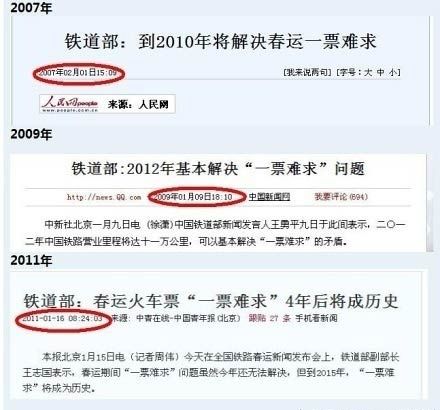
Illustration above: “2007: Railway Ministry says spring rush ticket problem will be solved by 2010.” “2009: Railway Ministry says, Ticket problem will have a fundamental solution by 2012.” “2011: Railway Ministry says ticket problem will be solved in 4 years.”
Yesterday,the designated railway ministry official meeting with reporters used these phrases, “a fundamental solution” and “a complete solution” without any inkling that these words were contradicted by reality.
According to the railway, during the 40 days of this year’s spring rush, they will transport 230,000,000, compared to last year an increase of 35,540,000. The various localities have started selling tickets, and once again for many people tickets are hard to come by.
On 1-15, The Railway Vice Minister Wang Zhiguo announced to the media that at present railways in China had not enough network of tracks, and far, far from enough transport capacity to meet demand. We must speed up the construction of railways, and increase transport capacity.” This 25th phase is one of large scale construction, and the end result of our long term railroad modernization drive. As this phase reaches its final segment, our country’s railroad is poised to meet the challenge of the spring rush, and the problem of difficulty in obtaining a ticket will pass into history.” According to this, the solution will be attained sometime after 2015.
Why not 2012? Why has it been postponed for three more years? More than a few netizens do not buy this. They have collected and reproduced the newspaper announcements of previous years, to criticize the railway ministry for saying the problem would be solved within a certain time frame and then postponing it again.
The 2007 statement
2007-02-01. The railway ministry called a news conference, and their media spokesperson Wang Yonggan stated that by 2010, a highly developed railway network would begin to take shape, with special lines for passenger traffic. These would connect with already existing high speed suburban lines , to form a complete network of high speed passenger transport. Our transport capacity will expand greatly, and I think the problem of obtaining tickets will be greatly solved. Wang Yonggan’s speech was put out with the title “The Railway Ministry states that by 2010 the difficulty of obtaining tickets during the spring rush will be solved.”
The 2009 statement
Although the content is not the same, the next statement also issued from Wang Yonggan’s mouth. On 2009-01-09, he said that solving the problem involved tapping the railways latent potentialities. Although they had greatly enlarged transport capacities, they still did not have sufficient to deal weigh the increased demand during the peak season. “By 2012, the Chinese railway system will manifest increased capabilities as “public transport,”and will be able to solve the railway transport bottleneck.”
The railway responds
The netizens are quoting them out of context, these statements by railway official are not at all in contradiction. An official from the Railway Ministry department of propaganda yesterday responded, saying a “fundamental solution” and a “complete solution” do not have the same meaning. The previous spokesperson Wang Yonggan’s statements, “large scale solution,” “fundamental solution to the transport bottleneck,” and the more recent statements by the Vice-minister Wang Zhiguo for a “thorough-going solution” are not in contradiction.
“Solving this problem is something the railway ministry has been working on without pause for many years. We are building rails and expanding transport capacity to meet demand. As for when the problem will be solved, we can only make projections, which are not absolutely certain.” This official informed this reporter, that every year at the spring rush the railroad’s inability is made apparent, but he hopes everyone will see, that they are raising their transport capacity. It is the goal every railway employee is struggling towards. “Every year transport capacity rises, but demand also increases. Even if the problem of meeting demand is solved in 2015, the railroad will still have to continue developing and building.”
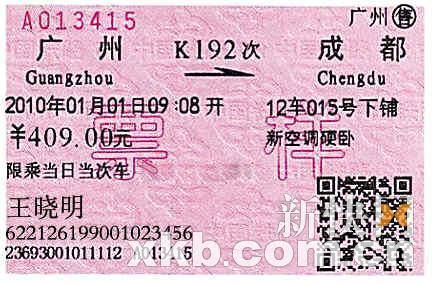
photo#1 name imprinted ticket. The bearer’s name 王晓明 Wang Xiaoming and identity number are in the lower left corner.
konjaku: The New Year’s holiday, the Spring Festival, may be the one time during the year that xinguanren and other migrant workers visit home. While looking through public notices from Shipai town in Dongguan, I came across the following:
Shipai town government:
Notice concerning the 2010 Shipai town extra trains for New Dongguaners to return home during the spring festival
Dongguan business enterprises, New Dongguaners :
The itinerary of the extra trains for the New Dongguaners of our town to return to their native places has been set. This year our town will run trains on nine routes. Because this year the railroad department is putting into effect a system of buying tickets by one’s name, we please request that New Dongguaners bring their identity cards and a duplicate copy to their respective residential district labor service center to register and place an order before 2010 -01-15, along with a deposit of 100 yuan for each ticket towards the total purchase price.
konjaku: I was unable to find out anything more about the town actually sponsoring extra trains, but I was curious about the “tickets by name” system. What was it, and what was it supposed to accomplish?
The initial article about this new system expressed some uncertainty about the details. Anyone travelling between Guangzhou and Chengdu during the spring rush had to produce a ticket with their own name and identity number printed on it. (Example, photo 1).
http://news.163.com/10/0110/04/5SKVKPPE000120GR.html
2010-01-10
The Guangzhou Daily reported on 1-10, that starting 1-30, the Guangzhou Railway will start selling name imprinted tickets as a trial project, but people are uncertain as to the details concerning how to buy these tickets.
Yesterday the Guangzhou Railway Group put out a second announcement with more details on the plan, from buying tickets to entering the station. A person who goes to the station on the day of travel, is permitted to buy one name imprinted ticket with one valid proof of identification. A person can also act as a proxy and buy a ticket for another person if holding that person’s valid identification document. If purchasing tickets in advance of the day of travel, by phone or at a ticket window, an individual can buy three tickets at one time.
The Railway admits honestly that it faces a stiff trial to implement the system during the spring rush, and asks people to bring two types of identification to purchase tickets.
Purchasing tickets by phone is limited to those persons who have residence permits. If purchasing from an authorized ticket -seller, the seller can swipe his or her resident identification IC card to enter the information automatically. If it is some other document, the information needs to be entered manually. The seller will verify the identification documents, but the buyer has to make sure what is printed on the ticket is correct. If the ticket and proof of identity do not correspond, the traveller will not be allowed to enter the station. If a purchaser wants to change or return a ticket, the same condition applies –the information on the ticket and the identification documents must correspond.
(More details –here omitted)
Source: Guangzhou Daily, reporters Yang Jin, He Zhiwen
konjaku: the next article adds more details.
37 train stations try out name imprinted tickets. 20 types of proof of identity are accepted
http://news.163.com/10/0109/07/5SIO6L1P0001124J.html
2010-01-09
These tickets for the spring rush will go on sale 1-21at 7 AM, 10 days in advance, for seats on 1-30 and after, until 2-13. On the face of the ticket the purchaser’s name and identity number will be printed. These need to be checked when one enters the station. The traveler must bring one valid proof of identity and the ticket. If these match, they can enter and board their train.Children do not require name imprinted tickets.
Types of valid identification include resident identification card, temporary resident identification card, military officer or armed soldier certificate, passport, Hong Kong-Macao home-return permit, etc.
After it has been called for again and again, the day for the system of name imprinted tickets has finally dawned The Railway Ministry has instituted the pilot project from Guangzhou to Chengdu.The railway department had already invested several hundred million yuan in scanners and hardware to check the tickets. The grassroots units in charge of implementation have received some training sessions, but not all the concrete details of how it works yet. As for why Guangzhou and Chengdu stations were chosen, an official said, “it is not yet possible to implement this plan everywhere. Therefore we chose the two stations where demand for this system has been the greatest.”
As is well known to the public, Guangzhou and Chengdu are the two “hottest” stations during the spring rush. Guangzhou railway station is called “the country’s number one” During the peak of the rush 200,000 travelers pass through in one day.
To achieve the system, three obstacles must be overcome
A specialist told this reporter, the first hurdle is in technology and investment. To make the name imprinted ticket system a reality, the existing system for selling tickets must be overhauled and replaced with a more advanced system. New software and hardware is required to inspect tickets and match them to the identity of the bearer. The railway system cannot yet do this quickly and conveniently, without a time -lag.
The second hurdle is whether the railway can provide enough ticket checkpoints within the stations, so the lines do not become too long.
The third hurdle is whether or not there can be impartiality in the selling of tickets, because some will probably find the “hole” to bore into the system and manipulate it to their advantage.
Data shows that every year ticket scalpers rake in 18 hundred million yuan in profits or more. Using more advanced technology, the efficiency of selling and inspecting tickets will rise. But, up until the 2009 spring rush, the Railway Ministry did not believe the system of name imprinted tickets was feasible. Representatives pointed out in public on many occasions, that the main problem was lack of enough train service to satisfy demand, and the name imprinted ticket system did nothing to address this issue. The railroad was trying to develop in the direction of having greater speed and convenience, and being burdened with more small details and troublesome procedures went against that overall goal. To make the name imprinted ticket system work, they need to greatly increase the number of personnel to inspect the tickets, and increase points of entry into the station.
Whether or not ticket prices will rise during the spring rush is not yet decided.
The National Development and Reform Commission has already released its Notice on Operations and Deployment for the 2010 Spring Rush. But in the Notice there is no mention as to whether ticket prices will or will not be increased. In 2007, when oil prices spiked, the Commission announced that railway ticket prices would not go up for the 2008 spring rush. However, bus tickets were allowed to fluctuate upward, but within the limits set by the government. At no time can bus ticket prices exceed the set limits. But now in 2009, oil prices have risen to a new peak, at 80 dollars a barrel on the international market.
It is calculated that 2.5 million people will travel during the 2010 spring rush, up to 7.7% over last year.The National Development and Reform Commission Transport Division intends to add train capacity in accordance with the flow of traffic, to satisfy the demand of travelers to the best of its ability. At the same time, they must continue to transport materials essential for daily life, such as coal for generating power, to ensure a steady and orderly flow of these supplies to the cities.
Source: Xinhua net. Reporter Zuo Lin
konjaku: Now it is clear why the name imprinted system of tickets was instituted –to prevent rampant ticket scalping. Scalping exists because there are more people travelling then there are tickets are sale, a situation referred to as “lack of transport capacity.”
At this point the xinguanren traveller only knows that 1) there is no better, and perhaps a worse, chance of getting a railway ticket this year with the new system, 2) he or she will have to make two trips to obtain it, one to the government office to register and pay a deposit, again to an agent to retrieve the ticket, hoping that all goes well and the information on the ticket is printed correctly, 3) the new system favors those who have residential permits, that is, residents instead of migrant workers, 4) he or she does not know what the price of the ticket will be.
konjaku: After the 2010 spring rush ended, a judgement was reached:
The Guangdong province name imprinted tickets system “passes the final exam”
http://news.xinhuanet.com/fortune/2010-02/13/content_12982706.htm
2010-02-13 Xinhua net
Reporter Chen Xianfeng
2-13 at midnight, the Guangdong 15 day experiment in name imprinted tickets came to an end. During this period, the name imprinted ticket system effectively choked off the rampant actions of scalpers reselling tickets at higher price. It preserved an orderly system of selling tickets for the increased spring transport season, allowing some ten million travelers to return to their native place in a safe and secure way, holding in their hands a ticket with their own name printed on it.
For this New Year’s season, this system was tested in 9 stations in Guangdong where there is a high concentration of migrant workers: Guangzhou, Shenzhen, Foshan, Dongguan, Huizhou, etc. During the successive ten days in which passenger volume was the heaviest, this reporter spent time observing in Guangzhou station. A record breaking number of travelers passed through this station, yet there were no lines or delays caused by the inspection of tickets. The system worked in an orderly fashion.
At the ticket checkpoint, the forehead of Xiong Xiaoyan, a migrant worker from Guizhou, was beaded with sweat. In one hand he gripped his ticket and two identification documents. He seemed apprehensive. A station employee promptly took his ticket and documents, and lightly passed them across the scanner screen. The computer retrieved information on his ticket and identity number. The three components “person, identity, ticket” all matched. The station employee stamped his ticket, and he passed through. The whole procedure took about 10 seconds. “I did not expect it would be so fast,” Xiong Xiaoyan said. He explained he had been afraid that checking the ticket would require more steps and take a long time, causing him to miss his train, Therefore, he had come to the station well in advance.
A Guangdong Railway department head Huang Xin explained, in order to keep the flow moving swiftly they had opened 108 ticket inspection checkpoints in the station. Before the name imprinted ticket system, they only had seven or eight checkpoints. They have increased this tenfold, in order that passengers do not have to wait. The Railway did research and development on producing the tickets, setting up the scanners, training personnel to run them, all in time for the increased demand during the Spring Festival season.
On 2-8, 232,000 travelers used the station, a historical record. But the great tidal wave of spring migration went off smoothly. The scalpers had no space in which to operate. The Hunan province migrant worker Wang Xiangneng said, “This year it was different. Anyone whatsoever could telephone in advance, go to the window to purchase. If you went early you could get a ticket, it was more fair than before. This year there were a lot fewer scalpers. Last year a “hard seat” (economy class) on an extra train from Guangzhou to Shaoyang cost 51 yuan, but during the spring rush, when buying from a scalper it rose to at least 200 yuan. For us temporary workers, just to buy one ticket was quite a few days wages –no small amount.”
The trial test of the name imprinted tickets did lay bare some shortcomings. In particular, because of scarce resources, demand was greater than supply.The scalpers were not entirely eliminated, and some travelers suffered inconveniences. It is urgent that these deficiencies are identified and corrected. The problem of “one ticket, hard to acquire” is still a reality. Yet what should not be denied, is that the scarcity of resources is dealt with impartially, distribution of what there is, is done fairly. This has a positive significance. The system of name imprinted tickets should not be abandoned at the slightest obstacle, but constantly pursued and its deficiencies rigorously investigated and perfected.
This year, in the system of name imprinted tickets, the difficulty of “one ticket, hard to acquire” exists as before. As Huang Xin explained, at present there is not enough transport capacity, and during the peak of the spring rush, it is difficult to fulfill the request of every traveler. A fair number can still select a different mode of transport. The “one ticket, hard to acquire” represents the disequilibrium between supply and demand. No matter whether it is booking one’s ticket by telephone, or trying out the name imprinted ticket system, these are unable to fundamentally solve the problem of transport capacity.
konjaku: Dongguan, the industrial city just south of Guangzhou in the Pearl River Delta, generated a certain amount of interest between 2004-to 2010 as a place which embodied the rapid expansion and heating up of the Chinese economy, based on cheap exports. Minimally skilled workers (sometimes underage) made long trips from impoverished areas, arriving to a city composed of factories and businesses that sprang up and disappeared overnight. In American newspapers, Dongguan was often the setting in articles about unsafe products produced for the American market (children’s toys, pet food), and oppressive labor practices. In her book Factory Girls, Leslie T Chang deftly shows that those who managed to achieve an initial, tentative success in Dongguan entered a newly emerging social world in which traditional hierarchies were inverted or simply non-existent, and it seemed possible to completely remake oneself, from a child of a struggling peasant family to a successful, urbanized businessperson.
Already Dongguan’s moment in history may have passed, as there is a perception that its position as a nexus combining cheap labor with a degree of technical know-how is being usurped by cheaper labor markets in other parts of Asia. By the end of 2011, Dongguan had become a place to go to find evidence of the contraction of the Chinese economy: less orders, less factories, less workers willing to take any low-paying job offered. What follows here is my own modest contribution to a social history of Dongguan as it existed in the recent past, before the slowdown. This is a part of a larger topic: how the floating population is faring, and how their migration to the cities for work is effecting civil society as a whole.
In reading an article about Dongguan several years ago, I came across a term not in the dictionary, xinguanren, literally “New –guan — person” (guan, as the second syllable of Dong-guan). I translate this word, somewhat awkwardly, as “New Dongguaner”. I did a search for xinguanren on the web, and found a newspaper article which explained its origin. This word had been created by a government committee to replace the previous official term which had come to be considered derogatory, “non-native worker.” A non-native worker, or migrant worker, is a member of the floating population who has come to Dongguan to live. The irony is that Dongguan has at least 3/5 more non-natives than natives. This larger percentage of the population would henceforth be known as xinguanren, or “New Dongguaners.”
I started another search to find out what an actual “New Dongguaner” thought of this new term. I inserted the pronoun “I” before the word xinguanren –“I, new Dongguaner” and the search results shifted from newspaper articles to personal blogs. In the blogs, the term was interpreted in terms of the details of daily life: the Temporary Residence Permits they still had to obtain, and the arbitrary fees they still had to pay. I began another inquiry to find out more about these topics. As I read more articles, there was an interesting twist. The national government announced that starting in 2009 it was abolishing many of the regulations the bloggers were complaining about, which acted to divide natives from non-natives, temporary residents from permanent ones. I then examined the actual extent of these changes through one issue important to New Dongguaner families –whether or not they can enter their children into the same state subsidized schools which are open to permanent residents.
I begin with the article which explains the term, xinguanren. Then, I shift to the perspective of an anonymous blogger. The rest of the translations that follow are an attempt to understand and explicate this blogger’s complaint. In digging into the layered strata of permits and fees, there are parts that will test any reader’s patience with the minutiae of details, but I wanted to provide as much of a whole as I could.
My comments between articles are prefaced by “konjaku”.
The Expression “New Dongguaner” (xinguanren) Manifests the Spirit of Dongguan City that “a Hundred Rivers Make up One Sea.”
2007-04-14 Dongguan Sun Net
Yesterday the new appellation for “non-native workers” went through final deliberations and was decided to be “New Dongguaner.” The transformation of this term will allow both the city residents and the staff of the many business enterprises in Dongguan to feel a sense of elation. With this appellation everyone will be able to manifest the warm and cordial spirit that “a hundred rivers make up one sea.”
More than a few factory workers have expressed discomfort at the previous term for them, “non-native workers,” feeling it contained a certain bias against outsiders. The New Dongguaner Mr Li said, “In the past, it seems that you people of Dongguan also came here from some other area, whether originally as migrant laborers or not. But no one called you ‘non-native workers.’ Why should it be any different for us?”
Although what has changed is just a word, this alteration expresses not only the government’s concern for migrant laborers, but also the concepts of “harmony” “openness” and “striving for compatibility” that are inherent in the new development phase of our city. As Associate Professor Lin Juying at the Municipal Communist Party school said, “This is actually a conceptual transformation, which demonstrates the rationality in the Dongguan people’s manner of doing things. By welcoming people of ability from different regions in this manner, we build ourselves up all together.”
The Communist Party School Provost Zhao Weihua said, This change to “New Dongguaners” shows our meeting of minds with the migrant workers. With this, we can further enliven the enthusiasm and initiative of these workers in their work here in Dongguan.”
It goes without saying that we all hope that from this glorious new beginning, that the ongoing reform and continuing establishment of Dongguan will reach perfection.
Editor: Mai Zhenxi
———————
konjaku: Now for a bloggers perspective:
The blogger posted a photo of a printed notice. I translate the text of the notice, followed by the blogger’s comments.

Procedure to Obtain Temporary Residence Permit
A notice from the Shipai town branch office of Dongguan city states that those workers who do not complete the procedures to obtain a Temporary Residence Permit by 2009-09-10, will be subject to a fine levied by the Public Security office. For the individual 50 yuan, for the organization that employs them, 500 yuan, for a total of 550 yuan. Every migrant worker should act with all possible speed to obtain the permit according to the following requirements:
1. Before 2009-09-05, they must appear at a processing office with a completed request form, a copy of an identity card, and two color photographs.
2. For each individual the fee to process the permit is 30 yuan. The cost will be deducted from the worker’s September wage payment from the employer.
3. If a worker fails to obtain the permit and is discovered by Public Security, the responsibility falls on the worker alone. The employer bears no responsibility. The entire amount of 550 yuan will be withheld from the worker’s salary.
—————————–
Blog Text:
As for the Temporary Residence Permit, everyone can feel the same perplexity as I do. How is it that on the very soil of my own country, I can only live in this place in a temporary status? In fact, I have resided here for many years, yet I don’t think I can become a native. In this area there is a strange system which is clearly discriminatory. It may be legal, even rational, but it does great emotional damage to non-natives–why is it human nature cannot change? Because there is a real managerial need to make this system as effective as possible, why don’t they just charge the base cost for the permit (5 yuan)? Doesn’t this make people feel they are being robbed (on top of that, we have to fork over a monthly fee to Public Security for “security expenses”)? If the Temporary Residence Permit fee was limited to 5 yuan, I believe more people would be willing to apply for it. Consider that last year in Dongguan the basic minimum pay was 770 yuan. While you might think the bosses at the different factories are acting according to the same norm, in reality, a majority of privately run factories have begun deducting as much as 100 yuan for living expenses and rent, whereas before they did not deduct this. The norm for minimum pay actually drops to five or six hundred. Prices for goods are soaring upward, but my pay isn’t. Three years ago a meal from a roadside vendor cost three yuan, now it is up to eight. At most, our wages have gone up 30% in this period. Because of the financial crisis, Dongguan residents(natives) have gotten bonuses and various types of financial benefits, but our wages have not increased. The bosses, following the new labor law, have decreased wages by 20% while returning to a monetary award system. If that sounds great, imagine my bitter smile when getting my bi-weekly salary…
It is constantly said that the term “New Dongguaner” is a very cordial and warm way to refer to us, but what sort of Dongguaners are we? The benefits the natives receive are shut off from us, and if there is ever a dispute, we will always revert to being outsiders. Can’t you see with what sort of expression they look at us? It is the expression of superior people looking at their inferiors. This attitude will never change! Starting next year natives will be able to ride public busses for free, but do non-natives get this kind of benefit? Not a chance. For our children to go to school, every school term we have to lay out several thousands in cash. Then for this kind of permit and that kind of permit we have to pay. Many people work overtime,to the point of risking their lives from the strain, and end up with just one thousand yuan and that’s all. Who can endure this kind of torment? We might as well go back home and start farming again! We don’t feel we have become the so-called “New Dongguaners.” I feel sick when I hear the word. I am not willing to be a New Dongguaner, please don’t call me that. I am nothing but a temporary resident!
konjaku: Dongguan is a prefectural level city, divided into towns, of which Shipai town is one. The government in Shipai in September 2009 was apparently trying to force those New Dongguaners who had not yet gotten a Temporary Residence Permit to obtain one. According to this blogger, the reason many do not get the Temporary Residence Permit is the expense –the 30 yuan “processing fee” mentioned in the notice, and, though not fully defined, other fees on top of that, such as the monthly fee for “security expenses.”
What does the blogger mean when he talks about the “base cost” of 5 yuan? An article from 2002, seven years before this blog, provides some answers.
Guangdong: Collection of fees for Temporary Residence Permits is Brought to a Halt — but there are Difficulties in Carrying this out
Xinhuanet 2002-03-13

Guangzhou has already started using an advanced Temporary Residence Permit in the form of an IC card — the collection of fees in that city is comparatively free of irregularities
————————
The new standards for fees are about to go into effect, and the departments concerned reiterate, during this transitional period, any additional fees over the base cost are against regulations.
The Guangdong Province Price Standards Bureau issued an Urgent Notice that all fees except the base cost are suspended for Temporary Residence Permits, to go into effect on 2002-03-01(hereafter, the ”3-1 Urgent Notice”). Since then, this newspaper has received phone calls from persons in Foshan, Dongguan, etc., saying that the old fees are still being collected, in amounts that are the same or higher than before. Therefore, this reporter went to interview an official in the Guangdong Public Security department concerned with floating population issues.
A Public Security representative answers questions —
Question: Is it or is it not against regulations to collect any fees beside the base cost when a non-native worker applies for a Temporary Residence Permit?
The County Public Security Bureau expects all relevant city departments to absorb the contents of the Urgent Notice of Suspension of Fees to Non-Native Workers sent out 3-1 (2002) within four days, and to act on its provisions. The collection of the Security Expenses Fee from non-native workers is against regulations.
What was the previous situation in regard to collection of fees from non-native workers?
Previously, Public Security in various localities collected 3 to 6 yuan a month from non-native workers as the Security Expenses Fee. This Fee was ratified by the Price Standards Bureau, and was used to pay the salaries of management staff. Because they collected this fee, up to now Public Security did not request the base cost to be paid when transacting the Temporary Residence Permit.
What is the current attitude toward the base cost?
According to the National Planning Committee stipulations, the base cost for a Temporary Residence Permit cannot exceed 5 yuan. However, the 3-1 Urgent Notice does not set what the amount should be. Therefore each city, when it comes to the permit, is faced with an embarrassing problem. It has been reported that lower level officials in the cities have stopped issuing Temporary Residence Permits because they don’t know how to fix the base price. But, we can still affirm that if anyone charges more than the 5 yuan price, this is against regulations.
A person in an official position in the Guangdong Province Price Standards Bureau said that the principal reason the Bureau put out the urgent notice is to settle for once and for all the matter of fees paid by non-native workers. The Provincial Government is about to present to the public the new policy. During this transitional period the best recourse is to suspend the collection of fees, as an essential first step to putting the new standards into place. This suspension has no effect on the forms and paperwork needed to get the permit.
At present in this province the three departments that have administrative expenses which impact the population of non-native workers are Family Planning, Public Security, and Labor. Among them there are 12 fee items in all. Excepting the fee for the Temporary Residence Permit, for the planned birth certificate, and the administrative fee when a worker gets employed, we understand that the other nine fee items will be dropped. At present the province is readying an intensive effort to disseminate and publicize the new standards. It is hoped they will soon be put into effect.
The Price Standards Bureau has repeatedly ordered that in the transaction of Temporary Residence Permits, all fees (excluding the base price) be suspended. However, on 3-3, the non-native worker Mr Wang, applying in Foshan city, in Shiwan district Zhangcha town Cunwei village, was still asked to pay a Public Sanitation fee of 15 yuan a month. Mr Wang comes from Sichuan. His Temporary Residence Permit became due on 3-4, therefore he went on the evening of 3-3 to Public Security. What is amazing about this, is that on the very door of the Public Security office where he was applying, a notice was posted, saying “As of 3-1, the collection of any fees whatsoever is suspended, except for the Public Sanitation Fee which is 15 yuan a month.”
When Mr Wang formally inquired the reason for this, the Public Security person said, “If you do not hand over the fee of 15 yuan, we will fine you 30 yuan. Just apply for the permit now. If you refuse to apply, we will arrest you.” Mr Wang had no choice, so he handed over the payment of the Sanitation fee covering from 3-4 to 4-4, amounting to 15 yuan.
Shortly after, this reporter called the Cunwei Village Public Security office. A person of responsibility in the office there said, “In Cunwei villager every villager is required to pay a Public Sanitation fee of 10 yuan a month. There is no reason why the non-native workers should not also pay it. If they don’t pay it, by what means will their garbage be picked up?” He thought collecting a fee of 15 yuan was entirely reasonable.
This reporter then made a special trip to that village. A staff member in the Public Security office said, “We did receive the 3-1 Urgent Notice, and we have suspended all fees in connection with Temporary Residence Permits. It is out of the question that there could be any problem of fee payment.” However Mr Wang had a receipt for his payment, which was dated 3-3.
A staff member of the Price Standards Bureau said the provincial office had made it absolutely clear to Foshan Public Security and other relevant offices that no fee whatsoever was to be collected.
“You mean as of 3-1 they should not collect fees beyond the base price? Why is it I still paid more than 100 yuan?” A non-native worker in Dongguan recently wrote to this newspaper. Apparently Dongguan is one of the few cities which continues to collect dubious fees for no clear reason, even after the Urgent Notice was issued.
Hubei native Xiao You wrote that he has had a temporary job in Dongguan Daoyao town for the last six years. Every year he renewed his Temporary Residence Permit for the whole year at one time. This year when he went to renew, his administrative district office told him to pay 50 yuan, and Public Security required from him 60 yuan [the base price for the Permit], making 110 yuan in all. Xiao You said, according to the stipulations he should pay the base price of 5 yuan per month, making his total 60 yuan, and that’s all, but the district made him pay 50 yuan more, for an “environmental protection fee.” He has no idea whether he really ought to pay this extra fee or not.
This reporter immediately phoned the Dongguan city Floating Population Management branch of Public Security, and spoke to a staff member. This staff member said that although they have ordered all relevant departments to comply strictly with the Urgent Notice, some irregular collections of fees were still taking place. There are many agencies that need to coordinate in the collection of fees –village committees, the factories which function as employers, and Public Security –all these need to communicate with each other. If there is a weak link, it is probably at the village committee level — these may still want to collect fees, and are not as responsive to Public Security communications as they should be.
Since the base price is still not clearly fixed, some towns and districts are not collecting any fee at all, others have suspended issuing permits altogether. There are some village committees that collect the same fees from non-native workers as before, and then issue the permit, even though Public Security has ordered them to issue the permit without the fees.
A male employee at the Changguang Company in Huiyang has written to this newspaper, complaining that this factory, following their practice of previous years, charged him 180 yuan to process the temporary resident permit. A spokesman of the company said, they were aware of the 3-1 Urgent Notice, but this did not stipulate what the base price should be. It was a big headache for them. The factory had already inquired at the local police sub-station what to collect, but the police referred them to the Huiyang City government. The City government sent them back to the police sub-station. They were forced to use the criteria of the previous year to set the amount of the fee. Once the new policy comes out they will return the overcharge or collect the shortage. A leading cadre at the factory said because of the overall confusion, many workers were reluctant to apply for the permit.
A list of the fees previously leveled on non-native workers in Guangdong:
Entity collecting Collecting agency Name of fee
Nation Public Security Temporary resident permit fee
Province Public Security Floating population security expenses fee
Province Family Planning Non-native workers family planning expense fee, floating population member family planning certificate fee
Province Labor department Employment services fee, employment registration card fee
Guangzhou localities City infrastructure improvement fee
Shenzhen Temporary resident administration fee
Zhuhai Temporary resident services fee, City improvement fee
Shunde Non-native workers administrative fee
konjaku: There is here a repeating pattern, in which a higher government office decides to regulate, standardize, and do away with fees considered excessive. In response, the lower, local administrative entity, facing a projected loss of income, tries to reinstate or replace the eliminated fees.The base cost (literally, “production cost”) of the Temporary Residence Permit is, or should be, 5 yuan. But note, as the example of Xiao You given above demonstrates, that the 5 yuan is a monthly fee, meaning the applicant actually pays 60 yuan a year. 60 yuan is almost 8% of a yearly wage of 770. The local government departments to whom the applicant goes to process the paperwork have added their own fees, a process of gradual proliferation which the 2002 reform seeks to bring to a halt. Although I don’t have an article which describes the implementation of the new policy in 2002, the following piece from 2008 provides an interesting overview.
Guangdong: the Four Transformations Strengthen Services to Members of the Floating Population.
Source: Xinhua net 2008-04-07
As Provincial Party Secretary and Governing Committee Chairman Liu Yupu explained, Guangdong province brings in labor from all over the country. The population of temporary residents has expanded from 500,000 in 1982 to 30,000,000 today. This immense flood of people has made important contributions to the Guangdong economy, but has also brought about great pressure on administrative and social services. In recent years Guangdong has made the following four changes:
1) From departments operating separately to coordination and synthesis between government departments administrating the floating population, which now makes up one third of the nation’s total population.
2) Putting people first: from an administration that restricts, to an administration that serves.
3)From biased and crude treatment, to a civilized and respectful treatment of the floating population.
4) To move from collecting fees to an overall finance and taxation system. Beginning in 2002, Guangdong successively abolished previously existing fees: the security expenses fee, the apartment rental security expenses fee, the employment services fee –nine fees in all. At present the only fee is the base cost for the Temporary Residence Permit (5 yuan at each renewal). In 2007 Guangzhou city took the lead in abolishing the need to pay the base price. The fee amount the province collected from the floating population decreased by 300 million yuan a year.
At the same time, because of the expansion of the rental housing market, in 2007 Guangdong issued a new Notice of Taxation of Rental Property, subjecting all renters to a tax. The proceeds from this tax were used to pay for services and administration of the floating population, making up for the shortfall caused by the loss of revenue from the abolished fees.
konjaku: In principle, extraneous or arbitrary fees that targeted the floating population were abolished. Well and good, but then there is a revenue shortfall. As the initial blogger’s post suggests, the 2002 reform was simply not possible to implement completely, and the old local fees crept back in. Making up the shortfall by taxing renters can in the end only be a temporary measure, because it is tied to “the expansion of the rental housing market” which cannot go on forever. This stopgap measure shows that the goal of a consistent and equitable “overall finance and taxation system” is still in the future. To be fair, the massive influx of migrant workers and their influence on local resources is a difficult problem.
Here are a few more examples from bloggers, making clear that, contrary to what this article states, fees abolished in 2002 have remained, perhaps with different names.
A blogger describes his frantic rush to get a permit, then sums the process up:
2009-10-10
The way to quickly get your Temporary Residence Permit is to follow this course: you need to go first to the police division office in your district and fill out an application form (you pay 16 yuan for the city greenery fee and photos), then carrying this material you next go to the local police sub-station and pay 30 yuan for the security expenses fee, getting a receipt in return. Taking this as well you go to the Public Security office and hand over your accumulated documents. If all is in order, the same day you can obtain the permit.
Another:
2009-07-31
Dongguan — at last I behold the mysterious Temporary Residence Permit!
In Dongguan I have already bought a house, but because of the government’s horse shit, I am still not a permanent resident. Currently in our district notices have been posted saying we must go to the local police station to get a Temporary Residence Permit.
There are several issues here I don’t understand. I called the police station to complain, but they said problems with the Temporary Residence Permit are ones they cannot solve!
1. I am a lawful citizen of the Chinese People’s Republic. Why do I need to have a Temporary residence Permit in my own country?
2. The house I bought belongs to me legally under established rights to property, why do I need a Temporary Residence Permit to live in it?
3. How did the fee for a Temporary Residence Permit get bound up with other fees — the city population increase fee, the security expenses fee, the city greenery fee? All these together add up to over 100 yuan. As a citizen, I have already paid my personal income tax, delivering the amount due in person. Why should Public Security sector problems be addressed by taking money out of the hand of the ordinary citizen?
We are powerless against this horse shit. As people of the underclass, what should we do? Will a voice from the far corners of the earth tell us what to do?
konjaku:Fees are not only an issue for members of the floating population. Others, some probably permanent residents,also encounter the Security Expenses fee. The blogs are full of people asking if this fee is legal or not:
In Dongguan, is the Security Expenses Fee legal or not? I am an independent merchant in Changping town (in Dongguan). If someone from the local police station comes to collect the Security Expenses Fee, is that legal or not? It is 200 yuan a year.
Best answer: It is not legal — it is not different from paying protection money to the criminal underworld. That these public servants behave like scum, does it not betray our nation?
In Dongguan city Chang’an town, is it legal for the Wushaliwu Public Security police to collect a Security Expenses Fee?
Every store has to pay the fee, 200 yuan a year. What’s more, the police come to one’s place of business to collect it. How is this different from protection money? Is there a Dongguan city government document which stipulates this?
3 answers:
1. Of course it is not legal. Those Public Security police over there are my fellow villagers, I heard that at the end of the year they got bonuses. The money for the bonuses came from there (the Security Expenses Fee).
2. Whether it is legal or not legal, there is nothing we can do but pay whatever they say.
3. It is like protection money to the criminal underworld, but the police are stronger than the criminals. Therefore if they say it is legal, it is legal. In the 27th article of the City Code it says that when migrant workers receive the Temporary Residence Permit, they should follow provincial regulations and pay the Security Expenses Fee.
konjaku: From these postings,we can tentatively reconstruct what has happened since the 2002 reform. The problematic Security Expenses Fee, which seems to exist in too many different forms to eradicate, continued to be bound to the permit application, even though the 2008 article from Xinhua states it had been abolished. In addition, new fees were promulgated on the city or town level: in Dongguan city the population increase fee and the city greenery fee. Looking again at the notice from Shipai city which the blogger photographed and then vented about, it says, “For each individual the fee to process the permit is 30 yuan.” We can now understand the history behind this statement, and the ways it violates the spirit of reforms initiated at the provincial level. Compare these two statements:
Xinhuanet 2002: “Public Security in various localities collected 3 to 6 yuan a month from non-native workers as the Security Expenses Fee. This Fee was ratified by the Price Standards Bureau, and was used to pay the salaries of management staff.”
Blog: “ Of course it is not legal. Those Public Security police over there are my fellow villagers, I heard that at the end of the year they got bonuses. The money for the bonuses came from there (the Security Expenses Fee).”
The statement from Xinhuanet sounds bland and reasonable on first reading, but the consequence is what is stated in the blog. Rather, the blog simply states the same facts in more direct and personal language. When a government agency needs to collect from certain segments of the population a fee to pay its own salaries, the integrity of the legal system and civil society comes into question. But such problems arise from one thing –a lack of adequate revenue and resources available at the time they are needed.
Before trying to force New Dongguaners to acquire Temporary Resident Permits using threats, Shipai town tried a softer approach. This article is dated a week before the blogger from Shipai town posted his complaint.
Shipai town requires a Temporary Residence Permit to Apply for a Driver’s license and a Travel Permit
Source: Dongguan Sun Net 2009-08-31
Our many New Dongguaner friends would do well to note, that when you apply for and acquire a Temporary Residence Permit, you will then have the right to apply for a driver’s license. Those members of the floating population who have not done so yet, should do so right away.
Section Chief of the Division of Supervision of the Floating Population Li Xiaobin: “What are the benefits of getting a Temporary Residence Permit? First, your children can attend school. Any New Dongguaner who meets the requirement of having lived here for three full years, can apply to have their children enter the state-run school system. Second, it is necessary to have a Temporary Residence Permit to register a motor vehicle. They can obtain a driver’s license, in the same way as residents. They can apply for a passport, and for a household residence permit. That makes five benefits in all. After coming to Shipai, an individual 16 years old or older can apply for a Temporary Residence Permit after 30 days, and should obtain one before the end of a year. With a Temporary Residence Permit a New Dongguaner receives the same conveniences as residents. The permit is also essential for the New Dongguaner to safeguard their own rights and interests. (Shipai town media center).
konjaku: The New Dongguaner who doesn’t have a Temporary Residence Permit might wonder why it is necessary to get one. As proof of identity, every person already has a permanent residence document. The Temporary Residence Permit might be an aid for the government to keep tabs on the floating population, by having them apply for and carry a card with a current, local address. However, members of this population change addresses frequently. The expense needed to maintain a database on temporary residents based on the information gained from the issuing of the Permits is probably not worth the possible benefits. New Dongguaners might suspect that the purpose of the Permit is solely to subject them to fees, which are in reality add-on local taxes. For the applicant, what benefits are there?
“First, your children can attend school.” As we shall see later, this claim is a matter of best intentions forfeited by actual circumstances. In any case, three years is a long time to wait to enter a child in a school. Perhaps New Dongguaners see this benefit as actually meaning: ‘pay fees (local taxes) for three years, then we’ll let you use our school system.’
“They can register a motor vehicle.” Fine, if they have one.
“They can apply for a driver’s license.” Those who are not getting Temporary Residence Permits because of the expense are unlikely to own or drive motor vehicles.
“They can apply for a passport.” Same. Those whose lifestyle includes overseas trips can afford the Permit and probably already have one.
“They can apply for a household residence permit.” This is not explained in enough detail to know what other conditions must be met. Whatever is referred to here however, was nullified by a reform initiative starting in 2010, described below (the article titled “Guangdong Implements New Rules “).
The pattern of sweeping reform at higher levels followed by local resistance because of revenue loss again appears in the following, apparently large scale change. At beginning of 2009 the national government announced reforms that seemed ready to sweep away all permits and fees. On the national level:
China “Cries Halt!” to the Hundreds of Fees –Canceling the Base Cost of Temporary Residence Permits Draws Widespread Interest
Zhejiang Province News 2009-01-09
Background: As of 1-01 of this year (2009) The entire country in unity abolishes or suspends 100 items of administrative service fees. 92 items are abolished, 8 are suspended. These include administrative fees, certificates and permits fees, authentication fees, education and examination fees, etc. These involve education, employment, the mobility of trained personnel, professional qualifications, engineering projects, foreign trade and exports, medicines and drugs, poultry breeding, agricultural produce, and many other fields of endeavor.
Upon learning that the fee for attending school as a temporary resident had been abolished, the temporary worker Mr Liu residing in Beijing Haidian district was glad. Mr Liu was from Shandong. He came to Beijing a number of years ago and now considers Beijing his home. His child was a first grader in a certain Haidian district elementary school. Because his child’s household registry was in his hometown, according to Beijing city regulations he had to pay the fee as a temporary resident of 200 yuan every school term. Since the fee was now abolished, Mr Liu calculates he will save 2400 yuan by the time his child has finished elementary school.
But Mr Liu could not help but worry: “If there is no more fee, can my child still attend school as a temporary resident? Will the school still keep my child as a student?
Principal Yang Ying of an elementary school in Xuanwu district (Beijing) responded, it is unlikely that abolishing the fee will have any effect on students whose parents are temporary residents. The school keeps revenues and expenditures separate. It sends the fees it collects to the bank account of the Finance Administration, which then authorizes the release of funds to the school. The school’s admission plan for spring is still being drafted, but ” the shortfall from the loss of these fees will be made up by the Finance Administration, that is clear. It definitely will have no effect on admissions.”
Most schools and families this reporter interviewed agreed that abolishing the fee was a good thing, but the government needed to go one step further and increase the outlay of funds for education. Without the promise of more funds, and the strengthening of structurally unsound school buildings, this policy change will not be implemented smoothly.
Abolishing the Temporary Residence Permit base cost
At 7 in the morning, this reporter went to the Liuliqiao police substation in the Fengtai district in Beijing. At around 8, five windows that deal with Temporary Residence Permits opened. This reporter talked to a Mr Zhao who had just gotten into the line. He said he had heard from a fellow villager from Hebei that from this year Temporary Residence Permits would be free of charge, so he hurried here today on purpose to get one. Before a quarter hour had passed, he had a free permit in his hand.
According to a staff member in the Liuliqiao police substation, the area comprised by the district is large. Because it is close to the Beijing West train station, and the Liuliqiao long distance bus station, people from elsewhere are densely congregated here. On any ordinary day many people come to the station to obtain a Temporary Residence Permit. Since New Year’s, after the 5 yuan base cost was abolished, the number has clearly increased, and they have had to add two more staff members. “Before there were 80 people a day. Now there are 500 people in two days.”
Abolishing the base cost certainly lightens the burden upon members of the floating population, but a new problem is produced. Recently there have been individuals who come back several times for a permit. Each time they claim they lost theirs. The police suspect they are using it as security when they pawn an item. They have reported this to the higher authorities, and are waiting for them to issue a restrictive measure to deal with this.
Entrepreneurs also like the Abolishment of Fees.
Mr Chen has a clothing factory in Guangdong. Because of the economic downturn, he is planning to start a new business. He told this reporter, that with this new measure, when he registers his new company he will have only a few expenses, instead of the many he would have expected before.
Once this policy is fully implemented down to the local level, the burden of administrative service fees will be removed from business enterprises and society. It is estimated that a total of 1.9 billion yuan (approximately 278 million dollars) will no longer be collected from the social entities that used to pay such fees.
A government cadre in the Finance Ministry said that this measure will spur reinvestment within business companies and give consumers more disposable income, expanding demand for goods. This will also stimulate the government to improve its administrative practices and move towards an administration that serves the people rather than manages them.
Reporter Zhao Da
Editor Zhang Peng
konjaku: Guangdong province at the beginning of 2010 initiated its own significant reform aimed at treatment of the floating population:
Guangdong Implements New Rules for the Floating Population, Announcing an End to the Temporary Residence Permit System
Legal Daily 2010-01-04 Reporter: Deng Xinjian
This reporter has read the new regulations, and these clearly state that members of the floating population will be able to have Residence Permits. In a step by step process of transition they will become eligible for the same rights and services as the general public.
Those members of the floating population between the ages of 16-60 can apply free of charge for a Residence Permit. In the place they reside they will be able to participate in Social Security, apply for a Driver’s License, and get business visas for Hong Kong and Macao. When they prove they have paid social security taxes at the same locality for five years, their children can enter school on the same footing as those of permanent residents. When they prove they have paid social security taxes at the same locality for seven years, they can apply for Permanent Residency.
The Residence Permit will have on it seven items of information, including name, gender, and place of registered permanent residency. If the period of validity needs to be extended, or the local address changed, it will be possible to rub out these areas and write in the new information. Therefore the holder does not have to reapply for a new card.
konjaku: This sounds promising, but for the moment, the only real change people will experience is that information on the card can easily be changed, making it easier to keep the card they have, and not have to miss work to apply for a new one when they change addresses. As temporary residents, they were already able to pay social security and obtain driver’s licenses. This holds true for the next article also.
In Dongguan:
The Temporary Residence Permit — as of New Years Day, in Dongguan We Will All Say Farewell to it
2009-12-25 Dongguan Sun Net
The Temporary Residence Permit — there are many people who do not like to hear these words, but with the New Year, this system will depart from the stage of history. As of 1-1, the 30,000,000 temporary residents will turn into residents.
This important news has had strong repercussions among New Dongguaners. At the same time they shout “bravo,” they expect that in education and employment they will enjoy more favorable treatment.
In Dongguan how exactly will the new residence permit system be carried out? What are the procedures to get one? The answers have today been published by the Working Committee on Implementation.
From now on members of the floating population will not have to go through the nuisance of constantly renewing their Temporary Residence Permit when there is some change in their situation. With a residence permit a person has only to go to the local police sub-station or the Floating Population Service Center in his or her residential district to make the change easily.
According to the Conference report, from 1-1 of next year (2010), the entire province will change over to a residence permit system. The Floating Population Service Centers will go by a “one certificate to pass through” system [a simplified application process requiring only one document of proof].
This means that the change over will commence New Year’s day, a week from now. According to the just announced regulations, along with the resident permits a person can also register a motor vehicle and obtain a driver’s license.
As for entering school, if the individual with the residence permit has lived at the same place continuously for five years, and has paid into social security for the same amount of time, the child can enter a preschool, and will be on an equal footing with permanent residents in applying for entrance into state subsidized schools.
If the individual has lived in the same place for seven years, and fulfilled all the other requirements (social security payments, family planning, no criminal record), that person can apply to be a permanent resident. Other specifics of the measure above the local level are being formulated by the People’s Government.
konjaku: What percentage of the floating population has lived in the same place for five years? On the other hand, there are “temporary residents” who do have houses and families. However, entering one’s children into public school turns out to be a more complicated issue, as the following show. The first article, from 2008, gives some background:
If They Fulfill the Four Conditions, the Children of New Dongguaners can Enter State Subsidized Schools
Bendibao.com Dongguan 2008-05-30
Yesterday, the Dongguan city government announced that it was seeking public opinions in response to the “Temporary Measure to allow the children of New Dongguaners to receive free education in state subsidized schools.” (Hereafter, “Temporary Measure”). All the questions of what sorts of conditions applicants must conform to, and what treatment they can expect to receive in terms of entering school, are dealt with in the Temporary Measure. Townspeople should send in their opinions in written form to the City government [address provided in the original], or by fax or e-mail, by 6-6.
70% of New Dongguaner children attend non-subsidized schools.
This year in our town the New Dongguaner children attending school number over 440,000, making up 60 percent of middle and elementary school children. Since 2001, every year this population has increased by 50,000. Among these, only 30 percent of New Dongguaner children attend state subsidized (public) schools, with the remaining 70 percent “absorbed” into non-subsidized private schools.
Already in 2000, New Dongguaner children were in theory able to attend state subsidized schools, but in practice, as their numbers increased, the resources were not sufficient to accommodate them. However, the quality of the private schools was not good enough to satisfy the New Dongguaner parents, and the appeals for high quality state provided education became greater.
Today, although the majority of New Dongguaners want their children to attend state subsidized schools, the number of places available is finite. Only those who conform to the required conditions can apply. As before, the private schools must assume the role of taking on the majority of new Dongguaner children. Therefore a person in charge in the city education department stated that educational policy must proceed on two fronts: tapping the latent potentiality of state subsidized schools, and improving the quality of the private schools.
Assuming the child is already enrolled in a private school, the parents have worked continuously (have an employment contract), have lived in the city for five years or more, are in conformity with national family planning policy, have a certificate recording an examination at a family planning center, then, if they meet one of the following four conditions, New Dongguaners can apply their children to a state subsidized school:
1. If one of the parents has a record of studying at a university, or has a bachelor’s degree (must provide academic record), if the parent has a regular job, and has paid into the social security program for at least five years .
2. If one of the parents has qualifications in a mid-level technical skill, or a qualification from the National Occupational Skill Testing Authority (with authenticating certificate), has a regular job, and has paid into the social security program for at least five years.
3. If one of the parents has invested in or owns a business licensed by the Ministry of Reconstruction and Commerce, and pays a yearly tax amount over 30,000 yuan, or if the parent pays a personal income tax of over 10,000 yuan.
4. If the parent has a position on the government Economical Development Board (must provide relevant documents).
konjaku: From a blog:
I am a person of Hou Jie town, Xin Tang district, and every day I see the children of New Dongguaners taking the bus to go to elementary school. On days when there is wind and rain, they wait for the bus, though there is no shelter. At times the bus is full of people, and the driver does not let the children on. I see children walking toward Hou Jie, just to get to an earlier stop on the line when the bus is less crowded.I stopped yesterday to chat with one of these students, and she told me the school requires them to come early in the morning to study the Student Rules (Di zi gui). She got up at 6:30 and went to wait for the bus, but the regular bus didn’t come. It wasn’t until 7:30 that she could board a bus, and got to school late. I can’t help but worry about these children. They are also Chinese citizens, they also live in Dongguan, why are they treated differently from the children of permanent residents? I am afraid that all the effort in trying to catch buses makes it harder for them to get in the frame of mind to study. If there is no money for school buildings for them, at least the city should put up covered bus stops!
konjaku: Di zi gui –a Qing dynasty primer, by Li Yuxiu, about respecting parents and elders.
konjaku: someone responded to this blog post, in a way that confirms the suspicions of New Dongguaners that there is a strong degree of prejudice toward them. However, the writer is a middle school student.
A response to the request to build covered waiting areas at bus stops for Xinguanren children
2010-03-18
Hello to all! I am a student in a certain middle school in Dongguan. Because of the steady increase of New Dongguaners around me. I have come to feel Dongguan is no longer Dongguan anymore.
When we residents of Dongguan walk on the main streets, the majority of the people are New Dongguaners. You New Dongguaners, are you aware that we look at you with disdain? To a certain group of New Dongguaners, I say, your behavior is too much.
Many people have come here to take temporary jobs in factories, causing the economy of Dongguan to grow. But your actions and behavior make people despise you. You make the streets messy with garbage, and spit everywhere. Aren’t you ashamed when you see the discarded trash floating in the river? During the night you go into the streets and commit robberies, aren’t you ashamed? When on the streets you use obscene words and rough language towards us Dongguan residents, aren’t you ashamed? When you destroy public property (such as phone booths), aren’t you ashamed?
Do you feel we act cold and detached toward you? Well, it is true. Can you reflect on your own behavior as to why this might be? You steal and swindle, how can we trust you? This damages the image, not only of Dongguan residents, but you New Dongguaners as well. We do not know how to tell which New Dongguaners are good, and which are bad. Therefore we keep our distance from all of you. When you ask for directions on the street, we just say we don’t know. Do you know why? Because we have already had experiences of this question being the start of an attempt to swindle us. Even if you truly need help it still might be an attempt to cheat us, therefore we do not enthusiastically offer help.
If what I have said is too biased or extreme, I apologize to certain of the New Donguanners. Because I am a middle school student, I am not skilled at giving my opinion, but I hope some will listen to me.
2010-05-05
Dongguan Sun Net
New Dongguaners have Intense Concern over whether their Children can attend State Subsidized Schools or not
Dongguan is a city in which a large percentage of the population has come from somewhere else. The problem of New Dongguaner children receiving a free education is of great concern to society. Where are the resources to allow these 400,000 children or more to all receive the same education? This year this has been one of the issues that the Dongguan city “Joint Session” has focussed on. We the common people can examine the issue through three “counter-attacks” that arose from netizens discussion boards, and two “good recommendations.”
Counter-attack #1
Why can’t “purchasing one’s residence to qualify” be realized?
After 2008-01-01, when Dongguan city abolished the ability of persons to obtain a residence permit by purchasing the place in which they lived, the hope of New Dongguaners that they could have their children receive a free public education through obtaining resident status was severed. In 2009-05, the Provisional Plan was released, which allowed New Dongguaners to apply based on a “credit system.” With enough credits, they could receive the same treatment as registered permanent residents, in regard to entering their children in public school.
Recently some New Dongguaners have urged a supplement to the Provisional Plan, namely, “purchasing residence qualifies for school admission.” This would allow those who have purchased their place of residence to be allowed to apply their children to public school. According to a poll by Dongguan Sun Net, 40% of the netizens agree to relaxing the Provisional Plan to allow this provision. Many netizens point out that they have already purchased their homes or apartments, meaning that Dongguan has effectively become their place of residence. Are they supposed to send their children back to their original hometown to attend school?
Government response:
Bureau of Education Director Yang Xiaotang explained, because resources for public education are limited, at present the government cannot implement the “purchasing residence qualifies for school admission” policy. The purchase of residential property is one item already in the “credit system,” and purchasing real estate property does add credits to the purchaser towards receiving a school admission. However, those who negotiated a contract before the Temporary Measure went into effect, to have a child admitted based on a purchase, should first check with the education bureau in the town they live in before buying the property. They do not want to be fooled by exaggerated claims.
Counter-attack #2
Why can’t the family planning and social security payment thresholds be lowered?
Last year in the fifth month, when the credit system and the Temporary Measure appeared, the time in which people could apply was limited to one month. Because of the requirements in terms of planned births and social security, by the end of the application period, there were not enough qualified applicants to fill the open school positions. Our city had no choice but to change the policy and take out the requirement regarding social security payments. This change allowed 14,000 New Dongguaner children to be admitted to state subsidized schools when the new term started in 2009-09.
Shipai town Duzhou Elementary School Assistant Principal Peng Lizhen explained, the majority of the New Dongguaners who apply are middle to low income families. After the new policy was put in effect, the places the schools set aside for New Dongguaner applicants remained vacant. She proposed lowering the thresholds for applying. “If the family applying has not violated national family planning policy, we should be flexible about their social security payments and how long they have been temporary residents.” Those schools with vacancies should take the New Dongguaner children who meet these conditions. For those families which do not, the school can give the children applying an examination and take those with outstanding scores.
Some netizens have even proposed the family planning threshold should be lower. “If a family has an excess birth of a child outside of family planning regulations, can’t the government still allow their first child, whose birth was not a violation, to apply to school?”
Government response:
Bureau of Education Director Wang Renhuai said, in looking at last year’s applications, the applications of 70 percent of the New Dongguaner children were rejected because of family planning violations. But family planning policy is a national policy, a basic policy of the state, and it cannot be relaxed.
As for the social security problem, in our city the Provisional Plan started undergoing revision in the 12th month of last year, and a draft of the revised manuscript was leaked. It states that if a New Dongguaner family has a stable income, is in accord with family planning, and pays social security for five years, they can apply their children. If they have not been here for five years, but if either the mother or father has paid some social security, they can apply, and, based on their total credits, the social security requirement threshold will be cancelled.
Counter-attack # 3
Can the procedures to apply be simplified? Many New Dongguaners who applied last year have unpleasant memories of the time consumed on trivial details and the supplying of numerous certificates. There were 14 items for which they needed attesting documents. For the family planning requirement alone, the head of household had to go to three different locations to obtain five certifying documents. A Mrs Ding of Nancheng went to two government offices, and then gave up. In one week she had to ask for time off from work four times, each time losing a half day of work. Many household heads had to request three absences from their job, and many could not complete the application process because of difficulty in obtaining leave from work.
Therefore, many netizens have made an appeal that the process this year be simplified.
Government response
An official on the city Bureau of Education said, the Supplemental Explanation issued last year in the 6th month describes how the process has been simplified for the convenience of New Dongguaners. If the New Dongguaner applicant prepares all the necessary documents and submits them at the town Education and Propaganda office, this office will act as the applicant’s representative and complete any remaining procedures for them. In this way, the applicant can complete their part of the application in one visit.
Further, the Education Department has published a handbook to acquaint New Dongguaners with the policy and provide convenient information on the procedures to apply for school in a timely manner. With this is hand, they can understand what is required at an early date, and when they return to their hometown they can know beforehand what documents they need to collect. This will insure that in 2010 the application process will go smoothly.
Two Good Recommendations
In recent years, on the net a number of persons in the education field have recommended that the best way to spread out the resources to extend to more non-native workers is by the use of an “education voucher.” Because money is allotted in the education budget according to the system of permanent residency, the nation and local governments have to implement ad hoc tuition waivers and extra charges to those attending a certain school on a temporary basis. Those areas which have absorbed a large amount of non-native workers believe the government should provide the extra money for their education budgets through a special fund, but they have no means of calculating in advance exactly how much they will need. Therefore, no matter how the budget is set up, there is no guarantee that the children of these non-native workers will have access to public education in a fair and impartial manner.
[konjaku note: if the government uses the permanent residency records as its data in determining the education budget, in theory it allots money to the migrant worker’s hometown, where his or her permanent residence is, rather then to the city where the migrant worker actually lives as a temporary resident and where he wants his children to go to school. If the government switched to education vouchers, instead of supplying funds to schools, the government would provide to qualified families an education voucher equal to a full or partial tuition. They could then take this voucher to the school of their choice.]
In the long term, the solution is to accelerate the transformation of the permanent residence system, and to reduce the emphasis on that system in determining the education budget. But since this must advance at a gradual pace, in the short term the option of the education voucher offers the best solution.
At present, the nation is increasing the education budget, and the whole country is moving toward a free public education system. This is a good time to put into practice the education voucher system. In this way the school would receive funds based on the actual number of students.
Good Recommendation #2
Some netizens have proposed: since there will always be a limited number of places in the pre-existing state subsidized schools, can the government put up the capital to build new public schools?
A senior person in the education department said, building new schools for New Dongguaner children is just not possible. Suppose they built a new school that would hold 2000 students, in order for all 400,000 New Dongguaner children to have a place, they would need to build 200 schools.This would a be huge investment by the government. Since the New Dongguaner population is liquid and mobile, there is no guarantee that in 10 or 20 years from now the current number of 400,000 will be sustained. On the other hand, at present there are privately run schools with an enrollment of 390,800, which is equal to more than half the total student population. Rather than build more public schools, the government should buy places for students at the privately run schools. These schools may be inferior, but they have latent potentiality, Already in 2008, Guangzhou city proposed this after studying the issue. This increased the number of temporary resident students receiving a public education for free.
Which persons without the total credits can apply:
1. If they have a residence permit in Guangdong province, have lived in our city and paid social security for five years, and have steady employment.
2. If they are personnel who have received a preferential treatment policy from the city government, including:
1)They have a Guangdong province residence permit valid for three years or more, given to them by the Province as a person of qualified ability
2) They have an ID card identifying them as persons of ability specially invited to Dongguan city
3) they are disabled servicemen
4) are recognized as outstanding contributors to the nation
The Credit System
Application sequence: The Bureau of Education announces the situation regarding school applications (5th month) — applicants submit their materials (5th to 6th month) — credits are calculated, each town puts out its roster of those admitted (7th month) –school attendance is settled
The 9 items of credit and their respective value
Degree of culture (academic record) 30 points
Technical occupational skill, including qualification from the National Occupational Skill Testing Authority 30 points
Number of years employed in Dongguan 30 points
Paying into social security 30 points
Housing conditions 20 points
Family planning 10 points
Investment in local business or income tax paid 30 points
Participation in volunteer services 10 points
Children currently attending school in Dongguan 10 points
These nine items make a total of 200 points. Depending on how many points the applicant has in each item, the total is calculated.
Addition or deductions of points:
Addition: if applicant has received a commendation from Dongguan city or town within Dongguan. 10 points for each commendation, not to exceed 30 points
Deduction: In the past subject to reeducation through labor, or involved in criminal matter, 20 points deducted for each case, not to exceed 30 points.
konjaku: From a blog:
The child is the future of the nation, and that upon which the father and mother place all their hopes. Without resentment or regret the parents sacrifice themselves for their child, but the Temporary Measure and the Provisional Plan affect the nerves of countless parents, who cannot give up on finding a way for their children to attend school. Why did they leave their native place? Why did they bring their family along? In order for their children to grow up in a healthy place and receive the nine year free education. However, the Temporary Measure and the Provisional Plan imposes a high threshold from which the New Dongguaners recoil. The dreams woven during all their years in Dongguan are shattered. Their sense of pride in one moment collapses down to nothing. Their disappointment is like falling into a bottomless pit.
As for you innocent children, because of these rules and regulations you do not attend school. Your destiny should not be bound to whether your parents are eminent or humble. If your parents are of low standing, you cannot seek knowledge. In terms of the Temporary Measure and the Provisional Plan, everyone is equal: but the superior are admitted, the inferior are eliminated. You are not destined to receive a state subsidized education, what damage does this do to your spirit?
Was it all due to some mistake on the part of your parents? They had no upper level academic record, they did not reside anywhere permanently, they did not contribute enough money…
New Dongguaners, for the sake of your children and the future, do not just accept this pain —
konjaku: As of June 2010, the school application process for New Dongguaners for the upcoming school year has ended. The following two articles summarize the results.
Guangzhou Daily 2010-05-25

Reporter Zhang Yingyan
It is the Last Week for New Dongguaners to Apply for State subsidized Schools — the Situation in Each School District is very Different
Some towns calculated in advance they would have several hundred applicants, but have received only 20 or 30 completed applications. In other towns the number of applicants far exceeds the places available. An Education Bureau government cadre said, it is unlikely that any change in the rules will be made to correct this disequilibrium. Instead, the unfilled places will be given to applicants from special groups.
In Nancheng town they have set aside 80 places for New Dongguaner children. “Every day many people come and seek advice, but those who have actually completed the application process up to now, have been just 30 or so.” It is the same in many other towns. Hue Jie town has 383 places, but only 80 people have turned in complete applications. A cadre at the Propaganda and Education Bureau said, in principle they can only accept complete applications. They are willing to offer pointers to applicants on how to complete the process.
“This week is the peak of the application process, and we firmly believe applications will rise steeply.” Some towns do not have enough places. Humen has set aside 1000 places, the most of any town, but it has 700 applicants for first grade alone, more than they planned for. “The competition for these spots will be fierce” said a town official.
Why can’t the disparity between demand and places available be adjusted? Each town makes its own estimate on how many students it will accept, and these decisions cannot be modified. The unfilled places will be given to special groups. These groups include those who have a signed agreement with a town before the Provisional Plan was enacted, or the children of Taiwanese businessmen who have invested in Dongguan.
The Period for New Dongguaners to Apply their Children to State subsidized Schools has Ended — in Some School Districts, there are Unfilled Places.
Nanfang Daily, reporter Xiang Xuan
On the one hand, New Dongguaners have complained that the spaces offered them in state subsidized schools are too few. On the other hand, many schools are embarrassed to find they have not enough applicants.
This year the Dongcheng town school district offered 120 places to New Dongguaners, 100 places in the elementary school, 10 in the early middle school. As of yesterday, 44 had come to apply. Among these, 30 had applied to the elementary school, and 14 to the early middle school. The elementary school needed 80 more applicants, the early middle school had 4 too many.
The situation is similar in Chang’an town, where many people are from somewhere else. Taking the demand into consideration, this town offered more than 500 places to New Dongguaner children. But the applications number 300 for elementary school, and only 90 for early middle school.
According to the Dongguan Assistant Director of the Bureau of Education Wang Renhuai, many New Dongguaner Heads of Household made a mistake in thinking the threshold was too high, therefore they gave up on applying. This is a common misperception. Actually, since last year the only requirements are the basic ones, to be in accord with family planning, etc. “One only needs one credit to apply.”
Although the final statistics on New Dongguaner school applications have not come out yet, the Education Bureau has said that those school districts that have many empty slots, can relax the rules, and give away the unfilled places to other applicants who fall in special categories. However, towns which take this step must first get the consent of the Education Bureau. They cannot make the decision themselves. These other applicants consist of the children of overseas Chinese, or those who made special arrangements with the city before the Provisional Plan went into effect. However, New Dongguaner families with credits will be given first priority.
konjaku: If these articles are accurate, there are not only not enough spaces in the public, state-subsidized schools, but the government would have to build and staff 200 new schools to accommodate every applicant. These articles take for granted that private schools are not well funded or of adequate quality (although doubtless there are exceptions).Therefore the government is forced to create a system in which certain groups get priority to enter public school. They chose to give “credits” to those New Dongguaners who are already in a more advantageous situation, that is, to parents with a higher level of education, owning their own homes and possibly their own businesses. This is well understood by the blogger, who says, ”[Attending school] should not be bound to whether [ ] parents are eminent or humble.” Only the family planning requirement applies to everyone, and this obviously disqualifies a number of families, as we saw in “counter-attack#2.” The government made the requirements too stringent, and in many schools was left with not enough applicants.
To conclude, two new Dongguaners sum up their feelings about how Dongguan has changed since they first arrived,. Both mention the fact that, starting in 2007, motorcycles were banned from streets in Dongguan.The first is a high school student, the second, an older man:
http://blog.sina.com.cn/s/blog_4f1a672f0100hwcc.html
2010-04-23
I am a new Dongguaner, and I love Dongguan!
From a Huanan shi da jia ma school student. [Huanan shi da jia ma school is a prestigious school with an international section. It was founded privately but receives government support]
Dongguan is like a bright pearl set in our country’s southern regions. One can truly say it is entirely different from what it used to be.
I am a new Dongguaner. When I first came to Dongguan, the streets were filled with garbage. There were no tall buildings or trees. The air was so smelly people covered their noses. However after years of hard effort and reform, Dongguan can be called a civilized city. More and more, I love Dongguan!
Previously the economy was poor, and few could afford to buy a car. Looking around, one saw only bicycles and motorcycles. The few cars there were were pitiful. Today, it is so much different! Now that motorcycles are forbidden, the the city has been transformed. There are many more cars. The economy is better, even for new Dongguaners. At New Year’s, the city buzzed with excitement!
Several years ago, when my family came here, the streets were bumpy, narrow, and so crowded with people it was hard to breathe. The summer days were scorching, and there were no trees to provide shade, only weeds creeping across the road surfaces.
Now I walk along a broad street, and feel the fresh breeze. The summer days are still hot, but there are many large trees and green grass, and I don’t need to worry about finding some shade. Dongguan resembles a beautiful, kind mother, who nurtures us, and in whose embrace we grow to maturity. I love my “mother” — this beautiful, green city, all day humming with business, and at night, filled with intoxicating passions!
http://bbs.sun0769.com/viewthread.php?tid=666967&extra=page%3D1&page=17
I came to Dongguan 16 years ago. It’s environment has improved, it has developed into a handsome city, winning both international and national awards. The roads are spacious, and the cars on them are of a better class. This is the result of good policy implemented by Dongguan city. But the cost of this transformation has been partially borne by us “New Dongguaners.” I saved for two years bit by bit to buy a motorized bicycle, only to see them banned. I was forced to dismantle the electric battery and change it into a bicycle. Good thing I didn’t know how to drive a motorcycle, or I would have scrimped and saved even longer for something which would only become a worthless heap of scrap metal. Now I am older, my health complaints have multiplied, I must pay over 500 yuan for medical expenses each month, all at my own expense. The truth is, I have a chronic illness –now I only wait for death. Do I think I will become a native Dongguaner? Maybe in the next life.
I will be posting translations of Chinese newspaper articles on a variety of topics. I hope this will be a contribution to Chinese social history of the present and recent past. This blog will attempt to cover selected subjects in some depth. It will not try to cover current news on a timely basis, or political issues as they unfold. There are already other sites which do this very well.

