Sleek and gleaming technology parks, soaring residential compounds enclosing lush gardens, a recreation and shopping center by the riverfront, a cultural hall with architectural touches of the past: these are what city planners envision when they look at the crowded village encroached upon by urbanization, or the urban “slum.” The money, the material resources, to make these visions come true is there, it seems, although there are fears some of it might be caught up in unfinanced loans and speculation. Still, for the time being it is only a matter of how quickly the old can be torn down and the new put up, and how the people can be repositioned to fit into this new reality.
That last may end up being the most difficult. Where do the displaced people go? Migrant workers are simply driven out. For the minority of residents who are well compensated for having been removed, and who can now live off the value of the real estate given to them in the new housing project, how do they spend the rest of their lives? As a kind of long idleness in utopia? (Click on images for original size)

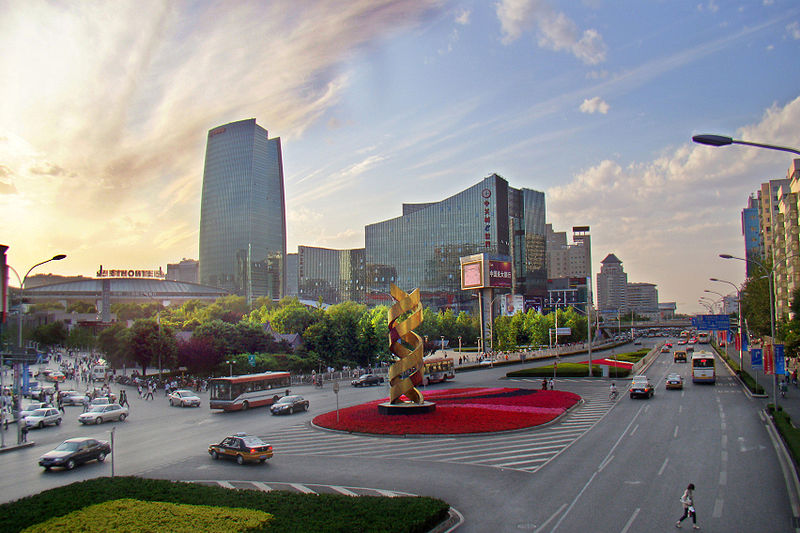
Shenyang 2007. The density of people crowding the sidewalk, stores spilling over the sidewalk to the edge of the street, the street itself compromised by the amount of pedestrians: the slum is full of people.

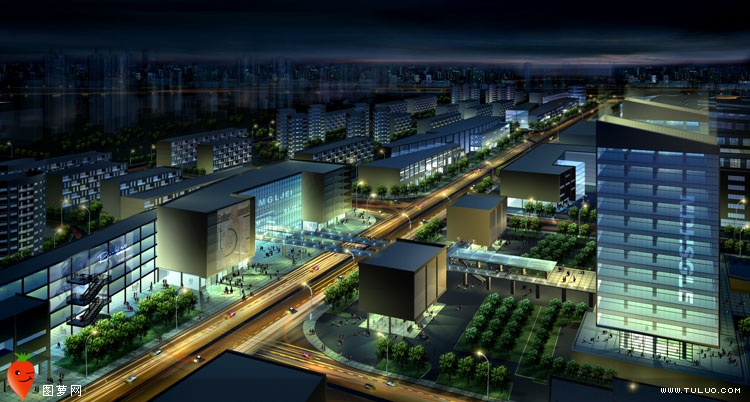
The slum is cleared, it becomes a park. The people are replaced by greenery. The streets and sidewalks are clean and clear.
http://liaoning.nen.com.cn/77971867083735040/20070724/2274213.shtml


The Dream:
The reality (Zhongguancun in Beijing)
The Dream:

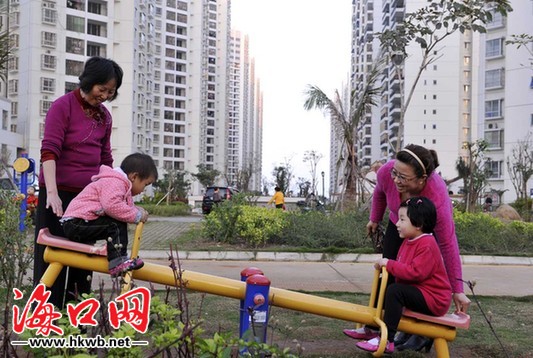
The reality:
Haikou
Shanghai
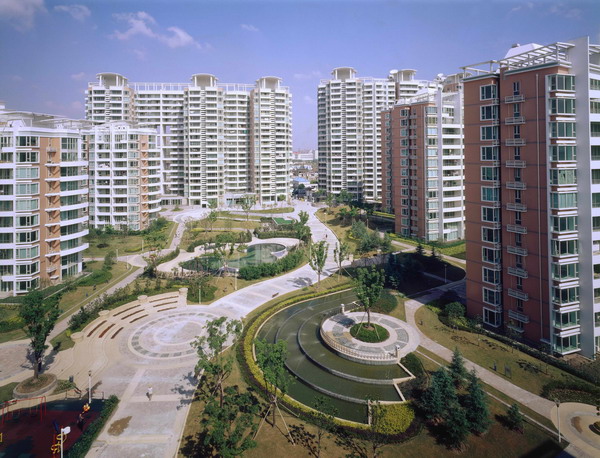
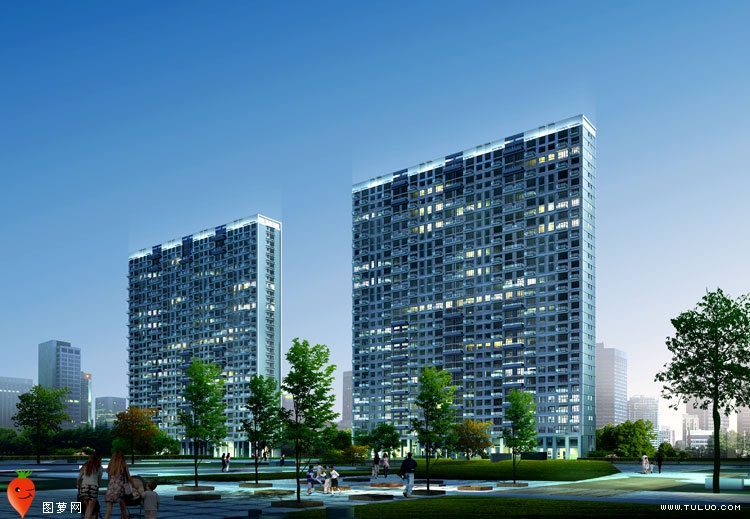
The Dream:
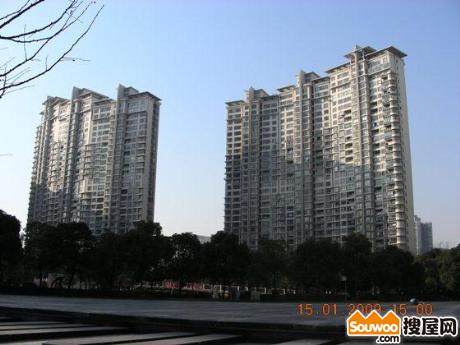
The Reality:
After “Sealed Villages”, is it going to be “Sealed Cities”?
News Center –China net 2010-07-30
Author: Xu Guangmu 徐光木
http://www.china.com.cn/news/comment/2010-07/30/content_20607126.htm
After instituting community management in Daxing, the same work will be undertaken in three groups of villages in Changping, involving 100 villages altogether. As a leading cadre in Changping stated, the first group of 44 villages will begin a pilot project. Among these are 15 villages in the Tiantongyuan and Huilongguan area, in which the population is 335,000, with members of the floating population comprising 275,000, close to 80% of the total. The main aim is to solve the public security problem ( Xinjing News 7-29)
In Daxing, 12 of the 16 inverted population villages in which a pilot program was launched at the end of the 4th month of this year, have had no criminal cases since the inception of the program. Since the result of “sealed villages” seems to be so striking, how can Changping, which suffers the same “damage” from inverted population, safely ignore this example?
Be that as it may, is it possible that there is a better method than sealed villages to solve the public security problem? A certain person said, if sealed villages is what we understand as village management, where will it lead? Does the countryside, as it once existed, have to continue to bear the weight of our nostalgia? The saying “close neighbors are more dear than distant relatives” calls up the scenes of local people in their neighborhoods in the Song dynasty painting “Along the River during the Qingming Festival.” For a long time we called our country Xiangtu Zhongguo, “Home-village China,” precisely because there was a traditional model of village management, in which fellow villagers helped each other. Now, having separated from that traditional practice, to use the name “community management” for what in the end is a sealed village, leaves us with no doubt that the village we recall with great longing no longer exists. The village has become another “urban society” in which peoples’ feelings toward each other are cold and indifferent.
A half century ago, the reason why we had a society in which law and order prevailed, putting aside the fact that it was an age in which everyone lacked material goods and there was no split between rich and poor, was that there was not the large scale population shift we see today. As long as there is a population shift, there will be public security problems. But, as the last ten years have shown, without the population shift, the economy would be stagnant, and there would be no hope of vigorous development in the nation. Therefore, to try and solve the public security problem by restricting the normal flow of the population (even including the normal coming and going of people between villages) in the name of solving public security issues, really leaves one with no leg to stand on. As it will be difficult to gain popular respect for the idea, it follows that it will be difficult to carry out in practice.
Sealed villages are not really necessary. Then, how should we solve the public security problem brought about by the population shift? Broadly speaking,the shift does not come about because people are fond of leaving their native place. Rather, it is because natural resources are not evenly distributed, and the gap between rich and poor has grown great. It goes to show that people flow from undeveloped areas to developed areas, from impoverished districts to well-off districts. Therefore, to solve problems brought about by the population shift, the essential point is to reallocate natural resources and wealth in a more equitable way. To avert the widening split brought about between the wealthy and the poor, is to get at the root of the problem.
Speaking more narrowly, sealed villages is just treating the symptoms of the illness. Although the sealed village strategy may mitigate the security problems of some few villages, can we apply sealed management to the whole city of Beijing? This obviously does not correspond to reality, and future development trends run counter to it. Therefore, rather than sealed villages, we can adopt some of the methods that have been effective, such as increasing patrols and registering residents. However, the key premise to a solution is to reduce the gap between rich and poor, and induce a more equitable distribution of the population.
远亲不如近邻 “close neighbors are more dear than distant relatives”
清明上河图“Along the River during the Qingming Festival.”
(http://en.wikipedia.org/wiki/Along_the_River_During_the_Qingming_Festival)
乡土中国 Xiangtu Zhongguo, “Home-village China”
In Changping District in Beijing,100 Villages to Implement Community Transformation Management — Credentials Needed to Go In and Out
Source: Beijing Times 2010-07-29
http://news.xinhuanet.com/local/2010-07/29/c_12384937_2.htm
Photo: After Shoubaozhuang village in Daxing implemented community management, residents need credentials to go in and out (file photo)
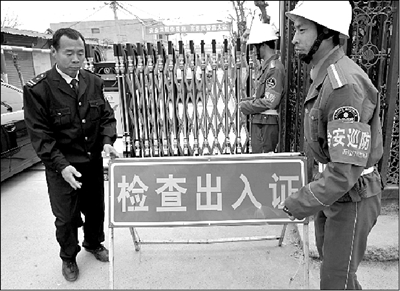
An enclosing wall constructed, a security gate, police box, people and cars stopped at a checkpoint. Continuing after Daxing District, Changping District is going on the path of village community management. Yesterday, this reporter found out from the Changping district government, that implementation would be carried out in 100 villages in the district. The first to begin a pilot program, starting in August, will be the 44 villages with an inverted population in Dongxiaokou town, Beiqijia town, Huilongguan town, and Shahe town.
Changping District will deploy patrolmen and floating population management personnel. They have been seeking applicants for 500 positions to assist public security. The important stress points in the villages, major streets and intersections, will be patrolled in all weather for 24 hours a day. Today the Changping public security has begun the first interviews with those who have applied and been accepted for the openings. When the complete number of recruits has been reached, they will begin the training. According to what this reporter has learned from the police, the successful applicants are men between the ages of 18 and 45, with a junior middle school education or above.
Each village implementing community management will synthesize the administrative effort into a central division composed of “three stations, two rooms.” The three stations are a Community Police Station, a Floating Population Management and Services Station, and a Public Security Patrol Station. The two rooms refer to a Civil Mediation Room, and an Inspection and Control Room. The Village Party Branch Secretary will concurrently become the head of this central division.
Many of the 44 villages in the pilot program are concentrated around Tiantongyuan and Huilongguan [neighborhoods with large affordable housing projects]. It is estimated that there as many as 275,000 members of the floating population in the area of Tiantongyuan, Huilongguan and Shahe, compared to only 60,000 permanent residents. This is a severe case of inverted population. These large scale communities offer many conveniences to migrants, but lead to an increase in public security problems. Recently, the city published a list of the criminal cases in the district, and one place stood out. The majority of cases occurred in villages on the periphery of Tiantongyuan.
This reporter was informed that a special study group was sent from Changping to investigate and learn from Daxing. After they returned they formed a vigorous leadership group composed of representatives from more than ten district government departments, to implement village community management.
Interview:
Reporter: What is the original intention of carrying out this policy in Changping?
Changping District Government Official: To ensure stability, promote harmony. We were inspired by the model of Daxing. Specifically, after Dashengzhuang village in Xihongmen town implemented the village community management, in three years there was not a single incident of a criminal case.
R: Will Changping just copy the Daxing model?
C: No, unlikely. We will take as a basic principle, “one village one strategy,” and not try for a meaningless uniformity. At present, everything is still in the planning stage.
R: How can you be sure the money will be there to implement this in the 100 villages as planned?
C: The district government will in advance appropriate 10,000,000 yuan [1,477,000 dollars] from the four towns to initiate the fund. After the community management is begun, according to what is necessary, the government will contribute 50% of further costs, sharing with the towns. It is unlikely the total cost for each town will exceed 25,000,000 yuan.
R: How will the government insure that there will be real results?
C: Those of the highest authority in each town, and those responsible for the effort, will at year end make an assessment –has it been successful or not? The responsibility lies with those in charge. After 9-20, the District Political Legal Committee will take the lead in assessing the progress of each village in the pilot program. If they have not achieved the criteria required, the leading cadre will be held responsible.
Viewpoints of different sides:
District government: Treating non-natives with bias is absolutely wrong
A staff member of the Changping district government said, The priority of this effort is to ensure public security, and to promote services to members of the floating population. It is not to treat non-natives with bias. “When people move from place to place too frequently they pose an inherent threat to public security. We have no choice but to act as we do.” A staff member said, at present, the details of the plan are still being drafted, but in time, both permanent residents and migrants will be brought under community management, and will not receive different treatment. Besides, the plan will alter according to the special characteristics of each village.
Residents: Community management means safety.
“As long as we are treated equally, it won’t be that bad.” Xiao Zhang is originally from Henan,and now lives in Zhongtan village with his family. In the village there are many migrants, and people constantly moving in and out. One constantly hears “At so-and-so’s house, something has disappeared.” Every summer, petty stealing goes on all the time. Xiao Zhang has lived in the village two years. He has not bought any large items, and does not dare to keep cash in the house. From what he has heard, the community management might be a good thing. But he worries that the policy might be directed only at migrants. “If that is so, it doesn’t matter what actions they take, we will just feel pushed out.”
Locally born and bred resident Mrs Zheng of Beiqijia town expressed warm support for the measure. “As an individual, I always have to worry about safety. Needing a permit to go in and out is a good thing. It will be much more convenient when everyone is checked.”
A sociologist: I suggest not building the enclosing wall
Beijing University sociology professor Xia Xueluan said that when the community management already developed in towns and cities is spread further to the village level, it will gradually bring about a more orderly life for the residents, and in that sense has merit. But there is also the matter of non-intervention in personal liberty. Building the enclosing wall is something which should be discussed further.
Xia Xueluan said, to strengthen public security one can increase the amount of patrolmen, exercise leadership to the residents, and also install security sensors. “But putting up an enclosing wall is like returning to the walled and moated city of antiquity. It is possible residents will end up disliking it.” For the measure to really work, the concept behind it must receive wide publicity and be fully explained to the residents.
On the scene investigation –a disorderly mess of privately constructed buildings everywhere– the woes of inverted population
Yesterday afternoon, this reporter went to Dongxiaokou town in Changping. He discovered that there is a disorderly crowd of villages north of Tiantongyuan. One can see privately constructed buildings strewn about in every direction. Small trucks come and go with a roar, transporting goods. Except for a few buildings near the city gate, the streets are a chaotic mess.
One tenant told this reporter, he lived in a three story building which a villager had built himself, just to rent out. The second and third floors were all composed of small rooms rented out to migrants. There were at times as many as 20 people living there.
According to a survey conducted by the Changping District government, of the 44 villages that will implement community management, the one with the smallest percentage of inverted population is Xiao Shahe village. The number of residents is 1217, the number of floating population is 1406: the ratio is 1:1.2. The most unbalanced place is Yantan village in Beiqijia. Permanent residents are 1893, migrants are 31,279, with a ratio of 1:16.5.
Background: The Daxing model receives the praise of Lui Qi
Dashengzhuang village in Xihongmen in Daxing was the first natural village to put into practice community management. On 7-3, Central Committee Political Bureau Committee and Beijing Municipal Party Committee Member Liu Qi, having investigated Dashengzhuang, said that the community management experience there would be spread to the whole city. He indicated that it was part of the plan to unify town and country in the overall development of Beijing.
Reporters Xia Mingqun, Wu Yini, Wang Penghao
东小口镇 Dongxiaokou town
北七家镇 Beiqijia town
回龙观镇 Huilongguan town
沙河镇 Shahe town
天通苑 Tiantongyuan
小沙河村 Xiao shahe village
燕丹村 Yantan village (in Beiqijia town)
中滩村 Zhongtan village
夏学銮 Xia Xueluan (professor)
Changping Community Transformation Management Draws Lessons from the Experience of Daxing
2010-07-29
http://news.sohu.com/20100729/n273839766.shtml
Source: New Beijing News 新京报
Carrying a pass to go in and out is a policy not directed solely at migrants
Starting 8-1, 44 inverted population villages in Changping will begin community management. The majority of residents this reporter interviewed said they were unclear about it, and needed to know more about its implementation before giving an opinion. But many tenants who had come from elsewhere were worried, as to whether it might be troublesome for them, and wondered if it would cause them to be treated with bias.
Zhongtan village is located on the Number 5 subway line near the Tiantongyuan stop, to the east of Tiantongyuan Xiyi district, in the vicinity of the Dongxiaokou district office. The Zhongtan village Party Branch Secretary said, with sealed management they could reduce the number of illegal motorbikes, and manage the floating population more effectively.
Yesterday at 6 in the evening, at the peak of the after-work rush, the roads in the village were filled to overflowing with people, and illegal motorbikes wending their way. By the side of the road were many small vendors. It was as buzzing with excitement as a country market. Garbage thrown down by the residents was everywhere.
The Zhongtan village Party Branch Secretary said, the original villagers in Zhongtan number a little over 1000, and those who have come from elsewhere to rent and have registered as temporary residents number over 30,000. Those who have not registered are about 10,000. This makes a total of 40 times more migrants than villagers.
One villager said, around here the principal income comes from renting rooms. Inside the village area on any space possible, a building has been built with rooms let to tenants.
In regards to “the village implementing sealed community management” most villagers know nothing about it. A villager named Mrs Shi said, she supports it, because the population is such a mix of people, and who knows what kind of people they are? The rate of crime is high, mostly petty theft, almost every day she hears of one or two incidents. Illegal motorbikes barge through streets, making accidents more likely. Once the sealed management starts, they can stop lawless persons from entering, and keep illegal cars and motorbikes out of the village.
Liu Mincheng, who came from Liaoning and rented a room in the village, said that requiring a pass to enter and leave did not do any harm. But she was worried this would lead to being treated with bias. She felt that over time it would come to have an unpleasant taste. “Who wants to feel like they are wearing a sign [identifying them as an outsider] every moment of the day?”
Proprietor of a small clothing shop Wang Yao did not support it. “Because prices here are pretty good, on weekends people come here from other places around Tiantongyuan. Some even come to do their laundry. If the village is sealed, they won’t be able to come in.”
According to the Zhongtan village Party Branch Secretary Zhang Liang, sealing off Zhongtan will be difficult. The village is large, its population is 40,000. There are several main roads in the village that are important communication lines, dividing the village into a number of sections. They will not be able to seal off these roads. Only certain parts can be really sealed off, and checkpoints at the intersections of these important roads.
Zhang Liang said, their village is famous for its high crime rate. Sealing off the village would help reduce crime, decrease the number of illegal vehicles, and help manage the floating population. To receive the support of the villagers, the village committee is seeking the opinions of as many villagers as possible. The majority have given their support. As for the cost, the money will come from the district government and the town. The village will not need to pay out anything.
After Daxing and Changping, will other districts carry out sealed management? Reporters of this newspaper have collected information on other districts which have a large floating population.
Shunyi District
The Shunyi District government office indicated that it was launching a pilot program of community management in the villages under its jurisdiction. The main aim is to provide public services for those villagers under the urban and rural unification project, to improve their living environment. It was really not a form of sealed management. If this pilot project gained the residents’ approval, it will be extended throughout the entire district.
Chaoyang
A leading cadre in the Chaoyang District government said, the district villages are currently carrying out a large scale land reserve plan [demolishing villages to make land available for development].Already the existing village structure has been smashed, and the villagers dispersed or relocated to other areas, therefore sealed management was not applicable. There is no plan to start a pilot project.
Shijingshan
Yesterday, this reporter was in Shijingshan, and found out that this district will at present not carry out sealed management. In fact, Shijingshan has already completed the removal of peasants out of their original residences. This year, three communities of Shijingshan were classified as ” listed up villages” singled out for reform to city level” [see note below]. This reform involves more than ten natural villages. Aside from these, the natural villages remaining in the district are not many.
[Note: ”Listed up villages.”
According to the Municipal Party Committee, this year the city government singled out 50 villages in which sanitation is poor and public security is in disorder, as places which will be “difficult at first but easier later.” These villages will be rebuilt as part of the city and countryside unification project. Because these villages are listed up as focal points of renovation to city level, they are called “listed up villages.”
Source:
http://news.dichan.sina.com.cn/2010/07/22/188506.html%5D
Chinese Academy of Social Sciences Rural Economy Research Fellow Dang Guoying said, under the present circumstances, village community management is an unavoidable step. In large scale neighborhoods like Tiantongyuan and Huilongguan, this kind of management will improve public security. But relying on sealed management alone will not solve the problems brought about by the population shift. The government focus should be on controlling the non-conforming buildings, not restricting the movements of the floating population. If they contain the spread of illegal buildings, public security incidents will naturally become easier to check.
At the same time Dang Guoying believes that community management should not be sealed management, as an enclosing wall which shuts people up in pens, but rather it should be something that offers better management and services to the people.
In three months, 12 villages under sealed management have zero criminal cases
As this paper has reported, at the end of the 4th month Daxing district launched a pilot project of sealed management in 16 inverted population villages. Yesterday, the Daxing police reported, that in 12 of those villages there have been no criminal cases since the program was instituted. Overall, criminal cases declined 73%, and emergency calls were down 46%. A government poll finds the people’s rate of satisfaction is now 88.5%, and approval of the living environment has reached 95.5%
Sealed Management — receives praise and criticism in hot disputes
The sealed management carried out in Daxing since the 4th month has received widespread attention. After some days of hot discussion, the phrase “sealed management” was quietly changed to “village community transformation management.”
“The villagers need to take the initiative and determine it.” A person in the Daxing district police and district government said, whether or not this new model is implemented is decided by the villagers themselves. Village community management is a new innovation. For this new model to spread, it requires each village to decide what form of management suits their own practical reality.
On the spot investigation
Dashengzhuang village already in 2006 put into place the basic elements of village sealed management. This year 4th month, the Daxing district public security bureau advocated this village’s management as a model to emulate.
The other day at nightfall, this reporter visited Dashengzhuang to take a look. At every entrance to this village there is a security person checking for passes. When this reporter approached, the security personnel simply handed over a notebook, which was for visitors to the village to write in their names, and their identity card number, along with showing their identity card. Compared to three months ago, the village was more neat and tidy. There was no trace of the piles of garbage that previously had been piled up by the side of the road.
According to a villager, criminal cases had clearly declined. They had set up 13 security cameras inside the village, everyone had to register, and there were patrols at night. “there are still small incidents of stealing, but these are by people in the village we already know well.”
A cadre at the village Comprehensive Management Center named Zhao said, we have executed sealed management to the letter. Because public security has improved, people from outside are happy to come live here, “at present, most available places are filled –there are hardly any rooms to rent.”
Laosanyu village “The pass performs no real function”
Sealed management in Laosanyu is not as strict as one might imagine. The other day at nightfall, the flow of people going in and out was quite large, more than 20 people a minute. When this reporter went in, no one inspected his papers. Pedestrians and cars were able to move freely in and out, there was no sign the village was sealed.
On both sides of the road there were small retailers and a large quantity of people coming and going. Voices were noisy, and garbage had been thrown on the ground. A Mr Ma, proprietor of a photo studio just 5 or 6 square meters in size, showed this reporter his pass, but said it had no real use. The sealing of the village was on the surface only. Before there had been inspections to see if things were carried out, but no longer. The gate used to be locked at night, but now it is sometimes locked, sometimes not.
Mr Zhang, proprietor of a cellphone store, said, “I go to sleep fairly late, and the other day in the middle of the night I heard a noise. I went to look, and a thief was forcing open the door to my shop.” Mr Zhang said, the sealing had had no effect on his business. However, he wishes the management was stricter. He did not want loiterers to be able to enter the village.
A staff member at the Village Comprehensive Management Center said the population of Laosanyu is too large, during the day the stream of people is quite huge. It is difficult to interrogate and examine them one by one. They only stop those that seem suspicious. Finally at 10 in the evening, when the amount of traffic decreases, they can check peoples’ identities one by one. The reason they are not more strict is simply that they do not have the personnel. The public security recruits are at present in the middle of training. When the training is completed, they will intensify the community management effort.
Reporters: Zhu Kaiyun, Jiang Yanxin, Liu Yang, Gan Hao, Wen Ru, Wei Mingyan, Li Liqiang, Shi Shasha. Trainee: Fu Lijia
顺义 Shunyi
石景山 Shijingshan
挂账村 “listed up village”
党国英 Dang Guoying
The Truth Behind Beijing’s Sealing the Village Management
Reporter Zhang Yanling 张艳玲
http://policy.caing.com/2010-04-30/100140248.html
The 954 commuter bus kicks up a cloud of dust at the Shoubaozhuang village stop, disgorging a crowd of dusty haired temporary workers. Dragging their exhausted bodies, at nightfall they return to their small rented rooms, rented for two or three hundred yuan a month. At night they rest and revive, then the next day head out again to the bustle of the center of the city
However, in the wake of Beijing’s “Sealing the Village Management,” the ability of these workers to go out early and return late is curtailed. Shoubaozhuang and Laosanyu are two of the villages in which the trial program was launched. An iron gate was put up, a long automatic pole at the crossing, a police sentry box installed. Though wearing the uniform of a patrolman, the person in the box is still a village cadre, calling out greetings to locals as they go in and out.
As the Laosanyu village party branch secretary Wang Changxiang explained, the essence of sealed management is “community transformation management.” At present non-native persons and vehicles must show permits to pass. Soon village residents will also have to get passes.
On 4-25, the Daxing district Public Security branch office held the “Spreading the Village Sealing Management Model Conference” in Laosanyu. Assistant Director Zuo Baoshuan said, starting from the initiative taken by the Jinxing police sub-station in March of this year beginning this as a trial program, the 92 villages in Daxing with an “inverted population” [migrants outnumber residents] will by the end of the year adapt this model.
However, public opinion in reaction to this was more negative than the government had expected. On 4-29 the Daxing district government held a press conference in response, stating that his measure was “community transformation management.” The villagers had themselves selected this model, and had chosen the details of how the sealing off would occur.
Laosanyu village is in Daxing district Xihongmen town. After the 5th Ring Road opened, easy access by public transportation and low prices for rent and other necessities drew many migrant workers. Those who had recently arrived in the capital from the countywide stayed in cheap places like this, passing their days selling vegetables and doing odd jobs.
The periphery of Beijing functions as a link to the countryside. Laosanyu has an “inverted population.” There are more than 6000 recent migrants, compared to 660 residents. Six or seven years ago, the residents made their living growing vegetables in fields. Now, their principle income comes from renting rooms to migrants.
The fact that the increase in migrants has become the chief source of income for residents, has led to social stresses. “Stealing, punches thrown, serious fights,” the village cadre Liu Xuezhu complained. Party Branch Secretary Wang Changxiang believes that the influx of migrants has not only increased the cost of village management, but exceeded what the village infrastructure could bear. Public health, roads, electricity, and water –these all need greater investment.
Therefore, the Laosanyu village committee applied for permission from the Xihongmen town government, to implement the sealed management, with the gates, walls, police boxes, 24 hour patrols, and permits necessary for outsiders to enter.
The community policemen and village committees in every village practice civil mediation, to overcome internal contradictions and mediate disputes. Mediation is at the center of what they do. They bring to fruition the adage,”small matters are not taken out of the village, large matters are not taken out of the town, contradictions are not turned over to higher authorities.” In every village, it is strictly observed that police and Floating Population Management personnel must be proportioned as 2.5% of the resident population and 5% of the floating population, responsible for village security.
A villager said, the permit is the size of a public transportation pass. To get one, a person must bring his or her landlord and identity card to a police sub-station. After following the procedure to obtain a temporary residence permit, the applicant uses this permit to apply for and obtain a permit.
Wang Changxiang believes that sealed management is an effective way of getting information about the non-native population. “Questionable people would not dare apply for a temporary residence permit.” A certain portion of the non-native population are idlers concealing themselves. Such persons, who “sponge off friends to eat three meals” are now unable to enter Laosanyu.
Sealed management is not entirely unknown to the village. During the unusual period in 2003 [SARS], the village first underwent sealed management, in which no one from outside was permitted to enter. In 2008 during the Olympics, sealed management was also temporary put into practice. “The first time it was putting up a rope, for the Olympics it was a pole, and now, a police box,” cadre Liu Xuezhu said half-jokingly.
However, for migrants in the village now, the way it affects them is not the same. Beside a line of rented rooms at the north end of the village, a young man named Liu said, “being surrounded by walls on all sides, and having constant patrols, feels like being inside a prison.”
Underlying cause: urban transformation
At the end of 2008, Beijing began a large scale effort to “unify town and country” linking together 753 square kilometers in a redevelopment. This involved the remaking of 227 administrative villages, and affecting 450 natural villages. The early stage of this project, starting in 2010, comprised 50 focal points of renovation in Chaoyang, Haiyang, Fengtai, and Daxing districts.
Wang Changxiang said that early in 2009 the effort to “urbanize the rural areas of Daxing” was accelerated. The plan to rebuild Laosanyu was set to start this year. But because of a change in leadership among the higher authorities, the effort was postponed to three to five years in the future.
Meanwhile, as more old buildings were pulled down in Jiugong and Hongfangzi [in Daxing] to the north, the floating population drifted south to Laosanyu. As the rooms available to rent were all filled, villagers began putting up second stories on their buildings. Some villagers just went ahead and built simply constructed buildings directly on the vegetable plots to the north of the village. In this way, buildings not conforming to code spread like weeds along the periphery of Laosanyu.
In 2009, the Xihongmen town government which had jurisdiction over Laosanyu village, repeatedly organized the forced dismantling of these non-conforming buildings. In order to restrict their spread, it went so far as to state that “the existence of illegal buildings and the salaries of the village cadres are linked together.”
By the end of 2009, Wang Changxiang said 60 percent of his salary was deducted, “the main cause was because of these illegal buildings.” He told this reporter, “We cadres cannot fully enforce the law. We can tear down illegal buildings on open land, but if a villager puts one up inside his own household compound, we can only try to dissuade him.”
“We want to control the influx of non-natives to the village, and preserve the village infrastructure in a relative balance,” said Wang Changxiang. By putting in place the “sealed management,” they reduce the number of new renters, thus effectively curtailing the chaotic building boom within private compounds.The villagers get less profits, but also have less disputes. And when the wholesale rebuilding of Laosanyu takes place according to the urbanization plan, the net cost will be less [fewer buildings to dismantle].
“Next year we will start pulling down buildings for the urbanization. We will tell the villagers who want to build something, you will never realize your investment.” The cadre Liu Xuezhu explained.
Wang Changxiang has a mental blueprint of the future Laosanyu. They will remove the peasants by tearing down their old houses and relocating them to better public housing, and they can build there an ecological green park. As for the remaining land, the government will change its status, invite bids and auction it off to be developed as a more concentrated residential district. At present the highest price paid for a hectare of land in Daxing is 1,900,000 yuan [approx. 280,000 dollars]. If 600 hectares of land in the village is sold, after the various levels of the government have taken their percentage, the village will still have 2 or hundred million yuan [44 million dollars] left over.
In Laosanyu now the roads are uneven, the buildings by the side of the roads small and shabby. But if one inquires if any room is for rent, the answer is always, “No, they are all full.”
At the corners of intersections in the center of the village, there are scattered piles of old bricks on the roadside, and next to these ponds of liquid cement — evidence of the villagers’ building fervor.
In conclusion, the purpose of “sealed management” is not just to assist public security, or to relieve pressure on the environment, etc.The hidden cause behind sealed management, which most people do not know, is to prepare for the forthcoming urban transformation and dismantling of villages such as Laosanyu according to the urbanization plan.
Aftermath of the Village being Sealed Off
At the clamorous and noisy village entrance, a long line of people queues up to pass by the public security gate. Inside the police box, a crowd of people wait to receive a pass.
The Laosanyu village head Guo explained that those who make up the police patrol groups and officials in Floating Population Management are all villagers who have passed an exam, and are chosen by the Public Security Bureau. Besides that, the town gives each and every village resident a monthly subsidy of 400 yuan, which is taken from the funds collected as the “public sanitation fee” and “water use fee.” Aside from 11,000 yuan given to the village committee, the rest is returned to the people.
The village committee set the public sanitation fee and water use fee at 30 yuan a month, but considering the number of migrants, they temporarily reduced it to 10 yuan a month. “Before, we had no way to count how many outsiders there were, but now we can use registrations for passes to gather our statistical information.”
The villagers are universal in not taking the sealed management seriously. “Previously the village was sealed off for May 1 or National Day, but not for long” they said causally to this reporter.
Now that they are no longer able to build wherever they want, some villagers have taken advantage of the sealed management and gotten jobs as patrolmen. But as for the 6000 migrants, their rents are on the rise. Those coming into the village are fewer, and the shops have less business. “If the environment has improved, rents should rise a bit. Those who can’t afford it will leave, and migrants with a higher income will stay and live here.” Liu Xuezhu believes this is a proper way to control the flow of incomers.
Laosanyu still has more than 600 hectares of farmland, which the residents mostly rent to migrants to farm. A small part of it is lent out to build cheap rental housing on. Li Lian, who built on a vegetable plot to the north of the village, is worried it will be torn down soon. “I put it up the fourth month of last year. At least if they wait two and a half years I’ll get my investment back, but if they tear it down now, my money will not come back to me.”
In fact, as Beijing urbanization expands from the 2nd ring to the 6th ring, the floating population is driven outward, away from the very urbanized areas they have had a hand in building. The most recent tenants in Laosanyu, have just rolled up their traveling bags and arrived from Hongfangzi, a place just slightly closer to the center of the city.
At present, in Beijing the floating population is 5,090,000. In Daxing there are 591,000. It is one of four districts in which the population is “inverted.” Among these, 85 percent live in the five northern towns of Daxing.
A prominent cadre in Daxing pointed out that most of the floating population in Daxing work in low skill labor intensive jobs in garment factories, food services, construction, small industrial plants, and waste recycling. While those in urban management see them as a “low end” population, every day they provide essential services to Beijing city, to such an extent that when this population goes back home for New Year’s or other festivals, the city inhabitants feel quite inconvenienced.
The five northern towns of Daxing (Xihongmen, Jiugong, Yinghai, Huangcun, Yizhuang) are about to adopt the sealed management model. Altogether 92 villages are going to implement this by the end of this year. As this happens, villages like Laosanyu will cease to take in more of the floating population. With the upcoming “urban transformation” members f the floating population will be pushed further and further out. Can they find any secluded nook anywhere in the city from which they will not be soon banished?
丰台 Fengtai
旧宫 Jiugong
红房子 Hongfangzi
瀛海镇 Yinghai town
黄村 Huangcun
亦庄 Yizhuang
Beijing peasants and laborers kneel down before Secretary-General Hu Jintao and Prime Minister Wen Jiabao in a cry for help!

2012-04-04 reporter Wei Min
Yesterday, in Beijing Daxing district Xihongmen town at the Shoubaozhuang village industrial park, more than 10,000 laborers, because the factories they worked in will be demolished by the Shoubaozhuang Village Committee, all lost their jobs. The lawfully operating businesses inside the industrial park met many times with the lessee Nan Yuhua, but were threatened by gangs of unidentified men. The police were no use! No help from anywhere! Their lives and property were under no protection. They are forced to kneel down before Hu Jintao and Wen Jiabao, asking for their attention. Give them a way to make a living!
It is reported that Nan Yuhua is a representative for the Beijing Xingdashun Waste Recovery Company, which is the landlord for all the 10,000 tenants of the Shoubaozhuang village industrial park. His son Nan Chao, raised the gang, his son in law is the leader of the more than 100 members concealing their identity, and Nan Yuhua himself crazily said, “I’ll have you die by 6 o’clock. You won’t be alive past 6:10!
We ask people from all parts of society, whoever you are, and friends in the media, to give support to and save these laborers.
http://www.chinamwcn.com/Html/?7849.html
2012-06-01
Beijing Daxing: their businesses to be demolished by force, the tenants purchase several hundred containers of gasoline to all go up in flames together
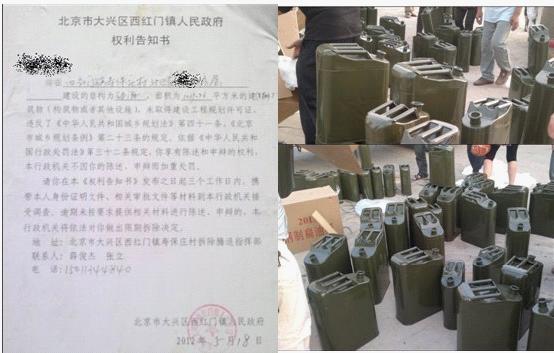
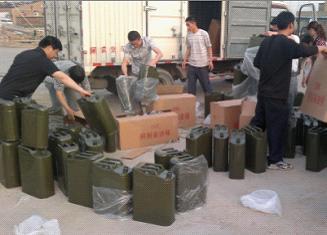
Reporter Wei Min.
Yesterday, this reporter learned that all the businesses in Beijing Daxing district Xihongmen town Shoubaozhuang village industrial park, to protect their lawful rights and interests, have prepared more than a hundred containers of gasoline, and are ready to incinerate themselves, die, and by their deaths to resist the demolishing of the industrial park.
In the Shoubaozhuang village industrial park, there are approximately 400 legitimate businesses, with 30,000 peasants and laborers who have jobs there, every year paying to the local government several 10,000s yuan in taxes. Recently, without any reason, the Shoubaozhuang village committee suddenly decided to tear down the industrial park.
On 2012 5-18, a notice, stated to be from the local government, was posted all over Shoubaozhuang village industrial park, saying that according to the stipulations of the national urban and rural plan, and the Beijing city urban and rural plan, that all the buildings in the industrial park would lawfully be torn down within three days.
According to the peasants, laborers and business proprietors of the industrial park, they had jointly made a lease agreement with the principal lessee Nan Yuhua, some for a period of 20 years, some for 30 years, and they had built the buildings on the land in conformity with the rental agreement as an investment. To date nine years have passed, and they have operated businesses with lawful business licenses, they have no idea why it is suddenly claimed their buildings are non-conforming?
To get a business license one must show proof of property rights, so how can the buildings in the 700 hectare industrial park be illegal if they have legitimate business permits? For over nine years the peasants, laborers and proprietors have supported each other. Now, in despair, they have bought several hundred containers of gasoline, and as their last act of solidarity, they will die together to resist the power of the state!
konjaku: After posting about Shoubaozhuang village community transformation management in 2010, I searched for more recent news about the village. Was Shoubaozhuang village going to be allowed to continue to exist as it was, or would the end result of becoming a “sealed village” be its demolishment and replacement as something else? There are predictions it will be demolished, as there are of many similar villages in Daxing and other areas on the periphery of Beijing city. In the meantime, I came across this incident, still unfolding.
This “industrial park” seems to be made up of small factories without much capital. In 2009, a garment factory fell behind on its rent, and the industrial park tenant organization in the night piled a mound of bricks in front of its entrance, blocking vehicles from getting near it, to “encourage” the owner to pay back rent. One can imagine a number of reasons why the Shoubaozhuang village committee decided this industrial park was an obstacle to cleaning up the village, but abruptly declaring it would be demolished brought on the possibility of a violent confrontation with the authorities.
The ostensible justification is that the industrial park buildings violate the “Law of the PRC on Urban and Rural Planning” under which (Article 41) every new development must first be submitted and found to be in accord with the urban and rural plan, before receiving a license which would enable the developers to build. (http://www.china.org.cn/china/LegislationsForm2001-2010/2011-02/11/content_21899292.htm)
This law went into effect January 1 2008, sometime after the industrial park was first developed.
The corresponding Beijing City law, (http://e.bjeit.gov.cn/Policies_Regulations/201107/t20110725_16524.htm) Article 23 begins, “All land for construction and construction projects shall conform to the urban and rural plans and be subject to the permit for planning.” This law went into effect May 2009.
In the Inverted Population Villages, what Managing goes on under “Community Transformation Management?”
Source: Beijing Daily 2010-07-12
http://www.cnr.cn/allnews/201007/t20100712_506722047.html
Photo 1
The Shoubaozhuang village entrance, in perfect order
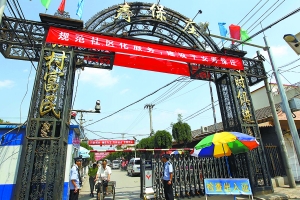
Photo 2
Kang Chunjing has been selling fruit for three or four years. Nowadays, she makes 3 to 400 yuan a day

Photo 3
A staff member records and puts on file the villagers’ registration, in order to strengthen population management
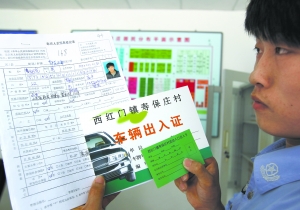
Photo 4
Shoubaozhuang village uses advanced methods in its community management effort

Dashengzhuang, Laosanyu, Shoubaozhuang. These villages in the southern outskirts of Beijing, which no one had heard of before, suddenly became the object of heated interest and controversy. Several months ago, these villages with “inverted populations” were sealed off as they implemented community management. “Inverted” means that migrants outnumber the original residents. The words “sealed off” caused people to wonder, how could these villages which had been open to the world since ancient times be simply “sealed”shut? Is it possible they would restrict people from going freely in and out?
Last month, this reporter visited the area for several days to investigate. In Laosanyu, when the controversy was brought up, villager Zhang Dama answered with a laugh, “How can it be a bad thing? Our village more and more is like a community within the city. It is clean, secure, stronger than before.”
Riding the 954 commuter bus , this reporter set out for Shoubaozhuang village. As the bus entered into Daxing district, it stopped frequently at a number of villages. The ticket seller had been back and forth on this route more than a few days. “Look! Sanitation in that village is very bad, it can’t compare with Shoubaozhuang.” I looked where she pointed at the villages along the way, and saw piles of garbage by the side of the road, bicycles and cars parked at will in front of house doorways, dogs and chickens wandering about, cars stirring up dust as they flew along the village roads.
Shoubaozhuang village is near the southern 5th ring, subordinate to Xihongmen town. At the main entrance to the village, two iron gates are open wide. A perfectly straight road runs north/south through the village. On both sides of the road are neatly marked out parking spaces.Although there were many family businesses near the city gate, there was not a crumb of garbage on the road.
“Hello, may I ask if you have a pass?”As I got off the bus and prepared to get a thorough look at the village, a public security person stepped in front of me and blocked my way. After taking the serial number of my identity card, he let me go through. It was 3 in the afternoon, and many people were away at work. The village was quiet and calm. There was only a group of old people doing fitness exercises under the shade of a tree, some chatting with each other. When asked about the change, Mrs Wang Yizhi paused in her waist bending exercises and replied, “Since the community management started, the village environment is much better. Everyone is satisfied!” She said that the village leadership had gone to the city to observe and study the methods of community management, and when they returned they set it up this way: the entrance gate, ensuring public security, keeping thing clean. Besides that, they supplied the exercise equipment, making it easy for everyone to keep fit. “Because the environment is better, it has attracted many new businesses.”
This year, with the city extending southward, there are many people like Mrs Wang who were looking forward to an improvement in their living conditions. But while things around them were changing quickly, Shoubaozhuang was still a traditional village. Because rentals are cheap, the cost of living is relatively low, attracting many migrant workers. Before long, the number of migrant workers exceeded the original population of the village by 12 times.
With more people, more problems. The village environment became dirty and disordered, all sorts of people came and went frequently. Relations between people were not as simple as before. The village police felt they could not handle the situation with such an influx in the population, and life in the village lacked a sense of security.
At the village comprehensive management center, this reporter happened to meet Zhou Youlin, who had come to Beijing as a laborer. The Jinxing substation policeman Song Xiaogang had just transacted a Temporary Residence Permit for him. As a non-native, he did not think the community management was in any way bad. On the contrary, it made things more convenient. Previously in the village where he lived he had to make a 20 kilometer round trip to get to the nearest police sub-station, but this time, since this service was available here, he did not even have to leave the village.
In places where city and countryside come together, it is usual for the peasants to rent rooms to the large population of people coming from outside the area. This is not unique to the Daxing district. Because the village residents received monthly rents as income, they did not think much about the increased pressure to the village infrastructure. Now that has changed. Since community management has started, it should work to alleviate some of these problems. A villager named Ma told me, in her house they rent out five rooms, and receive a monthly income of 1500 yuan. However because the amount of electricity used in their house has increased sharply, especially in winter and summer, their old circuit breakers trip, and many of their electrical appliances are damaged by power surges. Up to now they just had to endure it, but she thinks that with the present community management, the electricity capacity problem will somehow be settled.
Businesses that have moved into the village are worried about the entrance gate. People cannot just enter the village casually, customers will be fewer, business will worsen. A Laosanyu village woman proprietor who sells roast chicken said that besides those inside the village, they formerly had business from passersby. Formerly she could sell 30 or 40 roast chickens a day, but now business has fallen off. But what is interesting about this, is that all the small businesspersons this reporter interviewed, including this woman, were not thinking of moving, even though business was slack.
The proprietor of Fumao Household Electrical Appliances said that because of the community management, he had moved his business to Laosanyu. His salesclerk thought he was crazy –the rent here was 100 yuan a month more than other villages. The salesclerk found that although customers were a bit fewer, the store still managed to do all right. She said, “In the other location, every month we lost something when a petty thief came into the village. It was impossible to stop.” She pointed to the shelves of DVDs, the soy milk machine and other small home appliances. These items ranged from several tens to several hundred yuan. They didn’t put these on display before, because they were easy to steal. All the thief needed was an accomplice to distract their attention for a moment, and the item was gone. In a month this amounted to a loss of 1000 yuan. The proprietor said that now that public security is accomplished, and there are patrolmen on every street corner, his mind is assured. Although customers were fewer, he felt his business would not lose money.
The restaurant owner Wang Dage said, “Previously in summer we set up outdoor patio seating, but we worried that the customers who came would drink and cause a disturbance. Now, public security manages things, so those who might create a disturbance restrain themselves. He believes that now those who come to the village looking to rent will be more rather than fewer. “With this many tenants, they will need to eat meals, so how can business be bad?”
A comrade at the village comprehensive management center said, “In the past, homeowners only thought about making money, and paid no attention to the identity of their tenants. This only poisoned the village atmosphere, and caused a drop in the sense of security among villagers. Renting rooms, doing business: these have an effect on the economy, but also an effect on society. The key is whether these effects are beneficial to everyone in the long term. In society, the idlers who drift from village to village are actually few. The problem is to influence the majority of people who have many needs — if there is a room they rent it, if there is a business to do they do it. If we can explain to them how this management can change their present condition for the better, these people will accept it.”
In Daxing, there is a village that started this sort of community management already four years ago, namely Dashengzhuang village. At that village, this reporter happened to run into the village party branch secretary Li Wujiang, buying something at a small shop.He said, “At that time we were going through through the SARS epidemic, and considering how to continue to prevent the spread of disease, we just put up a large gate at the village entrance and made everyone show a pass to enter.” Unexpectedly, this method of preventing the spread of disease became the way for the village’s sense of security to “recover,” and since then, this village has not had the recurrence of a criminal case. Last year Chen Debao became director of the Public Security Daxing branch, and he forcefully advocated the spread of community management in the district. Li Wujiang, who had not thought deeply about it before, realized that the experience of Dashengzhuang village was already an example of this method.
“Of course, the government only puts forward the idea. The villagers in these self-governing villages have the final say on whether to put it into practice or not.” However Li Wujiang believes those non-natives who now live in the village should also have a say in important matters concerning the village.
Not long after that, Xihongmen town convened a special conference of all the village branch secretaries. They came to a consensus, and together raised 30,000,000 yuan in capital (4,400,000 dollars) to fund the village community management. “The government puts out the main part. The people do not need to pay anything, but they enjoy the results. Who would say no to that?” Li Wujiang wasted no time. He returned to the village and immediately convened a meeting of representatives. Besides the villager representatives, he selected representatives from the non-natives –1 person for every 20 households.
The first item on the agenda was whether or not Dashengzhuang village needed to go a step further with community management or not. The good results of the last several years were plain to everyone. Therefore, without opposition, all 32 members voted to adopt the measure. Enthusiastically they began to deliberate what concrete steps they would take. What responsibility the patrolmen would have, what hours the main gate would be open or shut, what sort of pass would be required. Up to now the villagers had depended on their own wells for water, but the water quality was not good. Instead they would change to a public water corporation. Everyone would pay a 5 yuan water fee a month. Public health would make a united effort at sanitation work, the vehicles collecting trash would increase from once to four times a day. If more money was needed, the government would subsidize it. If a non-native resident was handicapped, the water fee would be exempted.
When everyone participates, everyone benefits. But the way of doing things can sometimes lead to misunderstandings. They made a regulation that a sign saying “Rented Room” had to be posted on the door of every rented unit. Chen Guiliang, from Guangxi, had a negative reaction to this, seeing it as a type of discrimination. But the truth is the posting of this sign simply made it easier for the patrolmen and persons involved in floating population management, to understand that this was a place where a non-native lived. They could then set a fixed time to drop in and check on fire safety, or drop off some informative materials. This did not mean someone would stare at him 24 hours a day. After understanding this Chen Guiliang decided not to move away. He and several acquaintances instead became more interested in village matters. When they heard that security sensors were going to be set up, Chen Guiliang and several other non-natives took the initiative to go to the police and tell them where the weak points in the village were, from a security standpoint, so they would know where to place them.
Community Construction in Villages and Small Towns — a Gradual Process
In rural areas provided with the right conditions, some villages and small towns have implemented community management, and in many provinces and cities there are experiments underway. An official in Daxing gave this reporter data on two such places: Chifeng city in Inner Mongolia, and Gongsheng in the Yao Minority Autonomous County in Guangxi. What is striking about the community management in these places is that it involves a comprehensive set of measures to strengthen the community, and the building of public service facilities in rural areas. The intent is to provide publicity for local businesses, social aid services, synthesis of government departments, mediation services, clean-up of the environment, and opportunities for literary and recreational pursuits. In rural areas, community management involves bringing the social services and facilities developed in the cities to the villages.
However, Daxing is a special case. Beijing, as a large city, is a powerful attractive force drawing all different types of people. Safeguarding the social stability of Beijing must be part of the equation. Professor Wang Taiyuan, a specialist at the People’s Public Security University, has done research on the ongoing community management effort in Daxing. He emphasizes that the most important thing for Daxing is to establish good public security. “In other provinces and cities community management has meant strengthening public services in the rural areas, but Daxing is different. Many of the villages have inverted populations, and most of the original villagers no longer practice agriculture. The villages have already shaken off the older concepts, and are ready to develop into communities [become urbanized]. To refer to community management as creating ‘sealed villages’ in therefore a misnomer. Rather, these villages are focal points in the community management of Beijing as a whole.”
流动人口倒挂村 inverted population village, with the floating population in majority
寿保庄村 Shoubaozhuang village
老三余村 Laosanyu village
konjaku: In July 2010 western newspapers filed stories about villages around the periphery of Beijing with large migrant populations being sealed shut, using newly installed gates manned by guards.
People were required to obtain permits to go in and out of these villages. The Beijing administration called this new policy “sealed management.” The purpose was to cut down on crime and general social disorder. In the western media, this was seen as another example of the Chinese government using heavy handed tactics against those already socially disadvantaged. In the Chinese press, sealed management was touted as an effort to save the villages from destabilizing outside influences. The policy was not readily accepted, and against a rising tide of skepticism and criticism, the Beijing administration, which “spares no pains to be low key” quickly changed the name of the policy to “community transformation management.”
An article in Caixin by Zhang Yanling uncovered an underlying reason for sealed villages which no one else had seen: this was a step in the Unification of Urban and Rural development plan (described in the previous post). The sealed villages were villages slated to be demolished and turned into green zones or scientific industrial parks, the former inhabitants relocated into residential towers. Sealing them was not to save them in their existing form, but to freeze them in place, without any further influx of migrants, until they could be torn down.
I first post a number of stories on sealed management which appeared in the Chinese media in 2010.These have interesting bits of social detail. Then I will go on to Zhang Yanlin’s article.
Liu Qi and Meng Jianzhu affirm that the Beijing city Daxing district “Sealing the Village Management ” shall be extended to the whole city
2010-07-05 Xinhua Net/Beijing Times
The village surrounded by an enclosing wall, secured neighborhood gates, the entrances to roads with less traffic sealed off, checkpoints causing people and cars to show permits to enter and go out. This new type of community management in the natural villages that have arisen in Daxing district is inspiring hot debate in society at large. This reporter learned yesterday that the Central Committee Political Bureau Committee and Beijing Municipal Party Committee Member Liu Qi, and State Council Member and Public Security Minister Meng Jianzhu a few days ago went to Daxing district Xihongmen town to investigate, accompanied by the Beijing Mayor Guo Jinlong.
As for the management effort to carry out a “village community transformation” in Daxing, Meng Jianzhu gave his full assent. He said, in the wake of the recent fast-paced economic development, the floating population has greatly increased, bringing about many city management problems. This new model of bringing about community transformation management in the villages is a positive and vigorous attempt to analyze and investigate ways of dealing with difficult problems. He hopes the action taken in Daxing will be pushed forward and further explored.
Liu Qi said, The model being carried out in Daxing is being developed into a comprehensive plan for Beijing as a whole. He said it improves management efficiency, cuts down on criminal cases, improves the village environment, and increases the peoples’ sense of security.
On the Scene
Daxing district Xihongmen town Dashengzhuang village was the first place this new model was put into effect. As with other such villages, there is a checkpoint at the village entrance. People on foot or in vehicles must produce a pass to go through. At the village entrance Liu Qi picked up and examined a certain person’s pass. Below the registration information there appeared the person’s name, gender, ethnic group, as well as his or her place of origin, occupation in Beijing, identity card number, and cell phone number. He attentively questioned the patrolmen on duty, “Is this your only job, or do you have other responsibilities? How many are on your team? Is someone always here for 24 hours?”
An official cadre in the Daxing Public Security branch office said, Dashengzhuang village is one of those in Daxing in which the phenomenon of inverted population is the most severe. Members of the floating population number more than 2400, outnumbering permanent residents by 7 to 1. Public security problems are prominent. But putting up the enclosing wall, secured gates, police boxes, etc, has resulted in zero incidents of crime in three successive years. The 16 villages of Daxing Jinxing area have all put into practice this community management. The patrolmen and officials involved with the floating population altogether number 414.
Yang Guimei is a long time resident of Dashengzhuang village. Inside his household compound there are five buildings, rented out to nine people. Liu Qi opened up and looked at the documents Yang Guimei has put together concerning his migrant worker registration. He asked about what procedures Yang Guimei follows when he rents. Are you required to file with the Floating Population Management branch office? Do your buildings conform with the standards for renting? Yang Guimei produced a booklet detailing his responsibilities as a landlord. In winter there must be heat, in the rainy season the building must be secure and dry. Only after signing an agreement at the Floating Population Management office, is he allowed to rent. “Are your tenants satisfied with the state of public security here?” Liu Qi asked. Yang Guimei pointed to a bicycle outside. “You see that bicycle?It has been put there for several months. Before no one would dare to leave it for an hour –it would be gone!”
“The higher ups praise us” The Daxing Party Branch Secretary Li Wuxiang happily told this reporter. They have put more than 20 people into this community management effort. Some are on duty during the day. Then at night after they seal off the area, patrolmen take their shifts. The whole village is secure for all 24 hours of the day.
Li Wuxiang said, there is a portion of the floating population who engage in selling snacks. They do their best to keep from having an effect on their livelihood. The village allows them to set up stalls outside their stores at night, and to solicit business. The village residents used to complain that cars passing by at night harassed them. Now, with the community management, cars cannot drive through the village at high speeds, and the villagers can sleep soundly. Based on the residents’ suggestions, use of cars in the village has been limited, and parking is only in designated areas.
Reporter Zhang Ran, from the Beijing Daily News.
大兴区西红门镇 Daxing district, Xihongmen town
大生庄村 Dashengzhuang village
封村管理 sealed village management
社区化管理 community transformation management
konjaku: I hope to follow up in detail various aspects and histories pertaining to this massive project of urbanization in the outskirts of Beijing. How do the inhabitants of villages soon to be demolished deal with their situation? What happens after their villages are demolished? The overview is described in this wonderfully incisive article which appeared in Caixin.
Requisitioning the Land, Demolishing Houses and Removing the Inhabitants –will this Logic behind Beijing’s Urban Expansion be applied to the Whole Country?
Source Xin shiji (New Century Weekly Magazine) Caixin
2010-04-26
Reporters Gong Jing, Zhang Yanling
If you open a map of Beijing, before one’s eyes there clearly appears a diagram of expanding concentric circles. Taking the Forbidden City as the center, there is the Second Ring, Third Ring, Fourth Ring…circle after circle, marked by the Ring Roads, expanding ever outward in layers.
The peasants, and migrant workers have been waging a dispute with the government over the tearing down of non-conforming buildings for almost ten years now. This structure of expanding circles has been continuing since 1949 till today.
But nowadays, Beijing is undertaking a new urban transformation. From the end of 2008, the Beijing city government has decided to remake the rural periphery, under the rubric, “Unification of urban and rural.” They will tear down and rebuild several hundred villages that are “inside” the city. The timetable for this has already been formulated. Already in 2010, 50 villages are on the point of being demolished.
This will be a huge engineering project. The development zone will comprise half again as much as Beijings current area. The project will affect 620,000 registered permanent residents, and 2,800,000 members of the floating population.
This will be a difficult project. In recent years, demolishing and relocating the inhabitants, and requisitioning land, has exposed one of society’s largest contradictions. To gain the attention of the authorities, there have been incidents of protest, some going so far as to incinerate themselves. There is an expectation that the capital should be “the best of places,” but the cost of this is unendurable. At the same time, real estate prices have gone up rapidly, and the net cost of dismantling and relocating has sharply risen. There is a battle for any and all existing land, straining the capability of the finance and taxation system to adopt to the changing conditions.
Confronting the population increase and the powerful demands of urban transformation, the Beijing city government has a powerful motive for bringing to completion the new urban plan. Constrained by actual conditions, and peculiarities of the economy and politics, the Beijing government has been forced to try for an audacious breakthrough.
Yet the Beijing city government always spares no pains to be low key. This time, as opposed to the previous traditional form of demolition and relocation, the government has cautiously picked two new models as improvements on the old: the Dawangjing model and the Beiwu model.
Dawangjing is in the Chaoyang district, Beiwu is in the Haidian district, both are ordinary villages. The Dawangjing model is to increase compensation to the villagers being relocated, and to explore the possibility of giving them a share of the future profits for ground rents in the redevelopment. The Beiwu model is to allow the villagers to have a say in the urbanization process, and through control of village collective land, to partake of the gains of urbanization. Anything beyond this, and the situation becomes extremely complicated.
Although these two models are different, in the tidal wave of urbanization, they both represent a beneficial outcome in the match being waged between the government and the people. But the Beijing government is faced with a complicated situation. The administrative systems of the past, both new and old, with their own histories of development, are already in place. There is the system of the already existing urban plan, the land system, the finance and tax system, etc, etc., constraining their freedom of action. In addition, there is the objective reality that city and countryside are structured differently. The government’s methods and outcomes often run counter to the peoples needs.
A discerning person said, the Beiwu model clearly subverts the above mentioned systems. The problem is, given the special characteristics of Beijing as the capital, it can only be applied on a case by case basis. It cannot by itself completely undo the internal logic of dismantling and relocating as it currently exists, and it will be difficult to apply to other areas of the country.
When all is said and done though, the Beiwu model actually exists now. In the surge of the future it may become deformed or aborted, but it will be a reference point for the urbanization process throughout the whole country.
In the 4th month, at Yuquan Mountain in the northern suburbs of Beijing, there is still a nip in the air. Several hundred meters below the mountain, workers are finishing the construction of a 30 hectare green garden space.
It is hard to believe that just 10 months ago, there was a village of over 20,000 people living their lives here. 2009-06, this was the first pilot project of the Beijing city “unification of urban and rural.” This village with close to 1000 years of history, called “Beiwu village” was entirely demolished.
The scale of transformation is unprecedented. The 50 villages to be demolished in 2010 comprise an area of more than 100 square kilometers. 2010 will see the largest amount of demolition. Over the next several years, in all directions around Beijing, 450 natural villages (within 227 administrative villages) will be completely made over, a total area of 753 square kilometers. When the plan is completed in 2020, all of these villages, in the districts of Chaoyang, Haidian, Changping, Shijingshan, Fengtai, and Daxing, will be no more. Beijing City will be larger by one half its present size.
In the eyes of many Beijingers, the government has begun a new “city creation movement.” But in fact, since the start of the period of reform and opening to the outside world(1978-1992), this trend has been continuously getting stronger. Beijing, accelerating its outward expansion, like a caterpillar eating through town and countryside, has been unceasingly expanding its territory in “spreading out the flatbread” style.
In 1991, Beijing initiated a master plan, expanding its development zone from the 395.4 square kilometers of 1990 to 491 kilometers in 2000. The city proper was within the four loop roads. In 2007, the city area was 1289 square kilometers, ten times that of 1949, and two times larger than the 490 kilometers of 2000.
As the next round in the ongoing process of the “city creation movement” Beijing at the end of 2008 began the experiment to fully merge urban and rural. That year on 12-30, the Beijing Municipal Party Committee released a document, called “ Ideas regarding the Beijing Municipal Party Committee taking the lead in developing a new pattern of economic and social unification of the urban and rural.” This became the operation plan for the next large scale demolishing and relocating action.
The document stated that, in order to succeed in hosting the 2008 Olympics and Special Olympics, Beijing had already entered into a new development phase, from being a second tier developed city, to a fully developed city. It was necessary to go a step further in accelerating reform and development, and do away completely with the city and countryside as two entities structured differently from each other.
The main points of the document described how the joining between urban and rural would be remade. Since entering the new century, Beijing had already become a world class developed city, but insufficient linkage between city and countryside was an obstruction to the form of the fully modernized city. Therefore, based on the “unification of urban and rural blueprint” in the document, no matter what the overall arrangement of building, management, infrastructure, and social services, these would all be funneled into urban and rural unification.
Shortly after, the demolishing and relocating began quietly. The rate of advance was rapid. By the beginning of this year, demolishing and rebuilding in Beiwu village in Haidian, Dawangjing village in Chaoyang, and Jiugong in Daxing, were all close to completion, and the embryonic form of the new city was emerging. In Haidian the village of Tangjialing bordering on Shangdi Software Industrial Park, and in Cuigezhuangdeng village in Chaoyang, the demolishing and relocating had begun in earnest.
A Beijing City Construction Committee official told this reporter that the reason it was decided to procede with demolition and relocating on the city periphery, was because of the chaotic public security and management situation.
Since rents and living expenses are relatively cheap in the outlying areas where city and countryside come together, these places function as a kind of first stopover for migrants without permanent residency. 88% of Beijing’s floating population lives in these areas, spread out beyond the city proper and the suburbs, in the outer suburbs.
The Beiwu village Party Branch Secretary Guo Yuming said to this reporter, according to the Beijing city plan, villages between the Fourth and Fifth Ring Roads are to become a green belt zone. But, in reality, because so many temporary workers have come in waves to live there, the villagers’ principal income now derives from building rentals for them in their household compounds, the so-called “ tile income.” In the final analysis, it is just not possible to make a fully integrated and complete green zone according to the plan, without something having to give.
In response to this a city manager said, they are breaking their contracts which are for a house and garden, and building in their compound buildings that do not conform to code, in order to rent. The contradiction is this: the peasants who rely on renting non-conforming buildings are reaping “grey profits,” but the fact is, having lost their land, they have no other choice. Because of the continual expansion of the city, more and more agricultural land has been requisitioned. The era of tilling the land is almost at an end, and the majority of the peasants have already lost their traditional occupation. [ Grey profits –not quite legal, not quite illegal, under the table income].
In the “tile income” born from the huge influx of migrants, the local public facilities and services cannot keep up. The “dirty, chaotic, inferior” environment has a serious impact on the city, and the pressure on the government to maintain public order suddenly increases, Take a look at any one story building, and chances are it has a waterless toilet. In villages that lack the most basic sewage system, to suddenly admit a large amount of migrants, is to court a certain kind of embarrassment.
As Beijing Academy of Social Sciences Head Ping Xiaoying analyzed the situation to this reporter, the villages are lacking in publicly held natural resources, but they are bearing the weight of more than ten times the population of the cities. Every major city in China has this problem with “disordered hemlines” on the city periphery. Naturally, Beijing is no different.
2010-04-07, Beijing City Public Security Bureau stated that in the inverted population villages there were numerous buildings not conforming to code, small drinking places and hair salons etc., generated from low end real estate. These were places where criminal and public security incidents easily occur. These areas with a high number of incidents form concentrations of chronic disease that have a grave effect on stability and public security of the whole city. The Public Security Bureau will consider these areas encircling the city as a focal point for operations.[Inverted population village: a village in which the number of migrant workers renting rooms exceeds the number of village residents,]
In fact, this trend is not new either. Since the 90s, on the periphery of Beijing there have emerged one after another a large number of villages with many special characteristics, “villages inside the city.” For instance, in the Nanmuxiyuan area, the proliferation of small enterprises making clothing shoes and hats, with the flocking there of workers to these small factories engendered “Zhejiang village.” In the northwest, around Yuangmingyuan (the Old Summer Palace), there was Huajiacun, the “Artist’s Village.” Also in the north, a large number of independent artists lived in “Shu Village” (Tree village). In the past these have all been focal points of government operations.
In these “villages inside the city” the peasants and migrants on one side, and the government on the other, have waged a dispute over the tearing down of non-conforming buildings, continuously for more than ten years. Frequently the government tears down, and the residents simply rebuild. Taking Beiwu as an example, many villagers told this reporter, that for the last ten or more years, the district, town, and village governments have repeatedly demanded they tear down non-conforming buildings. The villagers resisted to the end.
In 2006, as the Olympics drew near, Beijing, in order to fulfill the promise it made to the international community to make it a “green Olympics,” having already allotted 100 million yuan, began a large scale project to renovate those villages within the city,
For instance, in 2006 Beijing invested 30 million yuan in a pilot project to renovate the environment in Beiwu. They widened the roads and hardened them. They put in streetlights to illuminate certain selected roads, added running water on these routes, and sewage pipes to carry off rainwater and soiled water, They built a hygiene service center and a police affairs service center, An important part of this was tearing down the non-conforming buildings.
Even so, it was just another round in the dispute. The government had merely treated the symptoms. As soon as the Olympics passed, the offending buildings went up again. The hardened roads, tap water and sewage, ameliorated conditions, were simply not enough to truly transform the “dirty, chaotic, inferior” appearance. The final outcome was that with the demolishing and relocating, the government escalated its management hold over the village.
Naturally, as Beijing looked to the next stage of joining urban and rural together, the underlying motive was to increase the land available for development.
The next stage was the “2007-2010 Midterm Plan for Land Supply.” This called for increasing the land available for development by 70%, in both districts designated as new development zones, and those designated as ecological self-restraint zones. These districts then fell into the urban and rural joining concept.
However in 2008 and 2009, the Chinese real estate market fell into a depression, slowing the development of land. In the latter half of 2009, values began to rise again, and Beijing was faced with a shortage of land available for development. The pressure to make more land available rose sharply.
Lying behind this was challenges from all corners to the government land finance program from those who were waiting for land to develop. In 2008, the income Beijing received from selling off land to developers was 493.9 hundred million yuan. In 2009 this climbed to 929 hundred million yuan, a rise of 88%.
Demolishing and relocating, a “powder keg”
In the old model of demolishing and relocating, conflicts between peasants and government, peasants and industry, as well as interior conflicts within villages, all became increasingly fierce. Reform of this model was imperative.
An expert in land authority believes that the secret behind Beijing’s “spreading the flatbread” lies in China’s unique land system. Property rights in China are different from the western developed nations, in that land in China is under public ownership. Specifically, city land is owned by the nation, and village land is owned by the village collective.
Between city land and village land, there is a wide gap which may be difficult to bridge. Under existing law, village land which is in the process of being changed into city land, especially village land which is in districts which are subject to city planning, cannot be sold on the public market. Unlike western countries, the city cannot simply treat the land on its periphery as part of itself, and open it up to development.
In order to accomplish the plan of joining city and countryside, it is first necessary to requisition all the village collective land into state owned land classified for development use. First, the peasant homesteads of house and garden are demolished and the inhabitants removed.The village collective uses its compensation fund from the conscription of the land to buy new places to live for the villagers. The village collective land then becomes state owned land. The government uses bidding through public auction to sell off the land. The final step is that, according to certain usages, those whose houses have been demolished and have been relocated receive partial compensation.
As land prices climb to record breaking levels, the net cost of demolishing and relocating rises. Land is the “real estate” which villagers have been able to pass down from generation to generation. For a considerable number of people, it is still their sole means of livelihood. Beijing real estate has already reached a value of 30,000 yuan per square meter, making this a problem that must be confronted.
In the beginning of the fourth month, this reporter went to villages south of Beijing. He discovered villagers putting up simple and crude buildings in their compounds. These were spare buildings propped up by large quantities of steel pillars and planking. They were put up side by side next to the original buildings in the villagers’ homestead compounds. The tallest were three or four stories. These were being built by teams of construction workers who specialize in this type of work, and can finish them in just a few days. Since this village was about to demolished, the only reason the villagers were rushing to complete these buildings, was to influence the amount of compensation they would receive.
To a certain academic, this type of behavior is entirely understandable. “When the amount of compensation is not at the level it should be, a family’s sense of their own land becomes based on what they can get for it.” The traditional model for requisitioning land has in recent years been the cause of more and more disputes. The legal stipulations for compensation to be paid are widely believed to be severely lacking, and the increased profits brought about by the increase in real estate values are mostly taken by the government and developers.
This irrational system of requisitioning land, demolishing homesteads and relocating the inhabitants has sparked increasing repercussions from the people. From 2003 until today, there was the forced relocation of the Jiahe neighborhood in Hunan (2004), the Nanjing resident Weng Biao 翁彪 who set himself on fire and died (2003), the Anhui resident Zhu Zhengliang 朱正亮 who attempted self immolation in Tiananmen Square(2003,but survived), the “most persistant “nailhouse owner” (dingzihu 釘子戶; i.e., a homeowner who refuses to relocate to make way for a development project) who stood off the developer for three years in Chongqing, and in Chengdu Tang Fuzhen 唐福珍 died after self-immolation (2009). Besides these serious incidents, there were similar group protests, too many to count.
As the capital of the country and the supposed “best of places,” Beijing is unable to endure the assault of these sorts of extreme events. Compared to other areas of the country, Beijing’s level of compensation to displaced peasants is considerably higher.
According to the investigation of reporters of this newspaper and other scholars, those peasants who have been well compensated for forced removal are not necessarily satisfied. Those who lose their land and change from rural to non-rural, have a difficult time getting employment. They do not have the skills for a position in a high-level industry, and low-level industries are also reluctant to take them. A considerable number of these have long term problems earning a livelihood, and become a hidden danger to society.
A number of academics are worried, that when these peasants who have lost their land use up their one-time compensation, they will not enjoy the rights townspeople have for health insurance and old age protection. Without employment or the income they derived from rentals, their compensation money goes to pay for water, heat, and other necessities, which all come to them now at a higher cost than when they lived in the village. The decline of their standard of living brings out a new social contradiction.
This sense of worry is not just speculation, but comes directly from past experience. An academic has seen with his own eyes this pattern unfolding in Gaobeidian in Chaoyang district.
Nowadays Gaobeidian has become just the name of a town in Beijing. People are quite familiar with the names Sihui, Sihuidong, and Gaobeidian as stops on the subway line, but originally Gaobeidian was a county town in the countryside. From 1993 to 2002, the state requisitioned the land and relocated 10,765 workers. At one time those who had themselves found new employment was as high as 8600, but at the end of 2002 this had dropped to 5950. In 2004-05, there were 2539 who had no job, and 2600 who had flexible employment without a guaranteed income. As an aftereffect of the demolishing and relocating, since 1998, Gaobeidian became the town with the highest amount of petitions to the authorities from village collectives, and there were many incidents of group protests. Among those enumerated by the academic, are 1) the Gaobeidian solid waste plant being surrounded by a group of residents, 2) petitioning to authorities over the demolition of houses to make way for high voltage electrical wires.
The consensus in the academic world is that under the current system the village collectives are not given the right to have a share in the long term increase in the value of their land. They become a group on the margin, excluded from the urbanization process. If the government continues to stubbornly use the old model of demolishing and relocating, there is a good chance in the future of hastening the growth of the urbanization powder keg.
The academic world also believes that if the flaws in the urbanization process going on in various localities in China are not rectified, clashes between peasants and government, peasants and business, and internal conflicts in villages will all be exacerbated and will intensify, as has already been seen in Gaobeidian.
In 30 years, China’s urbanization process is slated to be completed. If it continues along the present course, it is probable that the urbanization and modernization process will break down entirely.
The Dawangjing model — an improvement
In 2009, Beijing declared that the Dawangjing model and the Beiwu model would become in the future the method used in all urban and rural unification projects. Describing the operations of the Dawangjing model in detail: Beijing transferred 105.6 hectares in Chaoyang district into state-owned land. Using this as collateral, the bank granted a loan for preparing the land and building housing for those displaced. Finally, by putting 42.6 hectares into land held in reserve by the government for development, they recovered their capital and repaid the loan.
Comparing this to previous models of requisitioning land, the village collective was able to keep more of the land’s appreciated value. A considerable amount of the profits realized by the government were returned to the village collective. The collective was able to compensate individual villagers quite lavishly. Some villagers chose to receive replacement houses, those who did not received even larger sums. In detail, villagers received a replacement dwelling equal in value to the going price of 50 square meters of land. Compensation for a homestead with land for crops amounted to 8100 yuan per square meter. Those who did not choose to buy back a replacement dwelling received a further compensation of 3000 yuan per square meter. Those who did not go to live in the replacement building right away received 800 yuan a month as housing allowance. In the end this cost the government 50 million yuan.
For the 820 villagers who did not yet receive the social services due to city residents, the Beijing city government in a mere 45 days completed their transfer from rural to non-rural persons. In a one-step process they became residents with old age protection and social security. At present there are only 87 villagers still in the process of the transfer to urban residents and to becoming workers.
An even more significant step is that the government promised to return to the village collective 50,000 meters of land containing commercial buildings with shops on the ground floors. The line of thought is, “the property changes to being owned by shareholders, and villagers will be the shareholders.” The villagers turned urban residents will turn the village collective into a business enterprise, and as shareholders can enjoy profits in perpetuity.
In addition, the government will invest a considerable portion of the profits to create green areas for public use. As opposed to the previous model of paying a one-time compensation for demolishing and relocating, the Dawangjing model gives the villagers a whole spectrum of different shades of benefits.
But as one academic pointed out, behind the Dawangjing model, the shadow of government land finance machinations never completely goes away. Since another 198 of the 227 administrative villages will be used to create reserve land for development, these concerns are immediate.
[Translator’s note: it has been widely reported elsewhere that the government has fallen into a pattern of using the large profits accrued from transferring collective land to state-owned land to make up its own budget shortfalls. Revenue from land sales now exceeds all other sources of government revenue.]
As reporters for this paper have discovered, in Dawangjing the government continues to requisition land to build on, to a large extent because of market pressures for more land. In 2009 Beijing planned to put aside land for development equal to 1 trillion yuan, of which 20% was in the Chaoyang district. In the Beijing city master plan, Dawangjing was situated in the area slated for development by the Wangjing Group. The government and business arrangement was all set up, the value received by the business side was extremely clear. Except for 64 hectares set aside for roads and green areas, the rest was slated for development.
Also in 2009, corresponding to the master plan, Beijing through public auction sold off 247 grouped parcels of land, for the unprecedented sum of 92.8 billion yuan. That year, Beijing city’s influx of revenue was 202.68 billion yuan.
For 2010, Beijing city’s plan is to receive 1 trillion yuan for land set aside for development. Since land in every district and every county is in the process of rapid development, it is not hard to imagine that this year will also set a new record for revenues taken in.
The Dawangjing model has a lot of good aspects. But, if the government decides it has discovered a way to smoothly transition villagers into urban residents, it can continue as before to requisition land and develop it. The larger and more complex decisions about urbanization are put off, and the system remains in a state of inertia.
In 2010, two parcels of land from Dawangjing were put up for auction. They were sold respectively for the bargain basement prices of 27,000 yuan and 24,000 yuan per square meter. In an instant Beijing had some new “land kings” –all of which were centrally administered enterprises. This was the spark which instigated the State Council to call upon 78 centrally administered enterprises to withdraw from the real estate sector. [Translator’s note: this refers to the fact that the new “land kings” were not previously in the real estate business. Successful bidders in 2010 land auctions included China National Tobacco Corporation and the military-related China Bingqi Zhuangbei Group (Arms and Equipment).]
The Beiwu model — villagers given control in the urbanization process
“The Beiwu model is the plan we cannot help but select” — “We ourselves move out of our homes, we ourselves then build the new buildings, manage, and control the capital fund.” The villagers through their collectively held land participate in the urbanization process.
Of course, for the Dawangjing model to work, a key factor is that there needs to be an abundant amount of land available. In Dawangjing there was more than 105 hectares. Putting aside the land used for the green belt, 41.6 hectares was left over to be set aside for development.
But in many of the peripheral suburban areas subject to the urban and rural unification project, available land has already been developed commercially or appropriated by the government. All that remains is the household compounds of the villagers, in other words, the main village area. An academic characterized development in these villages as, “gnawing on the bones after all the meat is gone.”
Beiwu village is like this –it is hard to find even the bones. It has a large population and little land.There were more than 700 houses, 2700 people, on 33.6 hectares of land. The majority of this appears in the Beijing plan as part of the future green belt. The villagers stopped farming some time ago, and the majority of the village land was contracted out over time. Except for a small amount of land used for schools and businesses, what remained in the land collective was the villagers’ household compounds –their sole remaining property.
Aside from the certain number of villagers who can get employment in the green belt workers corps, the village collective has few jobs to offer. By renting rooms to migrant workers, the village managed to eke by.
Villager Hou imitated what his neighbors were doing. He renovated and built a second floor on his house, with 10 partitioned rooms barely one square meter in size, which he rented out for 400 yuan a month. This gave him a monthly income of 4000 yuan, which is what his family lived on.
As the villagers built rentals in their compounds, their living space become more cramped. The five members of the Hou family were pressed into rooms no larger than the ones they were renting.
The village infrastructure of water, electricity and sewage was overloaded. In the summer peak period for electricity use, the circuits tripped daily. When it rained, the water pipes became blocked and raw sewage flowed in the streets. As non-conforming buildings multiplied, the streets became narrow, electrical wires dropped lower, management costs for the village committee increased. In 2008 the village committee of Yuquan [the administrative village of the area –the administrative entity which includes the natural village of Beiwu] strove to tear down non-conforming buildings in an area reaching out to10,000 square meters, but the results were unclear.
Yuquan village is one of the eight villages in the Shijiqing Town government development in Haidian district. Along with Beiwu it is in a unique position, close to the beautiful landscape of the Summer Palace and the southern slope of Yuquan Mountain. Because the motorcades of the high-level leaders pass by here, it is an important road. Anything which is dirty and disorderly along this road draws high level attention. Therefore the renovation of Beiwu was classified as a project focal point.
However, from the government’s position, Beiwu has no land left to sell off. The past model, in which the cost of dismantling, relocating and rebuilding was defrayed by the income received when the land was sold and placed in a capital fund, is not applicable here. Besides, the Xijiao Airport is nearby, therefore there is a limit on the height of buildings. There are many three story buildings already, and it is not possible to expand the number much further.
For this reason, since the usual model of requisitioning land, dismantling and rebuilding in Beiwu would be profitless, a different way had to be considered. From the beginning of 2009, the cadres in charge of this issue repeatedly came to Beiwu for on the spot investigations. They formed specialized research groups to draft the plan for Beiwu.
2009-02, the plan was put forward. It was said that it had been amended 19 times. The villagers all voted on it, and finally accepted it as, “We ourselves move out of our homes, we ourselves then build the new buildings, manage, and control the capital fund.”
Roughly, the plan works like this: the town government through a land swap made available to Beiwu a separate parcel of some 10 hectares of land reserved for putting up housing for the dislocated villagers. Although this parcel was requisitioned as state land, it was not put up for public auction, but was directly transferred to the village collective. A special real estate corporation was set up in Yuquan to develop the parcel with housing units.
In the vicinity of this land, an additional 4 parcels of 21.5 hectares was set aside for the corporation. In this way the Beiwu village collective had direct participation in the urbanization process.
According to the plan, the majority of the original Beiwu village was to be turned into Beiwu Park. Opposite the park, the new housing units would be built for the dislocated villagers, with water and gas lines installed. Four roads would circle the periphery of the development. Once the buildings were completed, a pre-school, medical service center, and a supermarket would be constructed.
It happened very quickly. In March, the 700 households of Beiwu Village moved to the “Beiwu Excellent Garden,” a development of just completed six story housing complexes.
According to the Beijing city urbanization plan, Beiwu, as part of the administrative village of Yuquan, had no land for buildings allotted to it. In order to guarantee that the evacuation and resettlement of the villagers would take place as “rise up once and settle down once,” Beijing city specially approved the re-designation of 22.5 hectares of timberland as land for building. 10.5 hectares of this parcel would be used for the relocation development. The old village site was to be turned into a green area.
The projected ratio of the move and relocation had to be 1:1. Since the surface area of the relocation site was smaller than the original village area, the new housing development was changed from three stories to six stories. Converting from the original 775 household compounds with garden, every family received either two or three units in the complex.
The work of demolishing the village and constructing the new housing complexes was all given over to the building corporation run by the village collective, according to the plan. To a large extent, this appeased the villagers and lessened the opposition to the process. The corporation considered the villagers’ requests in the design of the building. They added a brick wall outside the complexes, and gave each family their own elevator. Comparing their situation to that of neighboring villagers which had been demolishing in recent years, the villagers were quite satisfied.
In addition, the villagers received a compensation payment of 3500 yuan per square meter of land and buildings, slightly higher than the standard, and 200 yuan per square meter for renovation costs. Because of this high compensation, one winter day in 2009, close to one hundred villagers purchased small cars.
Although this seems like an old tale in which the protagonist gets rich overnight, it doesn’t mean the villagers became happy. The villagers said that in the exchange from household compound to flat in a housing complex, their actual living space had shrunk. Some complained that with the loss of the “tile income” which had been their subsistence, they were worried that they would simply fritter away their new fortune.
The household of Villager Hou consisted of five members. His homestead with garden consisted of 120 square meters. “Previously, aside from my own family, I had space to rent to people from elsewhere. Comparing that to what we got in exchange, there is not room for just my family.” Mr Hou hoped they would give compensation based on the number of people in a family, with each person counting for 40 or 50 square meters.He said, even if he was able to rent some rooms to outsiders, how could he rent in a place like this?
In addition, the property rights to the new housing were not initially clear-cut. According to current law, village land is owned by the village collective, “a homestead with garden is defined as one family to one residence.” It is something that cannot be bought and sold on the market. Since development of Beiwu village land did not follow the normal course [and get auctioned off to developers], in theory, it still belonged to the collective.This was what is often called “small property rights” [The individual or family do not own their land or real estate outright. They have the right to live there but not to sell, as it is still controlled by the collective, therefore their property rights are “small.”].
Many villagers raised the question, that if they wanted to sell their housing units for profit in the future, since they only had “small property rights,” putting their parcel on the market would be difficult. Once the procedure to requisition land is begun, the guiding rule is that the land must go through the public auction stage and be offered publicly on the market. If this does not happen, the land doesn’t have a real existence on the market, and the profit they might receive would be compromised. This became a complicated issue.
The solution chosen by Beijing city government was characteristically understated. They designated the land on which the Beiwu replacement housing units stood as a “green zone thoroughfare” with “special characteristics.” In this way they avoided the public auction stage, and directly made it into state-administered land.
Although the amount of one-time compensation the Beiwu villagers received was less than the Dawangjing case, the land the village received was as much as 21.5 hectares. The idea behind the Beiwu model is that because it is difficult to predict the long terms profits for the villagers in the future, they should be given a comparatively large amount of land for their use.Plans for this land include apartment houses to rent to migrants on 20,000 square meters, a car dealership, an ecological garden restaurant, and a high end restaurant and bar.
Therefore, this real estate still remained in the hands of the village collective. The collective will organize its development cooperatively, attract businesses and invest capital, and provide jobs and increased income for the villagers.
The Beiwu village Party Branch Secretary Guo Yuming said that the projected profit for the high end restaurant was 100 million yuan over five years, and 15,000,000 yuan for the rental apartments.
If the pilot project in Beiwu is to succeed, the most important factor is maintaining sufficient capital. In the future this will be decided by the corporation’s ability to manage the real estate properties, and by market demand.
Academics and voices in the media are looking to see if these pilot projects in Beijing will set an example for the whole country. If these approaches to urban and rural unification are followed, these may set the course for urbanization over the entire nation.
In the case of Beiwu, the Beijing city government could not use the previous model of requisitioning land for development, since there was no extra land available. It was required by the plan to turn the existing homesteads with gardens into green space. In terms of net cost, the government had to requisition both the original village land, and the land for replacement housing for the villagers. Then it had to build the new housing complexes. These costs threaten to eat up any profits accrued through development.
In the end, the government avoided the requisition costs by directly transferring the land to the village collective. The government permitted the village collective to itself build the replacement housing. By economizing, the collective saved on the building costs and made some profit. The villagers moved out of their own houses, and by that economized on demolition expenses. All these factors led to a cost of as little as 1 billion yuan. If the government had proceeded in the traditional matter, they would have had to spend much more.
In general, for the government to subsidize a project to this extent, while knowing that it would realize no income from the sale of land, is something rarely seen. Perhaps because of this, the Beiwu villagers initially did not receive any assurance of social security, nor did they receive the transfer in legal status from agricultural to city resident. After visiting Dawangjing [whose residents did receive these benefits] the Beiwu collective put out a new demand for equal treatment. After meeting once with government representatives, their demand was accepted. However The Beiwu village Party Branch Secretary Guo Yuming said he was worried because they had only gotten an oral agreement, “I have not seen any document, nor have I found out if written minutes were taken at the meeting.”
Guo Yuming said to pay social security for the 2000 villagers would cost 100 million yuan altogether. At present he had not seen any of this money.
Another problem is that although the demolition of the village was a year ago, there has been no development on the land. The government promised to provide a certain amount of the capital to build the replacement housing, but the main capital is supposed to come from the village collective, which would be granted a loan, with the government providing a discount on the interest attached to the loan. For a short time there would be no profit, and in the future the collective will have to manage the risk. This prospect makes the village collective that much more cautious about starting any development. If the Beiwu pilot project is to go smoothly, the key factor appears to be whether the collective can start with sufficient capital, actually manage things successfully according to market demand, and truly generate profits.
In any city, especially any large city, these days it is a a normal fact of life to encounter a tidal wave of demolition and relocating residents to transform the urban fabric. Almost every major city in China is undergoing rapid expansion, extending into the rural land on the urban periphery. This is no accident. In every area of life — economy, culture, employment opportunities, public services, infrastructure, media –the city offers greater advantages. Large numbers of people are flocking to the cities with an unprecedented rapidity. In 1995 China’s urban population was 300 million, but by 2009 it had doubled to 600 million. The expansion is driven by the demands of this mass of people for a better life.
This has caused an intolerable burden on the cities. Environment and public services are overloaded. The crowding, with non-standard residences densely packed together, shows up must pointedly on the urban periphery. It is no wonder that every city government has a project to turn these areas into a new urban development on its calendar of things to accomplish. The problem is that, constrained by the rules of the land, finance and taxation systems already in place, and faced with the objective reality of the structural duality between urban and rural areas, the government’s building projects often end up running counter to the demands of the people.
A clear proof of this is the intensification of protests over demolition and relocating. Village collective land is requisitioned and made into state land. While the villagers are paid a pittance in compensation, the city government puts the land on the market and reaps large profits. The land finance system and the sudden huge profits accrued from putting land on the market is driving the urbanization process, rather than the needs of the people. The rural villagers are stripped of their land and their means of livelihood, and new migrants have no place to live.
Each time a new city development appears, the net cost of building and the high real estate prices propel each other in an ever higher spiral. Local governments seize these new opportunities to invest more capital. To raise money for more building projects, regional governments put up land as collateral to get loans, and risk to the banking system quietly accumulates. Up to the end of 2009, the amount of land in 84 cities that was held as collateral was 217,000 hectares, accounting for loans of 2.6 trillion yuan, three or four times up from the previous year.
All of this goes to show that as long as the urbanization movement proceeds by brute force, the way available to it becomes increasingly narrow.
konjaku: Key terms:
城乡一体化 unification of urban and rural
城中村 villages within the expanding city perimeter, “urban villages”
拆迁 tear down old houses, buildings, and relocate occupants
大望京 Dawangjing
北坞 Beiwu
摊大饼 spreading out the flatbread
Haidian海淀区
Tangjialing village 唐家岭
Shangdi Software Industrial Park 上地软件产业园区
Chaoyang District 朝阳区
崔各庄等村庄–Cuigezhuangdeng village
烂边儿 disordered hemlines (lit, messy hems)
瓦片经济 tile income, income derived from building rental units for migrant workers
朝阳区高碑店 Chaoyang district, Gaobeidian
玉泉村 Yuquan village
四季青镇 Shijiqing town
北坞嘉园 Beiwu Excellent Garden –the new housing complex for displaced residents
小产权 small property rights
konjaku: those who came to Dongguan and needed to rent a place to stay, probably rented from a “secondary landlord” 二手房东. This term was created to push the multitude of sub-lessors 二房东 into having a public and quasi-legal status. Property owners hired sub-lessors to manage their buildings and collect rent, but the responsibilities of these sub-lessors were unclear. If a tenant wanted a return of a deposit or other money paid, he or she found that the there was no way to get the sub-lessor to comply. The rental contract was between tenant and building owner, a person never met or seen, and whose location was unknown. The secondary landlord was simply not a legal entity . Efforts at reform commenced. In 2009 a notice was issued to begin to deal with the problems New Dongguaners had with secondary landlords, but as this article notes, the effort may have come too late. The boom years of Dongguan were over, and the problem was now one of too many vacancies. Therefore, this article does not take up the issue of tenants’ rights, and instead focuses sympathetically on one couple who came to Dongguan to become secondary landlords.
The Financial Crisis Roils Dongguan’s “Secondary Landlords”
2009-04-28
Nanfang Net
Reporter Huang Donglin
Last year on 9-17, the Xinguanren Service Center issued a notice directed at everyone in Dongguan concerning sub-lessors, or “secondary landlords.” The notice stated that in Dongguan there are 300,000 public registered rental rooms, and there are more than 20,000 persons who have been contracted by others to rent out rooms and manage rental properties, the so called secondary landlords.
“These people who rent out rooms in our city, fill a vital and important function, but in terms of the law they do not exist as a clearly defined entity or name. We request that people from all areas of society give feedback to the Dongguan city Xinguanren Service Center concerning this.“ This notice has been posted prominently in the Xinguanren Service Center and on its website, however, it may be too late to raise this issue. Because the recent financial crisis has had a large effect on Dongguan, the New Dongguaner population has diminished, the number of vacant rooms is now high, and the secondary landlords have one after another left Dongguan, and they have taken “new jobs” a term which refers to sinking into the general stagnation.
Those secondary landlords who remain have every day fewer customers, month by month their profits are shrinking, even to the point of suffering an overall loss. Whatever deposit money they received they have locked up tight –if the tenant leaves, it is not returned, if they stay, the same. The workers who came to make their fortune in the Pearl River triangle have suffered under the bad economic situation and left again.
Wu Xiao’an and Xiao Zhiyun (husband and wife) came to Baotun village in 2004. They have lived on the ground floor of the same small 5 story building with a yellow outer wall since then. Above the entrance gate less than a meter wide, there is a lightbox sign with “Rooms for Rent” written as 2 large characters (租房). There is also pasted by the gate a white piece of paper A4 size, on which is stated “Lawfully certified rental property.”
Entering the gate, there is a flight of stairs. In the area below the stairs is the old couple’s kitchen. To the side of the corridor, a tiny windowless room 7 or 8 meters wide is their room. There is as bed one meter wide, a 14 inch t.v. in a cupboard, a small table and a refrigerator.These five items, their entire possessions, occupy the whole room, leaving little room to pass.
“We live right by the entrance, so we can manage things well.” Wu Xiao’an said. He said he and his wife take turns on duty day and night.They want to make sure they are there if someone comes to rent, and they want to ensure the security of the building.
This building was originally leased by two sisters who came from Jiangxi in 2004. They signed a lease agreement with the owner of the building until 2008, but because of personal disagreements between them they quickly needed to sublet. Wu Xiao’an paid 60,800 yuan to completely buy out their lease, making him and his wife the “secondary landlords” of a building with 42 rooms and one commercial shop.
At that time, of the 42 rooms, 30 were already rented to long term renters. These paid 6500 yuan a month to the landlord with the couple’s net earnings 2000 a month or more. At that time, Wu Xiao’an felt his decision to “head south” was a wise one. But, beginning in the second year, as more and more residential buildings went up in the vicinity, the competition became intense, and rooms became hard to rent. Wu Xiao’an asked the building owner to lower rents to 6000 a month, and the couple still managed to clear 2000 for themselves. In 2007, they again lowered rents to 5500, and the couple were still able to earn 2000. In the first three years, they earned enough to turn a profit over their initial investment. The gradual lowering of rents year after year has affected all rental properties in Dongguan.
Wu Xiao’an’s original lease agreement expired in 2008, and he entered into another 5 year agreement with the building owner. Just as the old couple had made preparations for another period of stable earnings, the financial crisis from the West hit Dongguan, “Since the 9th month of last year, tenants have been moving out, but no one has moved in.” The first month of this year, Wu Xiao’an for the third time asked the building owner to lower the rent. The landlord saw that the couple had themselves repaired toilets when broken, and fixed ceilings, and therefore agreed to lower the rent to 4600 yuan –quite a discount from five years before.
In the same Houjie town Wang Lie, in 2006 utilized her household compound to build a six story building with 50 rooms, in all containing over 1430 square meters. After it was finished, she turned the whole thing over to a secondary landlord. Because so many migrant workers came to Houjie town, as soon as the rent notice was posted, all the rooms were filled. Because the building was close to Houjie’cun Road, the rent was comparatively high. Wang Lie calculated carefully, and determined that this one building could take in a rent of 11,700 yuan a month. Although every month there was a land use tax of 200 yuan, and a 230 yuan Public Sanitation Fee, this was still an impressive income.
However last year, the secondary landlord came to Wang Lie, requesting that the rents be lowered. For the first time Wang heard this phrase,” the financial crisis.” Factories were going bankrupt, workers were leaving. and Wang Lie realized that this “crisis” had a very concrete impact on her own income. She decided to lower the rent by 1000 yuan altogether, and appealed for a lowering of the land use tax, but this was not granted. This year after the Spring Festival, Wang Lie realized the crisis had still not ended, when the workers who had gone home at year’s end did not seem to be coming back. Her building was now barely half full. Her friend, whose building was was further from the road, had an even lower occupancy rate now, and had lowered rents by 50%.
This year I get 8000 yuan a month, that’s it! Wang Lie said, she has heard from her friends that disputes between secondary landlords and building owners this year have become intense. Reason number 1: the secondary landlords have been giving the renters their cash deposits [to get them to move in], but these renters, because of financial difficulties, ask to stay on credit, and even though they don’t pay, they won’t vacate. Reason #2: the secondary landlords pay their first month’s cash deposit, but the tenants, because of the difficulty in finding a job, run away at the end of the month.
After the Spring Festival Wu Xiao’an also realized the depth of the financial crisis. Of his 42 rental units, only 18 had occupants. He lowered rents across the board: a room that rented for 220 a month was now 180, one that had been 140 was now 120. The store had rented for 2900 last year, this year it was 2600. He had some short-stay rooms that in the second month he was renting for 20 yuan a night, amounting to 1000 yuan of profit for that month. By the third month he had dropped the rent on those to 15 yuan a night, but still only made 500 yuan that month.
Wu Xiao’an calculated that his income based on 18 rooms occupied ( a 60% vacancy) would be about 2500 a month. Add to that the rent of the store and short stay rooms, and it became 5500. To the landlord he had to pay 4600. Electricity cost 500 yuan, water 200 yuan, public sanitation fee 110 yuan. He paid out 5410 yuan altogether.
“A month’s hard work, for nothing.” Wu Xiao’an said he and his wife are getting old. If things continues this way, they will have no choice but to return home, with nothing to show for it. But Wu Xiao’an and his wife have not given up. After the New Year, they had no false expectations of getting new tenants, Rather, they tried to upgrade the services they provide, to convince their remaining tenants to stay. By doing this, at least they won’t fall into the red.
Previously, they swept the corridors every two days, but now they do it everyday. To the best of their ability they give their renters a clean and sanitary environment. Xiaozhi said these days when tenants return to the building from work, they take the initiative to greet them cordially and converse about small matters, as well as asking them how their work is going, to give them the feeling of “returning home.”
Husband and wife Pu Jinzhi and Zai Cuibi came from Guangyuan in Sichuan and have been renters for over a year. After last years 5-12 earthquake (in Sichuan) Zai Cuibi quit her job and went home. Pu Jinzhi was afraid he would not be able to collect his wages if he quit before the end of the fifth month was up, so he stayed in Dongguan. Zai Cuibi went home and found that their family members were all right. At the end of the sixth month she returned to Dongguan with their five year old child to begin working again.
“At that time returning to work was not easy. The factory no longer needed me, but it happened that someone who did cleaning left, so I took her job. Zai Cuibi’s salary went from 1500 yuan down to 900 yuan a month. Now her husband has still not gotten the overtime pay due him for working over the New Year’s holiday, He hasn’t been home for over a year since the earthquake, and is feeling homesick. He was just talking over with his wife about whether he should quit his job.
“Uncle Wu (Wu Xiao’an) advised my husband not to act on impulse. If he quit this job it would be hard to find another.” The couple talked it over and it was tempting to quit and leave Dongguan for good. Their living expenses here, including their child’s school experiences, were not small. They could be free of them, just like that.
Wu Xiao’an understood their feelings very well. At the same time, he didn’t want to lose good renters. Looking around for other means to keep his tenants, he heard some landlords rented a bus to take their tenants to and from work. He thought of following this example, but where would he come up with the cash?
Wu Xiao’an was born in 1940 in Changsha city Ningxiang county Meitanba town (meitan = coal). Before he retired, he managed a canteen in the office of a coal mine. His wife was in a worker’s cooperative. She ran a small eating place in the vicinity of the mines, which served light breakfasts and midnight snacks.
In 2002, in the mining area there was a person around 30 or 40 years old who made some money at a business. He went to Guangdong to see if he could develop it further. When he came back for the New Year holiday, he said you could make money in Dongguang as a secondary landlord, several 10,000s of yuan a year!
Wu Xiao’an was very interested in this, and in 2004 he and his wife came to Houjie town in Dongguan. At that time, Wu Xiao’an was able to withdraw 1000 yuan as his pension, and his wife Xiaozhi could withdraw some 600 yuan.
At first they stayed in the rented room of a fellow villager, while searching all over for a building they could lease. After two days, they found this building, in [Houjie town] Baotun village, Bantun road number 2. “At that time there were not many other residential buildings around it, just one factory. It didn’t seem like getting renters would be any problem.” What attracted Wu Xiao’an to this building was that there were windows on three sides of the apartments.
But what once was a ready source income is now like a bottomless pit eating up their savings. The fellow villager who first introduced them to Dongguan has already gone back to Hunan. “In Changsha he has built a beautiful building!” Zhaozhi said with an envious expression on her face.
The dream of the secondary landlord is to manage the building, pay the building owner a portion of the monthly rentals, take care of utilities, and still have a monthly profit. But Wu Xiao’an found this dream was not so easy.
First he had to wait impatiently for his building owner to obtain a legal certification to rent. Then he was notified that as a secondary landlord he had to report two times a year for training, in order to learn how to follow the regulations for renting in accord with Public Security requirements. In 2007 Wu Xiao’an paid 20 yuan in fees to take a qualifying exam at the Houjie town Floating Population and Rental Management Service Center. “It was an open book test, and the questions all multiple choice.” As someone who had managed a dining facility in the mining area, Wu Xiao’an had no trouble with this sort of exam. He passed easily and obtained a license to operate as a landlord.
Now that Wu Xiao’an was qualified, he was supposed to follow all the regulations he had studied to learn, but in practice this meant losing a lot of customers. “For instance, a short term renter may come, he cannot produce an identity card, which means I cannot legally register him as a renter.” It is forbidden to rent to anyone who cannot produce an identity card. But in order to get the income from short term rentals, Wu Xiao’an has little choice.
At times, bypassing this regulation has caused him suffering. One summer morning in 2005, he went up to the fourth floor to clean, as was his usual practice. He saw that the door to room 405 was half open. In this room was one of his long time tenants, who was always at work at this time. He pushed open the door to take a look, and saw inside a man with close cropped hair, who he had allowed to rent a room on a short term basis the night before. The man was wearing nothing but a pair of pants. He was going through items in the room. There was a disorderly pile of clothes and things already on the bed.
Wu Xiao’an reacted immediately. He grabbed the man, and shouted in a loud voice, “I’ve got you, you thief!” The man was in his thirties, tall and strong. He thought he could throw off Wu Xiao’an easily, but Wu Xiao’an held on tightly. Seeing other people coming, the man finally used all his strength to throw Wu Xiao’an down and ran away. Wu Xiao’an staggered and fell down the 4th floor stairs. The back of his head struck the ground.
Xiao Zhiyun took Wu Xiao’an to the Houjie Family Hospital, but to examine him would cost more than 3000 yuan. Instead, she had their son take him back home to Changsha to recuperate. At the Changsha hospital they said he had suffered a cerebral concussion. “We paid 2000 yuan, and after some two months he had recovered.” Wu Xiao’an never reported the matter to the police. “After all, none of my tenant’s things had been lost, and that person had no identity documents.”
“The building owner gave me a temporary job, so at least every month I get a set income of 1000 yuan.” Wu Xiao’an sees factories around him closing, but he still can’t believe that his superior building, well-ventilated, with windows on three sides, will not continue to attract tenants.
Source Nanfang Nongcun News)

