Commentary: demolishing and relocating leading to sudden wealth –can the Dawangjing model be sustained indefinitely?
Source: Xinhua Daily 2010-05-20
http://finance.people.com.cn/GB/11648606.html
Compared to those cases of demolition that occur by brute force and uncivilized means, the Dawangjing example is held up as a model of a better way. Although the myth of “sudden wealth through demolition” is a phenomenon that cannot continue, the Dawangjing model, which allows villages to share in future profits of the redevelopment and also in any future rise in the value of the land they relinquished, offers a bright alternative. This may be the secret to making the demolish and relocating process a harmonious one.
In this interim period between the old methods of demolition and the proposed new regulations, still in various localities demolition has involved clashes and extreme forms of protest. Compared to this, the Dawangjing villagers can be rated as very fortunate. As a village within the city that relied for income on “eating tiles” [building housing for migrant workers], the Dawangjing villagers became wealthy overnight. Many bought cars, apartments, and invested in funds. Within the space of one year, the villagers bought 600 cars, Some people joked that there were some households in which every family member now had an Audi. (5-19 New Beijing Times)
Even though we feel bitter and envious when we hear of these cases of sudden wealth, we need to acknowledge that through this process the villagers became satisfied. Actually there is no secret to it, the government is simply allowing the villagers to share in the profits accrued when the land they relinquished to development increases in value. In Dawangjing, the government, besides giving the villagers replacement housing and a impressive compensation payment, also offers to some of the villagers employment opportunities, and a one-step transfer from agricultural to urban resident status, including social security payments. Besides this, the government has promised to return to the village collective 50,000 square meters of ground floor commercial property, according to the principle “capital given to shareholders, shareholders are the villagers.” The village collective members become shareholders in a business enterprise, drawing profits from their shares. If this works out, the villagers will have a guaranteed long term source of income. Previously, demolition and relocation led those involved to experience fear and uncertainty about the future, but to a large extent this problem will be resolved.
As opposed to those cases of demolition that occur by brute force and uncivilized means, the Dawangjing example is one that “benefits both sides.” This arrangement came about because Beijing is, as the capital of the country, a place where people are very conscious of their rights and quite able at negotiating. As for the government, it is all the more reluctant to undertake actions which will lead to mass demonstrations and extreme forms of protest such as suicide, which has a negative effect on social order. With these checks and balances in place, both sides were able to sit down and proceed in a rational fashion, to discuss how the demolition and relocation would proceed, and the compensation plan.
As to why the Dawangjing villagers received such generous compensation plans, the key factor lies in the huge profits the government stands to make in opening up the land for development. Dawangjing lies in a “golden sector” of development beyond the 4th Ring, facing the flourishing Wangjing district. When the village land was slated for development, the villagers, albeit briefly,became “land kings.” But if the villagers received a generous compensation, it is because the government made a not insignificant sum in selling off the land.
The problem is this: not all villages slated for demolition are blessed with such ideal conditions for development, nor is it certain that real estate values in general will continue to appreciate indefinitely. In the near future, real estate prices may be controlled and regulated. Therefore the Dawangjing village cadres smell a risk [because they are supposed to get a share when the land they relinquished for development rises in value in the future –what if this doesn’t happen?].
Therefore, the myth of “demolition creates wealth” in Dawangjing would be difficult to duplicate, especially for areas in second and third tier cities, where the empty land does not have such a high real estate value. However, the Dawangjing model represents a new positive approach, and deserves to be spread as much as possible.
There are many local governments that make large profits selling off land, but this does not reach the pockets of the villagers. There are certain local government officials who heave a sigh, and say, requisitioning land for demolition is so much more complicated these days. Getting them to move to better circumstances is “like demanding their lives.” As a matter of fact, villagers are not at all stupid, they can weigh the pros and cons. They have to leave their housing compound and move to a multi-story building which they are not accustomed to. Also, demolition and relocation has often been a one-shot deal, in which they are supposed to make do with one low payment.They become urban residents, but are not allowed to share in the profits from the land they relinquished, while at the same time they still must think of how to make a living, and worry about what support they will receive in their old age.
Demolish if you must, proceed with the urbanization process however you will, but at least respect the villagers aspirations and rights. Resolve the problems of relocated villagers –help them find employment, provide for their old age, make sure they have social security. It is necessary to let the villagers enjoy a share of the profits that come about through urbanization. This is the way to make demolition and relocation a harmonious process. Ding Yongxun
Editor Nie Congxiao
Dawangjing displaced villager Mr Xu’s family lawsuit
Source: Beijing Evening News
http://law.iyaxin.com/content/2011-07/08/content_2902109.htm
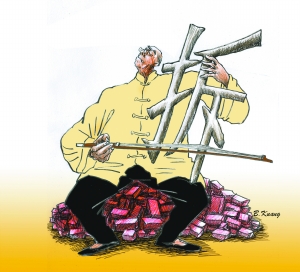
After receiving the most money of his lifetime, his son’s marriage falls apart
In Beijing, outside the 5th ring, in Jingwang Jiayuan, Mr Xu sits by his terrace, hanging his head, smoking. When workers come to do a renovation project, he raises his head to give them directions, then goes back to smoking.
Mr Xu originally lived in Dawangjing village. When the village was demolished, he received 4,000,000 yuan in cash and two residential suites in Jingwang Jiayuan, which he was now busy renovating. In his 60 years he had never had so much money, but his pleasure was short lived, because his son and daughter-in-law got divorced.
His placid life was suddenly roiled by a great wave, leaving him at a loss. “When there is wealth, a perfectly good family falls apart.”
The history of Wangjing goes back almost 1000 years. Before Ming (1368-1644) there was just Wangjing village. After Ming it divided into Xiaowangjing and Dawangjing (Little Wangjing and Big Wangjing). The villages are separated by a small stream, Dawangjing is to the east, Xiaowangjing to the west. Beijing is for the most part situated on the Beiping plain, on flat and level ground, whereas Wangjing is at a higher elevation. In those years commoners, travelling merchants, governmental officials, travelling north from the city, came to this higher area from which one could see far off the Forbidden City. There they would stop to rest. Mr Xu said he had heard from old people in the village, that there used to be a wide road that went through the village, with wine shops and inns lining either side.
Although Mr Xu’s was not one of the more wealthy and influential families in the village, they had four tile-roofed houses. Mr Xu had one son and one daughter. The daughter married out, and moved to another village. His son married and the couple had a daughter. This made up their family. Mr Xu and his wife lived in an old house in Dawangjing. His ancestors had all been honest and good-natured village people, and old Mr Xu knew how to till land and raise crops. Then ,Dawangjing became part of Beijing City new residential district. The Dawangjing villagers all moved to new residences. Without really feeling the necessity, Mr Xu followed along with his long time neighbors, and left the house of his ancestors, which had now become superfluous. His income from renting rooms to migrants had been ample for satisfying the family’s daily needs. His children had married and started families, one grandchild had come into the world. His day to day life was comfortable and without problems.
“Compared to the new city, our village was just a rural backwater, compared to our new residence, our village home was out of step with the times. However, it was roomy and spacious, and it was the source of an income for us. It was what we were used to, I can’t stop thinking about it.”
Like many other “urban villages” Dawangjing had an inverted population, in which members of the floating population outnumbered residents. Before it was demolished, the village had less than 3000 permanent residents, but over 30,000 migrants.
During those years Mr Xu and his wife lived a calm, uneventful life. Their chief source of energy and vigor came from watching over their granddaughter. Everyday they took her to the Wangjing kindergarden and picked her up in the afternoon, while their daughter-in-law went to her job as a temporary farm laborer.
Owing to the attentiveness and effort of the government agencies involved, Dawangjing village was demolished and the inhabitants moved in just 53 days. In under two months. Mr Xu’s life as he had known it disappeared. His new housing was in an unfamiliar place outside the 5th ring. However, with more money than he had every had before (4,000,000 yuan in cash and two residential suites in Jingwang Jiayuan), how could his family not flourish?
Never having had so much money before, Mr Xu though and rethought, and in the end decided that he and his wife would keep the two residential suites, and that he would give the money away to his children. He reasoned that what he had saved from many years of rental income was enough to support he and his wife in their old age. The 4,000,000 yuan he would give to his children. His daughter who had married out already had her own home, so he would give her a smaller portion, about 1,000,000 yuan. To his son he would give a sum over 2,000,000 yuan, which would be enough to buy a good residence.
His daughter and son-in law were satisfied with this arrangement. What he did not expect, was that a problem would develop between his son and daughter-in-law. His son wanted to buy a home in Wangjing, to be near his parents, but his daughter-in-law had other ideas. “I don’t know how she got the idea, but she wanted to move to Gu’an in Hebei (50 km south of Beijing). She said land there would appreciate, and if they invested there, they could sell later and make a profit. Gu’an? That’s very far away from us.”
Mr Xu was not supportive of the idea, but the daughter-in-law did not wait for objections, and went ahead and bought a residence in Gu’an. “She just went and bought it, then she said she wanted one of the residential suites that was in Jingwang Jiayuan, which we had reserved for ourselves.” Mr Xu thinks his daughter-in-law started a business in Gu’an without informing him first. That she then wanted one of the residences seemed excessive. They had many family meetings to discuss the money problem, but made no progress.
Who was right and who was wrong, was not determined. But his son’s marriage came to an end. His daughter-in-law filed for a divorce, taking their granddaughter with her. This made a division in their property.
This reporter attempted through Mr Xu to contact the son and daughter-in-law, but Mr Xu sighed and said, “One shouldn’t wash one’s dirty linen in public.” He was an honest, good-natural farmer who winced when he even heard the word ‘divorce.’ “My son told me the divorce was because of the compensation fund, and the residential suite. But he didn’t tell me in detail any more than that, about how their feelings changed.”
For Mr Xu, some points are still unclear. “These two had a free courtship [not an arranged marriage]. My daughter in law is from a family in the Beijing suburbs. Although we were within the city, our family has a rural background. Even so, socially and economically they were well suited to each other. Their feelings for each other developed smoothly and calmly over time, then they had a child. They two both worked, and got by OK as far as making a living. Now, I gave them 2,000,000, its reasonable to assume they have no worries about food or clothing. How did they get to this difficulty?”
“People are sure I’m pretending, but I really don’t want all this money, these two residences — I just want to return to the old village, when we didn’t have so many things…”
His son’s divorce lawsuit is proceeding. Because his son is busy at work, the elderly husband and wife need to oversee the renovations on their suite. They also want to observe the trial. For Mr Xu, who has always sincerely believed in peoples’ impartiality, confronting the law court is a strange and unfamiliar thing, making him nervous.
“Our daughter-in-law took her child back to her parent’s house. Before we took care of her during the day, now we don’t know when they will see her next. “ Mr Yu was prepared to compromise. ”Money or no money, the house goes to who, I don’t care about this. What I keep thinking about, is having my son granted guardianship of out grand-daughter, for her to come back to us. It is very sad that our household, which was going along just fine, is now divided like this.”
After demolition and removal from the village, many problems arose
Mr Xu said that among Dawangjing villagers, between husband and wife, father and son, and siblings, recently many problems have arisen. This reporter tried to obtain from the Chaoyang court the number of recent divorces from Dawangjing, but the court would only supply the number for the entire Chaoyang district, which did not help.
Lawyer Di Shunhong of the Zhenbang law office has handled many domestic lawsuits that have arisen from demolition of a village. She says this phenomenon is not limited to Dawangjing. When demolitions in Tongzhou occurred in 2010, many lawsuits arose over unequal distribution of the compensation fund. In Tongzhou there was a Mr Wang with five daughters. They received a 9,000,000 yuan compensation fund. The Wang husband and wife and four of the daughters each took 1,300,000, but the remaining daughter, the eldest, only got 400,000 yuan. This turned into a court case with the eldest daughter against all the rest.
Lawyer Di Shunhong considers the Xu family as an example of a typical dispute that occurs when parents and children live in the same residence. When that residence is demolished, what ensues is a blind rush for profits. There have even been cases in which once the compensation money has been distributed, either the husband or the wife takes all the cash and runs off, deserting the family.
Dawangjing villagers because of demolition and relocation find themselves suddenly rich –in the village many lawsuits arise
http://www.cnr.cn/gundong/201011/t20101123_507363635.html
Source: Yangshi (News 1+1)The following is a transcription of a t.v. program, “The village which became wealthy overnight,” broadcast 2010-11-22.
For Dawangjing villagers, the time for demolition came suddenly. The peasants of a village with a 1000 year old history did not have time to psychologically prepare themselves. But what caused them more difficulty than they anticipated, was that as participants in the urban rural unification project, their own lives changed so radically. They changed into persons of wealth, each and every household has purchased a new residence and an automobile.
One villager with over 1 million yuan in compensation money, bought a black BMW, which he tried to use as an illegal taxi. “When I drive this car I feel a kind of pressure from others. Since I bought this with money which I did not earn myself, I think others are jealous of me.”
Villager Zhang Xiu was head of one of the hard-up families in the village. His two grandsons both have cerebral palsy. When the village was demolished, his family received three residential units, and in addition he purchased one more unit at the market price. After that he still had 1,000,000 or more yuan left over. The wooden cart he had made himself for his grandsons was now replaced by a specialized nursing unit costing 20,000 yuan. He also went out and bought two cars.
Zhang Xiu: “ I have been a schoolteacher all my life, for 44 years, But I couldn’t figure out how to calculate this amount of money. People who pursue money die from overwork, but if money pursues you, its too easy.
Scene — a park. Reporter narrates. Only those who have a special connection to this place, will know that this, “Wangjing Park,” used to a place called “Dawangjing Village.” One year ago, the event which the media described as “demolition with force, without resistance, done within 53 days, a miracle,” occurred at this place. Nevertheless, the dispensing of huge sums of money, resulting in sudden wealth, has led to unforeseen problems.
Mr Wang: I think demolition and removal from one’s house destroys something in a person. Now we have mothers accusing daughters, elder brothers accusing younger brothers, taking each other to court, sisters fighting over who is right and who is not, a free-for-all fight.
Wang Qiyan: Naturally it is worrisome. Elder brothers, elder sisters, will not wave to each other on the street, will not give up a penny –it all goes back to memories of the demolition.
Another: in my family it has been divorce, divorce, one divorce after another. Truly.
Another: it’s good that your body doesn’t get dismantled [outwardly you stay healthy], but inside your mind something is taken apart. You brood over what you loved, then you become sick.
In one year, the Dawangjing villagers have gone through a lot. There have been over one hundred lawsuits, and more than 20 people have died, three or four times more than usual.
Mr Zhai: Since we moved here, everything has been out of sorts. In the village, I earned 6000 yuan a month renting rooms to migrants. Now I don’t have money.
Mr Zhai looks down from the 12th floor balcony of his market priced residential suite onto the site of his former village. He took out for us a birdcage which he kept hidden, because in city districts one is not allowed to keep birds.
Every morning I get up early and walk.
Reporter: do you take your birds?
I walk 10 minutes, then I look at the tree which was the Wangjing old pagoda tree.
After the village demolition, the Dawangjing village old pagoda tree was moved to a different place in Wangjing park and preserved. The villagers frequently return back there.
Wang Qiyan: the tree was our standard for everything. Whose house was whose, we thought of as how far from the tree. If you ask me,when you give money without rhyme or reason to the common people who has been uprooted, they spend it recklessly, and only consider later.
———————-
Commentator: Professor Wang Xixin:
Although it seems the Dawangjing villagers have acquired sudden wealth, it is actually wealth that has accumulated over a long time, the wealth inherent in the property which sustained their ancestors and which they expected would sustain their descendants in the future. We should consider the money they receive a just exchange for the property they have relinquished, and not be envious.
Documentary Host: You say it is reasonable, but what if it is so much money, beyond imagination, is it still reasonable?
We keep hearing about cases in which compensation is “so much, so huge” but really most of the time it is quite low. In the case of Dawangjing, the settlement is the result of negotiation. It is fair, impartial, voluntary. Rather it is our expectations of what the common people should receive that are askew.
konjaku: it turns out that attempting to ameliorate the displacing of villagers in the urban rural unification project by giving them more generous compensation funds and real estate properties, may lead to unexpected side-effects. The very speed and efficiency with which the Dawangjing villagers were induced to accept lavish awards and move out, may have contributed to the ensuing emotional distress and difficulty in adjusting to their new life as city residents. Some families fall into disputes over what to do with their “overnight wealth,” to others, it seems strange to have money they did not earn. The villagers feel the envious stares of society at large upon them, while brooding over the sense of belonging somewhere which they now have lost.
As of 2012-09-18 the documentary of which this is a partial, much edited transcript can still be seen here:
Jingwang Jiayuan begins procedures to allow people to move in
2011-05-09 Qianlong net
http://report.qianlong.com/33378/2011/05/09/83@6991536.htm
Neat and tidy exterior meets the city district standard
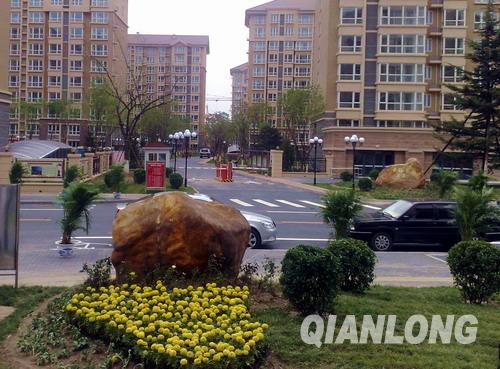
A villager about to move in, experiencing his new home

05-09, Chaoyang district Cuigezhuangxiang: 2228 residences in Jingwang Jiayuan are ready for displaced villagers to move in. 898 residents have transferred from agricultural to city residency, 612 have found jobs appropriate to them, 358 have received job training, and 238 old and infirm persons now draw monthly pensions to live on. In addition, as the villagers transform from “property rights to shareholders,” the village cooperative shareholders corporation have been established, and is in the process of surveying all its enterprise assets, and determining the status of members according to seniority and work record.
Energetically following up on the Dawangjing pilot project, Cuigezhuangxiang is starting the same process in Beigao, Dongying, Cuigezhuang, Shangezhung, and Suojia. The villagers are being moved, their replacement housing is being fixed in advance, a total area of 3,900,000 square meters.
Jingwang Jiayuan is designated as the place for villagers to move to. The whole development is slated to be completed in 2015. The first stage was started in 2009, the second in 2010. In the end, seven parcels of land will contain 7934 residential units, holding 22, 215 people. The phase one B3 and B4 parcels will accommodate 1054 displaced villagers from Dawangjing, 428 from Dongying, 746 from Beigao, Water, electricity, and natural gas have been put in through the municipal government. Heating is provided by wall-hanging units. The multi-story buildings are under a shared ordering system, with the perimeters monitored for security, managed parking lots, ventilation unobstructed, and an automatic warning system for fires, as well as a fire prevention command system. For the residents all conveniences for daily life are supplied, including a 24 hour security system. Each residential sub-section has its own perimeter roads, green areas, and parking lots. The placement of gardens and parks increases the sense of comfort and ease, and the residents can well asume themselves in their idle hours.
The Jingwang Jiayun development has earned satisfaction of the villagers in that a command post has been set up, composed of representatives from the Party, from the People’s Congress, and from the displaced villagers. This group deals with issues of security and quality control related to the building project, following every step in the construction. Cuigezhuangxiang has sought the villagers’ input in every possible way, to make Jingwang Jiayun more comfortable and convenient. Much has been done to make the procedural process of moving in quick and easy. Because the township Party committee and administration takes into consideration that villagers may be temporarily pinched for funds, and what cash they have they may want to use for renovations, they have decided that for the time being they do not need to pay anything when they move in. The building maintenance fee, the surface area adjustment fee, the tax on land ownership, the property rights registration fee, the certificate fee, the stamp tax, and other fees, will be put off until the villagers’ property rights are legally certified. From all corners, residents of Jingwang Jiayuan will be recruited to form building maintenance repair teams. One team of 160 people has already been formed. They will offer top quality standard building maintenance for the residents.
The 2306 residential suites allotted as replacement housing for Dawangjing villagers are mainly complete
Source: Beijing Daily 2010-12-28
http://news.xinhuanet.com/house/2010-12/28/c_12924850.htm
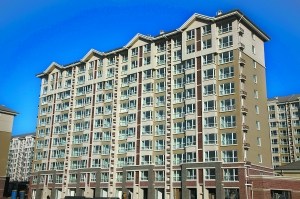
“My whole life I have never lived in a tall building, and soon I am going to move in.” The Dawangjing villager Wang Chunlan stood in front of a thicket of tall building, and was unable to restrain his happiness. At present, the main part of the first stage of construction of the replacement housing, Jingwang Jiayuan, has been completed. Before May Day next year, all 1692 households from the village will have moved in. The standard is 50 square meters granted per individual.
Jingwang Jiayuan is 2 kilometers from the Airport Expressway, occupying 78.8 hectares. This first stage of construction consists of 24 buildings of 9 to 11 stories, 2306 residential units, as fully equipped one, two, or three bedroom apartments. It is north-south aligned, every two apartments share one elevator, and has a high ration of usable space [all signs of high quality]. Yesterday, several villagers braved the early morning cold to come out and look at the construction site. “I work nearby, so I stop by whenever I can,” one said. They have watched as this area went from a wasteland to a large group of tall buildings.
Too impatient to wait for someone to open the door, we went carefully one after another into a residential suite. The walls had fresh white paint, the kitchen and the bathroom fixtures of cream colored porcelain. With just a bit more touch-up it would be ready for someone to move in. Wang Chunlan previously lived in a low, one story house and compound, old and shabby. According to the plan, his family of four members can choose two 2 bedroom units and one 1 bedroom unit, altogether 220 square meters of space. Looking out the window, ten or more big diggers were going by transporting workers. We heard that once the buildings are finished, they will refinish the roads, plant lawns, flowerbeds and trees. This will be coordinated with finishing the infrastructure of running water, natural gas, etc. The area that once was the village will be transformed into a beautiful park, Dawangjing Park. A covered walkway and shade trees are already in place. This will be a place where villagers can go for a stroll in their leisure time.
Within two years, in Cuigezhuangxiang, the five villages Beigao, Dongying, Suojia, Cuigezhuang, and Shangezhuang, comprising 6800 village households, will all one after another move into Jingwang Jiayuan, and part completely from the village life of the past.
Reporters, Hua Kai, Pan Jun
Jingwang Jiayuan 京旺家园
Beigao 北皋
Dongying 东营
Suojia 索家
Cuigezhuang 崔各庄
Shangezhuang 善各庄
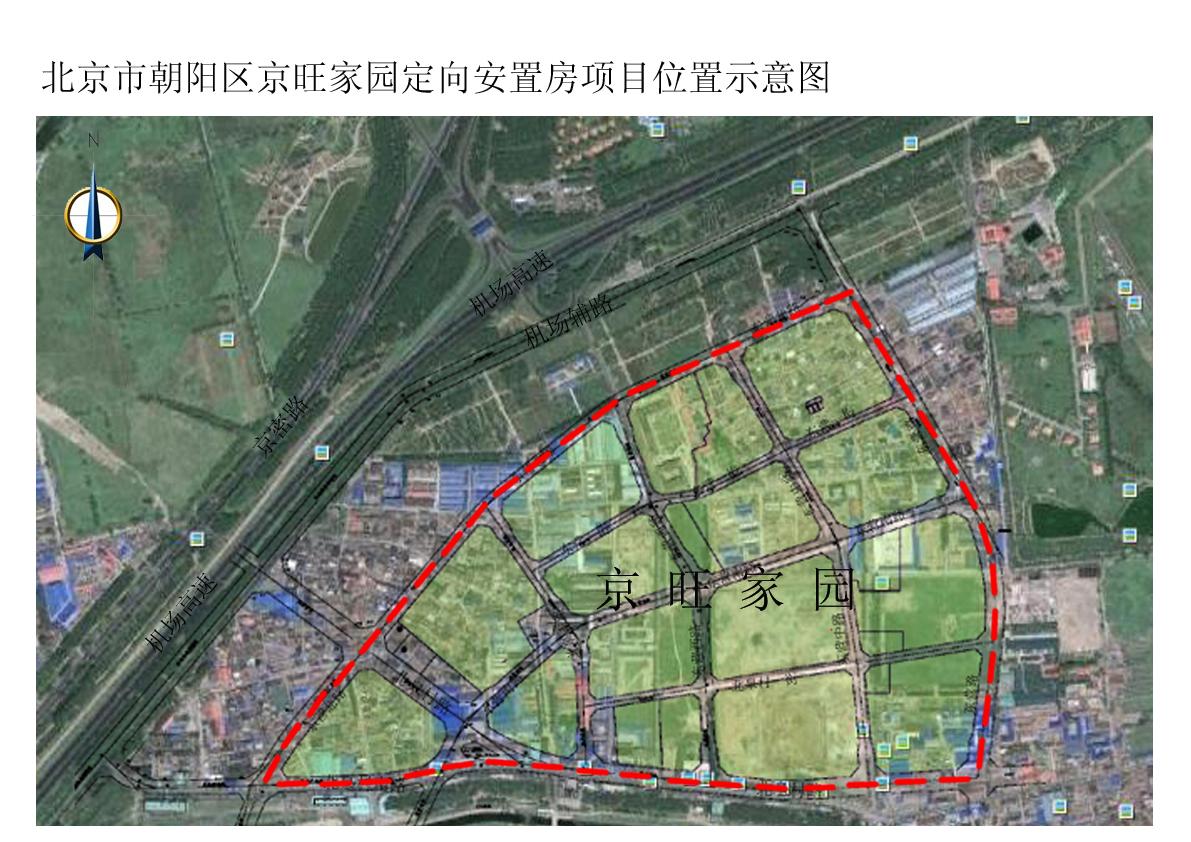
The Jingwang Jiayuan project from above
konjaku: The story of Beiwu and Dawangjing is meant to be a happy one. The villagers cast off backwardness and disorder, to become residents in a new, shiny residential complex, with promises of financial security and the privileges of urban residents. In Beiwu however, the start of the process was clouded by the existence of several hold-outs resisting demolition. Armed gangs entered the village to intimidate and physically abuse certain households, leading to the tragic case of Xi Xinzhu (“Beiwu follow-up 3 and 4: Resistance,” posted July 2012). Also, the villagers had doubts, as the government held back from transferring them to a city household registry, which would bring increased benefits. Because of this, the demolition process took six months. In contrast, in Dawangjing the terms seem better, and apparently there has been no resistance. It does indeed seem to be a happy story, with the villagers looking forward to the many benefits that will cushion their future.
Looking forward to “going to town,” and entering city life
2010-04-08
http://finance.people.com.cn/nc/GB/11318117.html
Source: Economic Daily
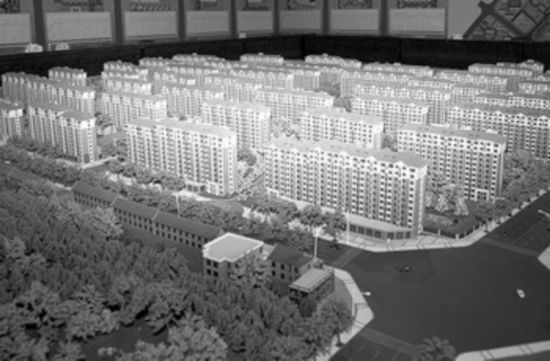
model of Jingwang Jiayuan
Where Jingshun Road and and the 5th Ring Road meet, there is a village called Dawangjing. Although it was a close neighbor to Beijing city proper, the villagers had to stay part of Wangjing sub-district. Now, as part of a pilot project in urban and rural unification, the process of merging into Beijing city proper is on an accelerated pace.
Living in a spacious and well lit residential tower is the most fervent dream of 78 year old villager Chen Xingquan. By the end of this year, the dream will be realized. Their family, from grandparents to grandchildren, will move into the designated housing for Dawangjing village, “Jingwang Jiayuan” (Jingwang Homeland). This old person said excitedly, “I can hardly believe I will be able to take on the life of a city dweller.”
As a long time resident of Dawangjing, Chen Xingquan deeply loved his native place. He told this reporter the origin of the village name. “wangjing” means “overlooking Beijing.” Several hundred years ago, one could look directly east from the village and see the towers over the city gates, he said. This reporter was unable to verify this point, but this represents the Dawangjing villagers’ sense of hovering just outside the city, and longing to live inside it.
Dawangjing in area is 106.6 hectares, with 1692 households, 2998 registered residents. Here there is not row upon row of tall buildings, but only out-moded low slung one story houses. Here there are not broad and level roads, only small and narrow alleyways. Instead of a clean and tidy environment, there is a aging infrastructure. As a local person said, “with one matchstick if you poke a running water pipe you could turn it into a geyser!” For a long time, Dawangjing has retained the characteristics of a village, but it is about to take one large step to becoming a city district brimming with internationalization, as “Wangjing New City.” Against this bright new contrast, Dawangjing villagers with some embarrassment for the moment continue to pass their days in “Wangjing” outside the city.
Since the 90s, renting rooms to migrant workers has been the Dawangjing villagers’ principal source of income. “At its height, there were 45,000 members of the floating population in the village,” the Cuigezhuangxiang township head Hu Zhenjian told this reporter. At the time the Dawangjing pilot project began, 30, 000 members were registered in the village, 10 times the amount of village residents. Villager Liang Guangcui told this reporter that many villagers divided their houses into smaller rooms which they sublet. One after another they built additional stories over their houses, or buildings in their courtyards, or illegal buildings on collective land despite repeated bans.
“During the day one was pushed by crowds on the street, at night electricity and water use was strained to the breaking point.” The buildings were low and damp, with mildew on the corners of the walls. In winter there was no heat, we had to burn coal to warm ourselves. You had to put a hat on when you went outside for a walk, to keep the coal dust off your head.”
On 2009-02-09, the villagers changed from Wangjing (overlooking Beijing) to the state of “rongjing”(merging into Beijing). The first step was to demolish the village and move the households. The villagers looked forward to this, but were also apprehensive. Villager Tang Hongxun: “In our household compound our family consists of eight people living together, it is too crowded. We look forward to moving to a higher building, but will the compensation fund be appropriate or not? Will the replacement housing be suitable or not?” As the project proceded, Tang Hongxun’s doubts gradually dissipated. “According to the project policy, with the compensation fund we can buy five residential suites. Finally we’ll have more room to live.” Tang Hongxun was very satisfied.
Other villagers also expressed satisfaction. According to the Municipal Party Committee Secretary Liu Qi, “In 28 days, all 1692 households have signed agreements to relinquish their current houses and move. More than 25,000 square meters of buildings have been demolished. This is all 43 days ahead of the plan projection. During this time no villager has registered a protest with the authorities, there has been no forcible demolition.” For the Secretary, the speed and efficiency with which Dawangjing has been demolished and the inhabitants moved, is like a “miracle.”
“Transforming urban villages and urbanizing rural villages always stirs up difficult issues. Not only does it involve the villagers’ emotional ties to their native place, but the matter of compensation is often in dispute,“ said the Cuigezhuangxiang township head Hu Zhenjian. He believes the high level of planning for the villagers’ needs and interests is causing the process to go smoothly.
Based on the total area of their previous residences, the villagers have two options in regard to compensation. Those who choose to move into the designated replacement housing receive 6500 yuan per square meter (the standard), or up to 8000 yuan per square meter. In addition, every person will receive the ability to purchase 50 square meters more in the designated housing at a rate of 4500 per square meter. Those who do not opt to move into the designated housing (choosing to buy replacement housing themselves) will receive 11,000 yuan per square meter of their previous residence.
Those villagers who sign the agreement to move within the first deadline will directly receive 45000 yuan as a reward for cooperating with the project. Those who move out before the first deadline will receive a reward of 1600 yuan per every square meter, for cooperating with urban rural unification, and 500 yuan per square meter as an reward for moving. If a villager family moves out within this time period, having a house measured at 100 square meters, calculating all of these compensation items together means they would receive more than 250,000 yuan ($39,380).
The plan makes allowances for families with financial hardships. Those whose village residence is less than 50 square meters, will receive a compensation amount calculated according to having 50 square meters. Those persons who are unmarried, 18 years or over, those over 30 who are considered in family planning as single people with the potential to get married, will be able to get compensation housing of 50 square meters or above, taking into consideration that in the future they may start a family.
For Dawangjing villagers the Cuigezhuangxiang township has prepared 1000 residential units in”turnover housing” (buildings constructed for displaced villagers, often of simple construction). Chen Xingquan and family is currently living in four rooms in Dongxinzhuang. He told this reporter happily, “this place is the closest to Dawangjing. It comes supplied with a toilet, electric water heater, it’s all here. A 3000 yuan a month apartment, and we don’t have to pay a penny, since the government subsidizes the rent.”
On 2010-04-02, the construction site for the replacement housing development for Dawangjing, “Jingwang Jiayuan,” located in southwest Cuigezhuangxiang, was very busy.The workers were building the first stories above the ground.According to a project engineer, work is progressing smoothly. When finished, it will consist of economically priced housing, the buildings 9 to 18 stories high, complete with shops, schools, recreational and cultural facilities, a green zone, and public transportation. It is close to the China National Film Museum, the China National Railway Museum, and the Civil Aviation Museum. It is within the 5th ring transportation hub, convenient to various forms of public transportation.
Not only will the Dajingwang villagers become city dwellers living in new multi-story buildings, but they will enjoy all the safeguards of urban residents (transitioning from agricultural workers to industrial workers, with a city household registry or hukou) and will go from having property rights to shareholder rights. In the pilot project, after the village is demolished, compensation for the requisitioned land will be returned to the village collective, and the villagers will become shareholders. They will receive the right to preserve the green zone, and receive as material compensation 50,000 square meters of property on the first and second floors of the buildings in Jingwang Jiayuan to develop. Rather than receiving a one time cash payment in exchange for their property rights (to the village collective land), they will get income from developing those bottom floor properties as shareholders in the venture. In the future, dividends from the shares they own will provide a consistent source of income over the long term.
Cuigezhuangxiang township head Hu Zhenjian gave this calculation: if we take the minimum possible rent of 50,000 square meters of bottom floor properties as 2 yuan per square meter per day, this would still yield a yearly income of 36,000,000 yuan. Shared equally among 2000 villagers, this comes to an income of 18,000 yuan a year ($2, 835). In fact, the current actual rent amount of land in the area around Dajingwang is just exactly that –2 yuan.
In putting up 50 square meters of land per displaced villager to be used for business, the Cuigezhuangxiang plan is to provide employment opportunities for the villagers over time, as these businesses are developed on the township level (with abundant capital) and generate employment opportunities for the villagers. “Housing is provided by building the designated housing, for workers there will be wages, and in addition the villagers will receive dividends as shareholders from both the village level and the township level. The peasants, who by themselves lack competitive power, will be protected by all these safeguards.” said Hu Zhenjian.
The Jingwang Jiayuan building site is bustling with activity, and the villagers are excited. “After many years Dawangjing will at last be part of the city.”
Editor Yan Lu.
konjaku: A part of the pilot project plan is that villagers are supposed to have more control over (and responsibility for) economic development on the land where the village once stood. However, development takes capital and resources. Activity on the village level will always take second place to the township level and above, as administrative responses to the macro plans issuing from Beijing city. Thus Hu Zhenjian says, “The peasants, who by themselves lack competitive power, will be protected by all these safeguards.” Yet the safeguards are dependent on the premise of continually expanding economic development. When the peasants were building non-conforming buildings to rent to migrants, they were active, self-sustaining economic agents. In the new city, they lack “competitive power” and perhaps are in danger of being forced into a state of passivity.
Dawangjing 大望京
Wangjing 望京
Jingwang Jiayuan 京旺家园
Cuigezhuangxiang 崔各庄乡
bottom floor properties 底商–units on the bottom floors of large residential complexes.底,”of low value” because the upper floors are more desirable as residences. However, in these 底商 there are commercial opportunities.
konjaku: in “Beijing: unification of urban and rural 1.Beiwu and Dawangjing” posted here in May 2012, Dawangjing village was given as one of the two models, along with Beiwu village, by which the Beijing government was signaling a new approach to urban development on its periphery. ” The Dawangjing model is to increase compensation to the villagers being relocated, and to explore the possibility of giving them a share of the future profits for ground rents in the redevelopment. The Beiwu model is to allow the villagers to have a say in the urbanization process, and through control of village collective land, to partake of the gains of urbanization.” Although it is hard to see at first glance how these approaches really differ, the main point was to soften the blow of demolishing the village by giving the displaced villagers increased compensation and the possibility of regaining some of the future profits from development of the land, which had previously been the exclusive possession of the government. As we saw, demolishing Dawangjing left a great deal more land available for commercial development than Beiwu. The government was more confident of attaining large profits from the project, therefore its terms to the villagers were more generous. From the beginning it was willing to give all the villagers urban resident status, unlike Beiwu. As with Beiwu, in the following series I will try and glean everything I can about what has happened to Dawangjing villagers after the demolition of their village.
Beijing Dawangjing village, all the villagers move to new interim residences.
2009-04-17
http://news.sina.com.cn/c/2009-04-17/025717625389.shtml
Yesterday, at Dawangjing village, the businesses lined up along the street have all been torn down.

This newspaper reported, after Beiwu village in Haidian district, the second stage of the Beijing pilot project of urban rural unification moved to Chaoyang district Dwangjing. As opposed to Haidian, the Dawangjing residents all became urban residents when they moved out of their previous residences. 50000 square meters of business real estate was slated to the villagers to be a source of future income and a social security fund.
Dawangjing village is located in the northeast corner of Wangjing, near the Airport Expressway, in the 5th Ring. It is a typical example of the area undergoing urban and rural unification.
After 7-30 of this year, the natural village of Dawangjing will no longer exist, except in name. In its place there will be a green belt and new buildings. The various existing organizations will continue for a time, and gradually fade into the establishment of a community management committee. The rural economic co-op will continue to function as a collective.
Since the demolition started at the beginning of this month, the parties involved in 81 of the 99 non -residential buildings have signed agreements and moved out. 51 of the buildings have been torn down. By the end of this month (4th month) they will all be gone. The demolition of the residences will begin in the 5th month.
At present. the process of measuring and estimating the value of the villagers’ homes is in progress. The specifics of the evacuation of the village and transfer to new residences will be announced at the end of the month.
As for replacement residences, the villagers can opt for a cash compensation and a one-time housing placement, or they can select to live in the targeted housing in the new development, Nangao Zutuan, which is in a new residential area south of the nearby Dongying village.
In the urban rural unification plan, the targeted housing is meant to be the preferred option. It will be similar to the Beijing Olympic village. Originally the village was inside the 5th ring, but after demolition and relocation the villagers will live outside the 5th ring.
After the demolition and relocation method is fully formulated by the relevant departments, discussed with the villagers, and approved by the Beijing city government, the standard of compensation will be announced. It will not be less than the 1:1 ratio implemented in Beiwu.
The Cuigezhuangxiang administration has set aside 1000 apartments for the villagers to move into during the transition. The villagers will themselves pay the rent in the interim, and will be reimbursed by the government later. 1500 children will be unconditionally received into schools in the township on a temporary basis, and tuition fees for the first half of the year will be waived.
Nangao Zutuan is a large residential development project of market priced housing in Cuigezhuangxiang. It will be built in 3 to 4 stages, scheduled to be completed in 2015. Within it will be businesses, schools, hospital, and social service community centers, to form a complete set of facilities.
How do Dawangjing and Beiwu compare?
Cuigezhuangxiang township head Hu Zhenjian said, while the Dawangjing pilot project draws lessons from the experience of Beiwu, there are some differences. The majority of Dawangjing villagers will become urban residents, with only 78 peasants left over. The plan is for all the villagers to achieve all the safeguards urban residents have, they will receive access to the five types of insurance (old age insurance, medical insurance, unemployment insurance, industrial injury insurance, partuition insurance) and the public housing fund. Second, while the Beiwu villagers will relocate to a housing development at the original village site, the Dawangjing villagers are given a cash compensation with which to purchase their replacement residence. Some may choose to go into the new development, the Nangao Zutuan. This means the villagers will be unable to return to the land they have lived in for generations and generations.
250000 square meters of first floor commercial property –will the villagers, as shareholders, be able to generate income from it? It is difficult to evaluate —
Dawangjing village and Dawang New City are right next to each other. Yesterday, this reporter sought the opinion of a noted developer in Wangjing, this developer said that at present bottom floor commercial space in Wangjing retails for 20 to 30,000 yuan per square meter. The profits the village corporation could obtain from rents is difficult to estimate, as it all depends on location. It varies widely from 2 to 3 yuan per square meter a day in less desirable areas,to 8-15 yuan in better areas.Because there are many business proprietors who do anything to make a name for themselves and over-expand, the rental income is entirely dependent on store management. In some cases income dwindles to zero, or even can become a net loss. It is entirely different from the market for residential property.
Reporter Li Liqiang, photo Xue Jun

Rendering of Nangao Zutuan
From sample locations in Beijing, we see villagers relocated from demolished villages taking courses to study how to live in residential towers
Xinhuanet 2010-08-22
http://news.xinhuanet.com/society/2010-08/22/c_12470212.htm

Photo: Yesterday, in Chaoyang district Dongbajiayuan 东坝家园, the residents’ pumpkin vines are growing up to the first floor terrace. (Photo, Wang Guibin)
Peasants who go to live in multi-story buildings have difficulty adapting. They continue with their old habits of growing vegetables and raising chickens. A “citizen school” will train them to learn how to live in cities.
As villages one after another are demolished as part of the urban rural unification process, the villagers are relocated. In Beijing there are 50 villages marked up for complete demolition and renewal. This means many dislocated villagers are being resettled, and transforming from peasants to city residents.
Can these peasants adapt to city life?A recent survey by this reporter of various communities in which villagers have resettled revealed that some residents, although they moved in a number of years ago, still have not adjusted to urban community life. In the designated green areas they grow vegetables and raise chickens. In other places though, they have left behind their old habits and adjusted to city life.Recently, the sociology and demography departments of Beijing’s People’s university have set up a “Citizen’s School” to explore with villagers the idea of harmonious relations in a high rise tower.
In Jinzhan town the citizen’s school was preparing its course material. In Jinzhan town there are four demolished and relocated villages .
Villagers speak their mind about the difficulties
Jinzhan town Changdian village is one of the 50 marked up villages. Everywhere in the village are the ruins of demolished houses. It had as many as 1200 residences. One villager said in his compound he grew onions, garlic and cucumbers, among other things. In the summer he didn’t have to buy vegetables.”Now I can no longer grow anything.” He said he was unable to adjust to living in a multi-storied building.
Besides Changdian, in Jinzhan town there are three other villages that will be demolished: Mafang, Louzizhuang, and Caogezhuang. An official involved in these operations said, in communities where displaced villagers were congregated they transplanted rice seedlings in the designated green areas, and piled up corridors with heaps of goods. To prevent these problems, they hope to transform the peasants’ ideas. For this reason, investigation and research into how villagers can adjust to urban life is a major topic in Chaoyang. The director of the citizen’s school says the next session will cover “civilized behavior in public,” divided into four topics: the public environment, public order, human relations and the public good.
Sample case 1:
In Chaoyang district, Dongba Homes A and B sectors, most of the residents are villagers who entered three years ago after being relocated from demolished homes. Recently in the B sector many residents were growing pumpkins in the green areas around the multi-story buildings. Around buildings number 108 and 109, cucumber and tobacco leaf had been planted. By 115 were onions, garlic, eggplant, and even hot chilis. Around 103 residents had spread our buckwheat husks to dry in the sun. These are used to fill pillows.
At 108 a Mr Chen said, his village had been torn down to make a green open space, and he had relocated here three years ago with the other villagers. He said previously his home had one sixth of an acre on which he grew corn and vegetables. “Before I engaged in agriculture, now I have no employment. Being idle with nothing to do I plant seeds to help economize and pay expenses.” A Mr Zhao said, he smoked dried leaf tobacco, therefore he planted some tobacco plants in the residential area. He said that moving from a compound with more than 200 square meters, his apartment in a residential tower felt like a birdcage.
Dongba homes staff person Liu said previously residents had raised rabbits, ducks, and chickens, but have now been dissuaded from doing so. He said raising vegetables in the green area was not permitted, but if among the residents no one was against it, and no written complaint was made, building maintenance had no authority to stop it. He said a good many of the residents had formerly been villagers together, and they were fond of getting together in the courtyard in the evening cool to gossip. Many of the men were ‘shirtless papas’ [men who take off their shirts or expose their bellies in public in the summer heat].
This reporter found out that in this residential district there are no neighborhood committees. The residents have no interest in forming activity groups. In the past, building maintenance tried to start an exercise group, but no one answered the appeal.
Sample case 2
Chaolai Green Homes
Time of Residency: about seven years
Abundance of activities, residents are well adopted to city life
“I get up at 5 in the morning, go downstairs and do taichi with my neighbors, at night I go and practice fan dance.” The 63 year old resident Auntie Wang explained her present life was rich and abundant, the same as that of a retired city resident. Originally she was from Guangying village. In 2006 her home was demolished and she moved here. Over 10,000 of the residents are from Guangying, Hongyunjing, and five other demolished villages. From 2002 they moved in, in successive waves.
The other day, there were no vegetables or chickens in the public green space, and the corridors had no piles of miscellaneous objects. Auntie Wang said she and the others had dropped the customs of village life.
“There were people afraid that the water would be cut off, so they carried big vats of water up the stairs, Auntie Wang recollected. They were unaccustomed to living in tall buildings, and didn’t want to throw away their village possessions. When they first moved in there were some villagers who wanted to plant cedar trees in the green area, but in the end they realized they shouldn’t do it.
In 2006, Chaolai Green Homes established a neighborhood committee. In tandem with the Guangying township government, the committee set up courses and lectures to help the villagers adjust to urban life. Many villagers went through these courses, learning scientific facts about hygiene, as well as more general knowledge about social etiquette. At the same time, the neighborhood committee set up sports and culture group activities, in order that the villagers would participate in community life –taichi, badminton, ping pong, and folk dancing.
Ping Qinuo of the Citizen’s School says in the course of their activities they have discovered that villagers do not develop a sense of belonging in their new residential communities if they do not establish firm social networks. In urbanization, the peasants are not only given a new multi-storied building to live in, but they are provided with a new urban way of thinking. Problem arise if they cannot change their old ways of conceptualizing to suit the fierce pace of change in the city. In western countries the process of urbanization that takes as long as several decades is now occurring in China in the space of just a few years. The government is spurring on the development of the urban infrastructure at a rapid clip, but the process of adjustment for the people involved takes a long time. Ping Qinuo believes the government should throw more resources and manpower into helping the residents form social groups and interpersonal relations as urbanization continues. They should establish a special office to have responsibility for this, staffed with professionals who can provide guidance.
Reporter: Zhang Ning
konjaku: this article says that the long term plan is eventually to make a large portion of the villagers affected by the urban rural unification plan into city residents with the attached benefits. However, “over 1 million” is still less than half of the total.
In Beijing 100,000 displaced villagers will within this year become city residents, eligible to receive old age care and welfare
Source: Jinhua Times, 2011-02-24
http://www.ciudsrc.com/new_xinwen/yaowen/2011-02-24/9882.html
Living in tall buildings, going to work at a company, getting paid a salary…this will become the life of the former villager in Beijing city. This year, more than 100,000 villagers who have gone through the “demolish, build, transfer” process, will at the appointed time turn into city residents. The project to demolish the 50 “focal point” villages and move the residents is occurring at a quick pace –eight villages have already been demolished. This year, continuing to draw lessons from the experience of Beiwu and Dawangjing, Beijing’s urbanization of its urban/rural periphery will proceed forward at a rapid pace, with villagers moving into upgraded residences.
A person involved in the project revealed that, according to the initial calculations, within the 900 administrative villages in the unincorporated areas on the periphery, including the 11 outer suburbs of Beijing, eventually approximately 850,000 villagers will become urban residents. In addition, in the future, small towns will be built, and 1,150,000 villagers will move into these towns and become city residents. It is projected that in the next several years or perhaps longer, among the 2,700,000 villagers currently living in the Beijing area, over 1,000,000 will become true city dwellers, with the same public services and welfare benefits.
10 villages are in a pilot project to “on the spot urbanize” So-called “on the spot urbanization” means. the village will directly be transformed into a public housing complex with all the infrastructure provided. The village social management structure will change, the environment will change, the buildings and real estate will change, social services will improve. Finally, the villagers will not just move from one house to another, but they will be able to enjoy a fully urbanized modern life. Although peasants have not changed into townspeople, their villages are actually already a type of urban environment. As a person of authority said, the most essential principle in the transformation is to retain the original character of the village, not to separate the villagers from their customs.
In the areas on the city periphery there are newly built vegetable plots. City agricultural commissioner deputy director Chen Tao yesterday said, the city vegetable supply is strained during the 7th 8th and 9th months. This year they will make vegetable plots in Hebei and other areas, to supply the city as necessary during those three months.
konjaku: this last paragraph refers to a side-effect of urbanization. As Beijing transforms the agricultural land on its periphery into urban developments, vegetables for the city inhabitants have to brought in from further away.
Leaving behind brick and tiles houses, living in a new town district
2012-06- 26 Beijing Daily
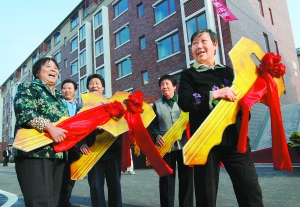
2010-09-30 in the afternoon, several Beiwu villagers who are about to move into new housing hold “golden keys” which symbolize their new good fortune. On this day, the more than 1500 apartments in Beiwu Jiayuan became open for people to complete the application process and move in.
Beijing development goes on anew every day, every month, an achievement attracting worldwide attention. In five years the environment has improved, life is more beautiful, the inhabitants happiness index has risen substantially. From 2012-06-26, the Beijing Daily starts a new column, “My Five Years.” to tell what sort of great changes have occurred, captured in the small details of daily life.
The narrator: Guo Guiying
I am Guo Guiying, 61 years old, a Beiwu villages resident. In five years I have experienced a big change –I have gone from living in a brick and tile house, to living in a high building, in a neighborhood just like a city district –with nothing missing!
Originally Beiwu was a small village of 3000 people, but also 20,000 migrants from outside. We all rented rooms to them. I put up a shoddily constructed building, that went right up to the street. In the village garbage was scattered, wastewater spilled out, the roads were bumpy. It was inconvenient to go away because of having tenants. Every day from early in the morning you had to wait in a line to use the bathroom. During this period, we saw townspeople living in clean, neat and tidy areas –how we envied them!
We were worried, but the government was even more worried. They came four times to investigate, and three times convened meetings to develop a plan to push forward urban rural unification. After that, Beiwu village formulated a plan to demolish the village and move, as “the government leads, the villagers take a major role, ” We were the first pilot project implemented in the urban rural unification plan, and in a mere half year, all 775 household compounds were demolished.
One year later, our new homes –Beiwu Jiayuan –were finished. 2.5 meter high rooms, snowy white walls, clear windows, gas electricity, water, heat, all energy saving; internet ready, with broadband. Now it is a beautiful town district with flower gardens and parks. There is an underground garage for cars, a bicycle shed, supermarket, pre-school, vegetable market, and all the other necessary facilities. I never would have believed this would be possible before!
konjaku: what follows repeats almost verbatim the content of an article from 2011-05-24 (Beiwu follow-up 9: a well earned rest.) Guo Guiying says heat and cooking in Beiwu Jiayuan is with natural gas. At first she was afraid to use it because of the expense, but discovered she actually saved money over using coal in the old village. She spends her days roaming in the nearby park, and considers the rest of her life “a well-earned rest in a comfortable nest.”
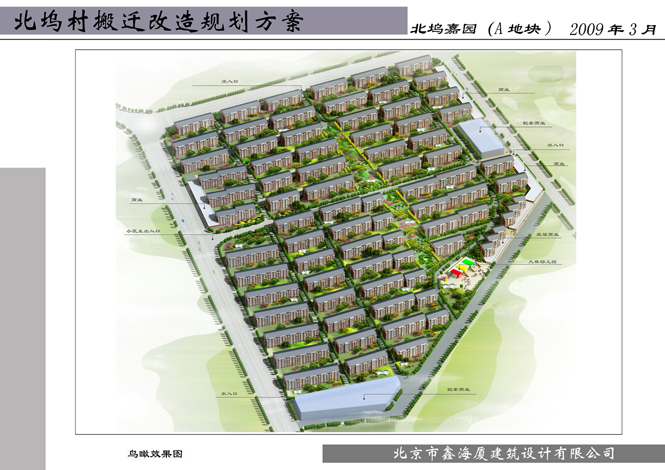
plan for Beiwu Jiayuan
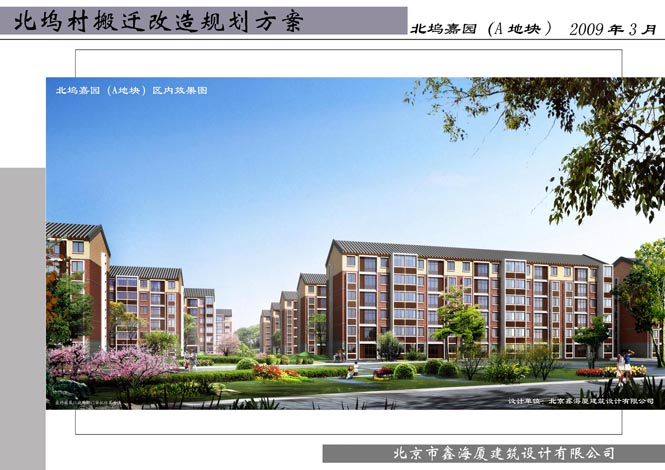
artist rendering of Beiwu Jiayuan 1
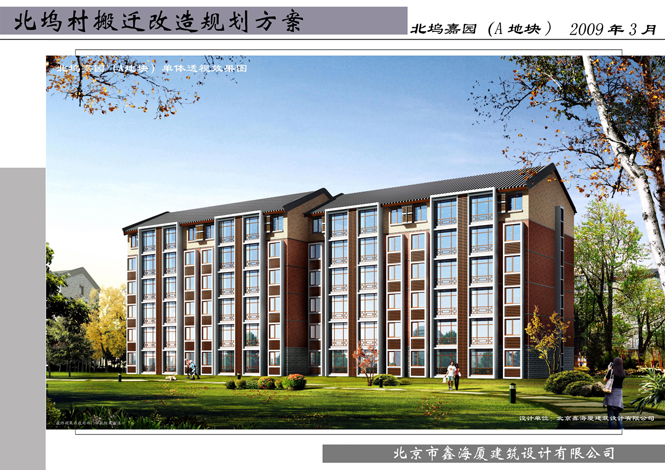
artist rendering 2

