konjaku: this recent article, very positive about community transformation management, contains some recent updates on the urban rural unification project as a whole. According to this, all 50 of the listed up villages have by now been demolished, and as many as 668 villages have implemented community transformation management.
As for Beiwu villagers, it says “the transition from a rural to a city household registry is proceeding in batches.” If all the villagers receive an urban hukou, this would be an important concession from the government ( the villagers would get social security and health insurance), although the meaning of “in batches” is unclear.
In positive articles about Beiwu, we meet Guo Yuming, and Guo Guiying (mistakenly given as Guo Guiming in Beiwu follow-up 9) . They represent villagers happy with the transition. Guo Yuming is described as a party branch assistant secretary, Guo Guiying lives in one of two residential units her family received on the 6th floor in Beiwu Jiayuan.
Satisfying the fervent expectations of the people for a better life: analyzing and explaining the problems involved in managing urban villages in the effort to connect urban and rural.
http://roll.sohu.com/20120623/n346327111.shtml
2012-06-23
Legal Daily
Beijing: Suiting measures to local conditions: pushing the villages to unify with the urban in community transformation management
Linking together urban and rural involves villages that were until recently distant from the city, and city areas that were until recently apart from agricultural lands. These zones, in which the mutual differences between urban and rural society and modes of living appear most strongly, make social management difficult. This article will analyze and explain the difficult problems that arise in the unification process and in the social management of urban villages.
In recent years, Beijing has used three approaches in it’s effort to link together, govern and develop the different realms of urban and rural: “stride across,” “advance gradually” and “tend towards uniformity.” Up to the present much has been accomplished. The 50 focal point [listed up] villages across the entire city have all been demolished. A comprehensive process to turn rural residents into urban residents has been started. Within the urban rural zone, 299 villages of mixed characteristics are being rebuilt to uniform standards, 668 natural villages are implementing community transformation management. The dirty and messy appearance of the zone has been powerfully transformed, and the first stages of orderly development have appeared.
The listed up villages have been transformed in two years
Walking into Beiwu village at the foot of Yuquan mountain, it is difficult to see anything resembling the traditional concept of the village. There are brand new six story buildings, the standardization of community management, convenient service centers, and a green belt around the periphery. It has been transformed to a neatly arranged city or town residential district. Two years ago, Beiwu was one of the listed up villages. The environment was disorderly, there were a high degree of public security incidents, the population inversion ( ratio of migrants to village residents) was great. This earthshaking change Beiwu has undergone is a successful example of precisely what the urban rural unification plan is attempting to achieve.
60 year old Guo Guiying is a locally born and raised Beiwu resident. According to her recollection, from 2000 on members of the floating population began flooding into the village, at its highest the ratio of migrants to village residents was 11:1. At that time, to earn money by renting, every household built additions, the village was filled with two or three story new structures. Water ran into the streets, garbage was everywhere, there were incidents of petty thievery and scuffles every day.
In 2009, the municipal party committee and the city government decided to make Beiwu a trial village in the urban rural unification plan, and relocate its inhabitants in entirety. Moving 775 households, 3200 people was not a simple matter, but in less than three years it was accomplished.
According to the Yuquan village party branch secretary Liu Yongli, the move went smoothly because the villagers controlled every step of the process. The village move was done without the participation of a Demolition and Removal Company, instead the villagers were given total control of the process. This made the removal operation entirely transparent, something the villagers could easily understand and accept.
Nowadays Guo Guiying, with four family members, lives in two apartment suites, each with two bedrooms, on the sixth floor, served by an elevator. Community management has made things much more standardized than before, and she is pretty content with her lot. Furthermore, for Beiwu villagers the transition from a rural to a city household registry is proceeding in batches. Her husband’s turn to become an urban resident is coming up. He will receive social security and health insurance, alleviating their worries about the future.
668 natural villages have implemented community transformation management
Under the governance of Beijing city Fengtai district Fenzhongsi [administrative] village there are seven natural villages, with 5700 residents, and 80,000 members of the floating population or more. In recent years, residents have relied on the “tile economy” (building rooms to rent to migrant workers). In the villages there are many privately built buildings, badly constructed, and many traveling peddlers and vendors everywhere. The state of public security is not hard to imagine. In a survey, the villagers’ dissatisfaction with the present state of affairs is 100%. The villages clearly exhibit the features of an environment in which the dissimilar realms of the rural and urban are mixed together. The village committee cannot manage, the neighborhood committees cannot supervise. This is long-standing problem for Fenzhongsi.
[Starting in 2010, Fengtai district started on a trial basis an “unifying urban and rural social management project.” –details omitted]
As with Fenzhongsi, and other areas in which difficulties arising from the structural dissimilarities of urban and rural elements have been great, Beijing has placed the responsibility to reconcile these elements squarely on the village administration. With this approach, what can stop the outlying urban-rural zones from evolving new public security problems? There has to be a more comprehensive approach in which leaders from the village committee join with public security, city management, and industry and commerce representative leaders to form a comprehensive operating group. “This group will coordinate the various management strategies in one effort. With this as a basis, we can have networks which, according to the specific factors of each village area and population distribution, work in a finer and more precise level to undertake management efforts. At the same time, they will work to weaken the concept of different communities comprising rural peasants and city residents and strengthen the mentality of being a city resident.” (Wang Fenglin, Fengtai administration deputy director).
Since 2010, over the last two years, Beijing has invested 2,050,000,000 yuan (2 billion 50 million yuan; 322 million dollars) in the rural urban unification project, and in the Beijing urban and rural areas 668 villages have implemented community transformation management.
Although over 90% of those polled say they are satisfied with community transformation management in their villages, the new development model also creates new problems. While this reporter was investigating in the Beiwu area, Liu Yongli said, “Before the transformation of the village, a portion of the villagers had income based on illicit rentals to migrants, but now that they have been relocated, how can they live and work, free from worries about the future? –this is one of the many problems the government is expending itself on.”
To deal with this, Beiwu village has established an employment service center to help the villagers obtain employment, and in tandem with the labor bureau are developing occupation skills training. Liu Yongli said at present the Beiwu village employment rate is 80.3%, which meets the Beijing standard for full employment.
konjaku: in July 2012, a one-bedroom apartment in Beiwu Jiayuan is listed at 3418 yuan ($535) on a real-estate board. The area is desirable and the facility is well-built, compared to other government built public housing(below). In 2011-01, Haidian district made an agreement to rent out empty units in Beiwu Jiayuan to technological workers in the area. “An official at the Beiwu Jiayuan said that taking a 60 square meter residential unit as an example, this would lease at 2600 yuan a month for 3 years, and 2700 yuan for 5 years. The rent would be collected and paid once every half year to the villagers. The rent amount would not be allowed to float during this time period.” (Beiwu follow-up 2). The articles here, from 6 months later, give a typical rent as 3800 yuan, and say subsidies are not yet determined. In any case, Beiwu Jiayuan seems to be a success at providing income for the Beiwu village committee and residents, provided these empty units are being rented. Still, even if a village household received the total of 3800 a month from the rent of their empty unit, this is still less than the seven or eight thousand yuan a month Zhang Beiqing claimed she received from renting units in her building to migrant workers (Beiwu follow-up 7: view of a villager), before the demolition of the village.
More than 700 technological workers obtain apartments in earmarked “human assets rental units,” getting a subsidy from both their companies and the government, paying only 1200 yuan a month in rent
2011-07-13 Xinhua net
http://news.xinhuanet.com/politics/2011-07/31/c_121749023.htm
From the government and business subsidies, the rent of a two-bedroom is just 1200 yuan, half the market price.” Until he put his signature on the rental agreement, Xing Zhimeng hardly dared to believe it. He and some fellow workers in the Bejing Power Resources Science and Technology Corporation are moving into the Zhongguancun Fengtai Garden first group of set aside “human assets rental units.”
The Fengtai Garden first group of human assets rental units is in the Dawayao Oasis Homes residential complex. In all there are 48 two bedroom suites with north/south breezes. Several other residential complexes have contributed units, adding up to more than 700.
According to the Fengtai Gardens deputy section chief, these units were originally replacement housing for displaced villagers, but more was built than needed. Now these empty units have been earmarked for business workers. There are three companies in the first group using these subsidized rental units: Bejing Power Resources Science and Technology Corporation, Beijing Yingnuo Biotechnology corporation, and the Zhongtie Electrification Corporation. For the renters,”people of ability” who bring new ideas and know-how, there is one subsidy from the government, and another from the corporations which employ them. (details omitted).
In Haidianyuan (a high technology economic zone) there are 600 vacancies given over to be “human assets rental units.” Some are located in Sujiatuo, and others in Beiwu Jiayuan. The Sujiatuo public housing development was financed by the government. The monthly rent was fixed at 19.75 yuan per square meter, making a one bedroom apartment 711 yuan, and a two-bedroom 1027 yuan, lower than the market price.
The Beijing Weijia Biotechnology corporation has taken ten units. Their arrangement with the government is that employees who have a master’s degree or the equivalent can live in the public housing rent free, although it must be two persons per apartment.
The Beijing Kejing Biological Products Corporation subsidizes 8 apartments in Sujiatuo, and 2 in Beiwu Jiayuan. The Beiwu Jiayuan apartments are the surplus of housing built for displaced villagers. The rent is determined by net costs (maintenance costs, insurance against depreciation or loss of rent, management fees, etc), making a two bedroom apartment 3681 yuan ($576) a month. Because in this company employees have different levels of seniority and different academic records, the company gives some a 40%, others a 70% subsidy. Quality control technician Yu Dan rents an apartment in Beiwu Jiayuan, She gets a 70% subsidy, making her monthly rent 1100 yuan.
Reporter Dong Changqing
Survey of 600 apartments designated as Human Assets Housing
http://news.sciencenet.cn/sbhtmlnews/2011/8/247274.html?id=247274
Beiwu Jiayuan is located in the western part of the 4th ring, convenient for commuting. The facilities lack nothing, but at 3800 for a two-bedroom, many wage-earning families will recoil
At the time when work ends, Beiwu jiayuan is filled inside with a stream of people. These office workers are capable of enjoying the favorable location of living in the 4th ring.

Sujiatuo is far away, but rents are cheap. Beiwu Jiayuan, has a favorable location in the 4th ring, but its rents are high. Many companies are faced with the problem of how to allocate housing between these two areas. A Beiwu Jiayuan building management staff revealed that, because there is a surplus of residential units, the residents registered their empty units with building management. Then building management and the government consulted, and put these in the category of “human assets rental units,” fixing the rent at 3800. There are 161 such empty units dispersed throughout the complex. Since at the time Haidian district entered into the “human assets rental units” policy it had no policy of tax exemption, for this reason the 3800 figure includes, beside the rent amount, a building maintenance fee and taxes.
Miss Feng works in a certain IT company. She said, “Our company has allotted ten apartments in Beiwu Jiayuan and Sujiatuo, but because rents in Beiwu Jiayuan are so high, we have done a swap with another company and now have all our apartments in Sujiatuo. Our company policy is to allot apartments to those employees who are not residents of the locality, on the basis of seniority. None of us have our own cars, we have to rely on public transportation to get to work in “Shangdi” (a section of Haidian district), but there are few buses there. Besides, at night in this area there are many streetlights which are dark, returning home at night is fairly dangerous.”
Mr Han, from Harbin is a trainee at an Imaging Technology Company on Suzhou street in Zhongguancun. His company has eight apartments in Sujiatuo, 2 in Beiwu Jiayuan. “To tell you the truth,” he said, “although we are happy to receive the subsidy from the government, there are problems with public housing (in Sujiatuo). We aren’t well protected from theft, the entrance can’t be locked. The steel border of the sink had a sharp edge, you can see how I cut my arm on it. Probably to reduce the net cost they cut corners on the building construction.”
In contrast to Sujiatuo, Beiwu Jiayuan is in a nice environment and its facilities leave nothing to be desired. Commuting is also convenient. However, at 3800 yuan a month, many employees are frightened away. In regards to a rent subsidy, an official with Haidian district said the matter was still under study, and a subsidy amount had not yet been determined.
Science Times 2011-08-06
konjaku: the following article states that 161 apartments in Beiwu Jiayuan have been allotted as human assets housing, In addition, there is a plan to build more apartments in Beiwu Jiayuan for this purpose, to be finished in 2012.
Beijing Haidian government distributes “human assets housing” to companies –the most one company can receive is 10 apartments
http://news.dichan.sina.com.cn/bj/2011/05/30/325626.html
(Excerpts)
In order to solve the problem of insufficient housing for workers with technological know-how employed in companies in the area, Haidian district has started a project, “human assets housing” which involves offering empty residential units to companies to house their workers, These empty units are in public housing projects, residential buildings in industrial parks, college and university buildings in the Zhongguancun science institution district, and privately built apartment buildings. Also, apartment buildings will be built in various locations.
Yesterday Haidian gave out the first group of human assets housing units, 600 units among 88 companies. The plan is also to build in Haidian 5215 units, with all construction finished in the early part of 2012. The first stage will be to build in Sujiatuo C02, and in Beiwu Jiayuan.
The plan is to “build new apartments as one batch, offer existing units as one batch.” As of today, 600 already existing apartments were offered to companies. 439 were in Sujiatuo C02, 161 in Beiwu Jiayuan, Individuals cannot directly apply for these apartments. The government turns them over to companies, which distributes them among their employees at their discretion.
Reporter: are the owners of Beiwu Jiayuan (the Beiwu villagers as represented by the village committee) willing to give over to the government the empty units, with the government fixing the rental amounts?
Haidian district housing director He Jie: the owners in general are willing. The government fixes the rental amount over a long period, and collects the rent every 6 months, it is very reliable. A two bedroom apartment goes for 4000 yuan.
Beiwu Jiayuan 北坞嘉园
Sujiatuo 苏家坨
Human assets rental units 人才公租房
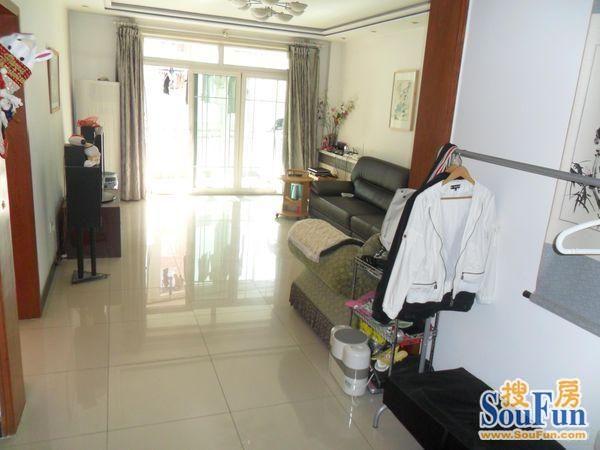
Interior of a Beiwu Jiayuan apartment, renting for 3418 yuan, July 2012:



konjaku: Spring 2011: the former Beiwu village became Beiwu Park. The “urban village” has disappeared. On its site are evocations of the pre-industrial village, set within newly planted trees and decorative lights. The village of the past is reincarnated through its few historical buildings,and a symbolic rice field. “At the base of Yu Quan Hill was the rice field reserved for the imperial family. The sculpture in the field represents the plowing of the field for the Qing Emperors.” (Click on photos for original size).

entrance to the park

a stroll path

to memorialize Beiwu’s past as a rice-growing village, a rice field was planted where the village once stood. To the right is Jinshan Temple.
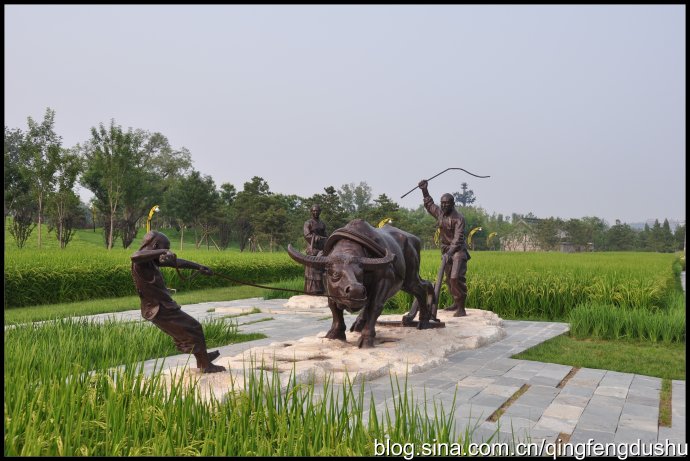
with this sculpture representing the picturesque past

the old opera house has been cleaned up. To give it a beautiful setting, a polished open space has been built in front of it. To the left is Jinshan Temple.
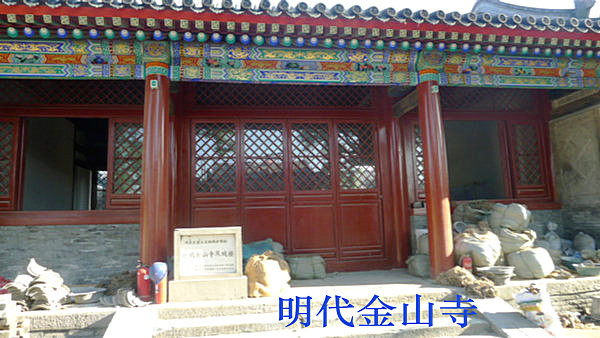
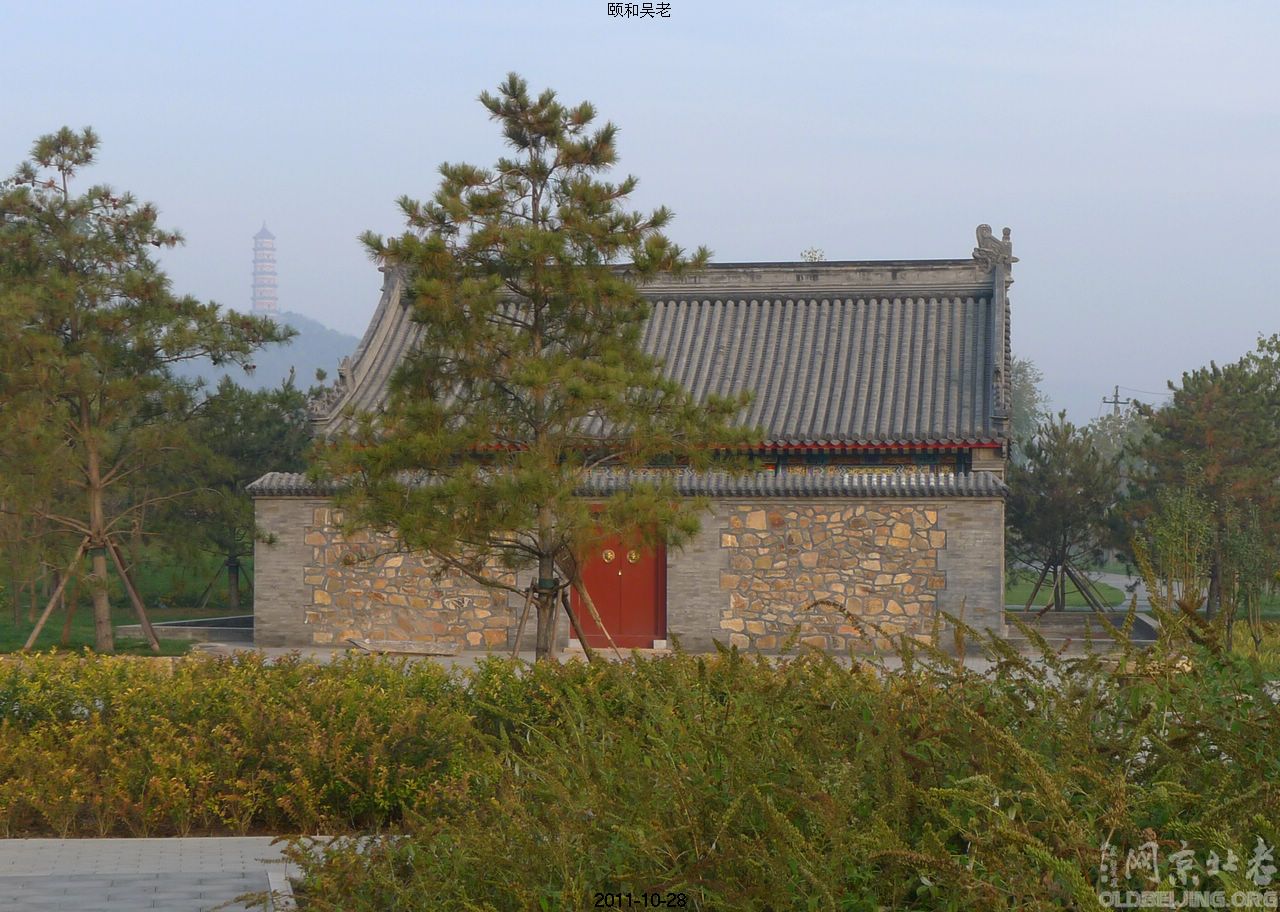
Jinshan temple, still being restored

Beiwu Jinshan temple, before restoration, below:
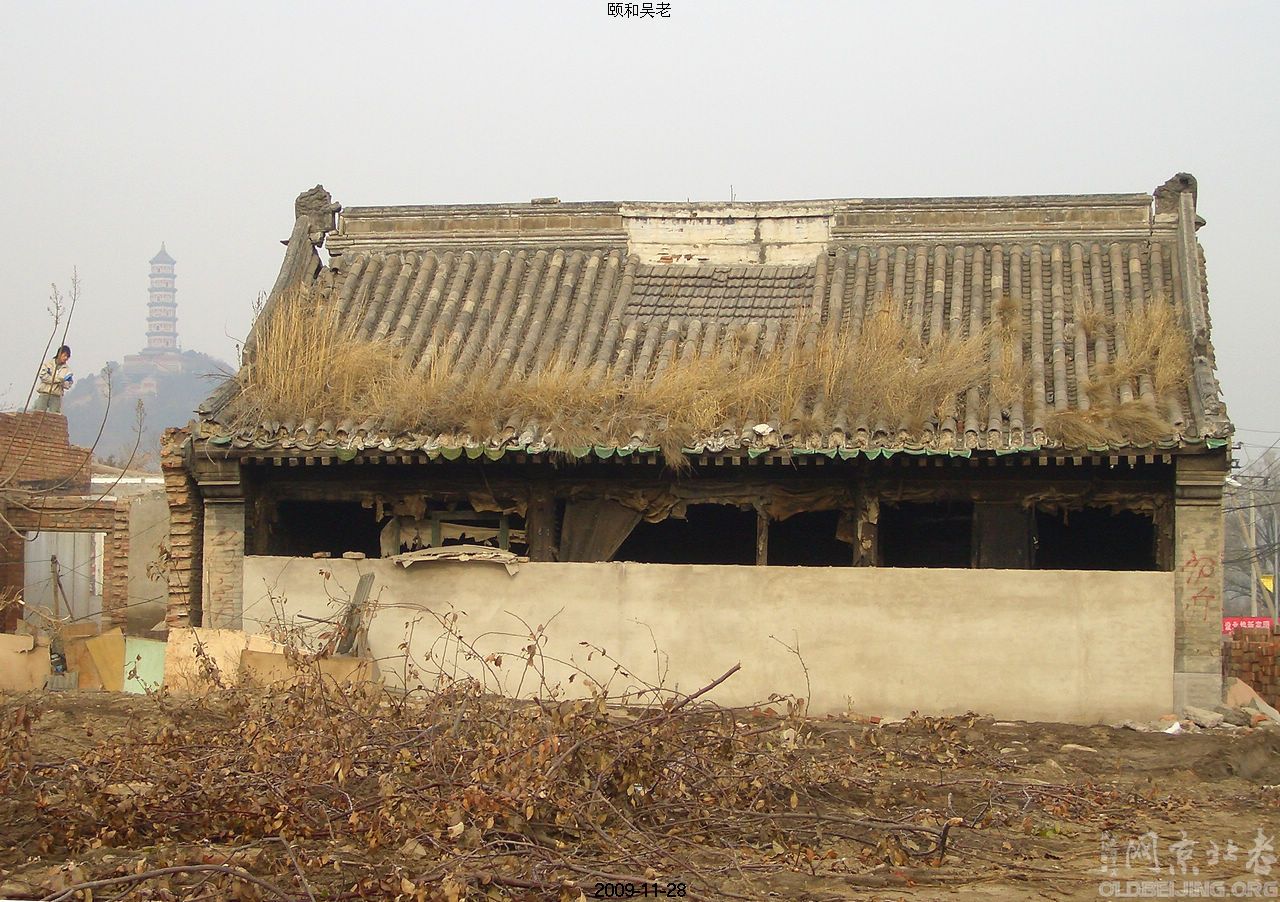
the same building after completion of the park:
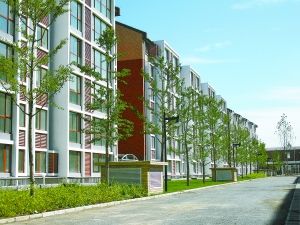
the newly built Beiwu Jiayuan
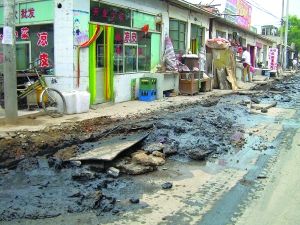
a street corner of the old Beiwu village, as it used to be

the old village site is now a park
Beiwu’s Big Change
2011-05-24
Source: Beijing Daily
http://news.163.com/11/0524/03/74POF2ME00014AED.html
This, this is Beiwu?
Stopping at the Beiwu village intersection, this reporter stared blankly.
At the foot of Yu Quan Hill, the old and shabby village remembered from two years ago was nowhere to be seen. As far as one see, there were trees and luxuriantly green vegetation, the clear blue water of the lake, a vibrant thriving summer day.
“You are looking for Beiwu village? It is now changed into something called Beiwu Jiayuan!” Following a passerby’s direction, I went to the western side of the old village site, and found a modern residential complex.
“Welcome again to Beiwu!” waiting for me at the north entrance was the party branch assistant secretary Guo Yuming, already from afar enthusiastically stretching out both hands in welcome.
When you enter Beiwu Jiayuan, if you don’t look closely, you would take this to be a residential complex of the very highest quality. There are 34 buildings, six stories high, all the same in appearance, with reddish brown tiles, elegant and graceful. Gingko and London planetrees on both sides of the road add a lush green touch.
“Come, take a look at my house.” Hearing that the reporter had returned to Beiwu, 60 year old Guo Guiming enthusiastically invited me. Her family had two residential units of 85 square meters. “I made sure to request the top floor. There’s another 40 square meters above, under the roof, that could easily be made into a small loft,” she said, letting a little pride slip out.
Taking the elevator up, we entered the living room, spacious and bright. Through two open doors there was a large refrigerator, a 46 inch t.v. and, on the wall was a 4 character phrase, “flower opens wealth and rank.” Most unique was the terrace. Before a glass window that dropped to the floor there was a tea table, with several types of tea to try. “These days, I have the free time to spend sampling teas,” she says, smiling. Guo Guiming had permed her hair to have a slight wave, she wore a black-green knit blouse with a string of pearls, on her face was a relaxed smile –at first glance, she had taken off some years, she hardly looked sixty.
“I always liked beautiful things, but in the past in the village it wasn’t possible to wear them. The coal ash in the air was bad enough.” She said the hardest thing about living in a one story house in the village, was the cooking in the winter. Every household compound had rental units, and the smallest room used at least seven or eight thousand catties of coal during the winter (1 cattie =500 grams), and many used as much as 10, 000! There was too much to store in one’s compound, so some was piled out on the road. When they finished cooking people threw out the coal ash, and the wind whipped it up, and it made everything dirty!
Now they all cook with natural gas. “In the beginning I was afraid to use it, thinking it was too expensive. But after a while, what do you think? I moved in here in the eleventh month of last year, it was just the time the central heating was turned on. Until the 3rd month I did not use the heating, and when I calculated what I had spent for the winter it was 800 yuan, whereas I used to have to spend seven or eight thousand for coal.”
Her days pass by in beauty. She loves to stroll in the park. “No need to go elsewhere, when I can go out my front entrance and roam in Beiwu Park!”
This Beiwu park she speaks of, is on the site of the old Beiwu village. The village was turned into a public park and green zone, with a total area of 300,000 square meters. The day this reporter returned was a nice day, the wind was clear, the clouds light, Beiwu park at one edge connects into Yudong park. The whole area is fresh and green, making one feel happy and carefree.
In the plan, Beiwu park is divided into an east and west section. The western part is already finished. There are flowering trees, wandering paths in thick vegetation, beautiful scenery. Besides this, there are also places for sports and exercise, such as basketball and pingpong.
“Living in a place like this is something I previously never dreamed would be possible.” With a happy sigh Guo Guiming said, I hope to live twenty more years, thirty more years, so I can enjoy a well-earned rest in this comfortable nest.”
konjaku: Gu Qinglin, chairman of the Chinese People’s Political Consultive Conference, visited Beiwu Jiayuan on 2011-02- 16. He inspected the whole residential complex and visited a villager family at their home. (Xinhua net, photo by Ma Zhancheng)

konjaku: this positive assessment of the employment situation was written shortly after Beiwu Jiayuan was finished and the villagers moved into their new housing. As we have seen, a major issue for the villagers is whether they will be allowed to become urban residents or not (change their household registry to city resident). In this article, it seems that those villagers who get jobs are allowed to become eligible for some privileges available to urban residents. Instead of giving urban residency to the villagers , the government may be parcelling out parts of it, in an incentive system. The villagers’ perspective:’You’ve taken away our land and source of income. At least make us urban residents, so we can get better health benefits and social security.’ The government’s perspective: ‘Show us you can behave like urban residents first, and get jobs.If you get a job, we’ll give you social security.’
Beiwu village peasants say farewell to the “tile income” , 80% get jobs
Qianlong net 2010-09-06
http://beijing.qianlong.com/3825/2010/09/06/1060@6069702.htm
During the one year in which the rural urban unification reform pilot project has been in operation, 30 hectares of land has undergone an amazing transformation, from patches of low and disorderly housing compounds, to a residential garden project. 81 percent of the peasants have found employment, and no longer need to rely renting rooms out to migrant workers, relying on the “tile income.” At this point Beiwu village has reached the standard for full employment.
Beiwu village is one of 8 natural villages under the jurisdiction of Sijiqing town Yuquan administrative village. There are 1427 people registered as farmers, and 806 as laborers. Although they are called farmers, starting twenty years ago, traditional agricultural production was already disappearing. Before the pilot project was launched, the village was a disorderly collection of low slung housing compounds. Ads posted for rooms for rent were visible everywhere. Many of the villagers were content to stay at home and rely on the income from rentals, instead of going out and looking for work. The villagers culture level was low, and they were reluctant to look for jobs in newly emerging industries. In addition, the local economy did not have sufficient openings. Only 423 persons in the village had entered the labor force, in all 52 percent.
Along with the demolition of the village and relocation of the villagers, a coordinated effort was made accelerate the process of finding jobs. At the end of last year, under the guidance of the Haidian District office, an employment service center was opened in Beiwu village, with three employees, responsible for giving the villagers vocational counseling.
26 year old Shi Zhen several years ago got a temporary job with an electronics company, but because the work was hard and his treatment poor, he soon returned home. He rented out a room he built himself, and lived off the income, although it was not terribly much. But he didn’t have to work hard, and didn’t have to follow a schedule. After the village was demolished, Shi Zhen’s sole source of income disappeared, and he was quite worried. Three times he went to the employment fair at the service center, but ended up with nothing. The reason was “the salary was low, 1000 yuan a month or a little more, so I didn’t want to.”
When he found out Shi Zhen’s view, the employment counsellor helped him to squarely face his situation. After all, his educational level was not high, he had no specialized technical skills. He went over the employment possibilities for Shi Zhen in meticulous detail, reading him chapter and verse. After listening to him, Shi Zhen suddenly realized, “If I get a job, I will be able to enjoy the same privileges as urban residents, and will be eligible for social security. That is a strong point to consider –the wages are just one aspect of it.”
Not long after that, Shi Zhen succeeded in getting a job recommended by the employment service center, at an auto sales and service dealership. He was able to give free rein to his desire to drive cars, helping customers by moving cars or delivering them. “This job really fits me. And it is not far from home.” He was very satisfied.
konjaku: this relates the viewpoint of a Beiwu villager. At the time of this article, the village has been demolished, construction has started on replacement housing.
The story of Beiwu villagers “sudden wealth”
2010-02-23
http://finance.ifeng.com/news/20100223/1847478.shtml
Source: Phoenix net, Liaowang Dongfang weekly, reporter: Wang Kai
Beiwu village has already turned into a pile of rubble. A thin covering of snow on the ground made it seem all the more empty. All that was left was the temple and the opera house, which still had traces of being defaced during the cultural revolution. These were now designated historical relics of Haidian district.
Lured to the village ruins was a husband and wife from Anhui. They had decided not to return home for the New Year holiday, in order to pull from the rubble any whole bricks, which they would sell, one brick for .17 yuan. Every day they retrieved several hundred bricks, and made 20-40 yuan. In one month they could make one or two thousand yuan. They told this reporter, this was the most minuscule amount of profit that could be reaped from the demolition of Beiwu.
“When the village was dismantled, the villages all became millionaires, However, they still didn’t want the village demolished.” They laughed as they said this.
The Beiwu villagers are to receive replacement housing in Beiwu Jiayuan at a 1:1 ratio with the area of their former household compound. Besides this, they receive 3000 yuan in compensation for every square meter (of their former household area), and 200 yuan per square meter as a renovation subsidy. Overnight they acquired two or three residential units in the new development, as well as several hundred thousands, up to one million yuan in cash. It seems they are truly “wealthy overnight.”
“You call this ‘sudden wealth?’ You think I’m rich now? Even if I have no way to make a decent living the rest of my life?” Beiwu villager Zhang Beiqing (alias) said this in all seriousness. She had had a 240 square meter household with garden, which she very much regretted having to part with.
Beiwu village is actually in a beautiful area. It is a close neighbor to the Summer Palace, and to Kunming lake. You can see the pagoda on top of Yu Quan Hill from the village. Not far to the north is the newly developed Yuyuan Villas(Majestic Mansion), which retail at 220,000 yuan per square meter.
Zhang Beiqing was not willing to talk about the demolition. “What’s the point in talking about it, it’s already done and over with.” Her family was one of those that agreed to cooperate with the government fairly early, and her house was razed in 2009-06, soon after demolition started.
Two years ago she borrowed money to build a two story building in her compound with 20 rooms, which she rented to migrants, earning seven or eight thousand yuan a month. “If I could have had another year, I could have paid off my debt.” Her salary is only 1000 yuan a month, but with the rental income her family lived comfortably. “Look at him,” she said to the reporter, pointing to a fellow worker. “On this cold day, he had to turn off his central heating.”
Two years ago, this 50 something man and his family moved to “better” replacement housing (after the demolition of their village, not Beiwu). At present his monthly salary is around 1000 yuan or more, it comes to something above 10,000 yuan a year. In his building the building maintenance fee and central heating bill amount to 4000 yuan a year.
“Previously our house and property nourished and supported us. Now it is we who must “nourish” our building with money, but since our income is low, how can we afford it?” Zhang Beiqing had done all the figures. They say we’ll get 20,000 yuan a square meter if we sell, but if we sell, where are we going to live?”
In Zhang Beiqing’s household there are five: the husband and wife, son and daughter-in-law, and the grandson, born recently. The son works in a Kentucky Fried Chicken store, his income is not large. In this move, Zhang Beiqing’s family received three residential units (in Beiwu Jiayuan) and some 800,000 yuan in compensation money, for their 240 square meter compound. The residential units comprise two two-bedroom suites and one one-bedroom suite.
This arrangement would incite envy in most people. However, Zhang Beiqing said she would prefer what she had before. She does not want her new “suite.” “With my low income, all the money will just be eaten away before not very long.”
800,000 yuan is by far the most money Zhang Beiqing has ever seen in her life. But her fellow worker said he had received a large compensation payment too, and it had long ago been used up in everyday expenses.
The area where urban and rural join, is where the” Beijing floaters” live. [Beijing floaters: people who work in or around Beijing, but do not have Beijing household residency]. Rents are cheap, a few hundred yuan a month, something migrants can afford. This is why there were so many migrants renting in Beiwu, from village residents like Zhang Beiqing.
But now she is moving up to “better” housing. Of the family’s three residential units, the one bedroom unit will be the only one they will be able to rent out. “Suppose we try to get 1000 yuan a month for it, what migrant worker will be able to afford it?” She said even if they are able to rent it for about that amount, their overall rental income will still be far less.
For Zhang Beiqing, her homestead with garden was not only her residence, but a reliable source of capital. Now she is moving up to better housing. According to the government plan her quality of life will be enhanced. She will be freed from the messy environment, the overcrowding. The government hopes the land which Beiwu village used to occupy will now become something greater.
Zhang Beiqing does not feel this is a change for the better. Her family is temporarily living in Mentougou village paying 2400 a month for rent, from a moving allowance of 560 yuan per person. After that, there is 40 yuan left over.
As for the 800,000 yuan in compensation, Zhang Beiqing used some of it to buy her son a car, a Beijing Xiandai ( made by the Beijing Hyundai corporation). “His work is far away. As long as we are able to do it, we want to make our son satisfied.” She figures they have 5 or 600,000 left.
Her fellow villagers also think, that they have gotten a lot of money but also increased expenses. In a few years the money will be gone, and they have no way now to invest it. “Should we buy a real estate property? Right now, prices are high, but what if they fall in the future, and we lose our investment?”
Zhang Beiqing did not anticipate that Beiwu would so quickly turn into a pile of rubble. At the end of 2006 the village underwent extensive renovations. The streets were repaved, new sewage and running water pipes were installed. There were new streetlights, new public toilets, and new brick paving at the entrance. At present, at the village site, the manhole covers have been pried off and taken away.
“Don’t just demolish the village, without letting us turn into urban residents,” Zhang Beiqing said. Her permanent residence booklet says she is a “villager,” but the plot of land with homestead and garden which the “villager” has for personal use is something which has now disappeared.
villager 村民
Click on photos for original size
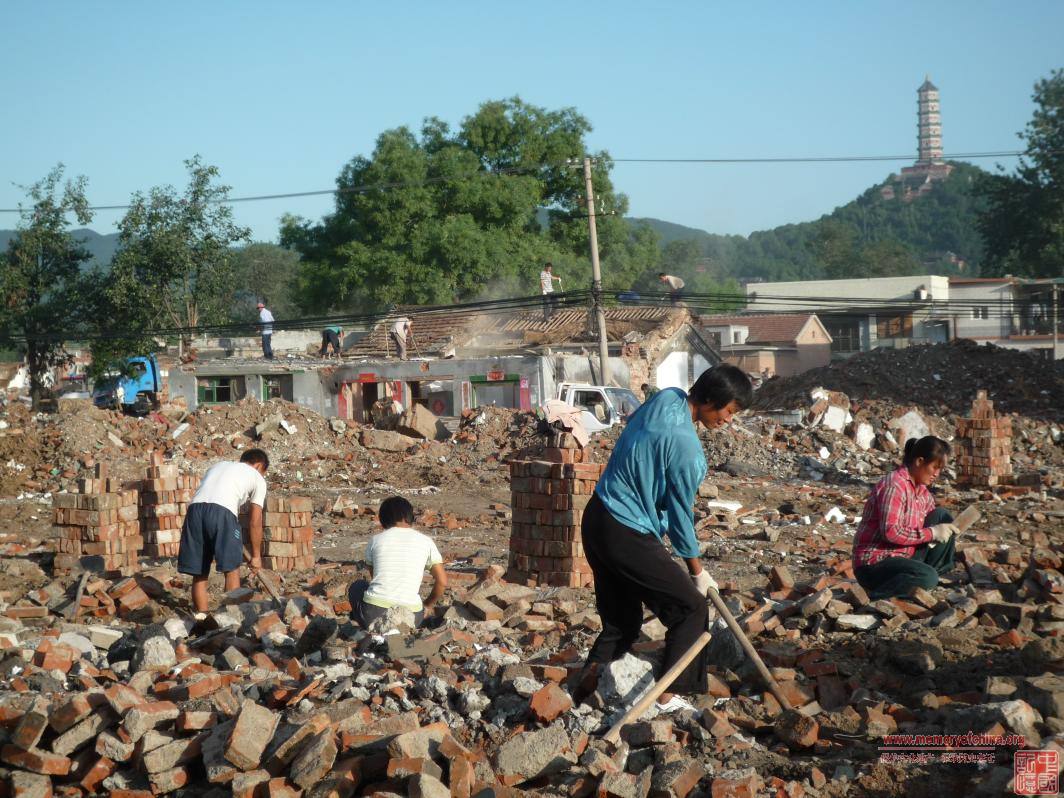
Beiwu village being demolished

Beiwu village demolished –from the air
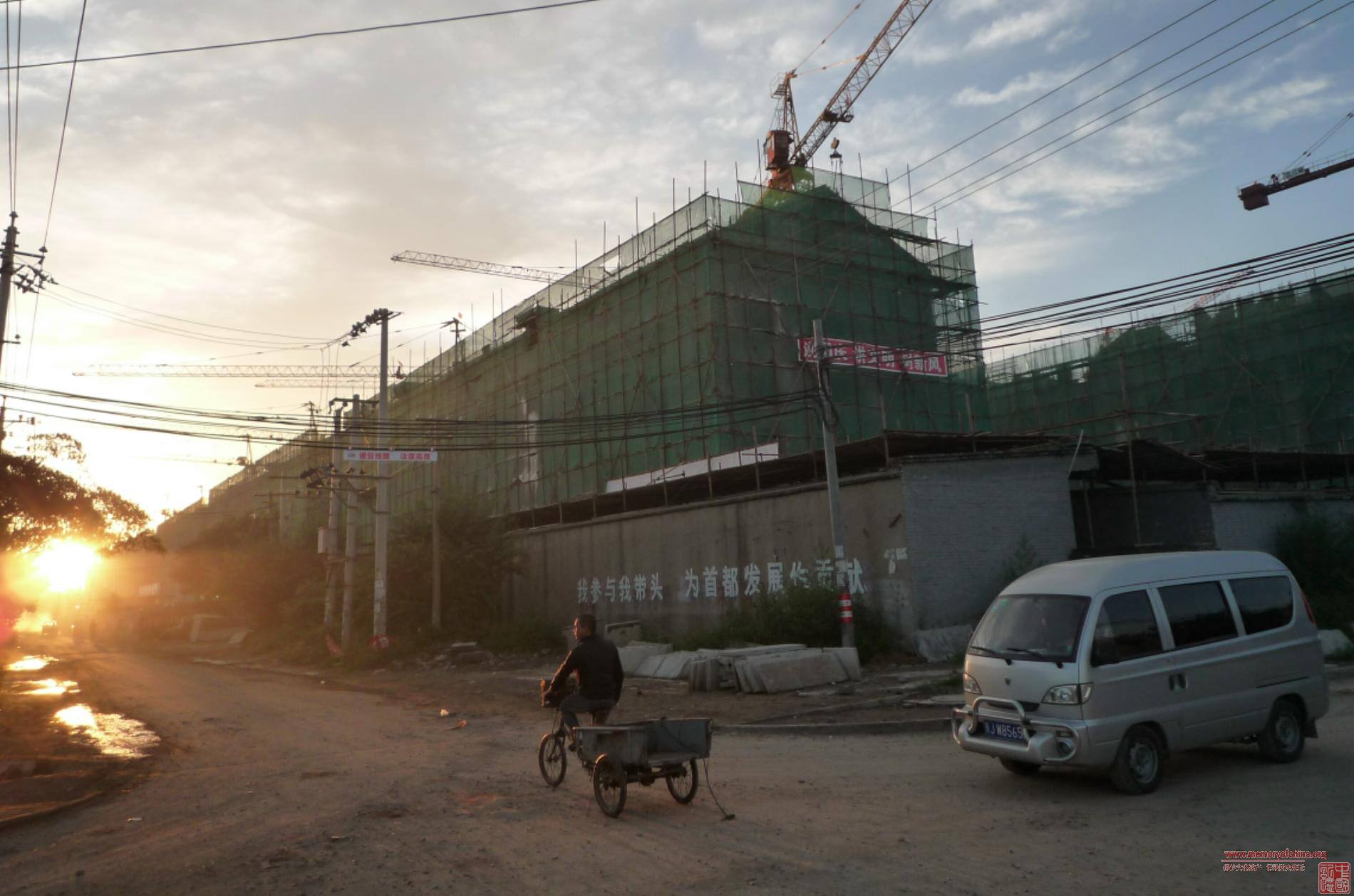
Beiwu Jiayuan under construction
The three photos above are from Memory of China
http://www.memoryofchina.org/bbs/read.php?tid-8949-page-1.html
Some photos of the Yuyuan Villas development:

Villa with Yu Quan Hill in the distance

konjaku: “Zhang Beiqing did not anticipate that Beiwu would so quickly turn into a pile of rubble. At the end of 2006 the village underwent extensive renovations.”
The background of this was treated in an earlier post: “In 2006, as the Olympics drew near, Beijing, in order to fulfill the promise it made to the international community to make it a “green Olympics,” having already allotted 100 million yuan, began a large scale project to renovate those villages within the city.
For instance, in 2006 Beijing invested 30 million yuan in a pilot project to renovate the environment in Beiwu. They widened the roads and hardened them. They put in streetlights to illuminate certain selected roads, added running water on these routes, and sewage pipes to carry off rainwater and soiled water, They built a hygiene service center and a police affairs service center, An important part of this was tearing down the non-conforming buildings.
Even so, it was just another round in the dispute. The government had merely treated the symptoms. As soon as the Olympics passed, the offending buildings went up again. The hardened roads, tap water and sewage, ameliorated conditions, were simply not enough to truly transform the “dirty, chaotic, inferior” appearance. The final outcome was that with the demolishing and relocating, the government escalated its management hold over the village.”
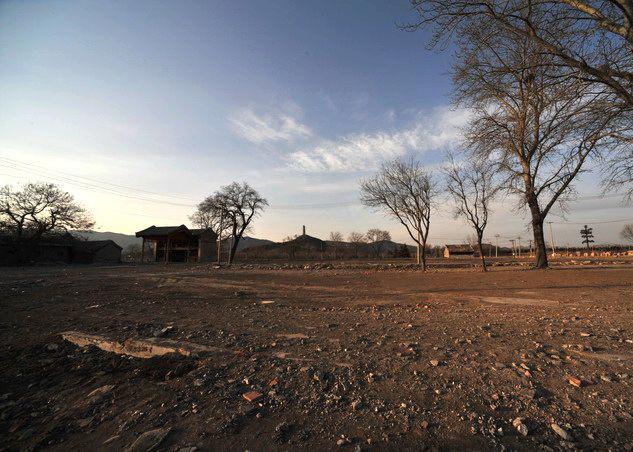
konjaku: some photographers came to Beiwu at New Years in 2010. Probably unaware of what had happened to Xi Xinzhu and his family in 2009-12, they were only pleased that the outlying buildings had been removed, allowing them to get unobstructed shots of the old opera house. In these pictures, the village structures are gone. What remains are the two sites that were recognized as having historical value: the opera house and a temple compound, the Beiwu Jinshan temple.

Poster addressed to “those villagers who have not yet moved”
In the photo below, the empty land in the foreground is where village household compounds once stood. In the near distance what remains are the buildings comprising Jinshan temple on the left, and the opera house on the right. In the far distance is Yu Quan Hill and the Yu Feng Pagoda. On the other side of Yu Quan Hill is Kunming Lake and the Summer Palace.


the opera house
Beijing Haidian district Beiwu village man Xi Xinzhu, at the point of forced demolition, attempts self-incineration
2010-03-25 Source: Beijing Times
Photo 1:
His wife looks after the burned Xi Xinzhu
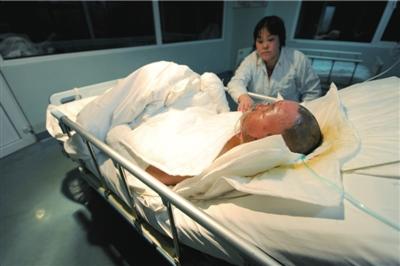
Photo 2:
After the demolition, Xi’s house turned into a pile of rubble

At the time the Yuquan administrative village committee enacted the forced demolition of his house, Xi Xinzhu poured gasoline on himself and ignited it, leading to the burns on his face and arms. At present the patient is out of danger.
Who is not telling the truth?
Xi Xinzhu’s younger brother showed the contract of sale for Xi Xinzhu’s house. Dated 1990-07-18, it records that Xi Xinzhu’s father, Xi Jinsuo purchased the house from a certain villager Li for 6000 yuan. Since that time, the Xi brothers and their families, five people in all, had lived in that house until the present.
In 2000, records show the Xi family was issued a building permit by the Haidian district, to expand the buildings within the compound. When the Sijiqing town government organized the removal from Beiwu village, the Xi family affirmed that the total area of their residence was 311.79 square meters.
This year in the second month, as the project to completely rebuild Beiwu village began, the villagers one after another moved out of their houses, but Xi Xinqiang announced that the village committee had never negotiated with them about compensation payments for the demolition and relocation.
On the 12th day of last month, the Sijiqing town Yuquan village committee put up a poster on the wall of the Xi family compound, demanding that they move out of their house by 12-15 at 8 AM, otherwise they would be subject to a demolition by force.
In response to Xi Xinqiang’s statement that they had never negotiated compensation, the poster put up on the house wall, stamped with the official seal of the Yuquan village committee, says something different. It states that until the deadline indicated the village committee would negotiate, in a process mediated by the Sijiqing town government.If an agreement still is not reached by the date in question, they will commence the forcible demolition.
The poster does contain an offer. It affirms the area of the Xi compound as 311.79 square meters, appraised at 260,000 yuan. It offers replacement housing in the new housing development, the Beiwu Jianyuan South, consisting of one three room residence of 94.21 square meters, and a two room residence of 94.21 square meters, and in addition, a compensation payment of 640,000 yuan.
But when confronted with the evidence of this poster. Xi Xinqiang said he knew nothing about it. He and his family members insisted they had no knowledge of it.
Yesterday evening, Xi Xinzhu’s wife described what happened. She said at 2 in the afternoon, one day before the deadline announced on the poster, the Xi brothers were at home taking a rest, when suddenly the door was opened and a line of men in helmets and fireproof suits filed in one after the other. Outside in the courtyard, a security cordon of more men formed.
“They’re here to demolish the house.” Xi Xinzhu became stirred up. He was lying on the sofa. (Not long before he had been assaulted by an unknown person. His leg had been broken, and he was still recovering.) Xi’s wife said, they had a certain amount of gasoline in their house which they used for heating. In order to stop the demolition, Xi Xinzhu sprinkled the remaining gasoline on his body. To threaten the persons who had come to demolish the house and get them to leave, he took out his cigarette lighter. But they did not withdraw, as he did not ignite it. She said she heard one of them say, “If you are going to do it, go ahead and do it.” At that time, she was using the phone to call for help. Behind her she heard a sound, a “poof,” and she turned around. Her husband had set himself on fire. The assembled personnel quickly extinguished it.
The same afternoon, the Xi compound and buildings inside was completely torn down.
The next day, this reporter accompanied Xi Xinqiang to the 304 hospital to see his brother in the critical care burn unit. This reporter saw through the glass window that Xi Xinzhu’s face was completely scarred. He was unable to go inside because of the danger of infection. However Xi Xinqiang exchanged a few words with his brother. He said his brother’s state of mind is calm and at ease, and “he said he definitely does not want to sign.”
Xi Xinqiang said his residence permit (hukou) was transferred to this village in the 1990s. Therefore he is a resident [an urban resident, not a villager], under the jurisdiction of this residential district. Since this moving out of the area is aimed at villagers, he and his family should not receive the same treatment as the villagers, nor should they fall within the category of those who have to move out. At least, he hopes to receive in exchange market priced housing, not the economically affordable housing development –Beiwu Jiayuan South.
http://bbs.local.163.com/bbs/bj4hy/168822368.html
Beiwu village pilot project –the villagers “move out voluntarily”
2009-12-14 in the afternoon, a large quantity of police and government officials came to Beiwu village, located to the south of Yuquan mountain in Haidian. Forming a security cordon, they surrounded the house of Xi Xinzhu. Xi Xinzhu still recovering from injuries after having been attacked not long before, poured gasoline on himself, and shouted at the intruders not to come inside. One of those persons said to him, “Don’t just play around,” and forced his way in, and at that instant Xi Xinzhu ignited himself.
In China here are many demolitions by force. Even though they are unjust, there still is a certain legal procedure to follow. Those demolishing must still bring a demolition permit. Yet what occurred in Beiwu was supposed to be something different, a new concept –not forced demolition, but “voluntary evacuation.” There was no need to initiate legal proceedings, because everyone involved had consented and agreed.
At the beginning of 2009, the Beiwu pilot project of “urban and rural unification” began. 3-19, the Beijing Youth Daily reported that in Beiwu they had broken ground for the cornerstone of the replacement housing. Those guiding the construction said the villagers would be able to move to their new housing by the end of the 10th month. Zhang Quan, the Yuquan village committee secretary in charge of the “evacuation” said that on the land on which Beiwu village currently stood, the plan was to build a high class restaurant and a large scale development, the Yuquan Huigu Second Stage Scientific Research Park.
2009-03-24, the Beiwu Village Transformation Plan was released. The plan affirmed that the demolition and relocation was occurring through the villagers self-autonomy. However, Article 5 of the plan states, “there will be a deadline set for the negotiations to determine the amount of compensation. Once the deadline has passed, there will be a 15 day period in which the persons involved can apply to the Sijiqing town government to act as mediators. If no settlement is arrived at within this period, according to the Yuquan village committee organic law, those who have not moved out will be forced to move out.”
2009-04-and 05. Preparations to begin the pilot project. 4-25: finish surveying and estimating the value of existing village structures.
2009-06
I went to Beiwu village at the request to a number of villagers to do an investigation. I interviewed a random sample of some 30 villagers. There was not one who was “voluntarily” moving out. The reason was simple. When one square meter of land is exchanged for one square meter in a multi-storied building, it is clear at a glance which is the better value. The villagers can always rent out rooms when they live in compounds to generate income, but when they move to a multi-story building, what are they going to to live on? Also, the villagers are being displaced from their land, but they don’t know when the replacement housing will be ready — it is still in the process of construction.
To complete the “voluntary evacuation,” government department officials have come frequently to this area.There are posters all over the village with slogans. These apply an irresistible pressure on the villagers. The government demands that those who resist must negotiate, if they refuse, they will not be able to work. Further, on 6-01 when the evacuation started, there appeared a gang of unidentified men roaming about. Doors and windows were smashed, bricks hurled into the compounds of those who were resisting. They even stopped water service, electricity, and telephone service to those compounds, etc etc.
In my capacity as a representative of the Haidian district People’s Congress, I proposed that a basis for equitable compensation for the villagers be put into law. I wanted the issues of compensation and replacement housing to be fully settled before the demolition began. But this proposal was not acted on.
2009-11-24 We again went to Beiwu at the request of some villagers. At nightfall we saw a group of unidentified men wearing camouflage clothing. Less than an hour after we left the village, Xi Xinzhu and his fellow villager Yu Xingui were assaulted by six unknown men. Xi Xinzhu’s right arm , right leg (tibia bone), and shoulder blade were broken, and he had numerous other injuries. Yu Xingui was in a stupor, with blood streaming all over his face.
2009-12-12. The Yuquan village committee announced that the Xi family had a final deadline of 12-14 at 8 AM to move out. On the 14th in the afternoon, the stand-off occurred and Xi Xinzhu ignited himself.
————
It was been reported that “voluntary evacuation” will be the model for the demolition and relocation process to be applied to all of Beijing.
—————-
konjaku: The above is excerpts from a longer article which appeared in the Nanfeng Chuang (South Wind Window). The author is identified as :许志永 Xu Zhiyong, activist and member of the Haidian District People’s Congress. The original article continues with a discussion examining the legal issues pertaining to forcible demolition, also comparing comparing China’s approach to other countries.
http://www.nfcmag.com/articles/1905/page/1
Here is the first paragraph of that section:
If we compare the case of Xi Xinzhu to to the self-immolation incident of Tang Fuzhen in Chengdu, in Beiwu the forcible demolition was a direct action of the village committee. It was done on the basis of being a “voluntary evacuation,” in order to transform the village collective land. There was no certified plan, no official land requisition document, no hearing, no demolition and relocation permit process, no contestation too be adjudicated, no application to enforce the demolition. In fact, there was no legal process whatsoever. They simply demolished the home which the Xi family held according to lawful property rights.
konjaku: For more on Xu Zhiyong, including his detention on 2012-06-07, see China Digital Times:
https://chinadigitaltimes.net/china/xu-zhiyong/
konjaku: going back in time now, to 2009 and the demolition of Beiwu village, there is one case of resistance to the process. This and the following two posts give a different perspective on the transformation of Beiwu.
Beiwu Village Demolition and Relocation Leads to One Sacrifice
Legal Daily
2009-12-24
http://www.legaldaily.com.cn/zmbm/content/2009-12/24/content_2010136.htm
2009-12-14. Beijing city Haidian District Beiwu village resident Xi Xinzhu, because of his discontent with the village committee’s “demolition by force,” attempts self-incineration.
2009-12-16 The Haidian District government publishes an announcement concerning this incident, but it contains discrepancies firm the truth.
2009-12-17.Xi Xinzhu’s relatives call upon the 400 representatives of the Haidian District People’s Congress to get involved in the investigation
2009-12-23 Xi Xinzhu’s lawyer says that the Haidian District Court put forth an answer to the complaint filed on behalf of Xi Xinzhu, stating that this matter occurred under the auspices of village committee organic law, and therefore is within the purview of village self-government. It does not fall under the jurisdiction of the District court, and the court does not take up the complaint on that basis.
————
photo:
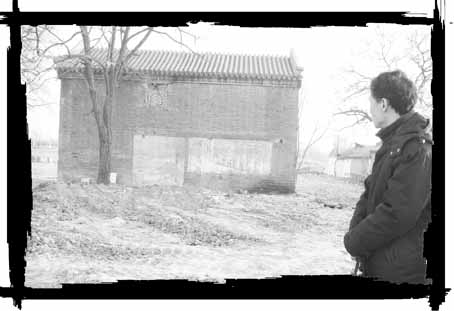
Xi Xinqiang stands in front of the rear wall of the old opera house.This piece of land is where his house used to be. He said, his older brother Xi Xinzhu loved this opera house. He used to go over there everyday and sweep, keeping it clean and tidy.
12 -14, 1:30 in the afternoon. A low rumbling sound was heard outside the house. 5 members of the Xi family were waiting inside for 2 o’clock, which yesterday evening the Yuquan village committee had promised would be the time for “final negotiations.”
Not 24 hours later, “12-15 at 8 in the morning,” had been previously announced by the village committee as the deadline for when the Xi family would be “permitted” to leave their house of their own accord.
Xi Xinzhu’s wife Long Shufang from inside the house, looked out through a crack in the metal door at the front of the house. “Quite a few large vehicles were driving up. There were fire engines, ambulances, and forklifts that were so large and noisy they resembled tanks. ”
As she later told this reporter from the Legal Weekly, “We knew then, there would be no negotiations.” Xi Xinzhu’s younger brother Xi Xinqiang told this reporter, at that moment the room fell silent, and the rumble outside became louder and more distinct.
Xi Xinqiang walked quickly to the second wooden door, thinking he would reinforce three bolts on the door. He ended up bearing the brunt of the force, as a group pushed on both doors (metal and wood) and kicked them open. In his line of vision, he was able to see 6 strangers rush into the house. They were dressed in fire-proof uniforms, and had on safety helmets . He couldn’t see their faces. Soon after, he was pulled out of the house. He saw his brother and his wife inside, saying something, and that was it.
“Go and call the police!” Xi Xinzhu’s right leg was injured, he couldn’t move. He pushed his wife away. He suddenly took out a fuel bottle full of gasoline. He poured the gasoline on himself. Long Shufang said later she did not know from where her husband took out this bottle.
“Everyone out!” Xi Xinzhu holding in his hand a cigarette lighter, yelled at those people who had entered the house. Long Shufang was very frightened, but she felt she had to do what her husband said, and she ran to the inner room to phone the police.
“I think my husband just wanted to scare them.” But Long Shufang said she heard, from among the dense mass of dark blue flameproof suits clustered around him, a voice saying to her husband, If you say you are going to light the fire, go ahead and do it.”
When she came back from the inner room, she saw her husband turn into a fireball. “He tried to pull off his down-filled coat, which was on fire, and staggered toward the courtyard.” 5 meters away, in the courtyard, was a large vat containing enough water to fill 10 to 20 buckets.This was originally prepared in case the resistance turned into a long siege. “My husband ran for the water vat. At the same time, the firetruck from outside sprayed a column of water on him.” Long Shufang said, at that time her emotions passed the breaking point. She yelled over and over. “Don’t help us! Our lives aren’t worth anything!”
Xi Xinzhu was taken by ambulance to the 304 Hospital. His 80 year old mother and Long Shufang were carried out and taken to the same hospital in a different ambulance. The doctor said that Xi Xinzhu was burned on 10 percent of his body. This reporter’s understanding is that Xi Xinzhu is at present in the critical care ward.
——–
On 12-16, The Haidian District government issued a statement on the incident, stating, ” As part of the pilot project of urban and rural unification undertaken by the Beijing city municipal Party committee, the demolition of Beiwu and relocation of the residents is in its final stage. As of 12-12, only two households had not signed the agreement to move out. In order to speed up the process, in 12-14 the concerned departments decided to go and negotiate with one of the two remaining household members, Li Fei (an alias). While negotiations went on inside the house, staff members waited outside in the compound for orders.
As the negotiations proceeded inside, someone from compound 272 next door [the house of Xi Xinzhu] suddenly opened the door, and Xi’s daughter-in-law Li Xiaoying came running out, shouting, “There is someone pouring gasoline!” As soon as they heard this, the staff members and the firemen ran quickly into the 272 compound, through the window they saw Xi Xinzhu dowsing himself with gasoline. The firemen sprayed Xi Xinzhu with fire extinguishing foam, but Xi Xinshu suddenly lit himself with a cigarette lighter. The firemen extinguished the fire, the first aid personnel waiting in the courtyard gave him medical treatment, and sent him off by ambulance to the 304 Hospital.
After this, the Xi household was torn down.
This reporter spoke to a Yuquan village committee member, who was reluctant to give out his name. He said that he was on the scene on 12-14, and said Long Shufang’s account to the media diverged from the facts. He insisted that at that time, when he was in the house next door, belonging to Zhao Bing, that he heard the Xi daughter in law Li Xiaoying crying for help, and only to ensure public safety did they enter the Xi compound.
“Li Xiaoying did not run towards my house.” That is what Zhao Bing responded when this reporter sought confirmation. Zhao Bing said at that time he was negotiating with the personnel who had come to demolish his house. However I did hear a woman cry out in fear from next door. Zhao Bing was aware that there was some kind of incident occurring at the Xi household. [Zhao Bing is apparently the real name of the person given the alias Li Fei in the government statement].
Xi Xinqiang was forced to stay outside the house, but he stated that he absolutely did not see Li Xiaoying run next door calling for help. “She was carried out of the house, with only slippers on her feet.” Xi Xinqiang also afterwards asked Li Xiaoying what she was doing inside the house, and she answered she did not remember.
Zhao Bing said, his wife was carried out of the house by the hands and feet by four public security personnel and taken away. He insisted on striking a last deal with those who had come to demolish the house. “I said I will go, if you let me take my cash. They saw I wasn’t confrontational, and let me go back in.” He went inside and got his house deed, identity card, cash and bank book, and a down coat and shoes for his wife. Shortly afterward he was taken away in a mini-van that “looked on the outside like an ambulance, but inside had no medical equipment installed” to the demolition and relocation office.
On 12-14 at 4 in the afternoon, Long Shufang was taken back under guard from the hospital to the demolition and relocation office. From inside the car on the way, she got a glimpse of something she knew well — the beautiful old opera house from late Qing (1644-1912). Behind the opera house was where her house stood –but it was no more.
Long Shufang afterwards recollected, there was a sign that something would happen that day. Those who patrolled the village garbage heaps looking for scraps were suddenly nowhere to be seen. “They at least seemed to be aware something was coming.”
“From 2009-06-01, when Beiwu village formally began the “moving out” process, within the village their appeared 6 or 7 people whose identity was unclear, who all day went around from place to place.” Zhu Fuxiang told this reporter. When he investigated, he heard “windows were smashed, doors broken, brick pieces thrown into compounds. ”
The 60 year old Zhu Fuxiang was not loathe to say he was a nail-holder. Since 2002 when he retired, he had been busy going from place to place in Beijing supporting other nail-holders.
2009-11-24 at 8 in the evening, Xi Xinzhu with another villager Yu Xingui were strolling in front of the old opera house, when they were attacked by six or seven unknown persons. When a doctor examined him, he determined his right arm, his right tibia and shoulder-blade were broken, and he had other numerous injuries. However, the Haidian district Public Security branch office report issued by the legal medical expert stated that he had “less than minor injuries.”
—————–
2009-03-24, the Yuquan village assembly adopted a plan to demolish and remake the currently existing Beiwu village. However, this reporter found that many of the Beiwu villagers said they never received any official notification, and had only heard about it indirectly, as gossip.
In the Beijing Youth News 2009-03-19, “Following with Interest the Beiwu Village Unification of Rural and Urban Pilot Project,” a certain person named Zhang Quan divulges that there are plans to build a high class restaurant on the site of the former Beiwu village. In the article this Zhang Quan is identified as the “village party branch secretary.” But this Zhang Quan has another identity –as the Beijing Yi Zhang Quan Real Estate Development Corporation legal representative.
The following day, 2009-03-20, in the same Beijing Youth News, there was article titled, “On the site of the former Beiwu village a park will be built,” here the source is “Haidian District Farming and Forestry committee Deputy director Wang Zhiwei.”
2009-12-18, Xi Xinzhi entrusted his younger brother Xi Xinqiang, the citizen Zhu Fuxiang, and the lawyer Yang Huiwen to file a complaint with the Haidian Disrict Court against the Yuquan administrative village committee (with jurisdiction over the natural village of Beiwu).
The complaint stated, that on 2009-12-12, the Yuquan village committee announced the removal from Beiwu village, the plaintiff did not accept the legitimacy of the action, and did not agree to the compensation plan. On 12-14, without any legal bias whatsoever, the accused forcibly destroyed the defendant’s legal property.
2009-12-15, Xi Xinqiang went to the demolition and relocation office accompanied by the media, wishing to reclaim the official papers and property taken and held in custody at the time of the house demolition. But he told this reporter, “I got nothing back. When it was time to examine the articles in question, they all walked out.”
2009-12-16, after the Haidian district People’s Congress Representative 72 year old Wu Qing made a special trip there, the Haidan government office handed over to Zhao Bing, acting as Xi Xinzhu’s proxy, the materials seized on 12-14, consisting of both households’ proof of ownership documents and identity cards, among other things.
“Property rights law clearly stipulates, that a citizen’s legally held property is protected under the law.”Wu Qing believes that Xi and Zhao, having proof of ownership for their homes, and residence permits from the city, owned their houses as personal property. “How can someone else come at random and take away their property? Even if their village falls within the area of land requisitioned by the government from the village collective, the government should still adhere to the law and negotiate with them.”
This reporter spoke by telephone to Deputy Director Wang, and he insisted that Beiwu village was a case of voluntary removal by the residents, not one of demolition and relocation.
Wu Qing stated, “The village committee is a self-governing entity — what authority do they have to forcibly demolish?”
Zhao Bing said, ” I did not sign any document of approval, there was no written judgement from any court, yet they demolished my house. That is not legal.” Zhao Bing felt wronged. I truly did not intend to be a nail-holder. But for my house, which I held with a legal document, they offered me as replacement housing a residence which was “valued the same according to the current economy.” But now I no longer had the same proof of ownership with the new residence, so I could not accept it.”
In the course of interviewing Xi Xinqiang, Zhao Bing, Long Shufang, the three often used the term “they” or “them.” When the reporter followed up closely as to who this referred to exactly, all three answered they couldn’t remember. Of those who came to their house, some said they were from the demolition and relocation office, some said they were from the village committee, some said they were from the real estate corporation, some said they were from the town government, some said they were from the District government. We become truly muddled as to who was who, ” Zhao Bing explained.
Xi Xinzhu’s medical expenses have already been paid by someone. “When I saw the person who paid, I asked him who he was, and he would not say. He just signed the agreement to pay and left. The signature was written sloppily, she couldn’t make it out.” Long Shufang was unwilling to accept anything whatever from “them.” At present she is still wearing the same clothes she wore on the 14th, and a hospital outfit to sleep in. Xi Xinqiang said, his wife Li Xiaoling and their child were staying at her parents house. He had no fixed place to stay. At present he was worried about registering his child for elementary school.
“To stay safe, the most important thing is keep safe my property documents.” Believing this is foremost, Zhao Bing has no plans to return to negotiate with “them” –“they cannot be trusted,” He does not dare to go so far as to hire a lawyer, “I do not want it to be turned into a legal case, I just want back the things they seized.”
Zhao Bing’s knowledge of the law comes from the “12345” government hot line. Although he is hiding himself in a trench, so to speak, and does not dare bring his case out publicly, he frequently calls 12345. The person on the line tells him impatiently that they do not know what he should do in his situation. He asks this reporter , “What should I do?”
Xi Xinzhu 席新柱

