Yanjiao home price runs up to 15000 yuan. But Transportation and Medical Facilities are not keeping up with the city growth
http://news.xinhuanet.com/fortune/2013-10/24/c_125594524.htm
Source: Legal Evening Daily
When Beijing house prices rise, those on the periphery hitchhike upward. But is Yanjiao worth the price, with inadequate transportation and medical facilities?
Passengers in Beijing board the 930 bus to go back to Yanjiao (file photo)
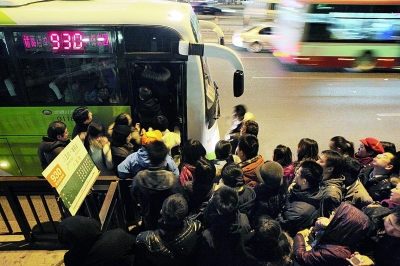
In the second half of this year, Yanjiao home prices once again topped previous highs to reach 15000 yuan per square meter.
When Beijing house prices rise, we don’t think there is anything amiss with prices rising in the Beijing satellite towns, such as Yanjiao and Gu’an, also. However, according to a real estate specialist, this sudden rise is not a particularly good thing for places whose infrastructure is weak, which are little more than “bed-towns” for Beijing. They build high price buildings, but these lack the necessary infrastructure.
Xiao Liu has been employed in Guomao (the Chaoyang Central Business District) for three years. He was planning to buy a residence in Yanjiao, but in the end, he didn’t pursue it at the right moment, and lost the opportunity to buy.
Xiao Liu said the one he had settled on was Wanzicheng, which, as it meets the 102 highway, makes the commute even better. Wanzicheng released a notice of when people could line up in numerical order to purchase one of their offerings. Because he was busy at work Xiao Liu could not go until after a week, but that day, because there were so many people in the line for numbers, they called off the lining-up.
A Wanzicheng sales representative said, on the first day to line up for numbers, there were more than 1700 people. The next week[the day Xiao Liu went ], there were more than 2700 people in the line. There were 800 residential units available for sale, so the number of people in line far exceeded that.
When they called off the line, Wanzicheng also readjusted the selling price. Originally the price was 13,000 to 14,000 yuan per square meter. But when Xiao Liu inquired again, the price had gone up about 1000 yuan, to 14,000 to 15,000.
The Wanzicheng sales representative said, initially the residences were offered in a semi-finished state, but the most recent sales offering changed to offering fully furnished deluxe residences, therefore the price was readjusted. However, Xiao Liu believes that if there hadn’t been so many interested customers, they would not have dared to change the price schedule even after they had put forward the public offer.
A real estate insider said it was not unusual for a real estate project to advertise a lower price to attract purchasers, and then later, after the formal public offering, to adjust the price based on demand.
Also, at present, the residences offered are contracts in advance, the building of them will not be completed until the end of 2015, when the purchase will officially occur. The regulation is that advance sale prices are to be lower, but at the time of purchase, it will not be so difficult for the seller to raise the price once more, to as high as 15,000 yuan.
Are rising prices for residences in Yanjiao justified? This reporter found that although the situation is improving, there are still deficiencies. In transportation, there is more traffic than the road system cam handle. Nowadays at rush hour the kind of traffic jams that are usual for Beijing, have also appeared in Yanjiao. According to a resident of Yanjiao, Ms Liu, there used to be only the #930 road to and from Beijing, with a bus arriving every 30 minutes. Now, as the Yanjiao population has increased, there are 10 more bus routes, on the 811, 812, 813 roads, etc. Most of the Yanjiao streets that link to Beijing have commuter buses, and these now come at ten minute intervals instead of 30 minute intervals. Even so, at rush hours, there are so any passengers that one very often cannot squeeze onto the bus.
With the increase in population, there are often traffic jams in Yanjiao itself. Ms Liu said that driving a short distance, say, the length of two city bus-stops, can take as long as half an hour. Often it would be faster to walk. As long as there is no rail or subway link to Beijing, especially a high speed rail option, these traffic jams in Yanjiao will continue.
Education: schools are over quota
According to this reporter’s understanding, if one buys a residence in Yanjiao one is given Yanjiao permanent residency. Therefore, in order to acquire a registered permanent residence, many northern floaters have bought homes here, expecting in one stroke to also solve the problem of their children’s education. But many of these people have found that the educational resources available in Yanjiao cannot keep pace with the demand.
According to a resident, Mr Yang, along Yanshun Road there are more than 10 residential districts, with a permanent resident population of over 10,000, but this area is served by only one elementary school. Therefore, in this elementary school, there must be 10 classrooms for every grade, with 70 students in each classroom, making it difficult to have good quality of instruction. At the Yanjiao #6 primary school near Yanjiao Park, the situation is the same. When it is time to drop off students in the morning or pick up in the afternoon, the whole surrounding area gets so jammed up that it is impossible for even a mouse to pass through.
Starting in 2012 the Yanjiao government has built one experimental primary school after another, such as Huadian Primary School, but in Yanjiao schools there is still an average of 55 to 70 students per classroom, far over quota.
Medical treatment:
As this reporter found out, Yanjiao has no shortage of hospitals, but they do not necessarily benefit those who live in Yanjiao but work in Beijing, which currently makes up 80% of the Yanjiao population. Those who work in Beijing have their medical insurance in Beijing. When they seek treatment in Yanjiao, they cannot submit their treatment receipt for a refund. If someone has a minor illness and sees a doctor in Yanjiao it is not a significant issue, but if by some remote chance they suddenly came down with a serious, acute problem that required immediate attention, that person would have to pay a large sum to a Yanjiao hospital, with no possibility of a refund. This would be an undue burden. Further, in Yanjiao one cannot get the same type of medical care one could in a large hospital in Beijing.
Heating:
Because of the many new buildings that have been constructed in recent years, the Yanjiao municipal administration heating system is overloaded. A clear example of this is that last year during the period of heating distribution, it was a common occurrence that central heating outlets never gave out hot air. Because of a lack of heat, many who moved into new buildings two years ago have not yet been connected to the municipal heating system.
A resident of the Yanjiao Xinghe [Milky Way]185 residential development said that after two years they are still not connected to the municipal central heating system, and the residents are afraid they will spend this winter in the same way as last year, stuck in what seems like an icehouse. Although they have repeatedly contacted the relevant government office, and even taken the extreme step of blocking the public road [see note below] to draw attention to their grievance, the problem has not been resolved.
As new residential districts are built in succession, and the population within them swells, the Yanjiao city government has clearly already reached the point of “a small pony pulling a big cart.” The steady rise of Yanjiao home prices has outstripped the reality of what the city can offer residents in services and infrastructure.
The Experts:
Deputy director Yang Jingui of the China International Economic Cooperation Society indicated that urban planning in Yanjiao has lagged behind the unrestrained real estate development boom, since it began in 2006. A real estate expert says that now that prices in Yanjiao have reached a high of 15,000 yuan per square meter, in the future it is quite possible that they will start to fall, making future investment by real estate corporations in Yanjiao a risky proposal.
Reporter: Li Lubin
Note: Blocking the public road: a protest in which the demonstrators walk side by side the length of a wide road, holding a banner, blocking traffic. These protests are broken up quickly by the police. The police use force, and sometimes strike the demonstrators in the course of clearing them from the road.
燕郊 Yanjiao,
固安 Gu’an
燕郊潮铭酒厂930车站 Yanjiao chaomingjiuchang 930 bus stop
睡城 bed-town. A town outside the city with residential complexes aimed at urban commuters, but without other services or amenities such as shops, restaurants, hospitals, schools, etc.
湾仔城 Wanzicheng
燕顺路 Yanshun Road
华电小学 Huadian primary school
据燕郊星河185 Yanjiao Xinghe [Milky Way]185
konjaku: previously I covered the demolishing of two villages, Tangjialing and Liulangzhuang, which both had a large temporary population of “northern floaters,”college graduates looking for jobs in high tech firms in nearby Zhongguangcun (the Beijing silicon valley). When the Beijing government demolishes a village as part of its urban renovation plan, the villagers with permanent residency are moved to new housing with a subsidy, but the migrants must fend for themselves. Laborers have little option but to move further away from the city in search of cheap housing, but presumably the northern floaters have somewhat better options. In these posts following the real estate boom in Yanjiao, a town in Hebei just beyond the 6th ring, I am tracking a major destination for displaced northern floaters, at least the most successful ones. I have focussed on the impact of rural-urban unification on the lives of villagers, but now I am expanding this topic slightly to look at other movements on the Beijing periphery.
Yanjiao is the first choice of Northern floaters
http://bbs.tianya.cn/post-house-431944-1.shtml
2013-05-06
Since the Beijing revision of the State Council five regulations came out, putting restrictions on the real estate market [see note below], real estate developers have been increasingly turning their attention to the periphery of Beijing.
A few days ago, shortly after the real estate spring gala, this reporter discovered that Beijing sixth ring house prices has passed the important milestone of 20,000 yuan. Increasingly the tribe of northern floaters has set their sights on Yanjiao, Xianghe, and Gu’an, etc., on the periphery of Beijing. Of these Yanjiao, separated only by a river from the city proper, has excited the most interest.
On 4-20, this reporter got off the bus at Yanjiao Yanchao mingjiuchang 930 bus stop, and was immediately surrounded by 10 or 20 men, with real estate handbills, each vying with the other to press them into his hands.

this bus starts in Chaoyang, near the central business district, and after only a few stops arrives in Yanjiao
Yanjiao is the hot place for real estate right now. “A new group offering is coming up from Shou’er Tiancheng in the fifth month. The going price at present is 8500 yuan per square meter,” the Shou’er Tiancheng salesman told me.
At the Shou’er Tiancheng model room in the sales office this reporter met Xiao Su, a prospective buyer. Xiao Su said he was an industrial worker in Beijing. It would be another two years before he would have the means to buy a residence. “A lot of my friends are coming here to Yanjiao to buy, therefore I came to have a look.” He said because of the tightening of regulations in Beijing, he had given up the hope of ever purchasing in the city. Besides, as Beijing continually expands outward, more transportation options between city and suburb will be built.
After investigating a number of Yanjiao real estate projects, this reporter found that although there are some which have gone over 10,000 yuan a square meter, many are keeping their prices attractively low, around the 8000 range. For the time being they are not being greedy, and compared to 2011 when prices were above 10,000, this is a substantial discount. Shou’er Tiancheng, a large-scale, international, intelligent, refined city, is very much worthy of consideration, priced at 8500 yuan.
A seller revealed that the aim of the low price was to attract a lot of buyers quickly, creating an effect of momentum in the market. Also, buyers who get in on the early stages can expect to see an appreciation of value to their investment. Consider another large real estate project in Yanjiao –Tianyangcheng–its first group of residential offerings entered the market at the rock bottom price of 4000 yuan per square meter, and at present those Tianyangcheng second-hand apartments are getting 8000 yuan. The first group of buyers in just several years saw their homes double in value. Although one can’t be certain how the value of Shou’er Tiancheng homes will change over time, getting in early will lessen the chance that a buyer will be stuck with unsaleable property further on down the road.
Why has Shou’er Tiancheng sold so well? Aside from the fact that it has the many resources of the Yanda Real Estate Group behind it, its internationality, as represented by “Shou’er” (Seoul), and its unique city creation concept, causes it to win many bravos and no doubts or apprehensions at all. It completely provides every aspect of modern life, from residential living to top quality work opportunities, from recreation to health services to education. All the necessary elements of a city are shrunk down to manageable size.
Note: for details of the five regulations, see:
http://news.xinhuanet.com/english/china/2013-03/01/c_124406212.htm?
Note: “In 2009 house prices top 20,000 yuan inside the 4th ring”
http://www.chinadaily.com.cn/china/2009-12/15/content_9181822.htm
燕郊 Yanjiao,
香河 Xianghe
固安 Gu’an
燕郊潮铭酒厂930车站 Yanjiao chaomingjiuchang 930 bus stop
天洋城 Tianyangcheng
—————-
konjaku: one year later:
http://money.msn.com.cn/house/20140410/04411678329.shtml
2014-04-10
Source: 21st Century Net
Because recently the “Beijing-Tianjin-Hebei integration” concept has heated up, home purchase prices in places like Zhuozhou have risen steeply. However in Yanjiao, which is an area rather close to Beijing, prices have actually not changed.
Since the “Beijing-Tianjin-Hebei integration” national-level strategy was issued, in a zone of 150 kilometers around the city, the real estate market has really gotten hot. However, In an area 70 kilometers from Guomao [the Beijing central business district in Chaoyang], from Tongzhou [district on the SE edge of Beijing] to Yanjiao, separated from the city only by the Chaobai River, prices have remained stable.
Yanjiao began development before other areas on the Beijing periphery, and reached the 10,000 yuan per square meter mark quite some time ago. However, as one real estate seller said, “Yanjiao prices are always half of those in Tongzhou. They directly correlate with those of Beijing.” Recently the Beijing market has been cool, and as one analyst said, “When Beijing sneezes, Yanjiao catches a cold.”
This reporter through interviews has discovered, that those marketing the large real estate development projects in Yanjiao,wittingly or unwittingly, ignore the Beijing-Tianjin-Hebei integration concept. In fact, Yanjiao has been under development long enough, that this concept will have little effect here. What they talk about the most is the impact of future transportation links to the city: the completion of the Dongxiaoying station in Tongzhou on the #6 line [slated for 2014], and the rumor of a new highway link to Xulin Road in the 6th ring [which goes to Chaoyang]. These will make the commute to Beijing more convenient.
The national highway changes to a seller’s street
Setting off from bustling Guomao on the 930 bus, heading eastward on the Jingtong expressway, after passing through Tongzhou, to go to Yanjiao the bus switches to the 102 highway. Without heavy traffic in 35 minutes we are on the edge of Yanjiao. Even before you get to Yanjiao, the scene before ones eyes is quite a shock.

As the bus goes through the toll station, one sees building after building which in Beijing would be characterized as “big and tall.” Getting off the bus at the Chaomingjiu stop, immediately dozens of real estate temps come rushing forward with handbills in their hands, doing their utmost to get the attention of the passengers. In fact, on both sides of the 102 highway, there are many real estate temps waving their handbills with all their effort at each passing car. If any car stops, these temps rush over and inquire if they are there to buy a residence or not. It even gets to the point that the temps frequently go out onto the highway itself to ask motorists stopped in traffic, if they want to see their model room or not.

Apparently these real estate temps are not directly employed by anyone. For the most part they are migrant workers who have come from elsewhere. Some are Yanjiao natives. They agree to work for a certain real estate development project, to solicit customers. If they bring in 30-35 potential buyers a month, the development company gives them approximately 1000 yuan. If one of the persons they brought in completes a purchase, they receive an additional bonus. The number of this auxiliary army of real estate solicitors has grown in the last two or three years to three or four hundred.
Along both sides of the 102 highway, there are sales offices of more than 30 real estate companies. In some cases the same real estate company has three or four offices up and down both sides of the road. This two kilometer stretch of road is called by locals “real estate boulevard.” As the media has frequently reported, real estate has become Yanjiao’s main industry.

real estate boulevard
As the map shows, Yanjiao is approximately 30 kilometers from Chaoyang, 37.8 from the concentrated residential district of Daxing and 16.6 kilometers from Tiantongyuan. “It is actually closer to the CBD than Shunyi and Daxing,” one of the real estate temps said. Because it is relatively close to the CBD, and fairly inexpensive, it is very attractive to the northern floaters. Yanjiao has a population of 40,000, among which 30,000 are northern floaters who commute to Beijing to work.
Yanjiao is divided into the north city, the southern new city, and the industrial part. The north city is the most built up, with about 120 residential building projects. These belong to the “build first plan later” era. Here there is very little land left on which to build, and second hand residences go for 12000 to 13000 yuan per square meter.
At present the southern new city is being energetically developed. Now it is “plan first build afterward.” The government is investing 10 billion yuan. Huge funds will be invested to build the Wumei Wuliu park, an Aviation Museum, and an amusement park larger in scale then the Happy Valley Beijing. As for the industrial zone, at present there is only Snowflake Brewery, Huifu vegetable oil, a power plant, a sewage treatment plant, and Hanvon technology [makers of computer tablets].
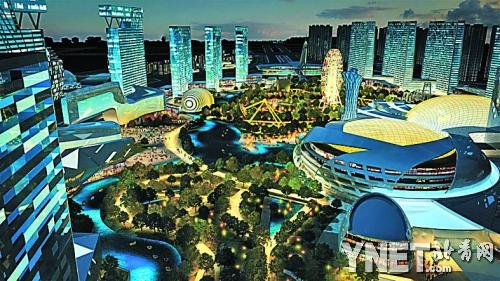
Wumei Wuliu Park
This reporter visited the main sales offices of the largest of Yanjiao’s real estate development projects, Xiaweiyi lanwan [Hawaii Blue Harbor], Kongquecheng [Peacock City], Tianyangcheng, and Shou’er Tiancheng [Seoul Sweet City]. In the large main halls there were only a few customers looking at the model of buildings. In the customer reception area there were only a number of salespersons lounging around, gossiping or checking their cellphones. In all these places the number of salespersons far outnumbered the customers.
According to a real estate temp, things are actually slightly better now than at the beginning of this year, but compared to last year it is still a big change. Last year offerings typically sold out the day they were offered. Now, several months after an offering, there are still units available.
A salesperson at the model table said his development sold out quickly whenever a couple of buildings were first put on the market. However, when this reporter asked if there were still units available, the salesperson said he could take his pick.
At Shou’er Tiancheng, a salesperson said a building which had been offered just over a week ago was selling very well. However, this reporter found that its rate of sales was not that high.
Since the Spring Festival this year, the price at Shou’er Tianchaeng has not changed. Other developments show slight rises. Only Xiaweiyi lanwan [Hawaii Blue Harbor] reports a rise of 800 yuan. In any case, whether prices have risen or not, the above mentioned developments are all making shifts to accommodate the market, offering reduced down payments, loan discounts, and special offers on prices. Last weekend, a salesman informed this reporter by phone that the Xiaweiyi lanwan [Hawaii Blue Harbor] price for their newest offering was 9600 yuan.
京津冀一体化 Beijing Tianjin Hebei integration. A policy to spread the flourishing economies of Beijing and Tianjin to the relatively impoverished areas of Hebei through development
涿州 Zhuozhou. A city in Hebei
通州 Tongzhou
潮白河 Chaobai River
燕郊 Yanjiao
东小营 Dongxiaoying
徐尹路 Xulin Road
国贸 Guomao
潮酩酒 Chaomingjiu
朝阳区国贸 the CBD (Guomao) in Chaoyang
大兴 Daxing
天通苑 Tiantongyuan
物美物流园 Wumei Wuliu park
北京欢乐谷 Happy Valley Beijing
汉王科技 Hanvon technology
夏威夷蓝湾、Hawaii Blue Harbor
孔雀城 Peacock City
孔雀城英国宫 Peacock City English Palace
天洋城 Tianyangcheng
konjaku: I came across Shou’er Tiancheng (Seoul Sweet City) as an example of “education real estate.” Of the three large real estate development projects in Yanjiao, outside Beijing, Shou’er Tiancheng is the only one that plans to provide residents with schools providing a 12 year education on the premises. Here are some reactions to the Shou’er Tiancheng phenomenon.
Blog: “Shou’er Tiancheng, should I fall in love with you?”
http://shouertiancheng010.fang.com/bbs/1010731527~-1/108725046_108725046.htm
I am the proud owner of a residence in Shou’er Tiancheng. I am not from Beijing, therefore I cannot rely on being one of those who had their old residence demolished and has been given a new one elsewhere. I can only sacrifice everything to working and saving up enough, and now I have just decided to entrust my future to Shou’er Tiancheng.
The reason why I chose Shou’er Tiancheng: First, the name is appealing –things Korean are in fashion, and “Sweet City” feels warm and inviting. It is apart from Beijing and vicinity, traffic is convenient, the environment is OK, there is to be a nightlife street, hospital, large shopping center, school, all the basic things I need, but the key point is that I am at last able to afford it.
My photos of my future home I took last week:

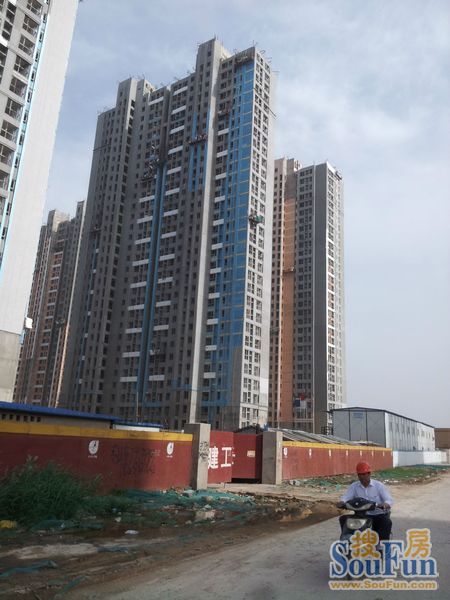
Blog:
http://house.focus.cn/msgview/8000/297916134.html
2014-04-26, at 9 AM, the Shou’er Tiancheng sales office is beginning a new round of sales. This time what is offered is the last residential building left, the last not yet offered for sale, the B32 tower. Other than this, one building in the MOBO International Center has not yet been offered.

Previous offerings were priced at 12000 yuan per square meter, but this time, there is a gift of space offered as an inducement, bringing the price down to 11000 yuan.
When I asked whether or not the 86 square meter 2 bedroom unit was being offered again this time, the answer at the sales office was that this unit is in high demand, and there are not many left. The 80 plus square meter two bedrooms are suitable for young married couples, or for a family of three willing to do some renovation after purchase. Most of the people there were interested in this type of residence.
The B32 tower has 33 stories. Upper level residences on the 20th-30th stories are higher in price. There are about 100 of these units.
I talked with a young couple, “after 90s” [born in the nineties, now in their twenties], the husband worked in Guomao [the Beijing central business district in Chaoyang]. They had started employment three to five years ago, their salaries were over 10,000 a month. They had savings, after buying a car they were now preparing to buy a residence. They had been looking at residences for two years. Prices in Tongzhou [closer to Beijing] rose daily, prices in Yangjiao went from 9000 to 12000 per square meter, The wife of this couple was restless and worried. The husband had his permanent residency in Hebei already, therefore as far as rules and regulations went, they had no problem buying here. The husband had flexible work hours, so he did not have to worry about the commute. Considering these factors, Shou’er Tiancheng was at the top of their list, and they considered it worth the price to them.
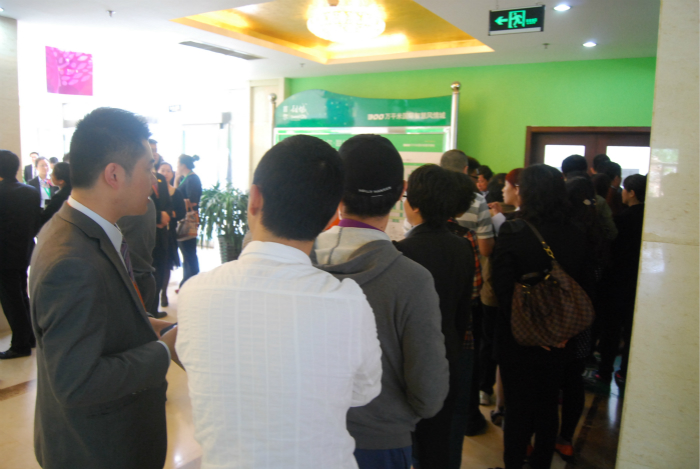
I noticed that some older couples there too. One couple said Yanjiao was one area that provided well for the aged. They were thinking of moving here, and turning over their residence in the city to one of their children who would thereby have an easy commute to work. By noon 40% of the residences had been sold, and more people were arriving in the sales office all the time.
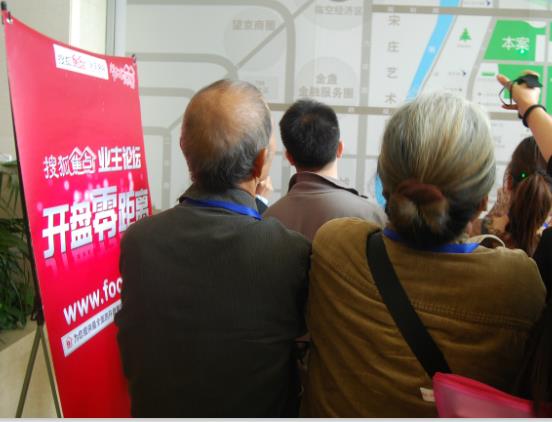
Blog:
http://blog.sina.com.cn/s/blog_bff53bed0101cqun.html
Blog: “the home I am thinking of, doesn’t have to be large” –in 2013, the northern floaters are choosing to live in Shou’er Tiancheng.
This picture recalls something I know well, the place where the struggle of the ant tribe occurred
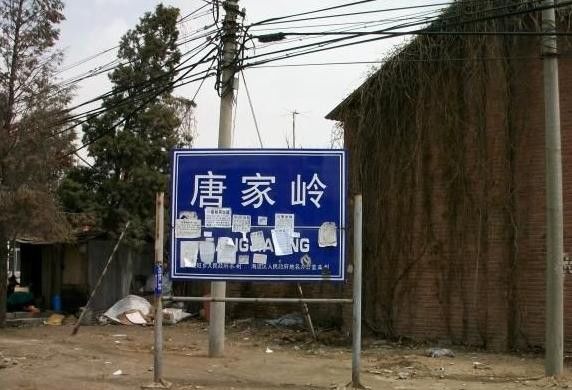
Tangjialing village sign, when the village was being demolished
On 2010-03-29 the project to relocate the population in Tangjialing, a village where the northern floaters congregated, began. At that time the median rent in Beijing was 3500 yuan a month, but outside the rings demand was less and prices were lower.
Well! Because Beijing rents were more than we could afford, the majority of northern floaters and we in the ant tribe chose to settle down and buy places in Yanjiao. Now, in the present, there is Shou’er Tiancheng, for young people, the best of the best, and also “Tianyangcheng 4th generation” (another large real estate project).
“The home I am thinking of, doesn’t have to be large” –even this small desire is difficult to achieve inside Beijing city.
Note: northern floater, ant tribe: college graduates looking for high-tech jobs in the Beijing area. Many come from someplace else.
konjaku: the Wanjing Jin Mao Palace residential development in Chaoyang has been cited as a prominent example of “education real estate.” Buyers of Jin Mao Palace properties can send their children to the Beijing #2 Experimental Chaoyang Primary School campus, built by the developer to function under the regulations as a “neighborhood school.”
Here are some other aspects of Jin Mao Palace. Although most of what appears in this blog are translations, these results came about from googling “Jin Mao Palace” in English. Note that ecological design in the buildings is meant to counteract “dense smog conditions.”

http://reports2.equitystory.com/reports/franshion_properties/annual/2013/gb/English/202015/our-green-strategy.html?printDoc=1
Adhering to the high-end positioning, Franshion Properties aims to develop a highly comfortable and low-energy consumption technology residential project with “constant temperature, humidity and oxygen” – Jin Mao Palace Series residential projects. Jin Mao Palace Series technology residence is the signature of the high-end product line of Franshion Properties’ residential products. Adopting a capillary radiation terminal and 24-hour air circulation system, it provides a healthy and comfortable indoor environment with constant temperature, humidity and oxygen under dense smog conditions. Besides, it has a geothermal heat pump system in place to supply heat using the thermal energy from the ground during winter and to supply cooling using the chill from the ground during summer where the residual heat in the building is trapped on the ground. Accordingly, it can effectively utilise the geothermal energy from the upper layer in the soil to reduce the energy consumption of the residential building and increase the level of comfort.
In 2009, Franshion Properties’ first Jin Mao Palace Series technology residential product – Beijing Guangqu Jin Mao Palace commenced construction planning. The property units were successively delivered in 2012. Until 2013, it has been operating for more than one year. Given the long-term smog condition in Beijing, it provides a healthy living environment to the property owners. From 2012 to 2013, Franshion Properties completed the streamlining of the Jin Mao Palace Series residential product line, completed the formulation of guidelines for the technology residential development and widely applied such in Beijing Wangjing Jin Mao Palace Project, Suzhou Gusu Jin Mao Palace Project and Ningbo Nantang Jin Mao Palace Project.
Click to access Jin_Mao_Palace.pdf
“Jin Mao Palace”, a top-end residential project located in the central district of Beijing, has decided to use Geberit SFD system products. China real estate industry is coming closer with the advance European residential water drainage concept. And it is the current trend of the industry.
This 280’000m2 construction area project became very famous already since 2009, when the developer purchased the land in Guangqu road with an investment of 4.1 billion RMB (about 630 million CHF), thus recorded the highest land price in Beijing.
Geberit’s order finally includes 6’000 sets of Duofix UP182 and UP300, more than 10,000 meters DB20 pipes, and more than 30,000 meters HDPE pipes. According to the benefits brought to the residential building by high-technology of Geberit products, it is displayed and highlighted at the property selling outlet as one of the “leading technology applied in the project”. Now, a specific project team was built, including members of Application Engineers, Technical Advisors, and local sales staffs. They are already prepared to give professional support of Geberit.
http://www.beka-klima.de/en/news.html
For the first time in company history, BEKA supplies a single project with 6-digit square metres of capillary tube mats.
BEKA is producing more than 110,000m² capillary mats for the high-end housing project “Jin Mao Palace” in Beijing. With Jin Mao emerges a new housing area consisting of several residential towers und extensive parks – right in the Central Business District of Beijing. For the investors of these attractive apartments ecological and comfortable heating and cooling was very important. Energy savings of about 70%, low CO2 emission, less dust and noise – all these requirements can be best achieved with radiant heating and cooling ceilings and capillary tube mats.
Thanks to successful large projects like Parkview or the Olympic Village in Beijing, the BEKA capillary tube technology ‘Made in Germany’ has gained high prestige in China. Consequently, it is no wonder that also the investors of “Jin Mao Palace” trust in the quality of BEKA capillary tube mats.
http://www.laufen.com/wps/wcm/connect/laufen_com/en/references/residences/ref_Jin_Mao_Palace_China
JIN MAO PALACE, BEIJING, CHINA
Jin Mao Palace is a new luxurious housing area consisting of several residential towers and extensive parks, right in the Central Business District of Beijing.
This residential project fulfils all requirements discerning residents might have. Residences are lavishly designed and decorated considering aesthetical as well as practical and ecological demands. Occupants benefit from the best quality products only. The sanitary ware chosen from LAUFEN offers residents of Jin Mao Palace a luxurious, spa-like bathroom retreat, more commonly the preserve of a five-star hotel.
Spectacular views of the newly developed super modern high-rise buildings in the surroundings can be admired. The CBD is set to become one of the most important areas of finance, media and business in China.
Adding all this, no wonder the land price of the Jin Mao Palace has accrued the highest in the city. Construction and interior fitting for the last parts are still going on and supposed to be finished this year.
LAUFEN products
ILBAGNOALESSI One bathtubs; living city washbasins; LAUFEN pro washbasins;
PALOMBA COLLECTION toilets
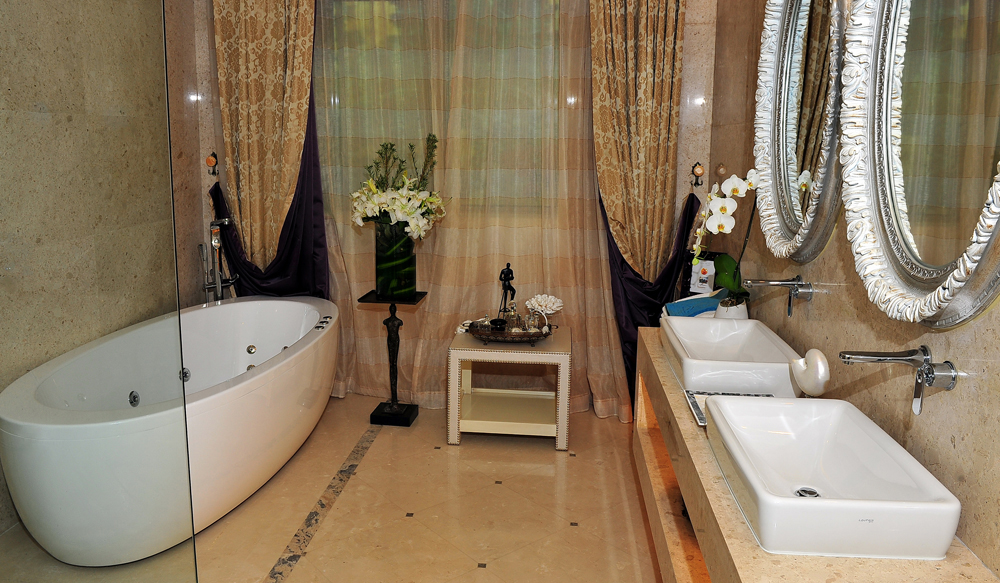
http://www.chinadaily.com.cn/business/2014-04/29/content_17472001.htm
http://www.property-report.com/global-fashion-designers-collaborate-with-asian-property-firms-34587
World-renowned designers from France and Italy recently partnered with real estate companies in Asia to spruce up their latest residential projects.
Franshion Properties, property arm of Chinese state-owned conglomerate Sinochem Group, has joined forces with high-end clothes designer Elysée Yang to create customisable décor packages for its Guangqu Jin Mao Palace project located in Chaoyang District in Beijing, reported China Daily.
Chinese-born Yang’s tailor-made designs for the 34-unit apartment complex are a pioneering concept by the Hong Kong-based developer, which hopes to set a trend in China’s luxury residential segment. Under the partnership, tenants can choose from a range of interiors and decorations created by Yang to fit their homes.
The Paris-based designer this week presented four customisable designs for Jin Mao Palace, where units have an average price of CNY30 million (USD4.8 million).
http://usa.chinadaily.com.cn/business/2013-03/16/content_16313125.htm
The commercial sector of Jin Mao Palace, a project close to Beijing’s CBD area, is scheduled to put up 154 units for sale around the end of March at an average price of 49,800 yuan ($8,008) per square meters.
However, there are so many potential buyers that the registration for purchases was closed within one day.
“Even for those who have registered their names to buy the units, they have to draw lots to decide who can get the unit they want,” a manager at the sales department said.
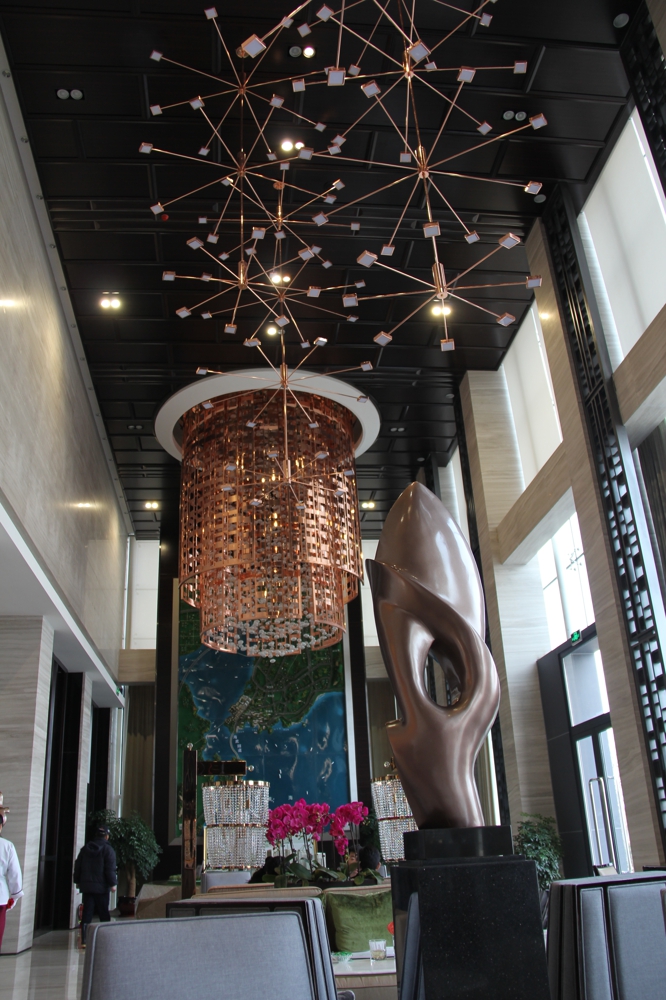
lobby
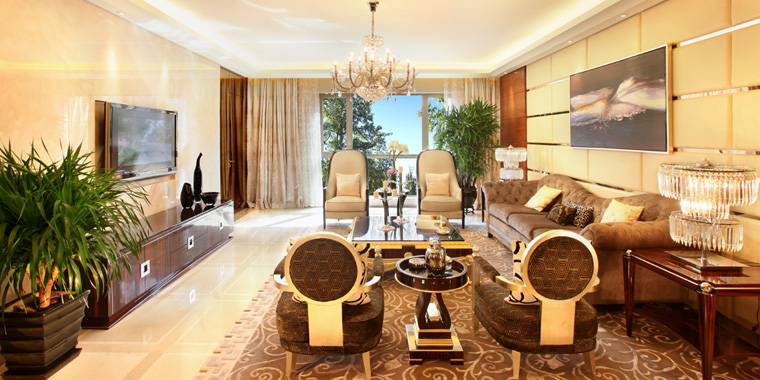
model room
Click to access nZBOAx-9yg-HjSaLrdq6JEl5lmHrPEJO8ny-HrZLYXAD0dz9lEiPUmk5Ilh3SiWnyi8UQG-u0.pdf
The 2009 injection of Jin Mao Group’s portfolio significantly enhanced Franshion’s recurring revenue base. The assets injected included six luxury five-star hotels and the Shanghai Jin Mao Tower, which is located in the heart of Lujiajui. Since then, Franshion has built out the Jin Mao brand to include eleven hotels and seven commercial properties.
While Franshion in recent years has shifted its focus to high-end residential development, its percentage of recurring revenue remains the highest under our stock coverage: 21% for 2012 estimates. We estimate that nearly 30% of its 2012 earnings come from recurring income. We believe this enables Franshion to participate in upside exposure to the development business and at the same time retain cashflow stability from its commercial and hotel assets.
konjaku: this article gives some background and perspective on the Shou’er Tiancheng real estate development (in English “Seoul Sweet City” or just “Sweet City”) on the eastern periphery of Beijing, in Hebei. As indicated in the last two posts, buyers of residences will be able to send their children to the 12 year multi-school campus being built within the “city.” Other advantages and attractions are described below.
As far as I can tell, there is not a good mass transit option to Beijing from Yanjiao, although more roads connecting to the city are under construction, to relieve congestion on the main highway (G102). The developer proposes that as Shou’er Tiancheng is built, Yanjiao itself will become a complete city, a center for high tech industries. Residents will be able to both live and work there.


Shou’er Tiancheng has its 10,000th buyer
2014-03-13
http://news.163.com/14/0313/21/9N8G3JJN00014Q4P.html
In 2013, the main Beijing real estate battlefield was not in Beijing city itself, but occurred in a 5 kilometer radius spanning the city periphery. Purchase prices in Beijing have seemed too high, especially since Beijing put restrictions on home purchases. The periphery outside the city has been the place where “New Beijingers” select to settle down. This has led to an eruption of new residences in Yanjiao, Xianghe, Gu’an, and Langfang. Among these, Yanjiao is often the first choice, for its favorable environment, and the fact that it got started earlier. All the necessary social infrastructure is already in place, and urbanization is well advanced. In a mere 10 years, Yanjiao has gone from being a small town, a “Northern floater town” and a “bedtown” for Beijing, to becoming an international, high quality city. It already provides all the amenities of a new community district, and an upgraded industrial park. Shou-er Tiancheng (Seoul Sweet City, or just “Sweet City”), which started development at the end of 2012, is an outstanding addition.
Shou’er Tiancheng began accepting purchase offers on 2012-12-29. After 429 days, they had exceeded 10,000 purchases. If one calculates 21 business days [weekdays] in a month, and 8 hours to a day, that means someone purchased a Shou’er Tiancheng property on average every 13 minutes since the start date. Six times they made group offerings for sale of residences in newly completed buildings, from 2000 at a time to 800 at a time, and each time, these sold out on the same day. Relying on this pace, in 2013 they have cleared 7,000,000,000 yuan ($1,137, 300,000 –1 billion, 137 million dollars), competing for the crown in real estate sales in the greater Beijing area.
The Ms Wang who signed the 10,000th contract on 03-02, is a typical Shou’er Tiancheng client, her expectations concerning what sort of residence and living area she wants are quite high.
She, and similar clients, get, within the Shou’er Tiancheng site:
an international grade office building complex with research and development into digital cameras, computers, television, optics, and new medicinal drugs, as well as a manufacturing base for these products. Also an IT research and development arm, with product development of software, networking, etc.
An International Design Center central district where one can shop, live, and work. This is suitable for those who can work from home or from a home office. They could link to biological, chemical and IT research centers planned to be built within and without the district, with an efficiency comparable to the Hong Kong-Macao –Pearl River Delta alliance.
The Beijing East Number One International Shopping Mall –300,000 square meters of world class shopping and entertainment options, with name brands from all over the world.
To solve the problem of one’s child getting into a “nearby school,” Shou’er Tiancheng offers a top quality educational system, from kindergarden through middle school, available to Shou’er Tiancheng residents, as well as Yanjiao townspeople. Those children within the area served by the school will receive an enviable elite education, starting with an internal bilingual kindergarden.
An international hospital has been established to offer complete medical care for the entire lifetimes of the residents. Every resident will have a yearly check-up, a file on each will be kept free of charge, and they are eligible for ongoing health evaluations and counseling. The hospital will also offer on-line psychological counseling.
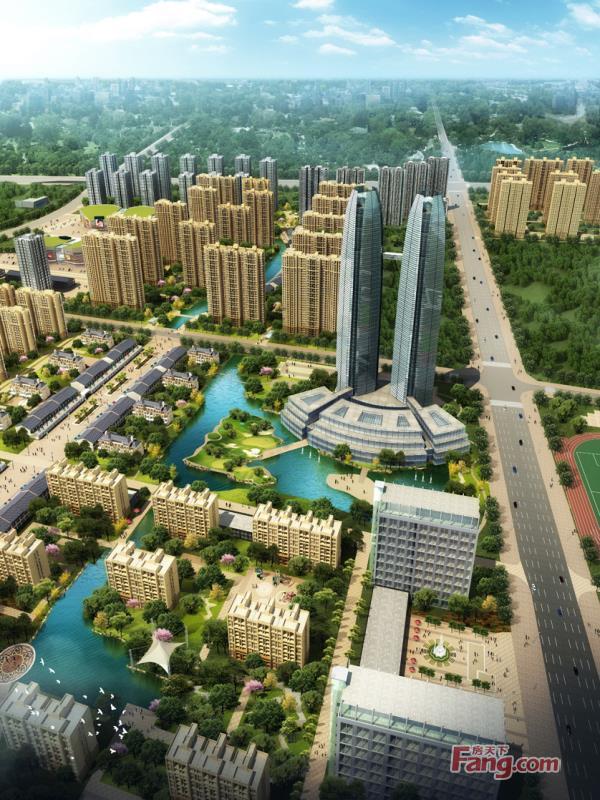
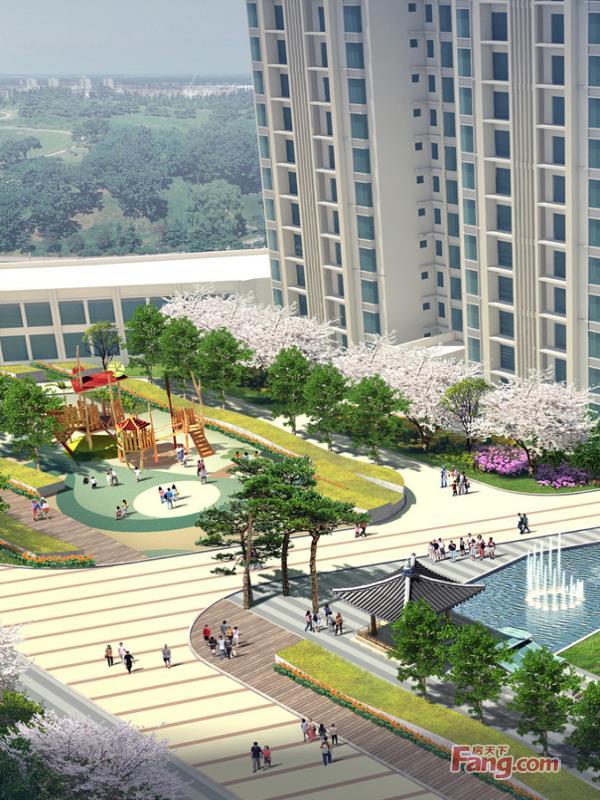
Some images of Shou’er Tiancheng features (click on images to enlarge):


Interview with the first client to sign:
On 2012-12-29, when Shou’er Tiancheng first offered residences for sale, 806 went in the first day. The first person to sign a contract was a Ms Yang. She waited at the sales reception area from early in the morning, and her salesperson worked with incredible speed to get her contract drawn up. Ms Yang said the Shou’er Tiancheng plan was far-sighted and scientific. Encircled by the Chaobai and Xingu rivers, the natural setting and 45% green area made it a fit place to grow old. At the same time, the education opportunity made it suitable for families with small children. Ms Yang and her husband are pleased at their choice, believing that Shou’er Tiancheng really delivers what it promises.
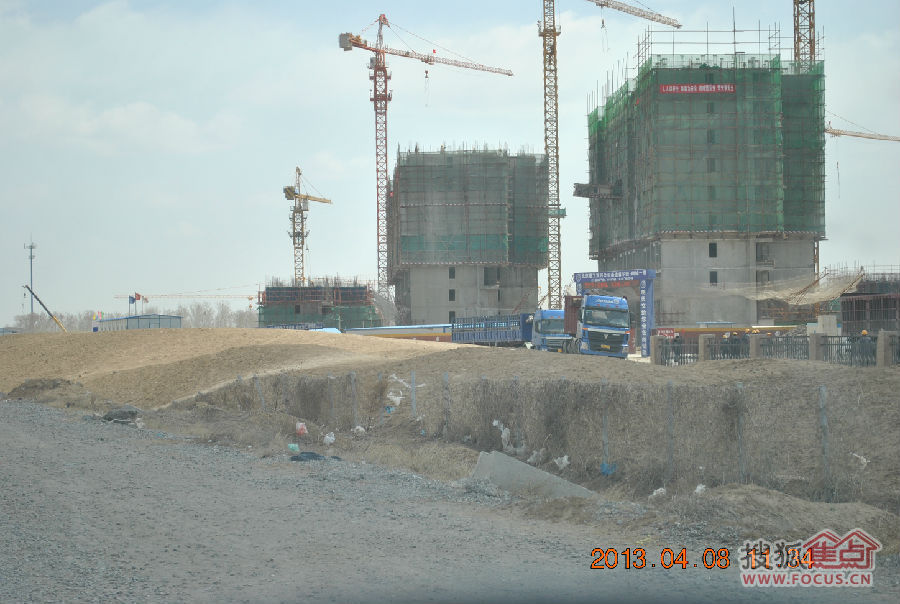
Photos of Shou’er Tiancheng under construction in 2013:

The 10,000th client, Ms Wang.
Ms Wang is a typical representative of those who purchase residences at Shou’er Tiancheng. She works in Bejing’s central business district, her month income is over 10,000 yuan ($1,626), she is careful in her purchases. She is interested in fashions, in convenience, in quality of life. She told this reporter that earlier this year she heard about Yanjiao. As a member of the “northern floaters” tribe, she felt she never had a choice of where to live, but just went where she was forced to go. She never thought of taking a look at Yanjiao, but she found it was a fully modern city, with a Carrefour, Walmart, movie theaters, and every kind of restaurant. In the Shou’er Tiancheng complex itself they plan to build a large scale shopping mall, a shopping street at the water’s edge, a Korean style lane with three floors of stores. International and fashionable, it will be a place where young people gather. The health service center is also an important convenience.
For Ms Wang, the most special feature is a service aimed at young people, the “youth dining room.” You can buy a ticket at the window for meal service, or you can reserve in advance one of the twenty kitchen spaces, and use these to prepare your own meal, with ingredients provided. Ms Wang says this is very convenient for the lifestyle of young people.
Model rooms:


The 10,001 client was a Mr Zhu. When he came on 03-02 he had already determined exactly what he wanted to purchase, a residence in the International MOBO Center, with 40 year property rights, believing this would provide the most value for his investment. As someone who works in the finance industry, he is especially cognizant of how to recognize a good investment opportunity. The population of Beijing is dispersing from its previous pattern of high density to areas outside the city. Based on this constantly reiterated news, Hebei and Tianjin are competing to snap up the as yet undeveloped real estate outside Beijing city, to capitalize on this population shift. However, in this contest the outlook for Yanjiao is comparatively calm, since Yanjiao, being closer to Beijing than other areas, has already been the site of a number of high-end developments.
Yanjiao has become the second most successful county administered high tech free economic zones in China, after Kunshan [in the Suzhou region]. Over the next twenty years it will work to achieve the same fame as Zhongguancun [China’s silicon valley], such that people will eventually say, “in the west is Zhongguancun, in the east is Yanjiao.” Therefore, there is no need to have doubts about investing in Yanjiao. The Yanjiao real estate market is not merely about giving satisfaction to residential buyers, it is also a market for those who want to invest in the type of real estate whose value is projected to increase over time, as a hedge against inflation.
Notes: northern floater. A floater refers to a migrant worker. A northern floater is also someone without a household registry in Beijing, but who has graduated from college and either works or is looking for work in the high tech industry.
bedtown: a town outside the larger city where commuters live, coming home only to sleep, a town without a fully developed urban infrastructure.
首尔·甜城 Shou’er Tiancheng
燕郊 Yanjiao
香河 Xianghe
固安 Gu’an
廊坊 Langfang
北漂城 Northern floater town
睡城 bedtown
MOBO国际中心 International MOBO Center
konjaku: Building a multi-school, multi-facility campus with 99 classrooms in all is a considerable investment for the real estate developer of Shou’er Tiancheng (in English, “Seoul Sweet City.”) The project of high-rise residential complexes is being built in stages, and in 2014-02 Xinhua carried a story that some purchasers have begun complaining that changes are being made to the original plan. Residents found that areas that were designated green spaces in the plan had become construction sites for new buildings instead. Those for whom the school was an important factor in their purchase might be excused for wondering if the school campus would live up to expectations. At least from the evidence of this blog, the kindergarden and part of the primary school complex are finished.
———
What Yanda Experimental School looks like can now be seen: A 12 year multi-dimensional education system for our darling children. High standards for both hardware and software, low density environmental setting, unmatched area, a cafeteria that meets all the best criteria, eight basketball courts, a 300 meter soccer field, exclusive educational resources and an exciting campus for our children, giving us back the best value for what we paid [for a residence in Shou’er Tiancheng] The buildings are already completed, they are finishing up the interiors and sports fields. With a little less than two months before school starts, parents can happily take their child by the hand and tour the grounds.
——-
konjaku: in the simulation of the complete campus, there are two buildings decorated with colorful squares, to the upper right. I assume these are a kindergarden and (possibly) primary school. Parallel to the soccer field is a long, lighter colored building with four wings to its west, and one shorter wing emerging at its center to the east. I assume this is a primary and middle school complex. According to these photos, the two buildings with squares are done, and it seems the lighter colored long building is partially done, but the four wings have not been started yet. 

the kindergarden buildings

the middle school building, still in process of construction
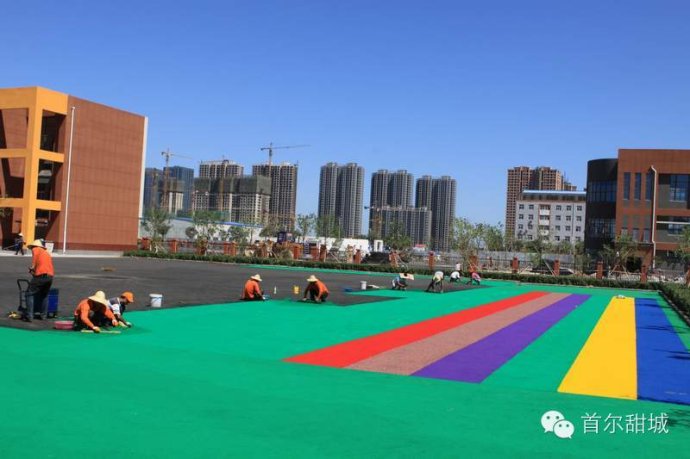
workers laying synthetic resin on the playground
konjaku: in the last photo, one can see the residential towers of Shou’er Tiancheng, some still under construction, in the background. These photos are dated 2014-07-15, from this blog http://blog.sina.com.cn/s/blog_a5c7d72b0102uxrh.html
konjaku: Jin Mao Palace (previous post) illustrates one approach to “education real estate:” to build an elementary school within the new residential project and contract out the operation of the school to an already established, highly prestigious primary school. Jin Mao Palace is located in the new Central Business District (CBD) in the Chaoyang district of Beijing. The Shou’er Tiancheng development, described below, is in Yanjiao, described in Wikipedia as “ a town under the administration of Sanhe City in central Hebei province, bordering Tongzhou District, Beijing across the Chaobai River to the west, located 35 kilometres (22 mi) east of Tiananmen Square and 21 km (13 mi) west of Sanhe. Chaoyang is between the 2nd and 3rd ring roads in Beijing city proper, Yanjiao is out beyond the 6th, a town beyond the city borders to which many people are moving for better real estate prices and lower cost of living. With plenty more relatively inexpensive land to develop, Shou-er Tiancheng has gone the next step in ”education real estate,” assuring purchasers of residential properties in their development that they will supply 12 years of elite schooling: a kindergarden, primary, and middle school built together on one large campus on site. Although their school, the Yanda Experimental School, is a public school, they are confident that it satisfies the “nearby school” stipulation, and they can guarantee places for the children of their residents.
For a description of the new Beijing CBD, see https://konjaku.wordpress.com/2012/10/18/dawangjing-follow-up-11-moving-forward-at-top-speed/
Dawangjing was the name of the village demolished to make way for construction of the CBD. I covered the process of demolition and relocation of the villagers in posts archived in September and October 2012.
———–
The trend for education and real estate to marry together — Shou’er Tiancheng development will have a complete 12 year education system
2014-07-24
http://finance.21cn.com/stock/cfgd/a/2014/0724/10/27880952.shtml
The recent Beijing city education reform for those entering primary school has gathered a lot of attention, especially the “every child is excused from taking an exam and can enter a nearby school,” and “children from families without Beijing household registry must present 5 forms of proof.” Besides the fevered debates among the general population, one section of society which already has developed a close connection with education –namely, real estate –has intensely focussed on these new developments.
A simulation of the Shou’er Tiancheng education complex: pre-school elementary and middle school all together

In recent years, there have been a number of real estate projects which function as examples of the development of large-scale “education real estate.” Wangjing Jin Mao Palace, Zhongtan Zichenyuan, Jingmao Guojicheng, and Shou’er Tiancheng. These satisfy a business demand, and promote a product which is receiving a lot of interest and attention.
A business insider believes that these education real estate products will not necessarily always be highly profitable, but when the market is depressed a certain amount will still sell, and when the market is booming, they will go for high prices. For 25-38 year old middle class consumers, demand for education real estate is high, and when educational resources are brought together in one complete package, this product is highly attractive.
A simulation of the Shou’er Tiancheng school campus

Among the ecology-based large scale real estate developments in Yanjiao, Shou’er Tiancheng has done well, even in the current bear market situation, because of the quality of its real estate and educational offerings. More than10,000 contracts have been signed, and there is an unceasing stream of interested inquiries.
This reporter discovered that purchasers were particularly impressed that Shou’er Tiancheng offers a complete education plan of 12 years, up the education ladder from kindergarden through junior middle school. They are building a 53,000 square meter campus including an international bilingual kindergarden, an elementary school and middle school, which will be completed for use by the 9th month (September).

As the Beijing Youth News reported in 06-13, the currently existing Yanjiao Primary School is over-enrolled, and faces a critical shortage of teachers. Against this background, it is easy to see why Shou’er Tiancheng, offering a guarantee of top quality education, will continue to sell well. Indeed, in the whole of the Yanjiao area, it can be said to be the top choice.
A simulation of the kindergarden:

——-
http://house.focus.cn/news/2014-08-19/5420242.html
2014-08-19
“When you enter school, we will give you a present. This will happen when you come and tour the classroom.” This is not a fly-by-night promise, but a sincere commitment. From 08-06, Shou’er Tiancheng began holding a school event, namely that “those who purchased residences and a school position, when they come to the school will receive a grand present.” Already the response has been enthusiastic. Many students and their families have come to inspect the new campus. These days when it is difficult to get into a school, Shou’er Tiancheng not only provides top quality educational resources, but expresses concern for the families by giving them a present, no expenses spared, causing the children and their families to be both touched and filled with pride. Those who purchased residences at Shou’er Tiancheng can feel gratified for the good choice they have made, and see that the educational services in the plan are being assiduously carried out.

Due to all the positive feedback, Shou’er Tiancheng is extending this offer until 08-25, so come and get your wonderful present! At the same time, you can try out the school bus and investigate the classrooms.
Procedure: While visiting the campus, take a picture of your child at the school and post it to the Shou’er Tiancheng WeChat (voice and text messaging service) site.
On the basis of the posted photo and one’s permanent residence booklet, meet with a Shou’er Tiancheng consultant who will take you into the planning office to receive your present.
Conditions: your child must be beween 6 and 9 years of age. Offer limited to 15 families a day.
The construction of the Shou’er Tiancheng school complex, the Yanda Experimental School, has been completed. There will be an international bilingual school, an international bilingual kindergarden with 12 classrooms, a public elementary school with 48 classrooms, a public middle school with 39 classrooms, adding up to 99 classrooms altogether of education excellence. The school area is 6600 square meters, 3700 square meters of building space, with a basketball court, a soccer field, a specialized track, and other physical education facilities. The classrooms are fully outfitted, the teachers are top-flight. This will be one of the top schools of the capital east area.
The Yanda Experimental School has been submitted for approval to the Ministry of Education, and is set to open in the 9th month. The entire Shou’er Tiancheng development project is 1,300,000 square meters, building space is 3,000,000 square meters, greenery percentage in terms of total area is 45%. It contains a high-rise residential complex, the MOBO International Center, built to international standards of reduced density, western style buildings within a garden community, with a completely outfitted shopping mall for the residents.
konjaku: The intent of the rule, “[to go to primary school] no child has to take an entrance exam, and every child can go to a nearby school,” is to bring about a state of equal opportunity. At the same time, even for well-positioned families, the process of getting their child into the preferred primary school may still be an anxious one. Prominent real estate companies have found a way to use the rule to allay the anxiety of those families. In planning a new, large scale residential development, a primary school is included in the plan. A prestigious primary school agrees to open a branch campus within the new residential complex. Since this fits the definition of a “near-by school,” those who purchase a property in the new development have a guarantee of acceptance in the new school. This is referred to as “education real estate.” The education real estate described in the article below is Jin Mao Palace. The Beijing #2 Experimental Primary School is at the top of every list of Beijing’s best primary schools.
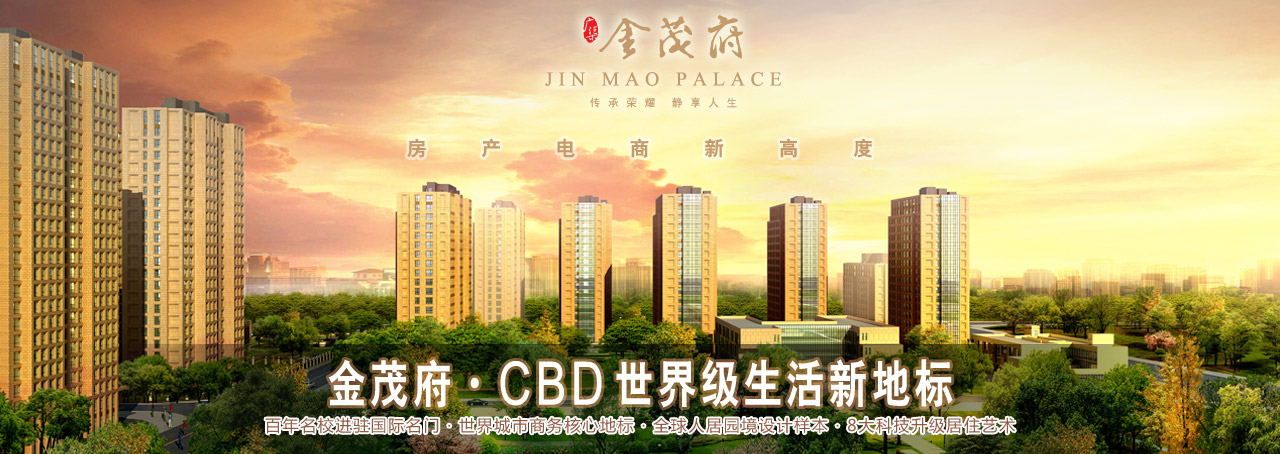
The power of the brand: the core financial resources of a real estate group and an educational flagship: two established brands cooperate together
http://bj.house.163.com/special/jmf05/
Franshion Properties is a real estate company, a subsidiary of Sinochem Corporation, a Fortune 500 company. The Beijing #2 Experimental Primary School is a Beijing city priority school. These two coming together symbolizes the model of education and real estate joint development achieving a new threshold.
“Education real estate,” that is, one item of purchasing a residential property includes the right to place one’s children in a designated school linked to that property. An agreement of this kind is clearly beneficial to the school authorities, because through business development the school has an optimal access to resources. The school in turn occupies an important place in the promotion and development of the real estate property. 2011-07, Beijing #2 Experimental Chaoyang Primary School formally settled an agreement with the Jin Mao Palace development. This brings the model of “education real estate” to a new level.
Beijing #2 Experimental Chaoyang Primary School campus is close to completion. In the 6th month it will be turned over to the Education Commission, in the 9th month it will formally open. The plan is to take four classes of first graders. Based on the principle of being able to attend a nearby school, they will mainly accept children of the appropriate age from the Jin Mao Palace residential community. To those who contracted to buy a residence before the end of 2012, the Jin Mao Palace is honoring its commitment [to provide a school for their children at the promised time]. After the first year they will begin adding the other grades, and within three years they plan to have all six grades filled.
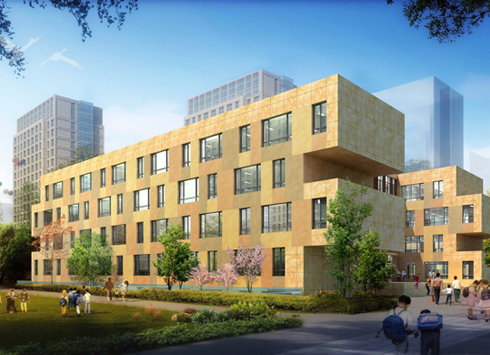
A representation of the new campus inside Jin Mao Palace

A representation of the school interior
Before signing a contract with the #2 Primary School, Jin Mao Palace looked at the other senior priority schools in Beijing’s top ten. But the motto of Franshion Properties is to deliver to their customers “the very best,” not the “pretty good,” when it comes to educational resources. Based on the strength of the teachers, the school’s distinctiveness, born from accumulated experience over the years, its social resources, and its possession of [computer] hardware, these combined factors made it the first choice.
Beijing #2 Experimental Primary School has the tradition of “education with love,” and take as their main theme, “reciprocal education of teachers and students together.” Among their star teachers, there are more than 20 senior teachers, many have Ph.Ds, or have returned from study abroad with Masters of Arts degrees. The schools has taken a prominent role in the research and development of elementary education in our country on a national, city, and district level. It is a UNESCO member school, a Ministry of Education modern technology demonstration school, a Beijing City Science and Technology Demonstration School, a Beijing city Gold Medal School for promoting Health, etc.
Sediments of a long history: concern for education: [10 years to grow a tree, but] 100 years to cultivate a person
Beijing #2 Experimental Primary School was founded in 1909, and is one of the most influential elementary schools, not only in Beijing, but even across the whole country. The world famous scientist Qian Xuesen (HS Tsien, rocket scientist), Tsinghua University provost Zhang Wei, Chen-ning Franklin Yang [Chinese-born American physicist], Hao Yichun [?], Chi Jishang [leader in the field of petrology in China] Wang Guangmei [politician, philanthropist, and First Lady], Zhang Guangzhi [Kwang-chih Chang, Harvard University archaeologist], etc, were all graduates.
Teaching quality for the Chaoyang school will directly come from the original school
Beijing #2 Experimental Primary School will export to the new school its educational principles, its culture and curriculum. It will dispatch a management team and a number of excellent, core teachers, to guarantee the overall quality of the Chaoyang School.
Unlike in the past, the Chaoyang school will be directly supervised by the main school. A provost of the main school will become principal of the Chaoyang School, mamagement staff and teachers from the main school will be assigned to the new school.
The new campus is first in the nation to receive LEED certification
Along with the excellent education quality, Jin Mao Palace has built a low carbon emitting green campus, based on the national Green Label Standard and the U.S. LEED standard. The plan was created using computers to simulate the processes of light, energy consumption, and sound in the new campus, to find ways to maximize the use of sunlight and natural ventilation, while insulating against noise. Apparently the LEED critical appraisal is very strict, they measure energy use, water efficiency, atmospheric quality. It’s certification has the highest government credibility.
In providing the children with a green campus which helps protect the environment, Franshion is following the corporate culture of Sinochem, to pursue excellence. In being the first to attempt to meet the internationally recognized LEED standard and receiving certification, they have done their utmost to make the Chaoyang school one which meets the highest international standards.
The school area of 13,400 square meters will eventually accommodate 24 classes, 720 students. Jin Mao Palace will stint at nothing to optimize the school capacities, it has an additional 22,000,000 yuan ($3,564,460) to spend on building expansions, as needed in the future.
Wang Ying.
education real estate 教育地产
Franshion Properties 方兴地产
Beijing #2 Experimental Primary School 北京实验二小
priority school 重点小学
Jin Mao Palace 金茂府
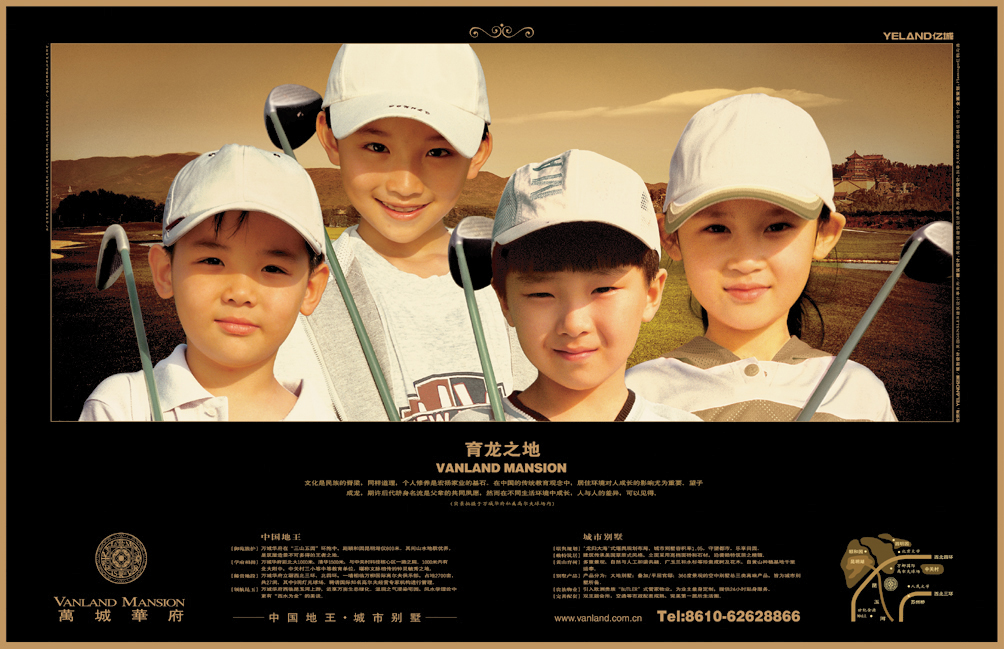
konjaku: Of the residential complexes in Wanliu within the school zone for the Zhongguancun #3 Primary School, Wancheng Huafu, a set of villas, or “mansions,” rather than the usual high-rise buildings, is a more high-end, luxury development. The ad campaign, which one can still find at several internet sites, is quite an elaborate fantasy. Many other high-end residential developments in Beijing promote their interiors as in a modern style, but Wancheng Huafu, perhaps because of its proximity to the Summer Palace, was marketed as an evocation of an Imperial past. The series of images created to form this imaginary past can be seen below.
First, Wancheng Huafu in its actual, physical form:
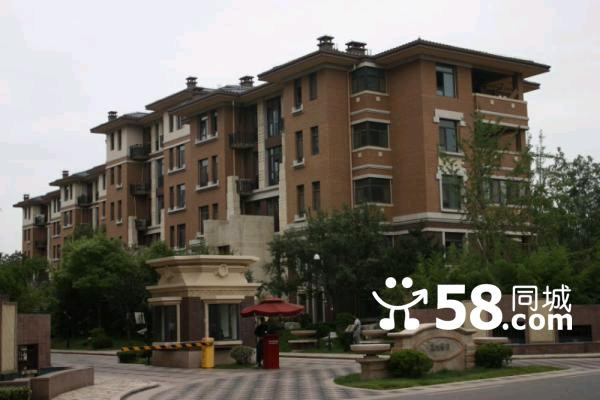

Most of Wancheng Huafu consists of four story condominium residences (first photo above) but there is apparently a more exclusive section of stand-alone homes, shown here (photo immediately above, and ad brochure, below). A couple return from a trip to their prairie contemporary style home, designed by the global architectural firm Gensler (which has also built a prairie style building on the UC Berkeley campus and homes in Marin County). Servants attend them, the lit up house awaits them. An air of quiet, restraint, and formality. The couple are obviously an image of wealth, but there are also echoes of the CPC in the man’s tailored Mao suit, and the white and red outfits of the attendants.(Click on photos to see more detail)
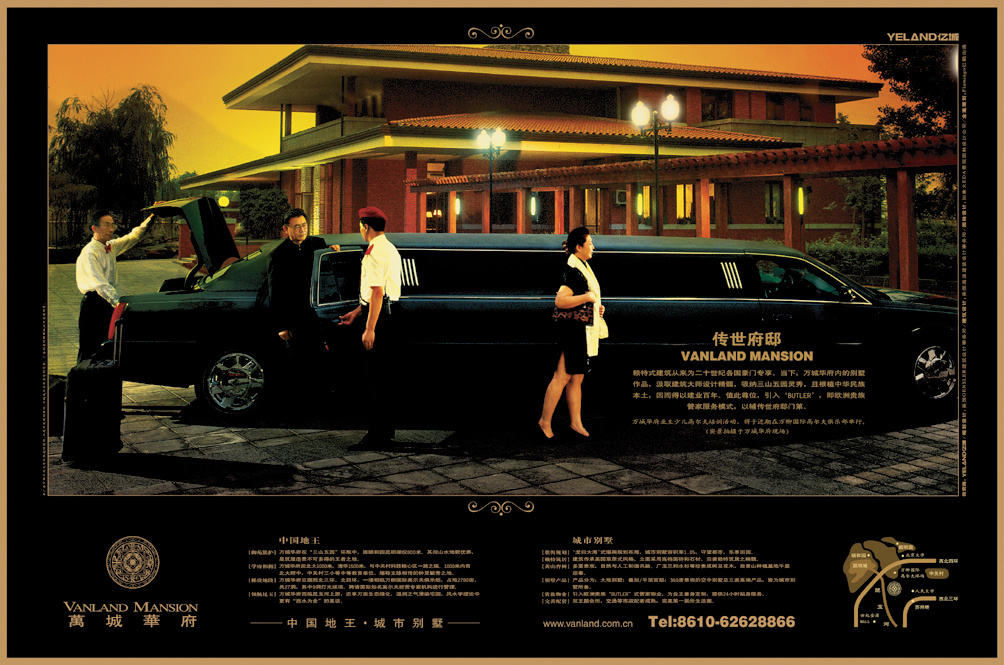
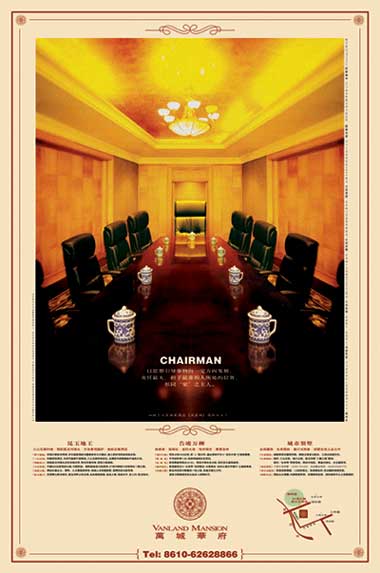
A tale of three men, each in one of the three types of formal wear: a Western suit, a Mao suit, and a Tang suit (rear). The man in the Mao suit has undone the collar of the jacket, giving him an informal, but determined air. Perhaps he is the same man as the one emerging from the car in the previous picture. They stare into the future, but “An Imperial Palace” is the backdrop of their lifestyle.

If there is any doubt who these men are, they are Chairmen of the Board
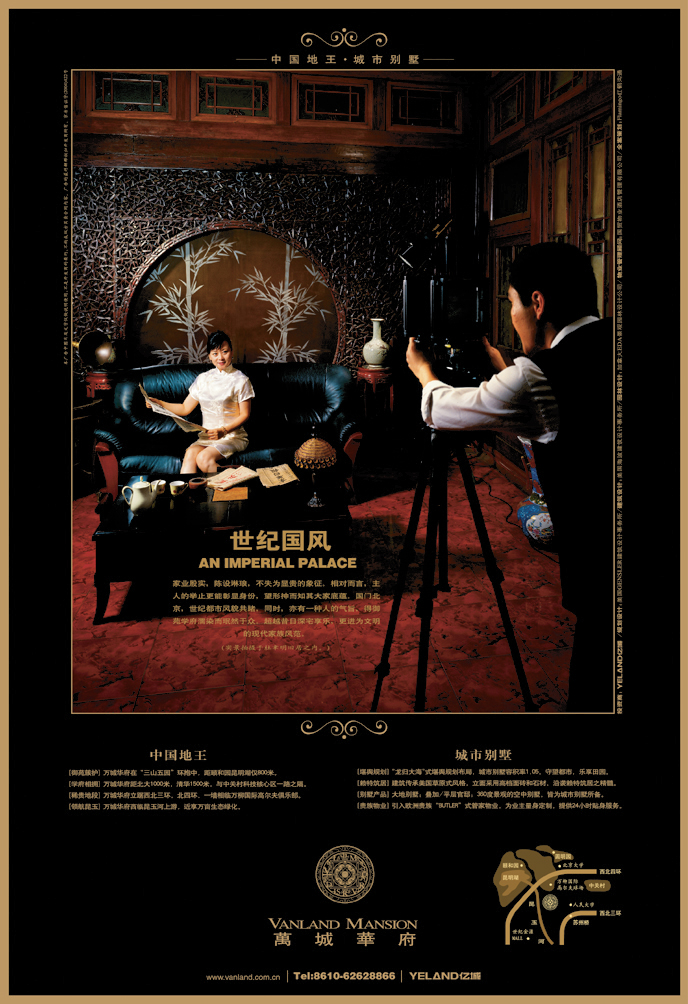
A young woman is shown reading a newspaper (where is her laptop?). A man is taking her picture, the large camera and tripod evoking both formality and the past (this is not a cellphone snapshot). The reason for this elaborately posed portrait is to highlight the setting, “An Imperial Palace,” which now also contains a shiny black leather sofa.
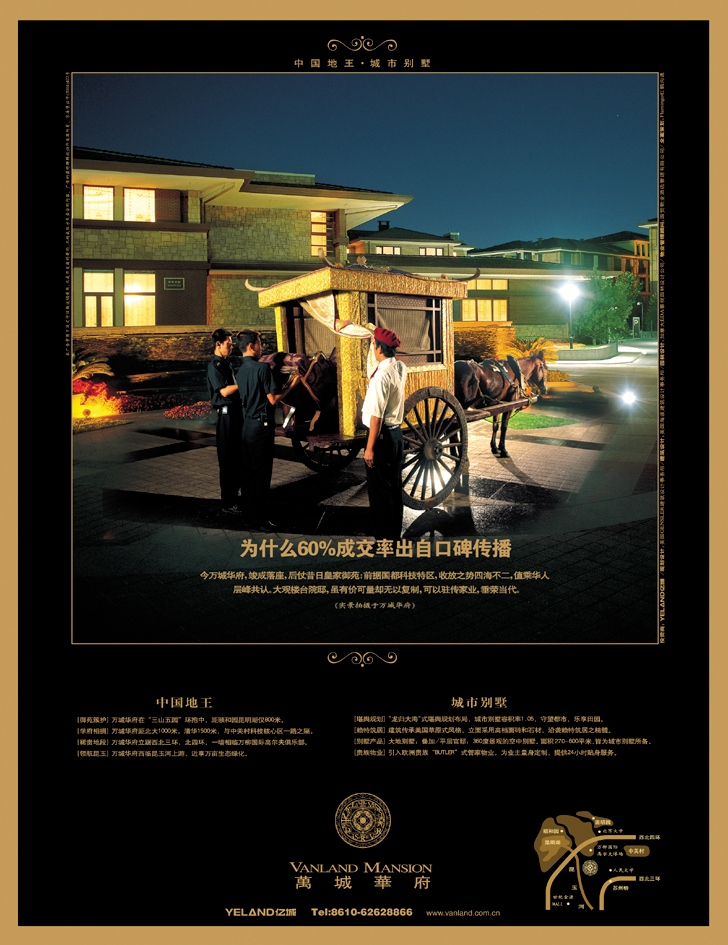
A touch of the past in this quiet neighborhood of exclusive, prairie style homes:
Wancheng Huafu is near the Wanliu Golf Course, the course with a view of the Summer Palace, which took over part of Liulangzhuang village land.

Those who live there, view from above, with an Imperial perspective:

konjaku: an editorial following up on the Beijing city announcement on 2014-04-18 that “jointly sponsored” student admission is to be abolished.
In Beijing up to now, there have been joint sponsorships for children going from pre-school to elementary schools, the essence of these is to turn public property into private property
Beijing Evening News
Su Wenyang
http://www.youjiao.com/e/20140423/53572b089fc74.shtml
On 04-18 [2014], Beijing city issued a notice, stating that the “jointly sponsored” student admission is abolished, and the new keyword is “student status inspection and control.” The China Youth Bulletin reported that the majority of disputes over admitting students have been about jointly sponsored students, therefore the new policy abolishes them. The underlying meaning of the abolishment of “jointly sponsored” in this stage of compulsory education is to say “no” to privilege. News spokesman Li Yi said, “the jointly sponsored student is an historical product, which the government used to strengthen the educational system, but its meaning and usefulness has now passed. There will now be a chance for more students to get into top quality schools.”
Jinghua Times, on 04-19, under the heading, “Abolishing “jointly sponsored”admissions will break open privileged schools” said, “the jointly sponsored mechanism is for the most part on the level of ministries and commissions. Jointly sponsored schools are top quality schools, to a certain degree privileged schools, this clearly deviates from fair and impartial admissions. The jointly sponsored fee by which these schools operate stems from [government] financial allocations, In other words, these schools use state money to benefit the privileged few of the upper stratum.”
In my opinion, this is an action aimed at getting rid of corruption, the corruption of turning public property into private property. It is worth adding another point, which is that jointly sponsored schools are not only supported by ministries and commissions, but also by state run enterprises. As a reporter dealing with education issues since the 1980s, I am familiar with the issue. At that time, people considered jointly sponsored schools to be a remedy for underfunding, and as a way to give better material benefits to the teachers, a “win-win” situation.
Besides jointly sponsored students, there were other categories of students in which the family household head paid the school, this practice was given the fine sounding name of “financial aid education”, but in reality it was paying money in order for one’s child to attend a school. In other words, if someone paid, the school would take the student, and they didn’t ask where the money came from. The school covertly sold a student a spot in the school, and no one thought that was a problem. Nowadays people take this matter more seriously, and many problems arise. Some jointly sponsored students are in a school because the household head paid a sum, and others are sponsored through public money. The schools that take jointly sponsored students are mostly public schools, they are supposed to provide service to the whole society, however, public resources are diverted to the benefit of a few.
Chinese people have up to now not fully understood the difference between public and private. We previously advocated being “fair and square,” later, it was “public interest comes before private.” Cases of the public property converted to private property have always met with criticism. At the beginning of the [1949] liberation, there was joint state-private ownership, then in the cultural revolution period, it was ”ruthlessly purge private thoughts.” For the first thirty years after liberation [1949-1979] it was the public assaulting the private, and for the next thirty years after that, what has emerged is the phenomenon of the private assaulting public property. As a typical example, there are people who use public money and government privilege to keep a mistress. Yesterday, this paper reported that a vice president of the Bank of China, Wang Yongli, kept a mistress, but the Investigation Committee said there was no financial problem. In my experience, this is the only case in which keeping a mistress did not involve the use of public money, it can truly be called a rarity of rarities. In most cases, officials have used public money to keep a mistress, and these are cases of corruption, they are punishable crimes. As for jointly sponsored students, a small clique uses public resources to educate their own children, It is the same thing.

