konjaku: in the tidal drift of migration, many flow to the large cities. An unskilled worker may think there will be more jobs in Beijing, Shanghai, Guangzhou, simply because the pace of new development in these seems faster compared to mid-sized cities, but there is also a fascination with setting out from a remote place in the countryside and actually making a go of it in these well known places. Now the government will offer urban residency to migrants, but perhaps not in the cities which have a hold on their imaginations and desires. Where people will settle will be determined by a credit system, which I will investigate in the next several posts.

2014-03-21
http://finance.china.com.cn/news/gnjj/20140321/2275947.shtml
The curtain opens for 100 million farmers to become urban residents –settling in the big city is not a completely impossible dream
The other day, the “National Urbanization Plan 2014-2020” was released. Taking “human-centered urbanization” as the core, by 2020 the plan provides for 100 million people to settle in cities. By 2020 about sixty percent of the resident population [those who have lived continuously in one place but do not have permanent residency] will be urbanized, and 45% of the registered permanent residence population will be urbanized. With a great effort, about 100 million of the transitioning population [from rural to urban] will move to cities.
According to the analysis of Xu Xianping, the national reform committee deputy director, those born in rural areas in the ‘80s and ’90s who are now migrant workers numbers over 100 million. Those who have been members of the floating population for five years or more numbers 50 million. Those who have migrated with their whole family consists of 55 million. By 2020, among the resident population in cities, those villagers who have migrated with their whole family will reach 300 million. First, the 100 million have to be settled, “this is not only possible, it is absolutely necessary.”
Xu Hongcai, the international finance exchange information department head, said that transforming 100 million into urban residents in six years is possible, but finding employment for all those people will be formidable task. This shows the governments nerve and resolution.
In addition, the plan calls for a method of granting residency across a spectrum of needs and requirements. The population of especially large cities over 5 million will be strictly controlled. This has caused many to worry: is there any hope that migrant workers like themselves will be able to live in a big city like Beijing, Guangzhou, or Shanghai?
Public Security Vice-Minister Huang Ming considers, “I don’t want to say there is no hope.” There is hope, but this hope is more likely if it is some other big city, even more likely that they can become permanent residents in a small to medium sized city. First we have to resolve to what extent we will assign residency to those who have lived in the city a long time, and to those who have good qualifications to be employed. Will we grant a higher percentage of residency applications to high school and college graduates, technical school graduates and skilled workers?
He pointed out that the permanent residency system has to be completely reformed. The process needs to be transparent, impartial, orderly, and at a controlled pace.
Xu Hongcai said that for migrant workers there is still hope, but the threshold will be high, the amount who get residency will be relatively small. The credit system will create different opportunities for different people, but the details have not been worked out yet. He urges migrant workers to take a pragmatic attitude, and not aim for the sky when something near at hand is available.
Investigation states net cost to change villager to urban resident is 100,000 yuan per individual
2014-03-03
http://finance.china.com.cn/roll/20140303/2227020.shtml
The various problems involved in transitioning the agricultural population, such as educating their children, providing guaranteed housing, what will be the net cost? According to the investigation organized by Vice chairman Gu Shengzu of the National People’s Congress, the cost per individual is approximately 100,000 yuan[$16,244], although this may differ somewhat from area to area.
The investigation involved interviews and on site research in 10 provinces, including Hubei, Hebei, and Shandong. The investigation pointed out that in order to drive forward urbanization, the key was to transition the agricultural population into urban residents. Institutional reform of the public service system is necessary to make this possible.
Among the required costs, one that stands out with some urgency is housing. A large portion of those that come to the city from rural areas belong to a low income group, and cannot afford market price housing. According to data collected by public security in Shandong province, 62% of migrant workers live in rentals, 35.8% live in dormitories, those who possess their own homes is only 2.3%. This is a great obstacle preventing them from becoming urban residents.
Gu Shengzu considers that investment in guaranteed housing [low cost public housing] by the central and provincial government will be insufficient. To incite a trend of the people using their capital to build guaranteed housing, it is necessary for the government’s “visible hand” and the market’s “invisible hand” to be linked, to form a double engine of the “government pushing forward” and and the “market dragging in.” This will encourage the people to vigorously participate in construction of guaranteed housing, melting away the problem of under-capitalization that would be the case if the government was the dominant actor.
An example of transitioning the rural population to urban residents: in Hefei [capitol of Anhui] the net cost is 155,000 yuan [$25,124]
2014-04-09
http://news.sina.com.cn/c/2014-04-09/034629890130.shtml
Zhang Jing 张静
How expensive will urbanization be? The Hefei local government has given one example: it has estimated the net cost to transform one person into an urban resident is 155,000 yuan. This data was put up yesterday on the Ministry of Finance website. The costs to turn the transitioning rural population into urban residents consists of compulsory education, guaranteed housing, medical and old age insurance, various types of aid and social management, infrastructure etc.
Taking Hefei as an example, if we suppose that every year 200,000 people are urbanized, every year the net cost will increase by 30 billion, by 2020 it will reach 240 billion, by 2030 it will be 540 billion (approximately $87.5 billion). In 2012 Hefei spent 11.3 billion yuan on the above costs. Assuming an annual increase of 20%, 2.26 billion will be added to this every year.
The post states that by 2015 the urbanization of Anhui will be at 50%, during 2012-2015 3,500,000 people will be transitioned to urban residents. By 2020 Anhui will have reached the national average, with 8,500,000 people urbanized. By 2030 the province will be close to 70% urbanized, the transitioned population will number 17,000,000.
Calculating roughly, if the net cost to urbanize one person is rounded off to 10,000 yuan, then the net cost to urbanize 3,500,000 is 35 billion yuan (3500 hundred million yi).
Yesterday Wang Bao’an, vice-minister of Finance said that by 2020 the rate of urbanization would reach 60%. This would cost 45 trillion yuan, with some of the money coming from social investment (non-governmental sources).
Previously the State Council estimated the urbanization cost at 10,000 yuan per person. According to the plan goal of transitioning 100 million people by 2020, this would mean an outlay every year of 1 trillion yuan for the next 7 years.
Last year the national budget was 14 trillion yuan. Of that, 6.4 trillion went to social security, employment insurance, health, etc., (including the amount of tax returned from the central government to local governments) costs related to transitioning rural people to urbanization. However, this amount is not wholly devoted to urbanization, but also consists of the usual yearly expenditures to support both urban and rural populations.
The Anhui Department of Finance post states that, “Looking at the net costs, the local governments will be unable to keep with with the yearly financial demands, and the government at all levels will be overwhelmed.” To really implement an equitable distribution of social services over the long term will involve a huge investment.
Pangoal Consulting Group urbanization research fellow Yi Peng thinks that the amount indicated in the research plan, 10 trillion yuan, will not all come from public financing. The local governments will also contribute funds through their investment companies [local government financial vehicles –see note below] and by selling off land. The government, current urban residents, and businesses, will make up three sources for the necessary funds.
Public -private partnerships (PPP) will be an important source of funding.The Ministry of Finance website proposes widening investment channels. To divide up responsibility for the net cost, the government proposes that it take a role in leading social investment, through government purchases, franchising, contracts with private firms, farming out social services, selling off land for development, etc.
The second proposal is to transform the rural property which originally belonged to the villagers. The government will entrust the villagers with a greater ability to control and manage their assets: the land, homesteads, buildings, and village collective property will become shareholders rights, which they can carry with them into the city. Through this they will cross over the threshold of net costs, and all the better enjoy the benefits of public services.
The responsibilities between the various layers of government are not clearly determined. 70% of the employment opportunity fund comes from the province level or above –the county government shoulders very little of this. In 2012 Anhui province paid 14,417,000,000 (14.4 billion) in medical insurance. The provincial government and central government paid 87.5%.
As for the employment opportunity fund, the province and central government paid 77.65%
Therefore, the proposal suggests that more responsibility for payments is shifted down to the county and township levels.
Wang Bao’an believes that “the PPP model is the key that will enable us to solve the problem of funding the urbanization project.” They are considering how to launch a trial project using the PPP model. The thought is to pick a fairly large scale governmental enterprise that has already been successful in generating a steady rate of profit over the long term, and gradually converting that to partially private investment and operation. “For instance, a municipal water company, sewage disposal, trash pick-up, or public housing construction corporation.” The Ministry is currently combing through both pre-existing and new infrastructure construction projects to pick a suitable one for the trial.
konjaku: more or less the same figures, stated slightly differently:
How much will it cost to urbanize rural residents?
http://www.nbd.com.cn/articles/2014-04-08/824151.html
According to government data, in Hefei the net cost to turn each migrant into an urban resident is 154,900 yuan. This includes compulsory education, low income guaranteed housing, medical insurance, various kinds of social aid and social management, basic infrastructure, etc.
Looking at the entire nation, at present urbanization is at 53%. According to the plan, by 2020 it is supposed to reach 60%. This means that in the next 7 years another 6.3% of the population will be urbanized. If the total population is 1.34 billion, this means about 84 million people.
If we round off the cost to urbanize one person to 10,000 yuan, in the next 7 years the nation will spend 8.4 trillion yuan.
Looking at the nation’s finances, last year the government took in 13 trillion yuan in income, and it paid out 14 trillion. Of this, the amount paid for social security, employment aid, medical and sanitation services, education, guaranteed housing, etc., plus the amount paid to urbanize rural residents, and also the amount the of tax income the central government returned to local administrations, was 6.4 trillion yuan, or 46% of the total budget expenditure. The government is paying out for social services in cities, towns, and rural areas, and urbanization is an expense on top of these already existing commitments.
On 03-20, Ministry of Finance Vice-Minister Wang Bao’an wrote on the Ministry website that it would take 42 trillion yuan to achieve 60% urbanization by 2020. Some of this will have to come from social (non-governmental) investment. Up to now, funds for building up cities have come from selling off land, but this has led to various abuses. In order for the urbanization process to be transparent and maintain standards, Wang Bao’an has proposed that the PPP model of public-private partnerships will be the key to solve the funding problem for urbanization.
http://economy.caixin.com/2014-04-09/100662774.html
The Heifei figure of 155,000 yuan per person is clearly higher than previous estimates. Research agencies attached to the State Council estimated the net cost per person at 80,000-100,000 yuan. Perhaps because Hefei is a provincial capital city in the central region of China, with a flourishing economy, the costs are higher.
Consistent with other provinces, Anhui’s spending on public services is seriously unbalanced, There is a concentration of government spending on cities, while public services in rural areas is on a village-generated “as needed” basis (一事一议).
If every year 200,000 rural residents transition to become urban residents, Hefei’s spending will increase annually by 30 billion yuan, by 2020 it will become 240 billion yuan. In 2012 Hefei spent 11.3 billion on infrastructure and social aid programs such as compulsory education, medical and social security, housing, etc. If this increases yearly by 20%, this will add every year 2.26 billion yuan. To add on top of that the costs to urbanize rural residents will simply overwhelm the resources available, and cause huge problems. Therefore the PPP model is proposed to solve this difficulty.
konjaku: If we take 100,000 as the net cost, multiply that by 100 million, the amount of people to be transitioned by 2020, then divide that by 6 (the 6 years from 2014-2020), the result is 1.67 trillion, as the amount the nation has to spend each year till 2020 to reach its goal (10 trillion altogether). As we see above, the figure the government gives is either 8.4 trillion or 42 trillion, based on different calculations, which is a huge increase to the current budget of approximately 16 trillion, already running a slight deficit. This is why the government is looking at privatization. The PPP model, public-private partnerships, is not to be confused with the more common use of the abbreviation PPP, “purchasing power parity” a calculation used in comparing economies of different nations. Privatization has its own set of risks.
However, if all the costs are spread out over a longer period of years( social security would be like this anyway), the net cost projections are much more manageable. Kam Wing Chan has analyzed the cost of urbanizing the rural population here:
konjaku: beginning a look at how the net costs to transform the rural population into urban residents is conceived of, and estimated.
State Council research member: the net cost to transform the agricultural population into urban residents is not unreachable
http://society.people.com.cn/n/2013/1201/c1008-23705056.html
2013-12-01
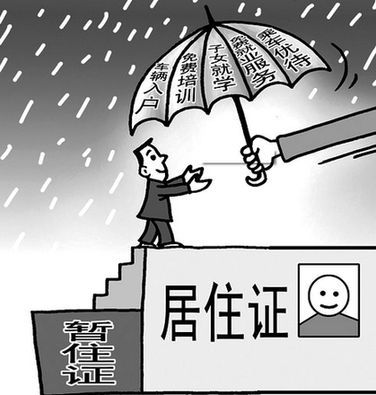
the urban residency umbrella
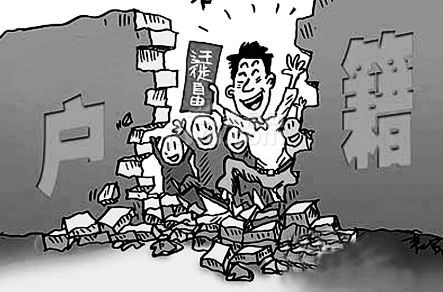
permanent residency
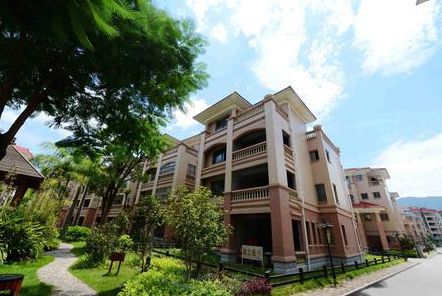
A home for the new urban resident
(photo and cartoons source:http://news.yesky.com/hot/401/36528901.shtml)
–Old age insurance subsidies are long term, payments for these take up close to one half of the necessary expenditure, this is the greatest pressure
–the later we wait to set up the fund, the higher costs will be
–Distribution of payments will constantly be readjusted among different levels of government
Reporter: what is involved in the net cost of transitioning the rural population that have become migrant workers in the cities into full urban residents?
Jin Sanlin: The essential point is that they must the same rights and public services.The cost of educating their children, medical treatment insurance, old age insurance, guaranteed housing [involving the construction of public housing at rental rates below market-priced housing], unemployment insurance, social management expenses, etc. — these costs make up the net costs.
Reporter: won’t making up these costs put even more pressure on local governments?
The State Council research center has done a study of Chongqing, Wuhan (in Hubei), Zhengzhou (capital of Henan), and Jiaxing (northern Zhejiang), four cities which are focal points of the problem of transforming the migrant population into urban residents. In the short term, compulsory education and guaranteed housing are the main expenses. In the long term, old age insurance will occupy 40-50% of the net cost.
For local governments, the fund for old age insurance payments is already under-subsidized. The system needs to be improved step-by-step, The costs to bring the migrant population up to urban resident status will add a further deficit because the migrant population is a comparatively low-income group, which means they will pay in less and get back proportionally larger payments.
Reporter: the third plenary session of the CPC 18th Central Committee “Resolution” proposed a system for handling payments to the transitioning population as it urbanizes. How do you think the net cost will be divided up?
Jin Sanlin: First we need to clarify what are the responsibilities of the different levels of government. The central government is responsible for establishing the minimum criterion for basic public services for the whole country, and it assumes responsibility for the basic net cost. For the trans-provincial transitioning population, it adds on subsidies to the provincial level governments. In turn, the provincial government establishes criteria for public service within the province, and assumes responsibility for the basic net cost. For the population transitioning from one city to another, it adds subsidies to help individual city governments. The city governments are also responsible for the basic net cost for public service on the city level, including infrastructure and transportation.
Going forward we must perfect the taxation system, and readjust the system of financial allotments among the various levels of government, taking the population of permanent residents as the basic unit of taxation. We need to strengthen the special fund for the transitioning population, on the level of both the central and provisional governments, to provide subsidies to the many cities taking in this population. We must establish a financial system that brings together and strengthens property ownership coupled with the attendant rights and responsibilities. We must ensure that on a grassroots level local governments are provided with resources for public services and regular allocations of funds, in order for them to have the ability to follow the distribution of the population in the areas of their jurisdiction.
konjaku: Among the words created by adding the suffix “hua” (化, to change, transform) such as 城镇化 to urbanize, 绿化 to greenify, 现代化 to modernize, etc., one example refers (possibly) to the transformation of people, 市民化.People who move to cities from rural areas are, at a certain point, to “transform into urban residents” (市民化). From the government’s point of view, this transformation is an essential part of urbanization, necessary for China to reach the next stage of development. For at least some of the people, this may mean giving up the security of having a homestead in a village, exchanging it to live in a high-rise residential complex, with new expenses matched by uncertain possibilities for future employment and a steady income. However, their apprehension is partially addressed by a government promise to provide for them the superior public services and better social security net given to urban residents. The question of how much the government estimates this will cost will be taken up in later posts.
In any case, the project to transform people is ambitious in many ways.
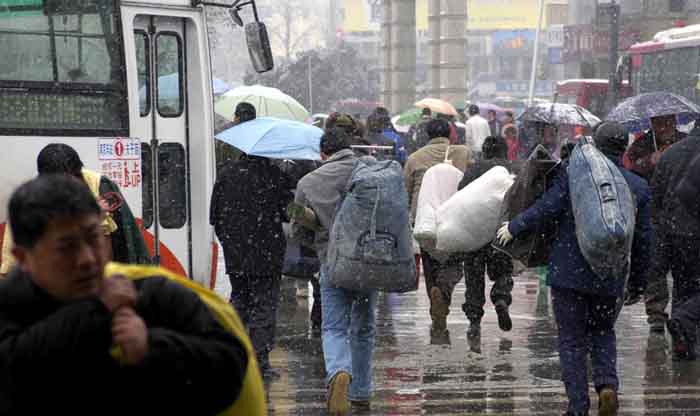
Deciphering the resolution made in the third plenary session of the CPC 18th Central Committee (held Nov 9-12, 2013)
2014-01-04
http://www.gov.cn/jrzg/2014-01/04/content_2559819.htm
As Xinhua reported on 01-04-2014, the third plenary session of the CPC 18th Central Committee Congress issued a resolution regarding the transfer of the agricultural population to become urban residents. Step by step, and in accord with existing conditions, the rural population will completely enter into the social security system of urban residents, as they take up residence in cities. The old age insurance and medical treatment insurance of those who live in rural villages must be inserted into the urban social security system. A finance mechanism must be set up to handle payments going to this transferred population.
To transfer the agricultural population to become urban residents is a major task facing the new urbanization effort in our country. This is an important challenge which must be achieved in order that our economy will continue to exhibit healthy development, and to enable us to successfully modernize. As experience has shown, there is no country in the world which has not first urbanized in order to bring about modernization. At present, urbanized areas of the developed nations is over 70%. The US stands at 82%, Japan is 91%, and Germany is 74%. These exceed our country by 10 percentage points or more. Urbanization follows in the wake of industrial progress, and the agricultural population over time continuously shifts to non-agricultural industries, moves to cities and towns. This causes the population of cities and towns to get larger, the scale of cities increases, the proportion of the population in cities steadily gets larger. Therefore, if there is no agricultural population shifting to the cities, urbanization will not come about. A major task of driving urbanization forward is to shift the agricultural population to non-agricultural industries, and bring them into cities as urban residents. Since the reform and opening to the outside world, the pace of urbanization in our country has been very rapid, but in perspective, the quality has not been high, and the transfer of the agricultural population to become urban residents has lagged behind. In 2012, in cities the number of residents who had lived in the same place for six months or more was 52.6%, while that of registered permanent residents was 35.3%, a difference of more than 17 percentage points. Between 2000 and 2012, the difference in percentage between these two groups went from 10.5 to 17.3%. According to the Chinese Academy of Social Sciences, at present the percent of the agricultural population that has urbanized [become permanent urban residents] is 40%. A large number of those who have migrated to the cities, while adding to the urban population, have yet to receive the status and privileges of urban permanent residents. They do not receive the same treatment as urban residents when it comes to getting jobs, sending their children to schools, receiving medical treatment, finding housing, and accessing public services. They do not have stable lives and livelihoods, they are in a state of being “half-urbanized.” Not only does this affect their lawful rights and interests, it also has a negative influence on social harmony and the quality of urbanization. A large number of children are left behind in the rural areas, women and the elderly also stay behind to look after the homestead. This causes a series of social problems, the direct result of “half-urbanization.” Therefore, we need to accelerate the drive to urbanize the transitioning population. This is an urgent need which must be met in order that our national economy and the urbanization project will continue to develop in a healthy manner.
It is necessary to set up a complete system to deal with the transitioning population. The first need is to innovate population management, to speed up reform of the census registration. There is a need to let go of restrictions to settle in autonomous towns, small and medium size cities, and at the same time, to strictly control the scale of the population in very large cities. We must accelerate the formation of a management system to unify the census registry and stabilize conditions of residency and occupation for the transitioning population. Step by step, over the long term, they will gradually achieve registered permanent residence in cities, and become full urban residents.
The second need is to steadily push forward with basic public services to cover all those who take up residence in cities. The old age insurance and medical treatment insurance of those who live in rural villages must be inserted into the urban social security system, to ensure that the monies they paid into the system while living in villages will be counted. The basic safeguards of urban residents: old age insurance, medical treatment insurance, unemployment insurance, and industrial injury insurance, must be given to the transitioning population. They must enjoy all the same rights to services as urban residents.
The third need is to set up a comprehensive system to share the responsibility for the net cost of transitioning and urbanizing the agricultural population. The central government and the provincial level administrations must enlarge the fund for this project. As those living in cities, and those who are not yet registered permanent residents in the city are urbanized, these government agencies must set up a financial system that splits up the responsibility for the funds and payments. Since public services expenditures required by this transitioning population as they urbanize are many, the ability to offer these services must be strengthened and enlarged.
konjaku: in the next series of posts, I turn from the micro level (the effects of urbanization on one village, Liulangzhuang) to the macro level: attempts to describe urbanization policy on a national scale. In these articles, we can see the size of the expectations, and intensity of the hopes, for the process of urbanization. When urbanization is completed in China, if recognizing a stage of completion is itself possible, then China will be transformed– not just the exterior landscape, but the inner selves of the people as well. It seems impossible to imagine future prosperity in any other shape than a fully urbanized space in which the “peasants” of a rural past will take on new lives as urban residents. According to the government, this involves new systems of social services, census-taking, and population management, the consummation of which must be “accelerated,” just as the urbanization drive has always been accelerated. It is against this demand to go faster, as though the huge project will somehow escape control if not pursued at ever increasing speed, that the words below “one should wait till conditions are ripe, than seize the opportunity” or “the drive forward must be positive and stable” have meaning.
After the formulation of urbanization, now comes the “new urbanization.” This refers to concentrating the population in urban spaces of higher density, surrounded by green zones. This is supposed to to bring about more efficient use of energy and other resources. One commentator says the new urbanization will solve China’s air pollution problem.

New urbanization
Pushing forward with urbanization — we cannot rely on paper plans
2013-07-01
http://bjyouth.ynet.com/3.1/1307/01/8107870.html
2013-06-29, deliberations on the urbanization project at the 12th National People’s Congress were made public. During the deliberations, many committee members believe that, although the urbanization development situation is overall favorable, there exists one blind spot. Urbanization should not be about transforming rural areas into cities. Rather, what the government should devote its energies to is formulating its development plans, and to setting up a system of public services in the areas in which urbanization is taking place. This will accelerate the pace of urban construction and improve the quality of urbanization.
Because urbanization is an important factor in the future development of the overall economy, the delegates yet had some pointed criticisms over the feverish rush to urbanize. The delegates all believe that current urbanization suffers from the malady of “ greed for the big, speed at all costs.” There are some areas that, having already begun to meet their construction targets, are adding on more and more. There are areas that believe, as their urban population increases, that they must respond by building cities on an increasingly larger scale, with more wide public squares, and more roads. Delegates said that if the pace of urbanization exceeds the rate of development of the economy, that inevitably “we will see an old familiar scene again –massive debt.”
For a long time the government has exercised monopoly power over the economy. Since the reform and opening to the outside world 30 years ago, the government has managed the economy to enlarge the GDP at a high rate of speed, keeping a firm grasp over and control of all the economic resources of society. Although the government have achieved its goal of making China the second largest economy in the world after the U.S., in the wake of this rapid expansion it has allowed serious problems to remain, in regard to sustainable development. In particular the system of income distribution is not in good order, and the great majority of the people cannot enjoy the benefits of the economic achievements. Indeed, many have had to sacrifice themselves for the sake of economic growth. Therefore, as the government now pushes to decentralize, there is the hope that its influence on the economy will lessen and market forces will be more free to operate.
However, this change will not happen overnight. In regard to new urbanization targets, the government still has the extraordinary custom of using paper plans to control everything. Actually, urbanization is a natural outgrowth of economic growth. Starting in the 80s, as the economy developed in the coastal areas, small towns sprung up like mushrooms after the rain, and gradually became connected together. The peasants living in these areas began living the lives of urban residents, even though they did not have the privileges of urban household registry. In these cases, the motive power for urban development did not come from the government, but from the market. When the government substitutes its will for the market, the peoples’ freedom to do things their own way often conflicts with the government plan and is repelled.
Propelled forward by the government’s magic power to “overcome difficulties when they arise, bridge streams when encountered,” urbanization has rapidly gone forward according to the government blueprints, and in the same way, under government urging, the GDP has displayed a string of handsome numbers, and risen continuously. But when this type of rapid expansion overtakes the overall economy, it prevents people from making and acting out their own choices. This insistence on going forward without any attempt to raise the income levels of those on the lower levels of society, only increased the burdens on the masses. Even though there is an upsurge of consumption, this type of consumption is merely, “tearing down the east wall to build the west wall,” something without any real advantage, not really responsive to internal demand.
After the government became the driving force pushing urbanization forward, even though the targets are reached, its influence over the market becomes further enlarged, inevitably leading to a distortion in the urbanization process. As some of the Congress delegates pointed out, this is “urbanization by the mayor”[by government decree] not “urbanization by the market.” This sort of development only satisfies the government official who gets an achievement noted on their career record, but it cannot truly benefit society, and certainly brings no happiness to the people at large. The government cannot continue driving forward as it has been, without creating a hidden snare that threatens to undermine future economic development. In this year’s upcoming working conference on urbanization, let us hope it does not become a mobilization meeting, or a meeting to pledge mass effort [to continue urbanization on the present course], but rather, that the delegates look seriously at the harmful effects brought about by recent urbanization efforts.They should demand that the government transform the way it functions, and come up with practical corrections to redress the rash and anti-scientific development trend we have seen up to now.
Zhou Junsheng (Shanghai, scholar)
Urbanization cannot rely on paper plans to go forward
Source: Xinhua net 2013-05-27
http://finance.chinanews.com/house/2013/05-27/4860767.shtml
konjaku: translation is the last paragraph of the article
The government is that which is engaged in social management and social services. But when the demand for urbanization is generated by a government plan, the government exceeds its function, becoming the designer of society, and the volition of the people is unable to be expressed. It is worth noting that the idea that urbanization is something that gradually forms as a result or outcome of economic development is rejected. Rather, urbanization today is used to accelerate economic development. Over the next few years, under the direction of the government, the percentage of urbanized areas will increase substantially, but what will this give to society, what will it give the hundreds of millions of rural residents? This is a question that deserves careful thought.
In pushing forward with urbanization, the results are spoiled by excessive zeal
http://news.xinhuanet.com/fortune/2013-12/14/c_118559258.htm
On 12-14 Xinhua (reporter Zhang Xiaosong) reported that the Central Working Conference on Urbanization advised that, to firmly fix the objective of urbanization, they must seek truth from the facts, be practical and realistic, and not rely on government decrees to add more and more projects. Better to examine and re-examine step by step, do not be impatient for results, and not spoil things by excessive zeal. Henceforth the course of urbanization must be energetic, reliable, and solid.
Haste makes waste. There are local governments which use urbanization as a way to bolster official careers, and go against the popular will. They go beyond the actual situation and the development stipulations, go over normal limits and get into debt. Lacking insight and understanding they build cities, displacing an agricultural population that finds it difficult to enter into urban life. The land allotted for urban development is not used efficiently, and the scale of construction oversteps capacity. Increasingly what appears is an “urban blight” which does no good to the economy or society, and holds within it many hidden dangers for future economic development.
Urbanization is really the only road to modernization, to grow the economy, to regulate the industrial structure, to improve the peoples’ livelihood. But the next step is for the drive forward to be positive and stable. The various regions must be practical and consider the problems they face as they urbanize: act according to their capacity, consider their financial resources, sustain their real estate values, have a safe food supply, etc. They should formulate a scientific plan and calculated rate of advance, without making urbanization into another “Great Leap Forward.”
A positive and stable advance of urbanization means valuing the wishes of the people. The new urbanization means putting people at the core. The goal is to enhance the inherent characteristics of the population and improve their lives. Regardless of what type of urban renewal is in progress, and regardless of what arises in the process of transforming an agricultural population to live in an urban environment, the people must be allowed to act voluntarily, things must be orderly — no one should be forced to do something which is difficult for him or her, in order for the project to advance.
In spoiling things with excessive zeal, the results often contradict the original plan. Rather, one should wait till conditions are ripe, than seize the opportunity. This would truly be the urbanization that would benefit the nation and the people.
The New Urbanization: firmly set the objective, and stick to the initial goal, without adding more and more
konjaku: this is an excerpt of the article
http://www.chinanews.com/gn/2013/12-15/5620154.shtml
Four questions about urbanization:
Why has China recently been pursuing urbanization?
The drive to urbanize is an important way to solve the problems of agriculture, rural areas, and the rural population. It supports regional coordinated development, expands internal demand, promotes industrial upgrading. It produces a comparatively good living standard across the board, and accelerates the the drive toward modernization of socialist institutions. In this way, the significance of urbanization is both immediate and practical, while also being of deep historical significance. The goal of urbanization is correct, the direction is on the right track, going along this path will set free the huge latent capacities of internal demand.
What is the guiding principle underlying the urbanization drive?
In all of human history there has never been an example of 1.3 billion people bringing about urbanization together. The process of urbanization must be joined to overall economic development of the society. The drive to urbanize started off in the early stages from the conditions of our country as a socialist society. Adhering to principles, but acting according to circumstances, it is a matter of seizing opportunities. When conditions are ripe, success is assured.
What problems does urbanization solve?
Urbanization steadily improves the ability of the population of registered permanent residents to engage in the amenities of urban life, it improves the efficient use of energy sources, lowering energy depletion and carbon dioxide discharges, it pays more attention to care of the ecological system, enlarges the proportion of green ecological spaces, such as forests, lakes, and wetlands. It improves environmental quality, conserves water use, decreases pollution, reigns in untrammeled development, and lowers the intensity of natural disasters.
How should urbanization go forward in China?
Urbanization should put people first. It should enhance the characteristics of the urban population, improve quality of life for the residents. It should provide a stable employment situation and keep life for permanent residents orderly. It should insist on green development, ecological civilization, cyclical development [turning industrial waste into raw materials for new products], and reducing the carbon footprint.It should minimize negative impacts on the environment. and use land, water, and energy sources more efficiently.
(write up by Jinghua Tines reporter Sun Xuemei and Xinhua staff)
konjaku: for the time being, this ends my attempt to record the demolition of Liulangzhuang and the transfer of its residents to its replacement, “Liulangzhuang New Village.”
Does the public really approve of tearing down Liulangzhuang to protect the Summer Palace?
2011-03
Han Ying
http://hanyingha.blogspot.com/2011/03/blog-post_28.html
Liulangzhung has a long history. During the Northern Sung people gave it the elegant name Willow-wave [Liulangzhuang, 柳浪庄] village, because the silken strands of willow on the embankments outside the village blew in the wind like light green waves. When the military hero Yang Liulang [Yang Yanzhao] passed through on his way to attack Khitan, he tied his horse to a stone lion in the village, and to commemorate this the village name was changed to Liulang [六郎 his nickname, plus 庄, village ] In the Qing, Empress Dowager Ci Xi was going by boat to the Summer Palace, and when she heard the name of the village after inquiring from the boatman, she thought it was “Six wolves village” [六狼庄] and she demanded the name be changed to Jixiangzhuang, “Good fortune village,” because she wondered if she was going to be the sheep the wolves would eat. However, her command was not fully understood, and not followed.In 1949 after the liberation it was renamed “Plentiful Commune” and during the cultural revolution it was again renamed “Red Army Village,” but none of these names stuck. The people who lived there proudly upheld the name Liulangzhuang [六郎庄] through these vicissitudes of history.
Liulangzhung village is in a beautiful setting. It has good air and water, situated by the Yongding river network, with rich historical artifacts nearby.
Agricultural products: it is famous for its “west of capitol paddy rice,” Beijing ducks, lotus root, water chestnut, and its two old temples, in a state of disrepair for many years. However this village is faced with demolition, just like Tangjialing and Beiwu.
2009-12-05 The newspapers came out with the news that Liulangzhuang would be demolished “to protect the Summer Palace.” The village would be replaced by a green zone.
Certainly the Summer Palace area should be protected, but to accomplish that, by what stroke of logic does it require that Liulangzhuang has to completely demolished and its inhabitants displaced? To change the area around the Summer Palace into a de-populated zone, the so-called green zone, is all a deception, clouding peoples’ minds and emotions. Rather, by driving out the people, the land becomes available as real estate, open to development, to be carved up, partitioned, and made into new sources of income. If a golf course is built, it is certain that luxury villas will follow. For the sake of a life of pleasure for the few, the Liulangzhuang villagers must sacrifice the homesteads and land which came from their ancestors…The pace of development and commercialization is so fast that a project like this, transforming a whole area, can by coincidence be fully completed during a party or government official’s term of office, giving them an impressive accomplishment to ink into their official record. Once the thing is done, it is too late to do anything about the deleterious effects of corruption and abuses of power that were woven into the process from the start.

Wanliu Golf Course
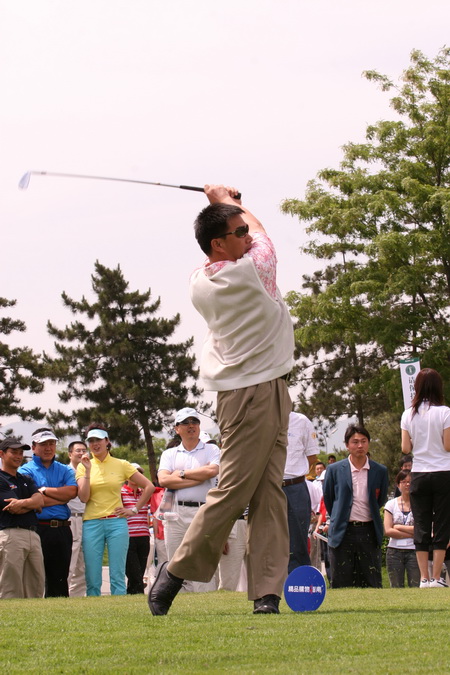
Wanliu Golf Course

Wanliu Golf Course
If the leadership considered the interests of the people, they might find a way to protect the Summer Palace and the surrounding ecosystem in a way that does not involve forcible displacement of the people who after all live within that ecoystem. But since the leadership only think of adding to their record of achievements and bolstering their own positions, they lose the peoples’ trust. They destroy the buildings the people built with their own sweat and toil, demolish their neighborhoods, erase their community and culture, their history, in the name of urban rural unification and the construction of a green zone.
In the same way as the Summer Palace, Liulangzhung should be protected. The villagers should be able to live and work in peace. There should be a guarantee that the replacement housing for them will be built on the village site, and that they will not be forced to move to another location. This is the villagers’ true opinion. Also that after demolition they hope their standard of living will not go down.
konjaku: This is from the same blogger who anticipated a bright future in Liulangzhuang New Village, while feeling some regret over the removal of the original village: https://konjaku.wordpress.com/2013/10/30/a-bright-future-in-the-liulangzhuang-new-village/. Now the New Village is complete, and this blogger is excited about the new development.
At Haidian Liulangzhung New Village they are giving out keys to residences!
Blogger “Beijing eldest brother”
http://blog.sina.com.cn/s/blog_488579410101pbl6.html
2013-10-09 At 7 in the morning, I with my wife and daughter excitedly drove to Liulangzhuang New Village (on the west side of Shangdi Shucun Park). There were already 200 to 300 people assembled on both sides of the wide center road that runs through the complex, their faces filled with joy and smiles. (Click on photos for larger size).

The blogger’s wife and daughter
There were two red inflated archways, inscribed with the eye-catching slogan, “Enthusiastically celebrate the opening of Liulangzhuang New Village” and 6 large red balloons with hanging red streamers, having on them the same slogan. This slogan perfectly captures the mood of the Liulangzhuang villagers, who have waited a long time for this joyous event.
Offices have been set up in a store front location in one of the buildings, and it is currently processing those who are signing contracts. There is a reception room, a room to verify and check one’s documents, a counseling station, a notary station, the room to sign the contract, building maintenance department, security department, green office, sanitation office, internet office. All these were lined up, so people could transact all their business at the same place.
At 9 o’clock on the dot, a fireworks display rose into the sky, followed by the deafening roar of firecrackers. The smell of smoke blended into the happy atmosphere, and the sound of the firecrackers mingled with peoples’ cheers. Whether old acquaintances or not, the villagers nodded and greeted each other, saying, “At long last, the day we longed for has come.”
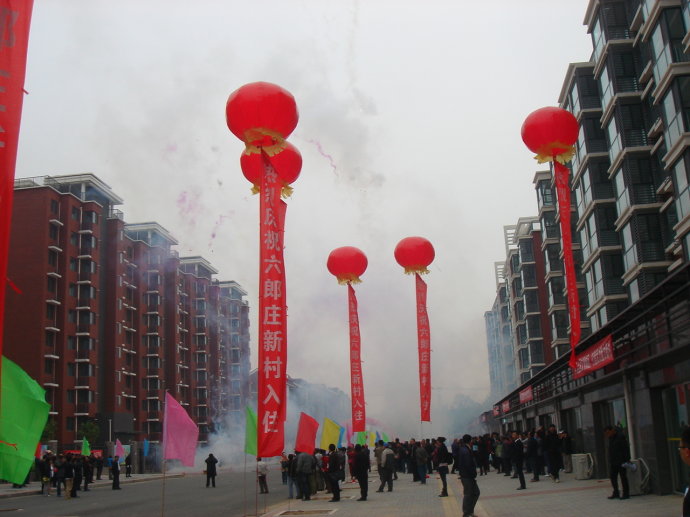
After 15 minutes of the happy sound of firecrackers, the Liulangzhuang opera troupe performed a lively battle scene, accompanied by the cheerful sound of drumbeats and music. The well-known rhythms, shifting from fast to slow, heavy to light, made peoples’ hearts dance, Then, to the sound of a gong, the acrobats took the stage.
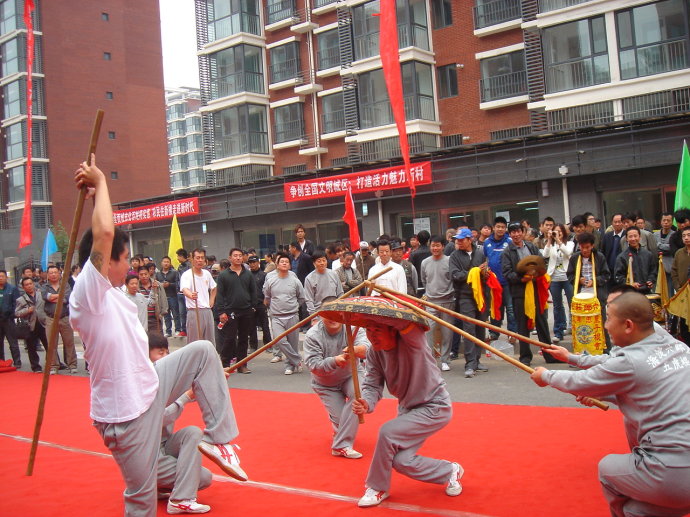
Battle scene from the Opera Troupe
When I was young whenever there was a memorable event, I had no camera, so my only record of those events is my memory. Now I have a camera, and excitedly press the shutter, often moving in for a close-up.I want to preserve these unforgettable memories forever.

When the acrobats were done, that was the close of the ceremony for opening of the New Village. There was no platform, no speeches, no fresh cut flowers, no ribbon-cutting. An alternate type of ceremony, brief and full of movement, for the common people.
On this day, twenty fortunate families were able to sign contracts, presenting all their documents and obtaining a certificate of residence. After this, they received the keys to their new places.
4034 families will live in this new complex, which was been named Liulang Jiayuan (Willow-wave Homeland). There will be a kindergarden, exercise facilities, sanitation office, a Bianmin supermarket, public green space, cultural programs, everything needed for a rich and varied, harmonious life! When we get our keys, the dream of our new life will be fulfilled.

In our new home, there are tall, purplish red buildings with bright, clear windows, and smooth, even roads with flowers planted along the sides.
In our new home, the old laugh heartily, and children play. In an elegant outdoor pavilion old Li reads the newspaper, while old Wang sketches a picture.
In our new home, a cultivated love for our fellow human beings will prevail, in a harmonious neighborhood we will all look out for each other. Whatever small task there is to do, we will all pitch in together, taking care of our new home.

The blogger, Wang Zhongzhen
I love you, my new home in Liulangzhuang New Village!
Wang Zhongzhen 2013-10-13
六郎庄新村 Liulangzhuang New Village
上地树村公园 Shangdi Shucun Park
柳浪家园 Liulang jiayuan
Haidian district, Haidian town, Liulangzhuang New Village is completed. The villagers happily move into their new residences
2013-11-01
http://www.bjyouth.gov.cn/jcxx/sq/525160.shtml

Liulangzhung New Village
A few days ago Liulangzhuang New Village, called “Liulang Jiayuan” formally opened. 4000 households received their keys to new residences.
“When I hear we would get our keys today, I was so excited I couldn’t sleep last night, before dawn I got up and went to the park and exercised. Then, very early, bringing all my documents, I arrived at the housing allotment office before the guard did.” “Since my youngest son came of age, we’ve just been waiting for this happy event.” This was the enthusiastic conversation among those waiting at the reception desk for their numbers to be called. The villagers could begin living in their new residence on this same day. From a building management staff member they received a handbook “Guide to life in the residence,” signed the contract, received the certified copy, then passed through transactions at the service center, sanitation department, building engineering office, etc. Everything was in readiness for them, the villagers received top class service, “all transactions completed in one locality” with each and every preparation completed, they were ready to move in.
Liulangzhuang –this is your home 2011-07-19
http://liulangzhuang.net/read.php?tid=60
konjaku: this message, on the site Liulangzhung.net, is from one villager to his fellow villagers. A person who apparently believes the words of the reform enacted at the beginning of 2011, that the authorities cannot forcibly demolish homes without a court order. A voice appealing to reason, legality, progress, negotiation without force. The notice from the village committee of 2012-01-06, half a year after this, makes it clear that force is an option. In any case, Liulangzhung has now been demolished, so what is written here is a record of a historical moment that has now past.

Liulangzhung before its transformation

Liulangzhung buildings before demolishment

Liulangzhung before
In recent years, many villages around here on the periphery of the city have been demolished. We should have acquired some basic knowledge about that, for sure. In the past the legal system was not well established. We were unable to rely on it, given that there were unscrupulous merchants, corrupt officials, and those who call themselves the “demolition corporation,” but who were in reality hired thugs operating a fly by night operation. Their approach is much the same in all cases: to intimidate on the one hand, and lure by the promise of gain with the other. It has now been 30 years since the reform and opening to the outside world began. The legal system is more solid. I think if by this time if there is no recourse for the common people to protect their own interests, then it will be difficult to advance any further.
Recently I read that the some people are standing firm. But, they are worried. Worried that if they don’t cooperate with the demolition, are the authorities going to carry out a forcible demolition or not? Will the village committee carry this out? No, you do not have to worry, they do not have the authority to destroy your house. They can only send some of those hired thugs, as we have called them, to harass you. If you don’t withstand this trial, naturally you will fall. In any society, there is someone who fears someone, right? They cannot go beyond reasonable limits. There is just one puny village head, and a few of the people, who have been bought off. Can they decide by themselves how the demolition of Liulangzhuang will go? This may be hard to hear, but your calculations are all off. The town government will give you support, truly the problem is, who among them is it that can hold fast?
The common people have accumulated their estate and property over generations. If you [the authorities] say “requisition,” can it just be requisitioned away from us? We are not against demolition. We are not against relocation. We are not against the state building what it wants, we just want at least reasonable and equitable prerequisites to be followed!
There are some greedy officials who say, you are unruly people. You ask for sky high compensation. Let me ask you. If it was your house, which your family had lived in for generation after generation, that was going to be lost, wouldn’t you be the same? Of course. And, you are cadres. From the beginning, you support the demolition, have your own home demolished. Then you say, I am a cadre, I have supported the state policy. Those common people who hold out to the end will not get half as much compensation as you. And you call that “society.”
Speaking of Tangjialing, there were definitely more than a few forcible demolitions, there was no good solution there. After that, who dares to be rash? What happened to the advancement of the legal system then? But comrades! You do not need to take that village’s policy as the same as ours –it is not the same. Please don’t be scared!
As for the demolition this time, I would like to sum up this way. Do not believe what you hear from the hired thugs, don’t let them measure your home unofficially, no matter what reason they give. [Measuring the total area to fix the compensation amount]. They might say measuring has nothing to do with the demolition. Don’t be fooled! No matter what, don’t sign anything! Don’t be afraid. That is the key. This is your home.
Urban village transformation –the removal and relocation of Liulangzhuang will be completed within this year
http://house.focus.cn/news/2011-01-10/1159647.html

Lin Fusheng
2011-01-10
Yesterday the Haidian district Joint Congress ended. The Haidian District Head Lin Fusheng, the assistant head, and the district press spokesman Fu Shouqing met with this reporter for an interview. Lin Fusheng said, priority will be on construction and development in the northern part of the district for the next five to ten years. This year, they will start demolishing and relocating seventeen villages, clearing out the space to build a high technology zone. The job to tear down and relocate Liulangzhuang and Zhongwu [village] will be completed.
In the northern “new district” 2,200,000 square meters of replacement housing will be built.
Jinghua reporter: Last year, the Haidian northern district development plan was promulgated. What is the significance of this plan to Haidian district in general?
Lin Fusheng: The plan calls for allotting 47,000,000 square meters to science and technology business development. The Haidian north district and Zhongguancun science district will mutually spur each other on to promote more research and development. However, it will be the north district that will see more construction of new properties.
Jinghua reporter: How will you solve the problem of the space needed for all that development?
Lin Fusheng: This year, Haidian district will begin to demolish and remove 17 villages to make space for high tech industrial parks. The villagers will be relocated to replacement housing in the nearby area. In advance, we will build 9 housing units, comprising 3,450,000 square meters of residential space, so we will supply adequate housing. In the second half of last year the first construction project already began, to provide 1,500,000 square meters. The plan is to build 2,200,000 square meters this year. In addition, the necessary infrastructure for daily life must be built: municipal government services and schools.
At present the city is vigorously trying to bring under control traffic congestion. In Haidian district there are many traffic “trouble spots,” how do you plan to deal with those?
Lin Fusheng: First, we must perfect the road distribution map. To break up the north-south bottleneck, we must make a great effort to route traffic into the new subway lines under contruction, the Shanhou line [est. 2015], the Xijia [Western Suburb line, est. 2014], and also the Xishan tunnel[est. 2020]. We must also speed up efforts to utilize the newly constructed southern section of Jushan Road, Youyiqu Road, and 14 other primary and secondary traffic thoroughfares. We must extend traffic circulatory systems to divert traffic from 58 congestion points in Zhongguancun, Shangdi, Qinghe, etc., and explore the possibility of building more sections of underground road passageways. Secondly, in west Zhongguancun we are launching an experiment to connect buildings with pedestrians overpasses, while car traffic and parking is routed underground.
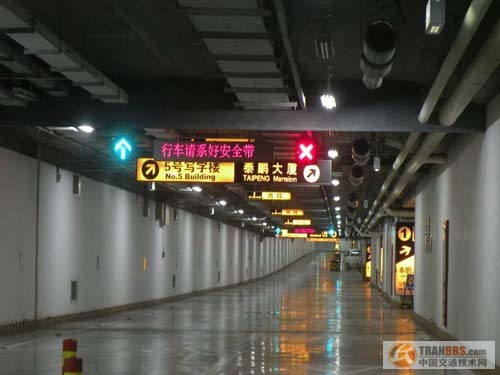
Underground concourse in Zhongguancun (photo added by konjaku)
Jinghua reporter: what steps are you taking to attract more people of high ability to Zhongguancun?
Lin Fusheng: For businesses and individuals of high ability, we have a system of providing rentals, building public [subsidized] housing which we offer for their use. To keep persons of talent in the area, we help their children get into schools of their choice, and provide help with medical and other issues.
Jinghua reporter: Where are these public housing units? Which people can apply?
Fu Shouqing: Haidian district will build batches of housing, 100,000 square meters of residential space, one at a time, in northerm Haidian. These will be open to young people who have a job and live in northern Haidian. This will guarantee that adequate housing is available for people of talent.
konjaku: For more details on such efforts, see https://konjaku.wordpress.com/2012/07/28/beiwu-follow-up-11-beiwu-jiayuan-and-rents/
Jinghua reporter: Last year, Haidian issued the demand that, as part of urban village reform, Liulangzhung village would be transformed, at present what progress has been made?
Lin Fusheng: This year we will continue to push forward with the project to urbanize Liulangzhuang, Zongwu, and other “focal point” villages [villages listed up as having a high ratio of migrant tenants and over-utilized infrastructure], using a collective enterprise to demolish the villages, and relocate the villagers. According to the principle of “for every village the same policy” the plan as a whole will completely transform these villages as part of urban rural unification.
Jinghua reporter: This year Haidian has alloted 300 million yuan to improving the environment around Xiangshan (Fragrant Hills) and the former Imperial palace and garden. In detail what does this consist of?
Fu Shouqing: We will demolish illegal buildings, keep any new non-conforming structures from being built, and so on, to create a beautiful environment surrounding former Imperial palace and garden.
林抚生 Lin Fusheng
人才公寓 subsidized housing for people of talent [with technical skills, etc]
六郎庄 Liulangzhung
中坞 Zhongwu
一村一策 “for every village the same policy”
城乡接合 urban rural unification
香山 Xiangshan
圆明园 Former imperial palace and garden

